
Every missed call is a missed appointment, and a human receptionist can only handle one call at a time, leaves gaps during lunch and after hours, and costs $35,000-$50,000 annually in salary alone. In 2026, AI medical receptionists answer every call 24/7, book appointments in real time, triage patient needs, and integrate directly with your EHR -- all while maintaining full HIPAA compliance.
We evaluated the seven best AI medical receptionists across six weighted criteria: HIPAA compliance, call handling intelligence, scheduling and EHR integration, voice quality, pricing, and feature breadth. Our goal was to give practice owners a clear, evidence-based ranking to guide their purchasing decisions -- whether you run a solo practice or a multi-location group.
The seven products were first evaluated between November 2025 and January 2026; the DeepCura sections were re-checked against the shipping product in September 2026. Competitor pricing reflects publicly available rates at the time of review and may have changed; custom-priced products were assessed on their disclosed enterprise ranges.
DeepCura publishes this guide and is one of the seven products. We say where another platform fits better (health systems on Epic, pay-as-you-go developers, messaging-first practices). Every DeepCura capability described here is in the shipping product; competitor cells in the comparison matrix mean "documented publicly" — an ✗ means we found no public documentation, not that the feature is absent.
Quick Comparison Table
| Product | Category | Price | Fits best |
|---|---|---|---|
| DeepCura | Full-stack clinical AI | $129/mo | Practices that want the receptionist, scribe, billing and EHR write-back in one account |
| Simbie AI | AI phone agent | Usage-based | High call volume |
| Hyro | Enterprise conversational AI | ~$10K+/mo | Enterprise health systems |
| Luma Health (ARIA) | Patient engagement platform | Custom | Epic-centred organisations |
| Retell AI | Voice AI developer platform | $0.07-0.12/min | Teams that want to build their own agent, pay as you go |
| Emitrr | Practice communication | $100-1K+/mo | Independent practices wanting texting + calls |
| Klara | Patient messaging platform | Custom | Messaging-first practices |
Hear DeepCura's receptionist take a call before you decide
15+ callable functions during live calls, plus the scribe, billing and EHR write-back in the same account. $129/mo · 1,000 credits/mo · free trial, no card.
+1 (415) 549-1829Available 24/7 · Set up in seconds · No credit card required
See pricing →$129/mo per provider · 1,000 credits/mo · 1 credit per standard note
1. DeepCura -- Full-Stack Clinical AI Platform
DeepCura workflow re-checked September 2026; the plan facts below carry their own verification date
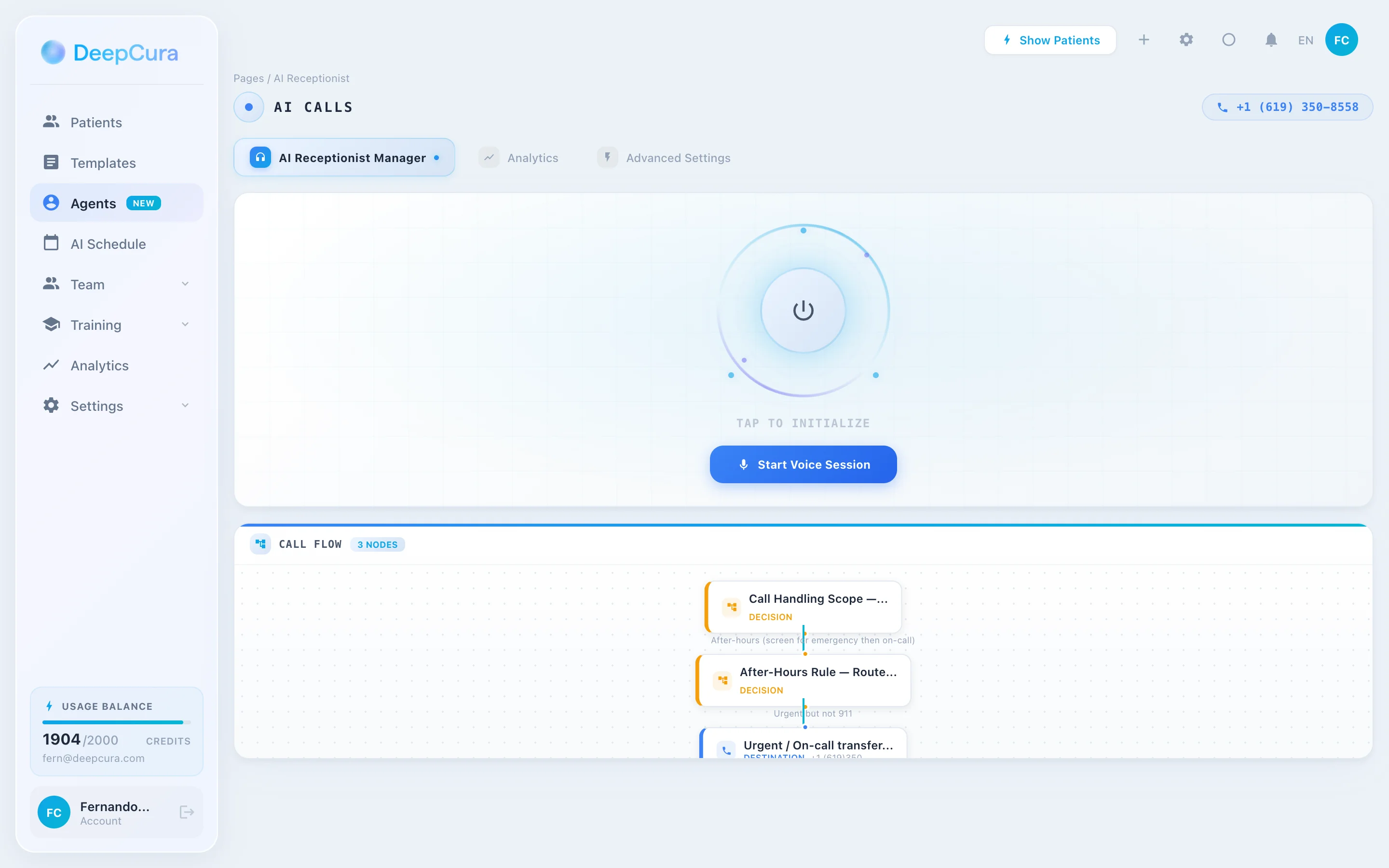
DeepCura's AI receptionist is built for medical practices that want more than just call answering. Powered by DeepCura's Voice Agent platform, it handles both inbound and outbound calls with 15+ callable AI functions that execute during live conversations -- from booking appointments and verifying patient identity to sending SMS payment links and searching the practice's knowledge base in real time.
What sets DeepCura apart is that the AI receptionist is part of a full-stack clinical AI platform. The same $129/month subscription includes ambient AI scribing, clinical note generation, ICD-10/CPT coding, EHR integration with athenahealth, eClinicalWorks, AdvancedMD, OptiMantra, Epic, DrChrono, CharmHealth, and Cerner, AI fax summarization, chart-built patient recall lists, and clinical AI chat. Most practices currently pay over $200 per month just for a human answering service that can only take messages -- DeepCura's AI receptionist actually takes action on every call.
Live SMS Fallback During Phone Calls
Since March 2026, DeepCura can send a text message mid-call when voice capture fails and inject the patient's typed reply back into the live phone conversation. We have not found another AI receptionist that documents this, and we have not tested every product on the market.
Important: The live SMS fallback feature is available exclusively to paid subscribers with a provisioned phone number. Free trial users receive the never-loop rule and graceful skip behavior, but SMS dual-channel requires an active paid plan.
Here is how it works: when the AI attempts to capture structured information (callback number, date of birth, insurance ID) and speech recognition returns garbled or ambiguous results, the system automatically falls back to SMS. The caller receives a text asking them to type the information. The reply is injected back into the live call in approximately 2-4 seconds. The AI confirms: "Got it -- 541-270-9500. Is that right?"
This solves the single biggest failure mode in AI phone agents: infinite re-ask loops. Every other AI receptionist on the market will keep asking the same question when it cannot understand the caller's response. The patient gets frustrated, hangs up, and the practice loses the appointment. DeepCura's three-layer defense chain eliminates this entirely:
- Layer 1 — Voice (2 attempts maximum). The AI asks via voice, re-asks once with simpler phrasing if needed.
- Layer 2 — SMS (text fallback). If voice fails twice, the AI sends a text. The caller types the answer. Reply is injected into the live call.
- Layer 3 — Graceful skip. If the caller is on a landline, has no SMS capability, or does not reply within 5 minutes, the AI skips the field entirely: "No problem -- our staff will get that when they call you back."
Security is built in: the SMS is always sent to the caller's verified phone number (never an arbitrary recipient), texts are rate-limited to 3 per call, reply content is sanitized before being used, and the SMS fallback is only available when the practice has a provisioned phone number. Practices without a provisioned number get the never-loop rule with graceful skip -- no false promises.
Never-Loop Rule
DeepCura enforces a hard rule: the AI will never ask for the same piece of information more than twice via voice. After 2 failed attempts, it either falls back to SMS or skips entirely. This eliminates the entire class of "infinite re-ask" bugs that plague every other AI receptionist on the market.
16 Premium AI Voices — Choose the Voice That Fits Your Practice
Most AI receptionists give you one generic voice and no way to change it. DeepCura offers 16 distinct, human-quality AI voices -- Mark, Brittney, Adeline, Vivie, David, Susie, Adam, Cassidy, Hope, Jessa, Alexandra, Hope Conversational, Hope Bubbly, Hope Podcast, Raju, and Pablo -- so every practice can pick the voice that best represents their brand. Whether you want a warm conversational tone, a polished podcast-style delivery, or a multilingual voice for diverse patient populations, there is an option that fits. If a patient-facing voice does not feel right, switch instantly during a live setup session: just tell the AI "switch to Cassidy" and the new voice takes over in seconds. No settings page to dig through, no support ticket -- the change is conversational and immediate.
Listen to every voice below -- these are the same voices your patients hear on every call:
Preview All 16 AI Receptionist Voices
Click any voice to hear a sample greeting. These are the same voices your patients hear on every call.
The voice you choose applies to every future inbound and outbound call automatically. Practices with diverse patient populations can pick the voice that feels most natural for their community, and providers who personally dislike a particular voice timbre are never stuck with it. This level of voice customization is typically only available on enterprise platforms costing $10,000+ per month -- DeepCura includes it at $129/month.
Surgical Script Editing
Practices that used to rewrite a whole script to make a small change ("change the closing line") can now make targeted edits in seconds. Describe the change in natural language and the AI updates just that part of the script -- no full rewrite needed.
A standout feature is link-based integration: the AI receptionist can text patients links to intake forms, patient portals, pre-visit questionnaires, telehealth sessions, lab result portals, or any web-based tool -- mid-call, at exactly the right moment. If it has a URL, the receptionist integrates with it. This means practices can connect the receptionist to virtually any external system without custom API work or waiting for a native integration.
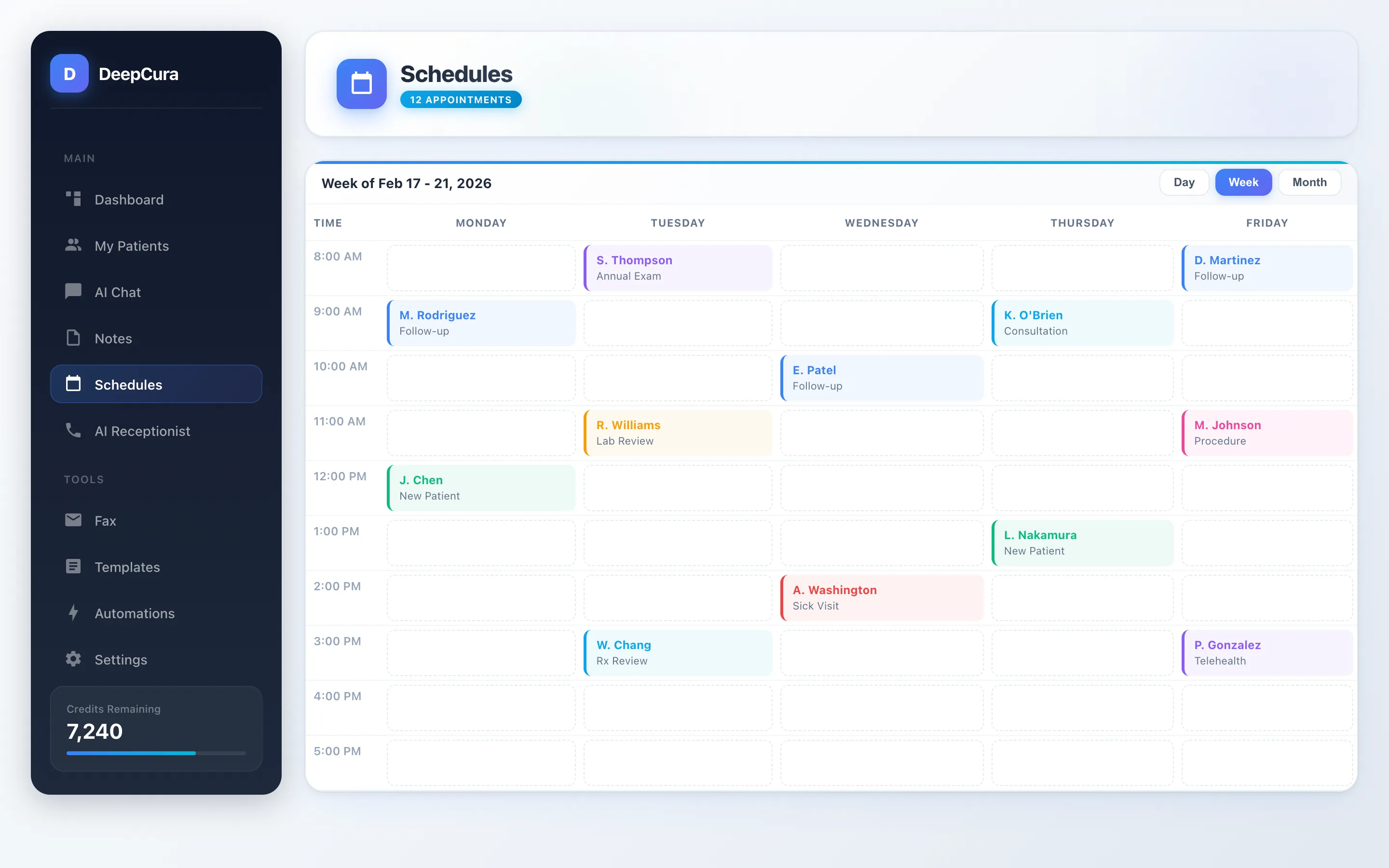
Call templates are written in plain language for each call type a practice handles -- scheduling, triage, refills, referrals, insurance questions, after-hours -- so practices can configure the AI's behavior for different call types without writing any code. Warm call transfers include a contextual introduction to the receiving staff member, and every call generates an AI summary with email notification.
Key Features:
- Live SMS fallback during phone calls — the caller types what the voice channel could not capture
- Never-loop guarantee — never asks the same question more than twice via voice
- Connect your own phone number — forward your personal or office line to the AI to screen calls, block spam, and auto-transfer to the right person or department
- 16 premium AI voices — choose from Mark, Brittney, Adeline, Vivie, David, Susie, Adam, Cassidy, Hope, Jessa, Alexandra, Hope Conversational, Hope Bubbly, Hope Podcast, Raju, or Pablo; switch instantly during setup
- 15+ callable AI functions during live calls
- Inbound and outbound call support
- Plain-language call templates per call type
- Warm call transfer with contextual introduction
- SMS payment links mid-call via Stripe
- Mid-call link sharing — texts patients links to intake forms, patient portals, telehealth, or any web tool
- Surgical script editing — seconds per change instead of full rewrites
- AI call summaries with email notifications
- Knowledge base injection per practice
- Patient identity verification (DOB, phone)
- Native EHR integrations (athenahealth, eCW, AdvancedMD, OptiMantra, Epic, DrChrono, CharmHealth, Cerner)
- AI scribe, clinical notes, and billing included
- HIPAA compliant with signed BAA
Pricing: $129/month per provider (or $999/yr) -- all features included, with 1,000 credits a month across every AI agent.
Pros:
- Live SMS fallback during phone calls — the failure mode that makes callers hang up on voice bots
- 16 voice options let you pick the voice that fits your practice
- Bundles the receptionist with the AI scribe, billing and EHR write-back in one subscription
- Never-loop rule: after two failed captures the call switches channel instead of re-asking
- 15+ live-call functions versus competitors that only take messages
- Works with your existing phone number — forward any personal, office, or carrier line to the AI for call screening, spam blocking, and smart routing to the right team member or department
- Integrates with any web-based tool via mid-call link sharing — no custom API work needed
- Replaces a separate answering service, AI scribe, and fax service
- Both inbound and outbound call capability
- Credit-based pricing (1 credit per call) keeps costs predictable
Cons:
- Newer platform with a smaller user community than legacy tools
- No on-premise deployment option (cloud-only)
- Outbound campaigns require manual template setup
Verdict: DeepCura is our pick for practices that want a single platform covering the entire clinical workflow. Its live SMS fallback during phone calls is the distinctive piece -- when voice capture fails, the AI texts the caller mid-call and injects their typed reply back into the live conversation. Combined with the never-loop rule (never asks the same question more than twice), landline detection, upgraded AI intelligence, enhanced speech recognition, and 16 premium AI voices to choose from, DeepCura has eliminated the entire class of "patient calls 3 times and can't complete intake" failures that still plague every competitor. At $129/month, you get all of this plus ambient scribing, clinical notes, EHR integration, and billing -- replacing three to five separate tools at a lower total cost. That bundle is the difference on this list.
2. Simbie AI -- AI Phone Agent for High Call Volume
Simbie AI is purpose-built for medical practices drowning in phone calls. Its AI phone agents handle appointment scheduling, patient intake, insurance verification, and prescription refill requests with natural-sounding voice conversations. The usage-based pricing model means practices only pay for the calls the AI actually handles, making it cost-effective for high-volume clinics that would otherwise need multiple receptionists.
Simbie focuses narrowly on phone automation and does it well. The AI can handle multiple simultaneous calls, reducing wait times to near zero. However, it does not include clinical AI features like ambient scribing, note generation, or billing support. Practices using Simbie will still need separate tools for clinical documentation and EHR integration -- making the total cost of the stack higher than it appears at first glance.
Key Features:
- Natural AI phone conversations
- Handles multiple simultaneous calls
- Appointment scheduling automation
- Patient intake and insurance verification
- Usage-based pricing (pay per call)
- HIPAA compliant
Pricing: Usage-based -- pay per call handled.
Pros:
- Handles unlimited simultaneous calls
- Usage-based pricing ideal for variable call volumes
- Strong natural language understanding for medical contexts
- Fast setup with minimal IT overhead
Cons:
- Phone-only -- no clinical AI, scribing, or documentation
- Costs can escalate with high call volumes
- Limited EHR integration compared to full-stack platforms
- No outbound call campaigns
Verdict: Simbie AI is a strong choice for high-volume practices that need AI phone answering and nothing else. The usage-based model keeps costs flexible, but practices that also need clinical AI will end up paying more for the full stack than a bundled platform.
3. Hyro -- Enterprise Health System Conversational AI
Hyro is the enterprise-grade conversational AI platform for large health systems. Deployed across organizations like Intermountain Health and Novant Health, Hyro handles millions of patient interactions across phone, web chat, and SMS channels. Its AI assistants manage appointment scheduling, prescription refills, provider search, and FAQ resolution at scale, with deep integration into enterprise EHR systems via HL7 and FHIR APIs.
The platform's strength is handling massive call volumes across multiple departments, locations, and specialties within a single health system. However, the enterprise focus means pricing starts at roughly $10,000+ per month, with implementation timelines measured in weeks to months. Independent practices and small groups are priced out entirely, and the IT infrastructure requirements make self-service deployment impossible.
Key Features:
- Enterprise-scale conversational AI
- Multi-channel support (phone, web chat, SMS)
- Deep EHR integration via HL7/FHIR
- Proven at health system scale (millions of interactions)
- HIPAA compliant with BAA
Pricing: ~$10,000+/month -- enterprise contracts with custom negotiation.
Pros:
- Proven at enterprise scale with major health systems
- Multi-channel support (phone, chat, SMS)
- Deep HL7/FHIR EHR integration
- Handles millions of interactions per year
Cons:
- Completely inaccessible to independent practices
- Enterprise-only pricing ($10K+/month)
- Long deployment timelines (weeks to months)
- No clinical AI features (scribing, notes, billing)
Verdict: Hyro is the gold standard for enterprise health system conversational AI, but it is not accessible to the vast majority of medical practices. If you are a health system with thousands of providers, Hyro delivers. For everyone else, more affordable platforms provide comparable AI receptionist capabilities with setup in minutes, not months.
4. Luma Health (ARIA) -- Best Epic Integration
Luma Health's ARIA platform brings AI-powered patient engagement with the deepest Epic integration in the AI receptionist category. ARIA handles inbound calls, appointment scheduling, patient intake, waitlist management, and referral coordination -- all connected to Epic's scheduling and patient record systems. For organizations already invested in Epic, the seamless data flow eliminates manual reconciliation.
The limitation is the narrow EHR focus. While ARIA excels with Epic, its integration with other EHR systems is less robust. Pricing is custom and typically oriented toward mid-to-large organizations rather than solo practitioners. Practices running eClinicalWorks, OptiMantra, athenahealth, or AdvancedMD will find better EHR connectivity with platforms that support multiple systems natively.
Key Features:
- Deepest Epic EHR integration in the category
- AI-powered appointment scheduling
- Waitlist management and backfill optimization
- Patient intake automation
- HIPAA compliant with BAA
Pricing: Custom -- contact sales for quotes.
Pros:
- Best-in-class Epic integration for AI receptionist
- Strong waitlist and scheduling optimization
- Proven with healthcare organizations
- Comprehensive HIPAA compliance with BAA
Cons:
- Integration depth drops significantly outside Epic
- Custom pricing oriented toward larger organizations
- No clinical documentation or AI scribe features
- Limited phone call AI compared to voice-first platforms
Verdict: Luma Health ARIA is the best choice for Epic-centric organizations that need AI-powered patient engagement and scheduling. For practices on other EHR systems or those who also need clinical AI features, platforms with broader EHR support and full clinical toolsets offer more value.
5. Retell AI -- Best Pay-As-You-Go Voice AI
Retell AI is a developer-friendly voice AI platform that lets practices build custom AI phone agents. With per-minute pricing starting at $0.07, it is the most cost-effective option for practices with low call volumes or those that want granular control over their AI receptionist's behavior. The platform provides APIs for building conversational agents, function calling during calls, and integration with external systems.
The trade-off is that Retell is a developer platform, not a turnkey solution. Practices need technical resources to build, deploy, and maintain their AI receptionist. There are no pre-built medical workflows, no EHR integration out of the box, and no clinical AI features. HIPAA compliance is achievable but requires the practice to implement it correctly in their custom build. For tech-savvy practices or those with development resources, Retell offers maximum flexibility at the lowest per-call cost.
Key Features:
- Lowest per-minute pricing ($0.07-0.12/min)
- Full API for custom agent development
- Function calling during live calls
- Multiple LLM and TTS model options
- Scalable infrastructure
Pricing: $0.07-0.12 per minute -- true pay-as-you-go with no monthly minimums.
Pros:
- Most affordable per-call pricing on the market
- Maximum customization and flexibility
- Strong developer documentation and API
- No monthly minimums -- true pay-as-you-go
Cons:
- Not a turnkey solution -- requires developers to build
- No pre-built medical or scheduling workflows
- HIPAA compliance is the practice's responsibility
- No clinical AI features (scribing, notes, EHR)
Verdict: Retell AI is the best option for technically capable practices that want to build a custom AI receptionist at the lowest per-call cost. For practices that want a ready-to-use solution with medical workflows, EHR integration, and HIPAA compliance built in, turnkey platforms deliver all of that out of the box.
6. Emitrr -- Best for Independent Practices
Emitrr is a patient communication platform built specifically for independent medical and dental practices. It combines AI phone answering with text messaging, online reviews management, appointment reminders, and a unified inbox. The AI receptionist handles basic call answering, message taking, and appointment scheduling, while the broader platform addresses the full patient communication lifecycle.
Emitrr's strength is its focus on independent practice needs -- simple setup, transparent pricing tiers, and features that address common pain points like missed calls, no-shows, and online reputation. However, the AI receptionist capabilities are less sophisticated than voice-first platforms. The AI handles straightforward scheduling and FAQ responses well but struggles with complex multi-turn conversations, patient verification, or live-call actions like payment processing.
Key Features:
- AI phone answering for independent practices
- Unified inbox (calls, texts, reviews)
- Appointment reminders and no-show reduction
- Online reviews management
- HIPAA compliant
Pricing: $100-1,000+/month depending on call volume and features.
Pros:
- Built specifically for independent practice needs
- Multi-channel communication (calls, texts, reviews)
- Reduces no-shows with automated reminders
- Simple setup and transparent pricing
Cons:
- AI conversation depth limited versus voice-first platforms
- No in-call actions like payments or identity verification
- No clinical AI, scribing, or documentation features
- Pricing can scale up quickly with add-on features
Verdict: Emitrr is a solid choice for independent practices that want AI call answering bundled with texting, reviews, and appointment reminders. For practices that need deeper AI call handling with live-call actions and clinical AI, full-stack platforms offer more functionality at a comparable price point.
7. Klara -- Best Unified Patient Messaging
Klara focuses on unifying all patient communication into a single platform. Phone calls, texts, voicemails, website inquiries, and faxes all flow into one shared inbox where staff can respond from a single interface. The AI component assists with routing and triaging incoming messages, auto-responding to common questions, and reducing the volume of calls that require human attention.
Klara's approach is more messaging-centric than voice-centric. While it handles incoming calls, the AI is primarily used for text-based patient communication, pre-visit intake forms, and post-visit follow-ups. The voice AI capabilities are less advanced than dedicated AI receptionist platforms. For practices that see patient messaging as their primary communication challenge rather than phone calls, Klara's unified inbox model is appealing. But for practices that need an AI to have real-time conversations with patients over the phone, more voice-focused solutions deliver better results.
Key Features:
- Unified communication inbox (calls, texts, voicemails, faxes)
- Multi-channel patient messaging
- AI message routing and triage
- Pre-visit intake automation
- HIPAA compliant
Pricing: Custom -- contact sales for quotes.
Pros:
- Best unified inbox for all patient communication channels
- Strong text-based AI for messaging and intake
- Reduces phone call volume through messaging alternatives
- HIPAA compliant with established track record
Cons:
- Voice AI capabilities lag behind dedicated platforms
- Messaging-first approach may not suit call-heavy practices
- No clinical AI, scribing, or documentation
- Custom pricing makes comparison difficult
Verdict: Klara excels at unifying patient messaging across channels and reducing phone call volume through text-based alternatives. But for practices that need an AI to answer phones, book appointments during live calls, and integrate with clinical workflows, voice-first AI receptionist platforms are a better fit.
When voice fails, DeepCura texts the caller mid-call
No loops, no hang-ups. AI receptionist + scribe + billing + EHR write-back — $129/mo · 1,000 credits/mo · free trial, no card.
+1 (415) 549-1829Available 24/7 · Set up in seconds · No credit card required
See pricing →$129/mo per provider · 1,000 credits/mo · 1 credit per standard note
Feature Comparison Matrix
Competitor columns reflect each vendor's public documentation when this guide was last reviewed; an ✗ means we found no public documentation of the feature, not that it is absent. DeepCura's column reflects the shipping product.
| Feature | DeepCura | Simbie | Hyro | Luma | Retell | Emitrr | Klara |
|---|---|---|---|---|---|---|---|
| Compliance & Security | |||||||
| HIPAA Compliant | ✓ | ✓ | ✓ | ✓ | ✗ | ✓ | ✓ |
| Signed BAA Available | ✓ | ✓ | ✓ | ✓ | ✗ | ✓ | ✓ |
| No PHI Used for Training | ✓ | ✓ | ✓ | ✓ | ✗ | ✓ | ✓ |
| Call Handling | |||||||
| Inbound AI Calls | ✓ | ✓ | ✓ | ✓ | ✓ | ✓ | ✓ |
| Outbound AI Calls | ✓ | ✗ | ✓ | ✓ | ✓ | ✓ | ✗ |
| Warm Call Transfer | ✓ | ✓ | ✓ | ✗ | ✓ | ✗ | ✗ |
| Emergency Detection | ✓ | ✓ | ✓ | ✗ | ✗ | ✗ | ✗ |
| Scheduling & EHR | |||||||
| Real-Time Scheduling | ✓ | ✓ | ✓ | ✓ | ✗ | ✓ | ✗ |
| EHR Integration | ✓ | ✗ | ✓ | ✓ | ✗ | ✗ | ✓ |
| Patient Identity Verification | ✓ | ✗ | ✓ | ✓ | ✗ | ✗ | ✗ |
| Voice & Personalization | |||||||
| Multiple AI Voice Options | ✓ (16 voices) | ✗ | ✗ | ✗ | ✓ | ✗ | ✗ |
| Instant Voice Switching | ✓ | ✗ | ✗ | ✗ | ✗ | ✗ | ✗ |
| Advanced Features | |||||||
| Live SMS Fallback During Calls | ✓ | ✗ | ✗ | ✗ | ✗ | ✗ | ✗ |
| Never-Loop Rule | ✓ | ✗ | ✗ | ✗ | ✗ | ✗ | ✗ |
| Personal Number Call Forwarding | ✓ | ✗ | ✗ | ✗ | ✗ | ✗ | ✗ |
| SMS Payment Links | ✓ | ✗ | ✗ | ✗ | ✗ | ✗ | ✗ |
| Mid-Call Link Sharing | ✓ | ✗ | ✗ | ✗ | ✗ | ✗ | ✗ |
| Surgical Script Editing | ✓ | ✗ | ✗ | ✗ | ✗ | ✗ | ✗ |
| Knowledge Base Injection | ✓ | ✗ | ✓ | ✗ | ✓ | ✗ | ✗ |
| AI Call Summaries | ✓ | ✓ | ✓ | ✗ | ✓ | ✗ | ✗ |
| AI Scribe Included | ✓ | ✗ | ✗ | ✗ | ✗ | ✗ | ✗ |
| Pricing | |||||||
| Monthly Price | $129 | Usage | $10K+ | Custom | Per-min | $100+ | Custom |
| Free Trial Available | ✓ | ✗ | ✗ | ✗ | ✓ | ✓ | ✗ |
How We Evaluated These Tools
We evaluated each AI medical receptionist across six weighted criteria that matter most to medical practices. Every tool was tested against the same standards -- from solo practices needing basic call answering to enterprise health systems handling thousands of daily calls.
HIPAA Compliance (30%)
The most heavily weighted criterion. We assessed BAA availability, call recording encryption, PHI handling policies, and whether patient data is used for model training. Any platform that could not produce a signed BAA or lacked end-to-end encryption for voice data was penalized heavily. In healthcare, compliance is not optional -- it is the baseline.
Call Handling Intelligence (25%)
We evaluated natural language understanding, multi-turn conversation quality, triage accuracy, warm transfer capability, and emergency detection. The best AI receptionists do not just take messages -- they understand context, ask clarifying questions, and execute actions during the call. Platforms that merely route callers through a menu tree scored poorly compared to those that hold genuine conversations.
Scheduling & EHR Integration (20%)
Real-time appointment booking, EHR connectivity with systems like athenahealth, eClinicalWorks, AdvancedMD, OptiMantra, Epic, DrChrono, CharmHealth, and Cerner, and bidirectional data sync were all assessed. We differentiated between platforms that simply push data into an EHR and those that pull patient context to inform the conversation. If you already use an AI medical scribe, having your receptionist feed directly into the same EHR workflow eliminates redundant data entry.
Voice Quality, Customization & Latency (10%)
Text-to-speech naturalness, response latency, accent handling, background noise tolerance, and conversational flow all affect the patient experience. We tested each platform with simulated calls to measure how natural the AI voice sounded and whether response delays disrupted the conversation. Patients who feel they are talking to a robotic system are more likely to hang up and call back during business hours, defeating the purpose of AI coverage. We also evaluated whether practices can choose from multiple voice options -- a voice that sounds great for a pediatrics office may not fit an orthopedic surgery center. DeepCura was the only sub-$500/month platform offering multiple premium voice options with instant switching.
Pricing & Value (10%)
We considered cost per provider or per minute, what is included versus add-on, and total cost of ownership versus hiring a human receptionist. Hidden costs -- implementation fees, per-integration charges, and minimum seat requirements -- were factored in as negatives. A platform that costs $129/month but replaces a $200/month answering service plus a $99/month scribe delivers more value than a $50/month tool that only takes messages.
Feature Breadth (5%)
Beyond core call handling, we assessed outbound call campaigns, SMS and payment link capabilities, AI call summaries, knowledge base injection, and multi-channel support beyond voice. These features separate a basic call-answering tool from a comprehensive front desk automation platform.
When choosing an AI receptionist, weight the criteria that matter most to your practice. A solo dermatology office may prioritize simple scheduling and low cost, while a 50-provider multi-specialty group needs deep EHR integration and enterprise-grade call routing. Use our criteria as a starting framework, then adjust based on your clinical reality.
Frequently Asked Questions
What is an AI medical receptionist?
An AI medical receptionist is a voice AI system that answers phone calls for medical practices, handles appointment scheduling, triages patient inquiries, and routes calls -- all without human intervention. Unlike traditional auto-attendants that play menu trees, AI receptionists use natural language processing to have real conversations with patients, understand their needs, and take actions like booking appointments or sending payment links during the call.
How much does an AI medical receptionist cost?
AI medical receptionist pricing varies widely. Full-stack platforms like DeepCura offer an AI receptionist bundled with scribing and EHR integration for $129/month per provider. Standalone solutions range from pay-as-you-go models like Retell AI ($0.07-0.12 per minute) to enterprise platforms like Hyro ($10,000+ per month). Mid-range options like Emitrr run $100-1,000+ per month depending on call volume. For most practices, a platform that bundles AI receptionist with clinical AI tools offers the best total value.
Are AI medical receptionists HIPAA compliant?
Not all AI receptionist solutions are HIPAA compliant out of the box. When evaluating options, look for platforms that offer signed Business Associate Agreements (BAAs), end-to-end encryption for voice and data, secure storage of call recordings and transcripts, and guarantees that patient data is not used for model training. Developer platforms like Retell AI require you to build your own compliance layer, while turnkey solutions like DeepCura, Hyro, and Luma Health include HIPAA compliance by default.
Can an AI receptionist integrate with my EHR?
Yes, many AI receptionist platforms integrate with EHR systems, but the depth of integration varies significantly. DeepCura integrates with athenahealth, eClinicalWorks, AdvancedMD, OptiMantra, Epic, DrChrono, CharmHealth, and Cerner for bidirectional data flow. Luma Health offers deep Epic integration through its ARIA platform. Hyro connects to enterprise EHR systems via HL7 and FHIR APIs. Simpler tools like Emitrr and Klara offer more limited integrations. Always ask vendors specifically about their integration with your EHR and what data flows are supported.
How does an AI receptionist handle emergency calls?
A well-designed AI receptionist uses triage protocols to identify emergency situations and route them appropriately. Leading platforms include built-in emergency detection that recognizes urgent keywords and symptoms, immediately transfers the call to a live staff member or instructs the patient to call 911, and logs the interaction for follow-up. Most AI receptionist platforms support configurable escalation rules so practices can define what constitutes an emergency and how it should be handled.
Will patients know they are talking to AI?
Modern AI voice agents sound remarkably natural thanks to advances in text-to-speech technology. However, best practice -- and in some jurisdictions, legal requirements -- dictate that AI systems disclose their nature to callers. Most platforms include a brief disclosure at the start of the call. Patient satisfaction studies show that most patients are comfortable with AI handling routine tasks like scheduling as long as they can reach a human when needed.
Can I choose which AI voice my receptionist uses?
Some AI receptionists lock you into a single voice. DeepCura offers 16 AI voices at its standard price, including Mark, Brittney, Adeline, Vivie, David, Susie, Adam, Cassidy, Hope, Jessa, Alexandra, Hope Conversational, Hope Bubbly, Hope Podcast, Raju, and Pablo. You can preview and switch voices instantly during setup by simply asking the AI to change. The voice you select applies to all future inbound and outbound calls. If you later decide you prefer a different voice, switching takes seconds -- no support tickets, no waiting.
Can an AI receptionist handle appointment scheduling?
Yes, appointment scheduling is the core function of most AI medical receptionists. The best platforms can check provider availability, find the next open slot based on patient preferences, book appointments with date, time, reason, and provider, send confirmations, handle rescheduling and cancellations, and deliver reminders via outbound calls. The key differentiator between platforms is whether scheduling syncs with your EHR or practice management system in real time or requires manual reconciliation.
What happens when an AI receptionist can't understand the caller?
This is the biggest failure point for voice bots -- many loop, re-asking the same question until the caller hangs up. DeepCura's answer is a live SMS fallback: when voice capture fails twice, the AI texts the caller mid-call and asks them to type the information instead. The typed reply is injected back into the live phone conversation in 2-4 seconds. If the caller is on a landline or cannot receive texts, the AI skips the field gracefully and moves on. We have not found another AI medical receptionist that documents this dual-channel capability.
Can an AI receptionist replace a medical answering service?
For the routine share of calls, yes: an AI receptionist answers every call at once, 24 hours a day, verifies who is calling, books against the real schedule, texts links for forms or payments and, when a call needs a person, transfers it to the staff line you configure. What it should not do is give clinical advice or make triage decisions on its own. DeepCura's receptionist follows the script your practice writes and hands calls that fall outside it to the number you set, so practices typically keep a human path for urgent or complex calls and let the AI take the rest.
AI receptionist vs. a virtual receptionist service for a medical practice — which is better?
A virtual receptionist service staffs humans remotely, usually billed per minute or per call and limited to the hours you buy. An AI receptionist takes unlimited simultaneous calls at a flat monthly price and never leaves the desk, but it is only as good as its script and its scheduling integration. Many practices combine the two: AI for scheduling, refills, directions and after-hours, humans for the calls the script does not cover. If your call volume is spiky or your hours are long, the flat-price AI is the cheaper option; if most calls need judgment, keep the humans.
Does an AI receptionist work for a med spa or aesthetics practice?
Yes. Med spas mostly need consultation booking, pre-visit forms and deposits, and an AI receptionist handles all three on the call: it books against the calendar, texts the intake form as a link mid-call and, with DeepCura, can send a Stripe payment link for a deposit while the caller is still on the line. HIPAA still applies whenever health information is discussed, so choose a platform that signs a BAA even for cash-pay aesthetics work.
What is medical receptionist software, and how is an AI receptionist different?
Medical receptionist software is the toolset a human receptionist uses: the scheduling calendar, check-in, patient messaging and call logs inside your EHR or practice-management system. An AI receptionist is the staff member, not the tool: it answers and places the calls itself and writes into that same schedule. The two coexist; the question to ask a vendor is which of your systems the AI can actually book into, not whether it "integrates".
Most AI receptionist vendors offer a free trial or demo period. Take advantage of this -- test the platform with real patient calls across your most common call types before committing. Pay attention to voice quality, scheduling accuracy, and how well the AI handles edge cases like callers with thick accents or complex multi-appointment requests. A one-week pilot will tell you more than any sales presentation.
Final Thoughts
The AI medical receptionist market in 2026 offers real operational value for practices of every size. The days of patients sitting on hold or leaving voicemails that never get returned are ending -- today's platforms answer every call, schedule appointments in real time, and integrate directly with clinical workflows.
What changed in 2026: DeepCura can fall back to SMS mid-call when voice capture fails and inject the patient's typed reply back into the live phone conversation. We have not found another product on this list that documents the same dual-channel handling, and the never-loop rule stops the re-asking that drives callers to hang up.
Our recommendation for most practices is to choose the platform that best matches your operational complexity. If you need a full-stack solution that handles call answering, scheduling, scribing, and billing in a single product -- with the live SMS fallback described above -- DeepCura is our recommendation at $129/month. If you are in a large Epic-based health system, Luma Health ARIA integrates most deeply with your existing infrastructure. If you just need affordable, developer-controlled voice AI, Retell AI gives you maximum flexibility at the lowest per-minute cost.
If you are evaluating AI agent platforms that go beyond just reception, see our guide to the best AI agents for healthcare according to Reddit — covering multi-agent platforms that combine receptionist, scribe, billing, and more. If you are also evaluating clinical documentation tools, see our ranking of the Best AI Medical Scribes in 2026, or read our in-depth reviews of Freed AI and Heidi Health -- several platforms on this list overlap with the scribe category. For specialty-specific scribe guides, see our rankings for psychiatry, dentists, and dermatology. If you are choosing an EHR for your practice, see our ranking of the best EMR for a small practice -- several of the ranked systems integrate directly with AI receptionist and scribe platforms. For practices looking to automate patient intake alongside reception, see our guide to patient intake form templates with free downloads for 8 specialties. And for clinicians exploring AI-assisted clinical reasoning, our guide to the Best ChatGPT for Doctors covers the leading options.
Whatever you choose, the important step is choosing. Every missed call is a missed appointment, and every missed appointment is lost revenue and a patient who may not come back. The tools exist to solve this problem -- the only question is which one fits your practice best.
Try DeepCura Free — No Credit Card Required
AI receptionist + scribe + billing + EHR integration. One platform, $129/mo. Join 6,000+ clinicians.
+1 (415) 549-1829Available 24/7 · Set up in seconds · No credit card required
References
[1] U.S. Bureau of Labor Statistics, "Medical Secretaries and Administrative Assistants — Occupational Outlook Handbook," U.S. Department of Labor. bls.gov/ooh/office-and-administrative-support/secretaries-and-administrative-assistants.htm
[2] U.S. Department of Health and Human Services, "HIPAA for Professionals," HHS.gov. hhs.gov/hipaa/for-professionals
[3] DeepCura, "AI Medical Scribe Platform — Ambient Scribing, AI Receptionist, EHR Integration," DeepCura.com. deepcura.com
[4] Simbie AI, "AI Phone Agents for Healthcare Practices," Simbie.com. simbie.com
[5] Hyro, "Conversational AI for Health Systems," Hyro.ai. hyro.ai
[6] Luma Health, "ARIA — AI-Powered Patient Access and Engagement," LumaHealth.io. lumahealth.io
[7] Retell AI, "Voice AI Developer Platform," RetellAI.com. retellai.com
[8] Emitrr, "Patient Communication Platform for Independent Practices," Emitrr.com. emitrr.com
[9] Klara, "Patient Communication and Messaging Software," Klara.com. klara.com
[10] U.S. Department of Health and Human Services, "Business Associate Contracts — Sample Business Associate Agreement Provisions," HHS.gov. hhs.gov/hipaa/for-professionals/covered-entities/sample-business-associate-agreement-provisions