
Thousands of doctors use ChatGPT every day for drafting notes, researching diagnoses, and answering clinical questions. But ChatGPT was not built for healthcare. It lacks HIPAA compliance, cannot connect to your EHR, does not generate structured SOAP notes, and has no ambient listening capability. In 2026, a new category of clinical AI platforms has emerged that does everything ChatGPT can do for doctors and far more. We evaluated the eight best options across HIPAA compliance, EHR integration depth, clinical workflow coverage, and pricing to help you find the right fit for your practice.
All products were evaluated between November 2025 and January 2026. Pricing reflects publicly available rates at the time of review and may have changed. Custom pricing products were assessed based on disclosed enterprise ranges and verified customer reports.
Quick Comparison Table
| Rank | Product | Category | Price | Best For |
|---|---|---|---|---|
| 1 | DeepCura | Full-stack clinical AI | $129/mo | Doctors who want one platform for everything |
| 2 | ChatGPT Plus | General-purpose AI chatbot | $20/mo | Quick clinical Q&A and draft writing |
| 3 | Google Gemini Advanced | Multimodal AI chatbot | $20/mo | Image and lab analysis with AI |
| 4 | Microsoft Copilot | Enterprise clinical AI | Custom | Large health systems on Microsoft |
| 5 | Freed AI | AI medical scribe | $39-$119/mo | Solo practitioners wanting fast notes |
| 6 | Heidi Health | AI medical scribe | Free / $150/mo (billed yearly) | Clinicians who need structured templates |
| 7 | Nuance DAX Copilot | Ambient AI scribe (enterprise) | Custom | Enterprise health systems on Epic |
| 8 | Suki AI | Voice AI assistant | Not publicly priced | Doctors who prefer voice-first workflows |
DeepCura: The HIPAA-Compliant ChatGPT for Doctors
Clinical AI chat + ambient scribe + EHR integration + AI receptionist. Everything ChatGPT can't do. $129/mo. No credit card required.
+1 (415) 549-1829Available 24/7 · Set up in seconds · No credit card required
1. DeepCura — Full-Stack Clinical AI Platform
Editor's Choice — Best Overall
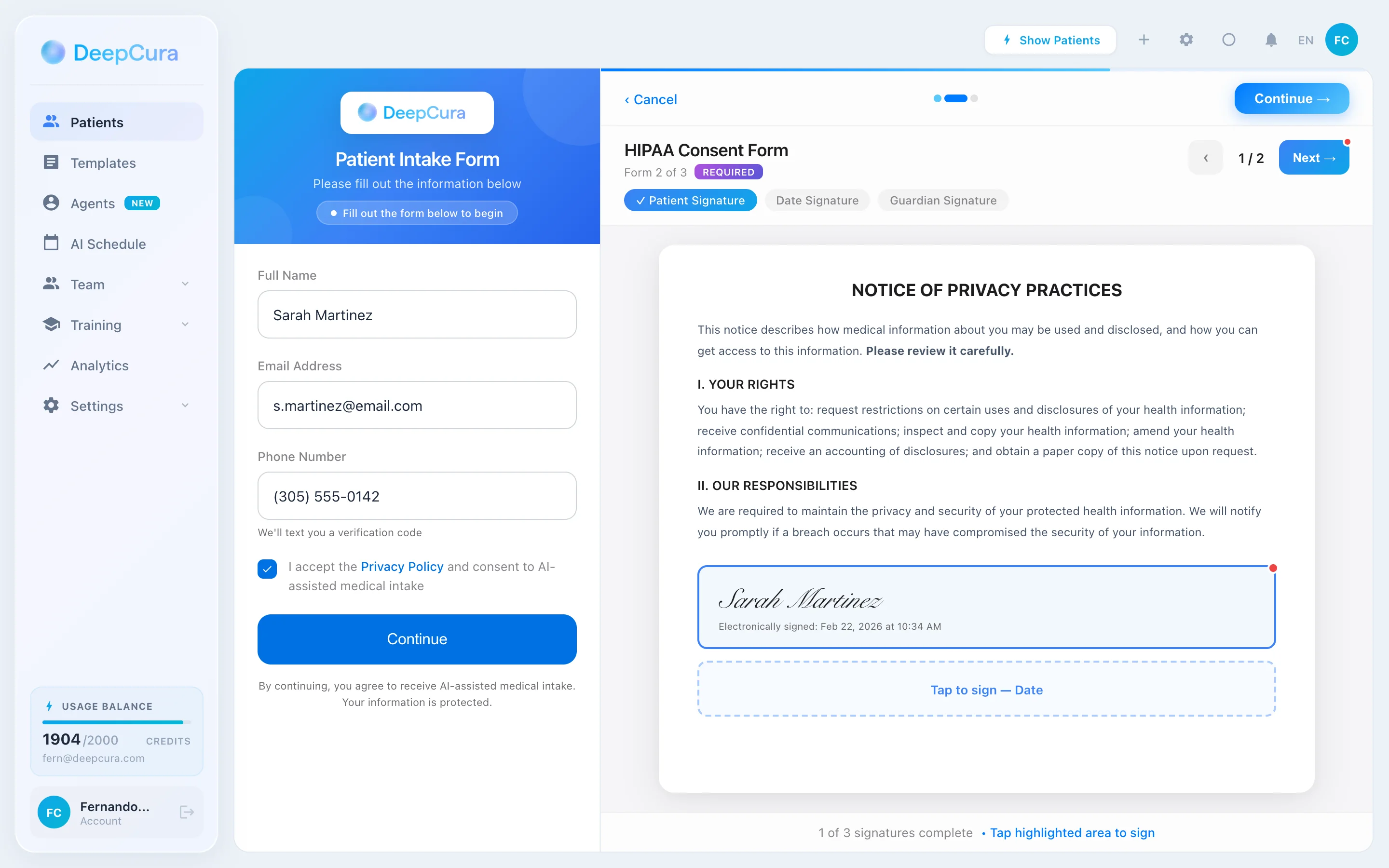
DeepCura is the platform doctors wish ChatGPT was. It combines everything clinicians currently piece together from multiple tools — AI-powered ambient scribing, clinical note generation, intelligent chat, EHR integration, a 24/7 AI receptionist, and fax management — into a single HIPAA-compliant platform. Where ChatGPT gives you a generic text box, DeepCura gives you a clinical operating system.
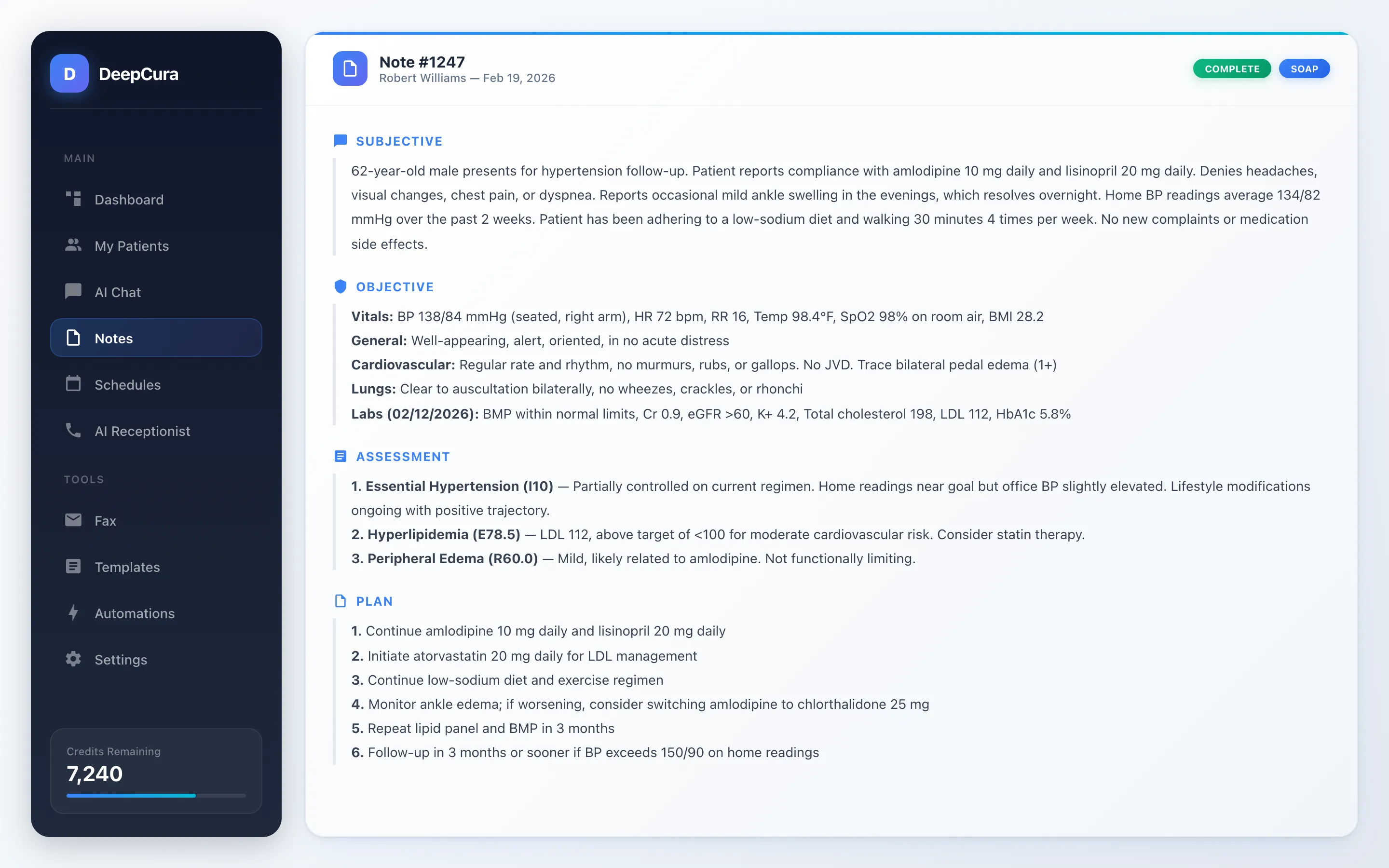
The ambient AI scribe listens during patient encounters and automatically generates structured clinical notes in SOAP, H&P, progress note, or custom formats. It suggests ICD-10 and CPT codes based on the encounter content. Notes push directly into your EHR — athenahealth, eClinicalWorks, AdvancedMD, OptiMantra, Epic, DrChrono, CharmHealth, or Cerner — eliminating the copy-paste workflow entirely.
Beyond scribing, DeepCura's AI chat is trained on medical knowledge and understands clinical context. You can ask it to draft referral letters, summarize patient histories, generate prior authorization language, or explain differential diagnoses — all within a HIPAA-compliant environment where no patient data is used for model training.
Key Features:
- Ambient AI scribing with real-time transcription
- SOAP, H&P, and custom note templates
- ICD-10 and CPT code suggestions
- Native EHR integrations (athenahealth, eCW, AdvancedMD, OptiMantra, Epic, DrChrono, CharmHealth, Cerner)
- 24/7 AI receptionist for calls and scheduling
- AI-powered fax summarization
- Clinical AI chat (HIPAA-compliant)
- No patient data used for training
Pricing: $129/month per provider (or $999/yr) — all features included, with 1,000 credits a month across every AI agent (a standard note costs 1 credit).
Pros:
- Only platform that combines AI chat, scribing, EHR integration, AI receptionist, and fax
- Replaces 3-5 separate tools at a lower total cost
- True bidirectional EHR integration (pull patient data and push notes)
- Free trial with no credit card required
- Works across all specialties with customizable templates
Cons:
- Newer platform with a smaller user community than legacy tools
- Mobile app still in development
- No on-premise deployment option (cloud-only)
Verdict: DeepCura is the best ChatGPT alternative for doctors who want a single, purpose-built platform that covers the full clinical workflow. At $129/month, it costs less than assembling ChatGPT Plus, a standalone AI scribe, a fax service, and an answering service separately — and all those tools actually talk to each other.
2. ChatGPT Plus — Best General-Purpose AI
ChatGPT is the tool that started the clinical AI conversation. GPT-4o is remarkably capable for medical reasoning, literature review, and drafting clinical text. Many doctors already use it daily to brainstorm differentials, draft patient education materials, translate medical jargon, and compose appeal letters. Its strength is versatility — it can do almost anything you ask, across any specialty.
The problem is what it cannot do. ChatGPT has no ambient listening capability, cannot connect to any EHR system, does not generate structured clinical note formats, offers no ICD-10/CPT coding, and is not HIPAA compliant on the Plus plan. OpenAI does not sign BAAs for ChatGPT Plus or Team tiers. Patient data entered into ChatGPT may be used for model training unless you opt out, and even then the compliance posture is insufficient for PHI.
Key Features:
- Powerful medical reasoning (GPT-4o)
- Versatile text generation and editing
- Custom GPTs for medical use cases
- Image analysis (radiology, dermatology)
Pricing: $20/month per user.
Pros:
- Best general-purpose AI reasoning available
- Extremely affordable at $20/month
- Huge ecosystem of plugins and custom GPTs
- Excellent for research, writing, and brainstorming
Cons:
- Not HIPAA compliant — cannot safely process PHI
- Zero EHR integration capability
- No clinical documentation workflow (no SOAP notes, no coding)
- Patient data may be used for model training
- No ambient listening or real-time transcription
Verdict: ChatGPT is a brilliant general-purpose tool that every doctor should know how to use — but it is not a clinical platform. Use it for non-PHI tasks like drafting letters, reviewing literature, and brainstorming. For anything involving patient data, you need a HIPAA-compliant alternative like DeepCura. And for medical research questions specifically, picking a single chatbot is a bet — our guide to the best AI for medical questions explains why running Claude, GPT, Gemini, and Grok in parallel beats picking one.
3. Google Gemini Advanced — Best Multimodal AI
Google Gemini Advanced brings multimodal capabilities that set it apart from text-only chatbots. Its ability to analyze images, PDFs, and complex documents makes it particularly interesting for clinicians who want to upload lab results, radiology images, or research papers and get instant AI analysis. Google's Med-PaLM research has also shown strong performance on medical licensing exams.
Like ChatGPT, Gemini is a general-purpose AI with no clinical workflow features. There is no ambient scribing, no EHR integration, no structured note output, and no HIPAA compliance on the consumer plan. Google Workspace does offer BAA options for Enterprise customers, but the consumer Gemini Advanced plan is not suitable for PHI. It is a powerful research and analysis companion, but not a clinical documentation tool.
Key Features:
- Strong multimodal capabilities (images, PDFs, video)
- Deep Google Workspace integration
- Long context window for large documents
- Google Search grounding for up-to-date information
Pricing: $20/month (Google One AI Premium).
Pros:
- Best-in-class multimodal analysis (images, PDFs, charts)
- Excellent for research and literature review
- Strong medical knowledge base from Google's Med-PaLM
- Affordable at $20/month
Cons:
- No HIPAA compliance for consumer plan
- Zero clinical workflow features
- No EHR integration or structured note generation
- Limited to Google ecosystem
Verdict: Gemini Advanced is a strong multimodal AI for research and image analysis, but like ChatGPT, it is a general-purpose tool with no clinical workflow capabilities. Doctors can use it alongside a clinical platform like DeepCura, but it cannot replace one.
4. Microsoft Copilot for Healthcare — Best for Enterprise Health Systems
Microsoft's healthcare Copilot is the enterprise play in clinical AI. Built on Azure's HIPAA-compliant infrastructure, it integrates deeply with the Microsoft ecosystem — Teams, Office 365, Azure Health Data Services, and FHIR-based EHR connections. For large health systems already invested in Microsoft, it offers AI capabilities across clinical documentation, patient communication, and administrative workflows.
The challenge for most doctors is accessibility. Copilot for Healthcare requires enterprise licensing, IT infrastructure, and Microsoft ecosystem commitment. It is not available as a standalone product for independent practices or small groups. The pricing is custom and typically involves six-figure annual commitments. Individual clinicians looking for a ChatGPT alternative will find it out of reach.
Key Features:
- HIPAA compliant with BAA (Azure)
- Deep Microsoft ecosystem integration
- FHIR-based EHR connectivity
- Enterprise-grade security and compliance
Pricing: Custom enterprise pricing.
Pros:
- Full HIPAA compliance with enterprise-grade security
- Native integration with Microsoft 365 and Teams
- FHIR-based EHR connections for large systems
- Backed by Microsoft's AI research and infrastructure
Cons:
- Inaccessible to independent practices and small groups
- Expensive custom enterprise pricing
- Requires heavy Microsoft ecosystem commitment
- Long deployment timelines (months, not days)
Verdict: Microsoft Copilot for Healthcare is a powerful enterprise solution, but it is not a practical ChatGPT alternative for most doctors. If you are in a large health system already on Microsoft, it is worth exploring. For everyone else, DeepCura offers comparable clinical AI capabilities at $129/month with setup in minutes, not months.
5. Freed AI — Best Simple AI Scribe
Freed AI is the simplest AI medical scribe on the market. It does one thing well: ambient listening during patient encounters, followed by automated clinical note generation. The setup is fast, the interface is clean, and the note quality is solid for primary care and common specialties. For solo practitioners who just want to stop typing notes, Freed is a compelling option.
The limitation is that Freed is only a scribe. It does not offer AI chat for clinical questions, does not integrate with EHR systems for bidirectional data flow, does not handle fax management, does not include an AI receptionist for after-hours calls, and does not provide coding suggestions. Doctors who use Freed still need ChatGPT (or another AI chat tool) for clinical reasoning, a separate fax service, a phone answering service, and manual EHR data entry. The total cost of this stack often exceeds what a full-platform solution costs.
For a detailed side-by-side analysis, see our DeepCura vs Freed AI comparison or read our full Freed AI review.
Key Features:
- Fast ambient AI scribing
- Simple setup (minutes, not days)
- HIPAA compliant with BAA
- Clean, minimal interface
Pricing: $39/month (Starter, 40 notes), $79/month (Core, unlimited), $119/month (Premier; $104 billed annually).
Pros:
- Fastest setup of any AI scribe (under 5 minutes)
- Clean, distraction-free interface
- Good note quality for primary care
- HIPAA compliant with signed BAA
Cons:
- No AI chat or clinical reasoning capability
- Minimal EHR integration (mostly copy-paste)
- No broader workflow features (AI receptionist, fax, phone answering)
- Requires additional tools to replace ChatGPT functionality
Verdict: Freed is a solid, simple AI scribe for doctors who just want ambient note generation and nothing else. But if you are looking for a ChatGPT replacement that also handles scribing, EHR integration, and clinical workflows, DeepCura covers all of that in one platform for $10–$50 more per month than Freed's paid tiers.
6. Heidi Health — Best for Template Customization
Heidi Health is an AI scribe with strong template customization. Based in Australia with growing US adoption, Heidi offers ambient listening and note generation with extensive template controls. Clinicians can define exactly how their notes should be structured, which fields to include, and how information flows from transcript to note. The template system is one of the best among pure scribe tools.
Unlike Freed, Heidi does offer an AI receptionist feature for handling patient calls. However, it still does not include AI clinical chat, has limited EHR integration beyond basic copy-paste workflows, and does not offer broader clinical platform features like fax management. Doctors still need separate tools for ChatGPT-style clinical reasoning, EHR connectivity, and practice management functions that a full-stack platform provides natively.
For a detailed side-by-side analysis, see our DeepCura vs Heidi Health comparison or read our full Heidi Health review.
Key Features:
- Excellent template customization system
- Ambient AI scribing
- HIPAA compliant
- Growing specialty coverage
- AI receptionist for patient calls
Pricing: $150/user/month billed yearly (free tier available).
Pros:
- Best-in-class template customization for note structure
- Strong note accuracy across specialties
- HIPAA compliant with BAA
- Active product development with frequent updates
Cons:
- No AI chat or clinical reasoning features
- EHR integration is basic (copy-paste, not bidirectional)
- Limited workflow features beyond scribing and AI receptionist
- Smaller US user base compared to competitors
Verdict: Heidi Health excels at structured note generation with flexible templates and is one of the few scribe tools that also offers an AI receptionist. However, doctors who need ChatGPT-style AI assistance, fax management, and deep EHR integration will still need to pair Heidi with additional tools — or choose a platform like DeepCura that bundles everything together.
7. Nuance DAX Copilot — Best Enterprise Ambient Scribe
Nuance DAX Copilot, now part of Microsoft, is the incumbent enterprise ambient scribe. It has the deepest Epic integration of any AI scribe on the market and is deployed across large health systems. The ambient capture quality is excellent, and the Epic workflow is seamless for organizations that have completed the integration.
The barrier for most doctors is the same as Microsoft Copilot: enterprise-only availability, custom pricing that typically runs $200-400+ per provider per month, long deployment timelines, and a requirement for organizational-level Epic integration. Individual doctors or small groups cannot purchase DAX independently. It is a powerful tool trapped behind enterprise procurement.
Key Features:
- Deepest Epic EHR integration available
- Enterprise-grade ambient scribing
- HIPAA compliant with Microsoft BAA
- Proven at scale (thousands of providers)
Pricing: Custom enterprise pricing — not publicly priced.
Pros:
- Gold standard for Epic ambient integration
- Proven reliability at enterprise scale
- Excellent ambient capture quality
- Strong Microsoft/Azure security posture
Cons:
- Completely inaccessible to independent practices
- Expensive custom enterprise pricing
- Scribe-only — no AI chat, clinical reasoning, or workflow tools
- Deployment requires months of IT work
Verdict: Nuance DAX Copilot is the best ambient scribe for large Epic health systems, but it is not a viable ChatGPT alternative for most doctors. If your organization uses Epic and has the budget, DAX delivers. For everyone else, DeepCura provides ambient scribing plus full clinical AI at a published $129/month with zero enterprise overhead.
8. Suki AI — Best Voice-First AI
Suki AI takes a voice-first approach to clinical AI. Rather than just ambient listening, Suki functions as a conversational voice assistant that doctors can talk to during and between encounters. You can dictate notes, ask clinical questions, and navigate your EHR using voice commands. The interaction model feels more like having a human assistant than using a software tool.
The voice-first approach works well for doctors who prefer speaking over typing, but the platform is narrower in scope than full-stack alternatives. Suki offers EHR integration with several systems but does not include a 24/7 AI receptionist, fax management, or the breadth of clinical workflow tools found in platforms like DeepCura. At $199/month, it is also the most expensive scribe-category tool on this list.
Key Features:
- Conversational voice AI assistant
- Ambient and dictation-based scribing
- EHR integration (multiple systems)
- HIPAA compliant with BAA
Pricing: Not published — contact sales.
Pros:
- Most natural voice interaction of any clinical AI
- Can navigate EHR via voice commands
- Works in both ambient and dictation modes
- HIPAA compliant with signed BAA
Cons:
- Enterprise pricing (not published) — among the more expensive tools on this list
- No AI receptionist or fax management features
- AI chat capabilities limited compared to ChatGPT or DeepCura
- Voice-first model is not ideal for every clinical setting
Verdict: Suki AI is the best choice for doctors who strongly prefer voice-first interactions and want EHR voice navigation. But with enterprise pricing (not published) and fewer features than DeepCura at $129/month, most doctors will get more value from a full-stack platform.
Stop Using ChatGPT for Patient Data
DeepCura gives you HIPAA-compliant AI chat, ambient scribing, SOAP notes, ICD-10 coding, and EHR write-back — in one platform.
+1 (415) 549-1829Available 24/7 · Set up in seconds · No credit card required
Feature Comparison Matrix
| Feature | DeepCura | ChatGPT | Gemini | Copilot | Freed | Heidi | DAX | Suki |
|---|---|---|---|---|---|---|---|---|
| HIPAA Compliant | ✓ | ✗ | ✗ | ✓ | ✓ | ✓ | ✓ | ✓ |
| Signed BAA | ✓ | ✗ | ✗ | ✓ | ✓ | ✓ | ✓ | ✓ |
| No PHI for Training | ✓ | ✗ | ✗ | ✓ | ✓ | ✓ | ✓ | ✓ |
| Ambient AI Scribing | ✓ | ✗ | ✗ | ✗ | ✓ | ✓ | ✓ | ✓ |
| SOAP Note Generation | ✓ | ✗ | ✗ | ✗ | ✓ | ✓ | ✓ | ✓ |
| ICD-10 / CPT Codes | ✓ | ✗ | ✗ | ✗ | ✗ | ✗ | ✗ | ✗ |
| AI Clinical Chat | ✓ | ✓ | ✓ | ✓ | ✗ | ✗ | ✗ | ✓ |
| Medical Knowledge Base | ✓ | ✓ | ✓ | ✓ | ✗ | ✗ | ✗ | ✓ |
| Multimodal (Images/PDFs) | ✓ | ✓ | ✓ | ✓ | ✗ | ✗ | ✗ | ✗ |
| EHR Integration | ✓ | ✗ | ✗ | ✓ | ✗ | ✗ | ✓ | ✓ |
| 24/7 AI Receptionist | ✓ | ✗ | ✗ | ✗ | ✗ | ✓ | ✗ | ✗ |
| Fax Management | ✓ | ✗ | ✗ | ✗ | ✗ | ✗ | ✗ | ✗ |
| Monthly Price | $129 | $20 | $20 | Custom | $39–$119 | Free / $150 (billed yearly) | Not publicly priced | Not publicly priced |
| Free Trial | ✓ | ✗ | ✗ | ✗ | ✓ | ✓ | ✗ | ✗ |
How We Ranked These Tools
We evaluated each tool across six weighted criteria that matter most to practicing clinicians. Generic AI chatbots like ChatGPT were measured against the same clinical workflow standards as purpose-built medical platforms — because that is how doctors actually use them.
HIPAA Compliance (30%)
The most heavily weighted criterion. We assessed BAA availability, encryption standards, data residency controls, and whether patient data is used for model training. Tools that cannot sign a BAA or that use PHI for training received significant penalties, regardless of how capable their AI is.
EHR Integration (25%)
We evaluated native connections to major EHRs (athenahealth, eClinicalWorks, AdvancedMD, OptiMantra, Epic, DrChrono, CharmHealth, Cerner), along with bidirectional data flow capability. Products that only support copy-paste workflows scored lower than those with true EHR read/write integration.
Clinical Workflow Coverage (20%)
Beyond basic chat or scribing, we looked at ambient scribing, note generation, coding suggestions, referral management, fax processing, 24/7 AI receptionist capabilities, and patient communication tools. Platforms that reduce total administrative burden scored higher than those focused on a single task.
Pricing & Value (10%)
We considered cost per provider per month, what features are included versus sold as add-ons, and total cost of ownership compared to assembling the same functionality from multiple separate tools.
AI Quality (10%)
Accuracy of generated notes, hallucination rate, medical knowledge depth, and ability to handle specialty-specific terminology. We tested across primary care, cardiology, orthopedics, and psychiatry encounters using standardized scenarios.
Ease of Setup (5%)
Time to first value, onboarding complexity, training requirements, and IT burden for small practices. Products that require months of enterprise deployment scored lower than those a solo clinician can start using in minutes.
When choosing a clinical AI platform, weight the criteria that matter most to your practice. A solo family medicine physician may prioritize simplicity and price, while a multi-specialty group needs deep EHR integration and workflow coverage. Use our criteria as a starting framework, then adjust based on your clinical reality.
Frequently Asked Questions
Is ChatGPT HIPAA compliant for doctors?
No. Standard ChatGPT is not HIPAA compliant. OpenAI does not sign Business Associate Agreements (BAAs) for ChatGPT Plus or Team plans. The Enterprise and API tiers offer BAA options, but they still lack clinical-specific safeguards like EHR integration, structured note output, and medical coding. Doctors who need HIPAA-compliant AI should use a purpose-built platform like DeepCura, which is fully HIPAA compliant with end-to-end encryption, BAA coverage, and no patient data used for model training.
What is the best ChatGPT alternative for medical professionals?
DeepCura is the best ChatGPT alternative for medical professionals in 2026. Unlike generic AI chatbots, DeepCura combines ambient AI scribing, clinical note generation, AI-powered chat with medical knowledge, EHR integration (athenahealth, eCW, AdvancedMD, OptiMantra, Epic, DrChrono, CharmHealth, Cerner), fax management, and a 24/7 AI receptionist in a single HIPAA-compliant platform. It replaces the need for separate tools by covering the full clinical workflow from patient encounter to documentation to follow-up.
Can doctors use ChatGPT for clinical documentation?
While doctors can technically use ChatGPT to draft clinical notes, it is not recommended for production use. ChatGPT lacks HIPAA compliance, cannot connect to EHR systems, does not support structured medical note formats (SOAP, H&P, progress notes), and has no ambient listening capability. Purpose-built clinical AI platforms like DeepCura offer real-time transcription during patient encounters, automatic SOAP note generation, ICD-10/CPT code suggestions, and direct EHR push — making them far more practical for clinical documentation. For ready-made templates, see our free doctor's note templates.
How much does DeepCura cost compared to ChatGPT?
DeepCura costs $129 per month per provider, which includes the full clinical AI suite: ambient scribing, note generation, AI chat, EHR integration, fax management, and a 24/7 AI receptionist. ChatGPT Plus costs $20 per month but only provides a general-purpose chatbot with no clinical features, no HIPAA compliance, and no EHR integration. When you factor in the cost of adding separate AI scribe tools, EHR integration fees, fax services, and phone answering services, DeepCura typically costs less than assembling equivalent functionality from multiple vendors.
Does DeepCura integrate with EHR systems?
Yes. DeepCura integrates with athenahealth, eClinicalWorks, AdvancedMD, OptiMantra, Epic, DrChrono, CharmHealth, and Cerner. Integration allows providers to pull patient demographics, view appointment schedules, push completed notes directly into the patient chart, and sync clinical data — all without leaving the DeepCura interface. This eliminates the copy-paste workflow that plagues standalone AI tools like ChatGPT.
What can DeepCura do that ChatGPT cannot?
DeepCura offers several capabilities that ChatGPT cannot match: (1) HIPAA-compliant infrastructure with signed BAA, (2) real-time ambient AI scribing during patient encounters, (3) automatic generation of structured clinical notes (SOAP, H&P, progress notes) with ICD-10 and CPT coding, (4) direct EHR integration for pushing notes and pulling patient data, (5) a 24/7 AI receptionist that answers calls, schedules appointments, and handles patient inquiries around the clock, (6) inbound fax management with AI-powered summarization, and (7) a clinical AI chat trained on medical knowledge rather than general web data.
Is there a free trial for DeepCura?
Yes. DeepCura offers a free trial that includes access to the full platform — ambient AI scribing, clinical note generation, AI chat, and EHR integration. No credit card is required to start. You can sign up at app.deepcura.com/register and begin using DeepCura in your practice immediately.
Should I use a general-purpose chatbot or a clinical AI platform?
The answer depends on your use case. If you only need AI for non-clinical tasks — drafting generic letters, brainstorming ideas, reviewing published literature — a general-purpose chatbot like ChatGPT or Gemini is sufficient and affordable. But if any part of your AI workflow involves patient data, clinical documentation, EHR interaction, or medical decision support, you need a HIPAA-compliant clinical platform. Most doctors find that starting with a purpose-built clinical AI platform like DeepCura eliminates the need for a separate general chatbot entirely, since DeepCura's AI chat handles both clinical and general-purpose queries within a compliant environment.
Final Thoughts
The clinical AI landscape in 2026 has matured well beyond the question of whether doctors should use AI. The question is which AI fits your workflow. Generic chatbots like ChatGPT and Gemini remain useful for non-clinical tasks, but they were never designed to handle the security, integration, and documentation demands of modern medical practice.
Our recommendation for most clinicians is to choose a platform that matches your workflow complexity. If you want a single tool that replaces ChatGPT, your AI scribe, your fax service, and your phone answering service, DeepCura delivers the best overall value at $129/month. If you are in a large Epic-based health system with enterprise resources, Nuance DAX Copilot integrates most deeply. If you just want the simplest possible ambient scribe, Freed AI gets the job done starting at $39/month.
For deeper comparisons of specific products, see our Best AI Medical Scribes in 2026 ranking, our DeepCura vs Freed AI comparison, and our DeepCura vs Heidi Health comparison. For a Reddit-verified comparison of AI tools doctors actually use, see our guide to the best AI for medical professionals according to Reddit. If you are evaluating dictation and documentation tools specifically, see our guide to the 9 best medical dictation software. If you are choosing an EHR that pairs well with AI tools, see our ranking of the best EMR for a small practice. And if reducing phone burden is a priority, see our guide to the best AI medical receptionists in 2026. For specialty-specific documentation tools, see our guides on AI scribes for psychiatry, pediatrics, and neurology.
Whatever you choose, the important step is choosing. Every hour spent on after-hours documentation is an hour not spent on patient care, personal recovery, or clinical growth. The tools exist to reclaim that time — the only question is which one fits your practice best.
Try DeepCura Free — No Credit Card Required
AI chat + scribe + receptionist + billing + EHR integration. One platform, $129/mo. Join 6,000+ clinicians.
+1 (415) 549-1829Available 24/7 · Set up in seconds · No credit card required
References
[1] OpenAI, "Enterprise Privacy at OpenAI," OpenAI.com. openai.com/enterprise-privacy
[2] U.S. Department of Health and Human Services, "HIPAA for Professionals," HHS.gov. hhs.gov/hipaa/for-professionals
[3] Google, "Med-PaLM: Large Language Models for Medical Question Answering," Google Research Blog, 2023. research.google/blog/large-language-models-encode-clinical-knowledge
[4] DeepCura, "AI Medical Scribe Platform — Ambient Scribing, AI Receptionist, EHR Integration," DeepCura.com. deepcura.com
[5] Freed AI, "AI Medical Scribe — Ambient Clinical Documentation," Freed.ai. getfreed.ai
[6] Heidi Health, "AI-Powered Clinical Documentation," HeidiHealth.com. heidihealth.com
[7] Microsoft, "Microsoft Copilot for Healthcare," Microsoft.com. microsoft.com
[8] Nuance Communications, "Dragon Ambient eXperience (DAX) Copilot," Nuance.com. nuance.com
[9] Suki AI, "Voice AI Assistant for Clinicians," Suki.ai. suki.ai
[10] U.S. Department of Health and Human Services, "Business Associate Contracts — Sample BAA Provisions," HHS.gov. hhs.gov/hipaa/for-professionals/covered-entities/sample-business-associate-agreement-provisions