
Disclaimer: This review is based on publicly available information as of March 31, 2026, with Freed's plan prices re-verified on September 27, 2026. Features, pricing, and capabilities may have changed since the time of writing. We encourage readers to verify current details directly with the vendor.
$119/month for their top plan. Setup in minutes. No native EHR API write-back. That is Freed AI in a nutshell — the simplest AI scribe on the market, for better and worse.
Here is what Freed AI does and does not do:
- Does: Ambient listening, SOAP note generation, fast turnaround, clean interface, patient instructions, referral letters, ICD-10 coding
- Does not: Turn what was said into a coded, evidence-linked patient chart (its output is the note), process inbound faxes, put fax + email + phone + SMS in one AI-cleared queue, native EHR API integration, real-time SMS during AI calls, AI payment collection
- Expanding into: AI receptionist (Early Access — requires booking a sales call to try), revenue cycle tools (Early Access)
- Best for: Solo practitioners who primarily need notes and basic coding assistance
- Not for: Practices that want the visit itself to update the chart — coded entries, trends, population queries — or that need a full roster of AI agents orchestrating every communication channel from one shared context
Two gaps matter more than note quality in 2026, and neither is about transcription:
- Freed writes a note. DeepCura's scribe writes the chart — every value spoken aloud becomes a coded, evidence-linked entry you approve, then a trend, then a practice-wide query.
- Freed has no inbox. DeepCura clears one. Fax, email, phone, and SMS land in a single queue where an AI agent proposes every disposition at once — priced, checkable, and executed only after you confirm.
And because both run on the same event timeline, the second one knows what the first one heard.
This review is an honest assessment of Freed AI in 2026. We cover pricing, features, accuracy, EHR integration, HIPAA compliance, and how it stacks up against platforms that automate more of the clinical workflow.
The Ambient Data Gap — Freed Writes the Note; DeepCura Writes the Chart
Every ambient scribe on the market — Freed included — automates the same artifact: the note. The structured chart underneath it — the problem list, the med list, the flowsheet trends — still gets updated by hand, or not at all. The value your patient said out loud ("her A1c came back at 7.2") dies as prose inside a paragraph.
In July 2026, DeepCura closed that loop with Ambient Data. The scribe no longer just writes the note — it stages coded, reviewable chart entries from what was said in the room:
- Spoken facts become coded entries. A diagnosis mentioned in conversation stages as an ICD-10-coded problem; a lab value stages as a LOINC-coded series point; a med change stages as exactly that — approving a "stopped the metformin" card records a stop on the med list, not a sentence about a stop buried in a note.
- Every entry carries its receipt. Each suggestion shows the verbatim quote and the exact second of visit audio it came from — click and replay the moment it was said. Freed states that patient recordings are not stored, which also means there is no way to audit what its AI heard. DeepCura anchors every committed value to its retained source.
- Nothing enters the chart unreviewed. Suggestions queue as cards with keyboard triage — approve, edit, or reject. Approving records the fact as clinician-verified under your name; rejecting keeps it off the chart forever, and every decision is audited.
- Codes are verified before you ever see them. Every AI-suggested code is checked against DeepCura's built-in clinical terminology engine — spanning ICD-10-CM, LOINC, RxNorm, and SNOMED CT — before it reaches your review queue.
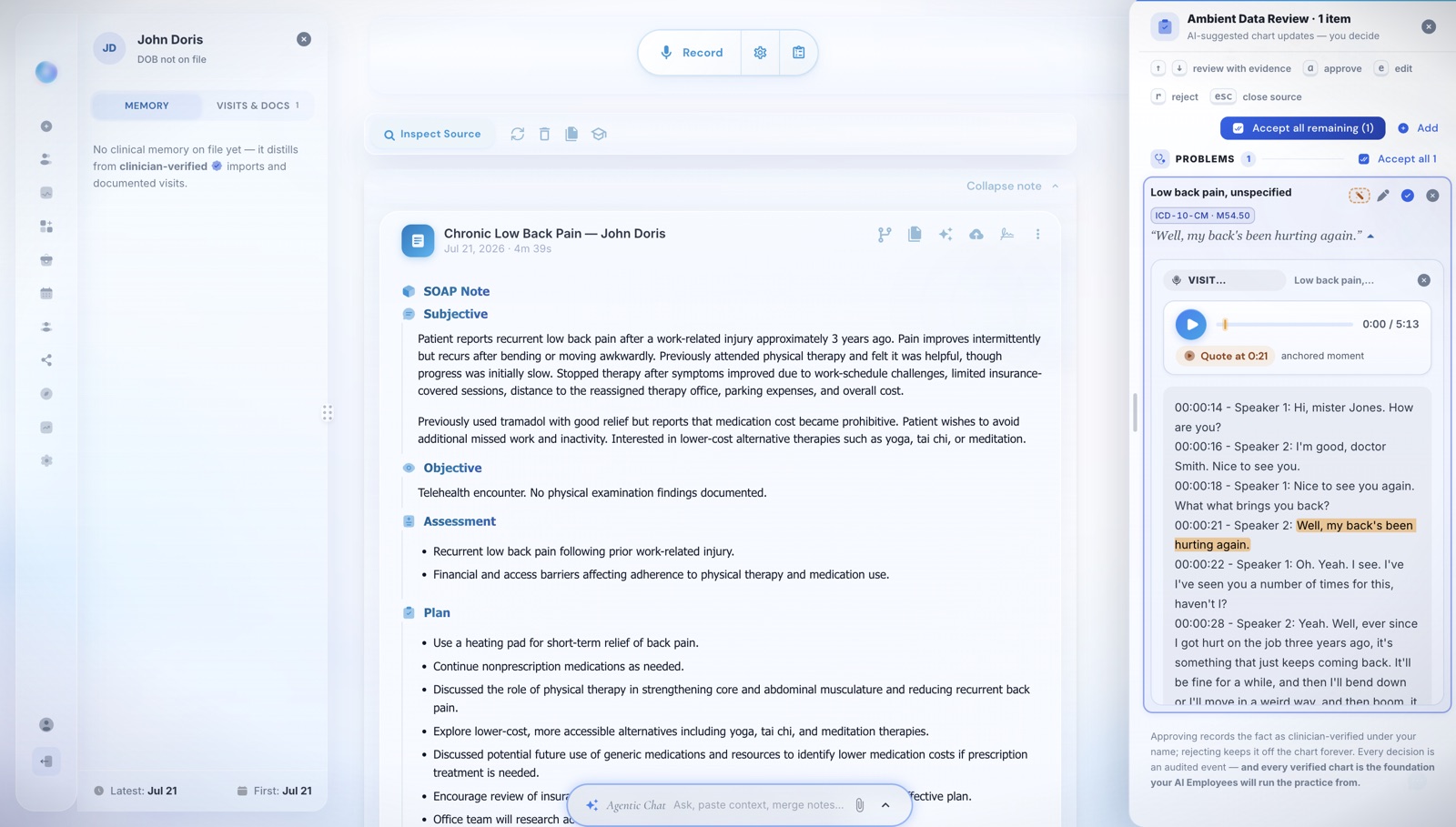
The Ambient Data review panel — a staged problem card (ICD-10-CM · M54.50) carrying the verbatim quote "Well, my back's been hurting again," anchored to second 0:21 of the visit audio. Approve, edit, or reject; nothing commits without you.
Because entries are coded, they compound. Custom Ambient Trackables let a practice track anything — pain per joint, PHQ-9 scores, injection units per site — and the scribe captures it from conversation at every visit: say it once, tracked forever. Follow-ups start from an always-current picture of problems, meds, allergies, and trends instead of a 7 AM chart-archaeology session — you review the handful of things that changed, not the whole ocean.
And it scales past one patient. The Population Panel turns the accumulated data into practice-wide answers: "every patient whose latest A1c is above 9," the overdue list, lost-to-follow-up — one query, each result carrying its evidence, with a CSV export for outreach. As of July 2026, DeepCura is the first US system that turns conversations into population-level data — the chart writes itself, every value carries its evidence, every entry approved by you.
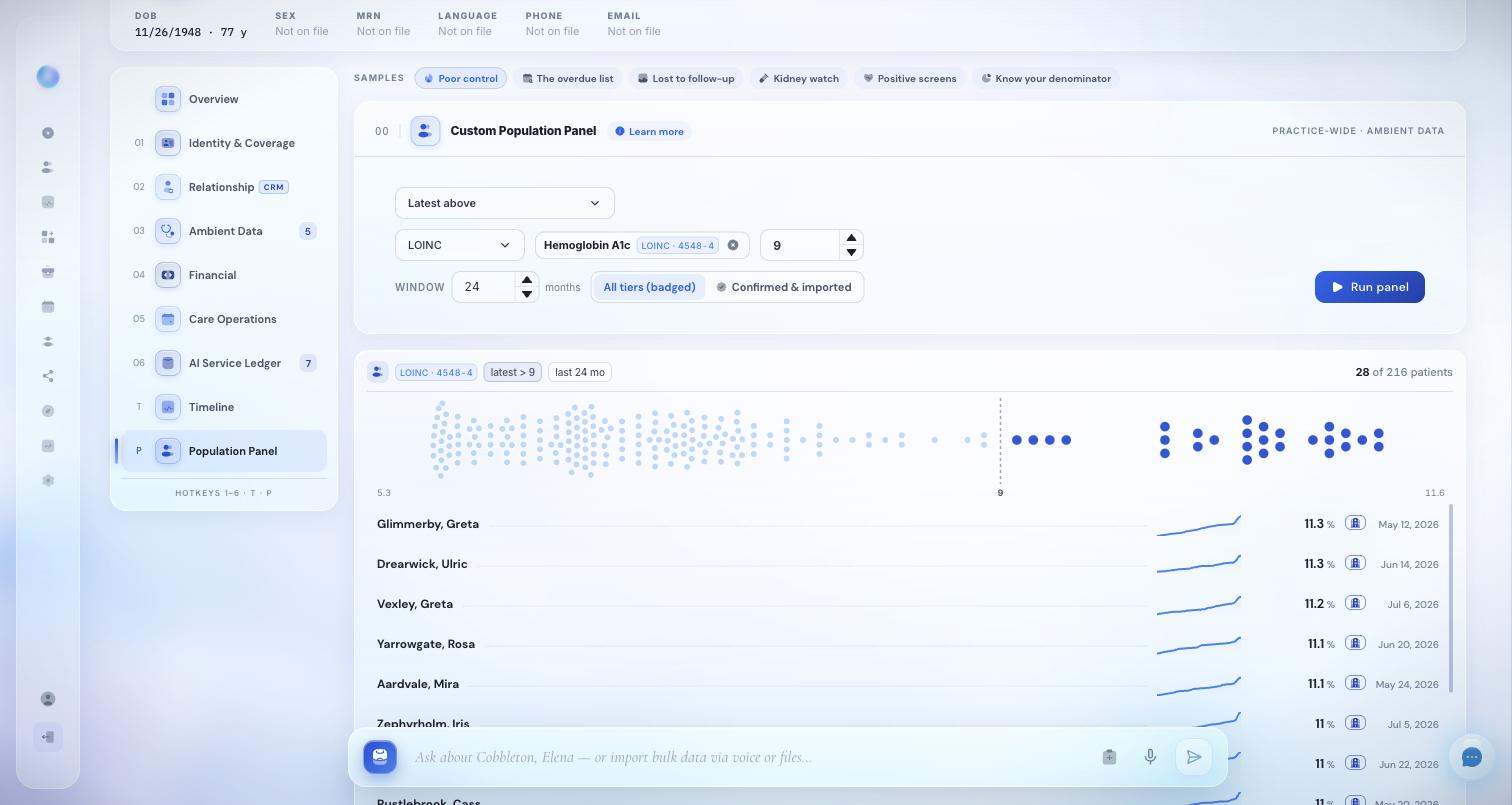
The Population Panel — one practice-wide query ("latest Hemoglobin A1c above 9, last 24 months") returning 28 of 216 patients, each with a trend sparkline and its evidence one click away.
The same review pipeline now runs on paper, too. When a fax arrives, DeepCura reads it and matches the patient — MRN first, then phone plus date of birth, then name; an ambiguous match is never guessed, it is surfaced for a one-click confirm — and once paired, the document's contents stage as coded chart suggestions, each anchored to the highlighted line of the PDF and cross-checked against the live chart, so a conflicting dose gets flagged and a duplicate gets dropped. A faxed lab report stops being a TIFF in a folder and becomes trended data on the right patient's chart. Freed does not process inbound faxes at all.
Freed's Premier plan suggests ICD-10 codes on the note, and that is where its structured output ends — no longitudinal coded chart, no per-value evidence trail, no population layer. That is the difference between automating the document and automating the chart.
The AI Inbox Gap — Freed AI Gives You Nothing to Clear
Ambient data answers one question: what happened in the room? It says nothing about the other half of the day — the fax tray, the shared email account, the missed calls nobody returned, the texts sitting unread. That queue is where front-desk hours actually go, and no scribe touches it.
In July 2026 DeepCura shipped the AI Inbox: fax, email, phone, and SMS in a single work queue, with an AI agent that clears it on command. This is the capability gap that has widened most in 2026, and Freed AI does not compete in it at all — its public documentation describes no inbound fax processing, no unified communications queue, and no bulk disposition tooling.
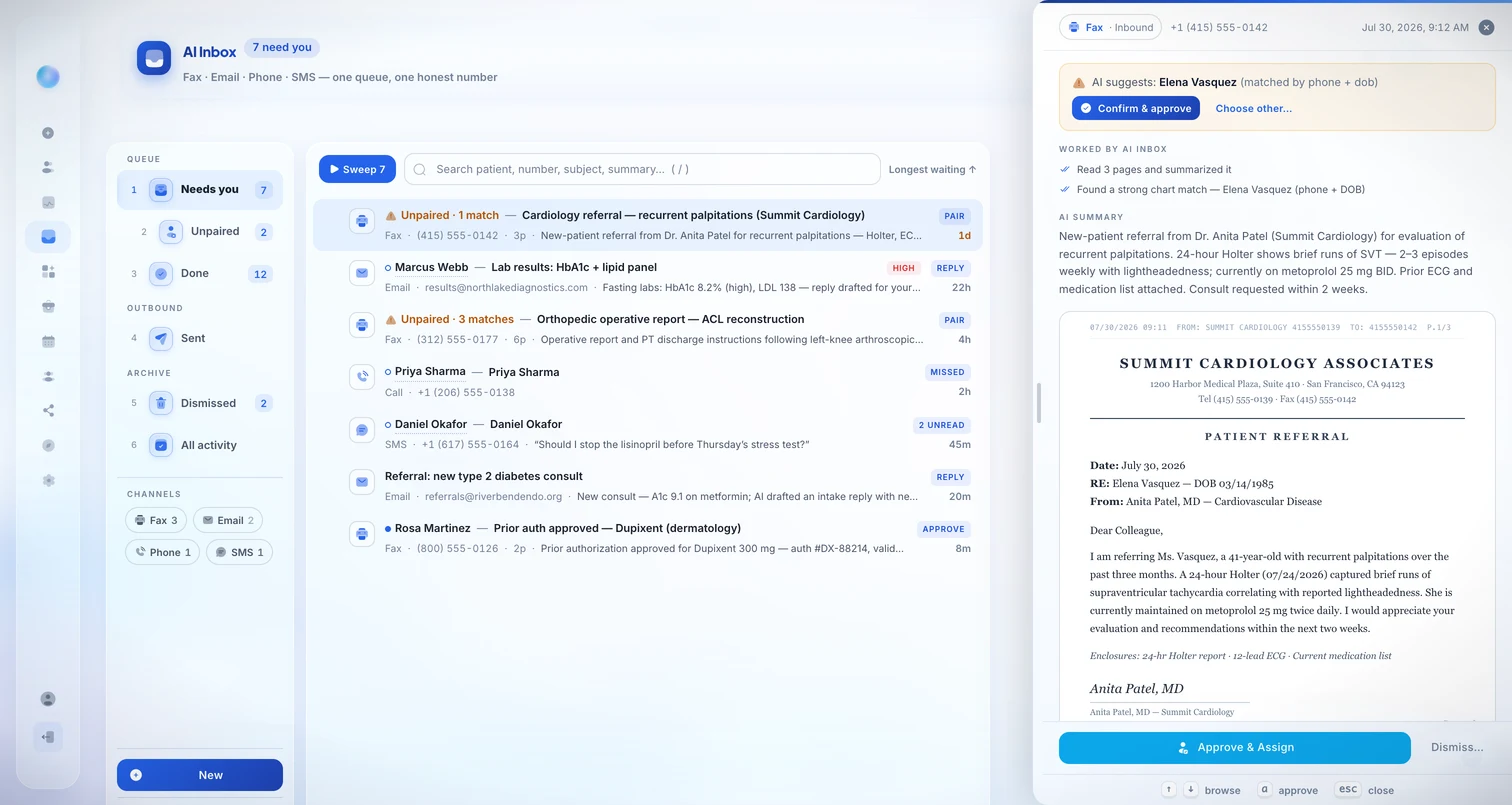
The AI Inbox — four channels, one queue, one honest count of what needs a human. The referral fax on the right arrived already read, summarized, and matched to Elena Vasquez by phone + DOB; "Worked by AI Inbox" shows exactly what the agent did before you got there.
Tell It "Zero My Inbox"
Press ⌘K from anywhere in the inbox and type it in plain English. The agent reads all four channels and comes back with one checklist of everything it proposes: the fax it would file and to which chart, the exact words it would text each missed caller, the emails it would draft — with the credit cost totalled before you commit. Uncheck any row you disagree with. Nothing runs until you press confirm.
That last sentence is not marketing politeness. It is enforced on the server:
- The confirm is a real gate. The execution tool refuses outright unless the preview carries a confirmation flag that only your browser can set — the model cannot forge it, and it cannot stage and execute inside the same turn.
- A double-click can't send a second text. The batch is claimed with a single-shot lock before the first side effect, so a duplicate confirm, a transport retry, or an impatient second click returns "already executed" instead of a second message to a patient.
- Unchecking is binding. The rows you skipped are stored server-side and merged with whatever the model relays back. The agent can skip more than you asked. It can never skip fewer.
- Everything expires. A proposal you walk away from dies in 30 minutes rather than sitting around waiting to be confirmed by accident.
What It Refuses to Do Is the Product
Any tool can promise bulk actions. The engineering that matters is the list of things the agent is forbidden to batch, because those are the cases where automation quietly damages a chart:
- Weak patient matches never auto-file. A fax only pairs itself when the match is strong — MRN, phone + date of birth, name + date of birth, or a human's manual pick. Phone-only or name-only is a weak match, and it stays a human decision. So does a possible duplicate, and so does a fax the AI could not read cleanly.
- The agent drafts email; it does not send email. Replies land as drafts in your own inbox for you to send. Sending was deliberately never given to it.
- Opt-outs are enforced at the moment of sending, not at the moment of planning. If a patient has texted STOP, the send is refused downstream, reported honestly, and never retried.
- Multi-word tags are rejected before you confirm rather than failing after — the preview validates against the same rules the endpoint enforces.
The gates are a line-for-line mirror of the ones behind the manual buttons, so the agent structurally cannot bulk-execute anything a human clicking one item at a time would be blocked from doing.
It Tells You the Truth About Its Own Coverage
The inbox counts pending faxes, missed calls, and unread texts. It does not count email, because email is a live merge with your Gmail rather than a number in a database — and rather than paper over that, the agent is instructed to disclose it. It says "all caught up" only when the counts it can actually see are zero, and it names email as the thing it cannot count. An AI that admits the edge of its own knowledge is worth more than one that reports a confident zero.
Every Action Leaves a Receipt
Each executed item writes a real entry on the patient's timeline attributed as "AI Inbox on behalf of Dr. ___" — the fax pairing, the text, the archived call, the drafted email, each one individually recorded alongside a summary of the whole batch: what was attempted, what ran, what failed, what you unchecked, what the guardrails blocked, and what it cost. If the agent claims it did something, there is a durable record proving it. If there is no record, it did not happen.
Pricing follows the same honesty: a text costs 1 credit and an AI-drafted email reply costs 1 — exactly what those actions cost when a human clicks them. Filing a fax, dismissing a fax, marking a call handled, and tagging a call are free. There is no batch surcharge for letting the AI do it, and the preview states the total before you confirm.
Everything Feeds One Context — the Difference Between 9 Agents and 9 Tools
Here is the part that is easy to miss in a feature list, and it is the whole architecture: the AI Inbox is not a separate product with its own database. It is the same agent, the same patient records, and the same timeline as everything else DeepCura runs.
Concretely, while it is working your inbox, that agent can also:
- Pull one patient's entire communication history across all four channels at once — every text, email, call, and fax for that person, as one view, instead of four searches in four systems.
- Read the patient brief the ambient scribe built — the coded problems, meds, and trends from the visit — so a reply it drafts is written by something that knows the clinical picture, not just the last message.
- Query your whole panel mid-triage. The same cohort engine behind the Population Panel is available from the inbox, so "which of these callers is overdue for an A1c" is a question you can ask while clearing the queue.
- Ask the scheduling agent about real availability before it proposes texting a patient a time — the schedule is not a second app it has to guess about.
Read that list against what a point-solution stack gives you. A scribe writes a note. A separate fax tool routes a PDF. A separate phone system logs a call. Each one is correct and none of them knows about the others, so the human becomes the integration layer — retyping, cross-referencing, and remembering. Freed's structured output lives inside the scribe by design; nothing else it sells reads from it, because there is nothing else.
DeepCura's agents are not separate products bundled at one price. They are roles reading and writing one shared context: the receptionist's call becomes an inbox item, the inbox files the fax into the chart, the fax's contents become coded chart entries, those entries become the trend and the population panel, and the panel tells the inbox agent who to text next. Say something once, and every agent knows it. That compounding is what $10 a month actually buys — and it is not a feature a competitor can ship by adding another module, because it is a property of how the system stores its data, not of any single screen.
The Agentic Chat Gap — One Query, Many Actions
Freed's UI is built around a single linear flow: select a patient, pick a template, capture a visit. Look at Freed's blank-state screen — it starts every session with a literal arrow telling you to "Enter the patient's name before starting your visit." There is no chat box that orchestrates work, no way to chain multiple backend actions, and no way to generate a finished note from a single multi-step instruction. Freed's AI chat capability is limited to reviewing details from previously generated notes — useful for visit prep, but not agentic.
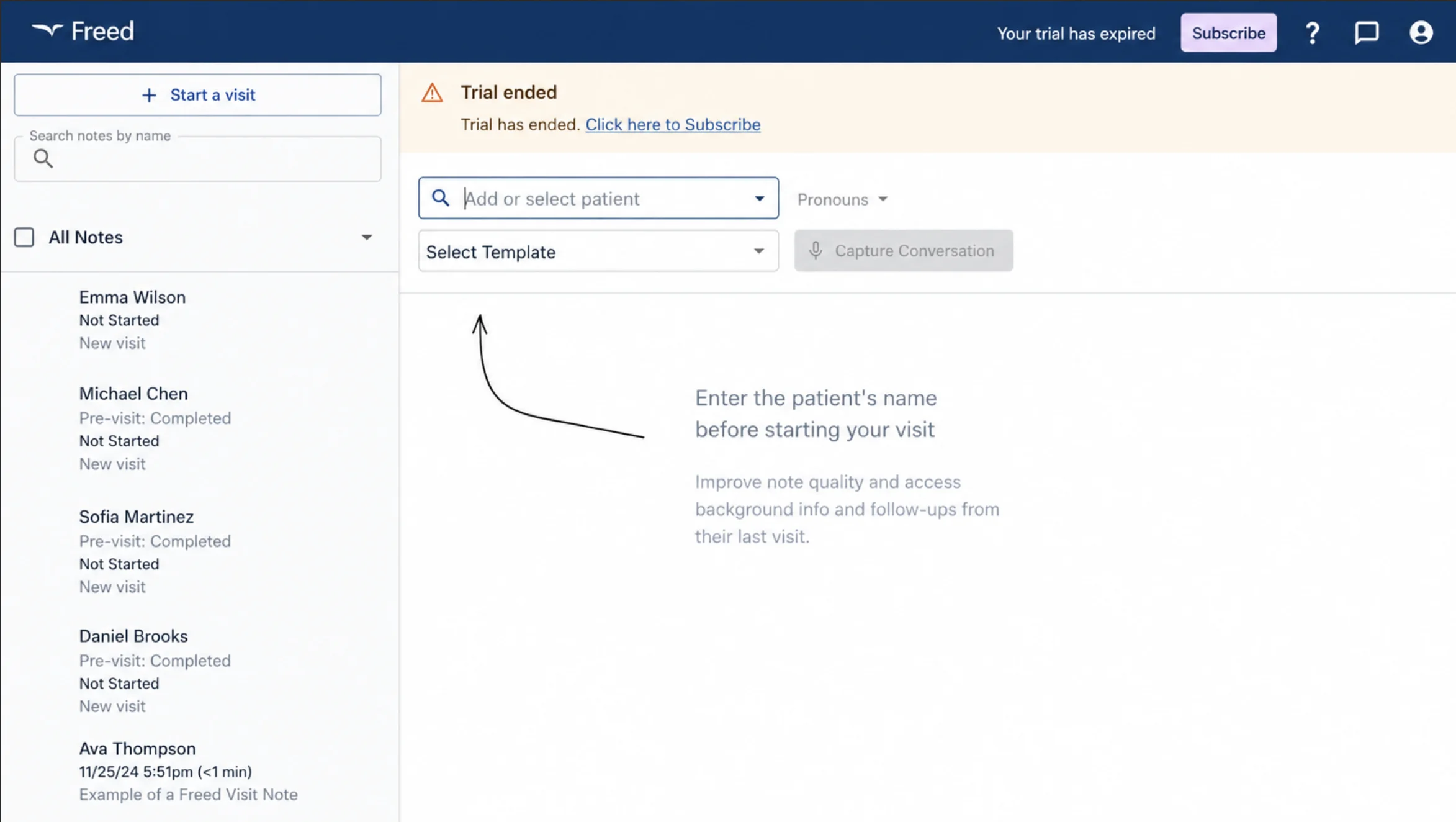
Freed's blank-state UI — linear workflow, single template per visit, no chat orchestration that can chain template retrieval, patient history lookup, and note generation into a single instruction. Screenshot from Freed's web app.
DeepCura's Agentic Chat is fundamentally different. It is not a chat box — it is an LLM-driven orchestrator (Claude, GPT, or Gemini) that can chain multiple backend actions inside a single user prompt. When you ask DeepCura to "pull this patient's last visit, apply my Cardiology Follow-Up template, and add F48.9 to the problem list," the agent autonomously fires three separate tool calls behind the scenes — fetching the prior chart, locating your saved template, loading its structure — then merges everything into one finished note. No clicking. No copying, splitting, or opening unnecessary tabs. No second prompt.
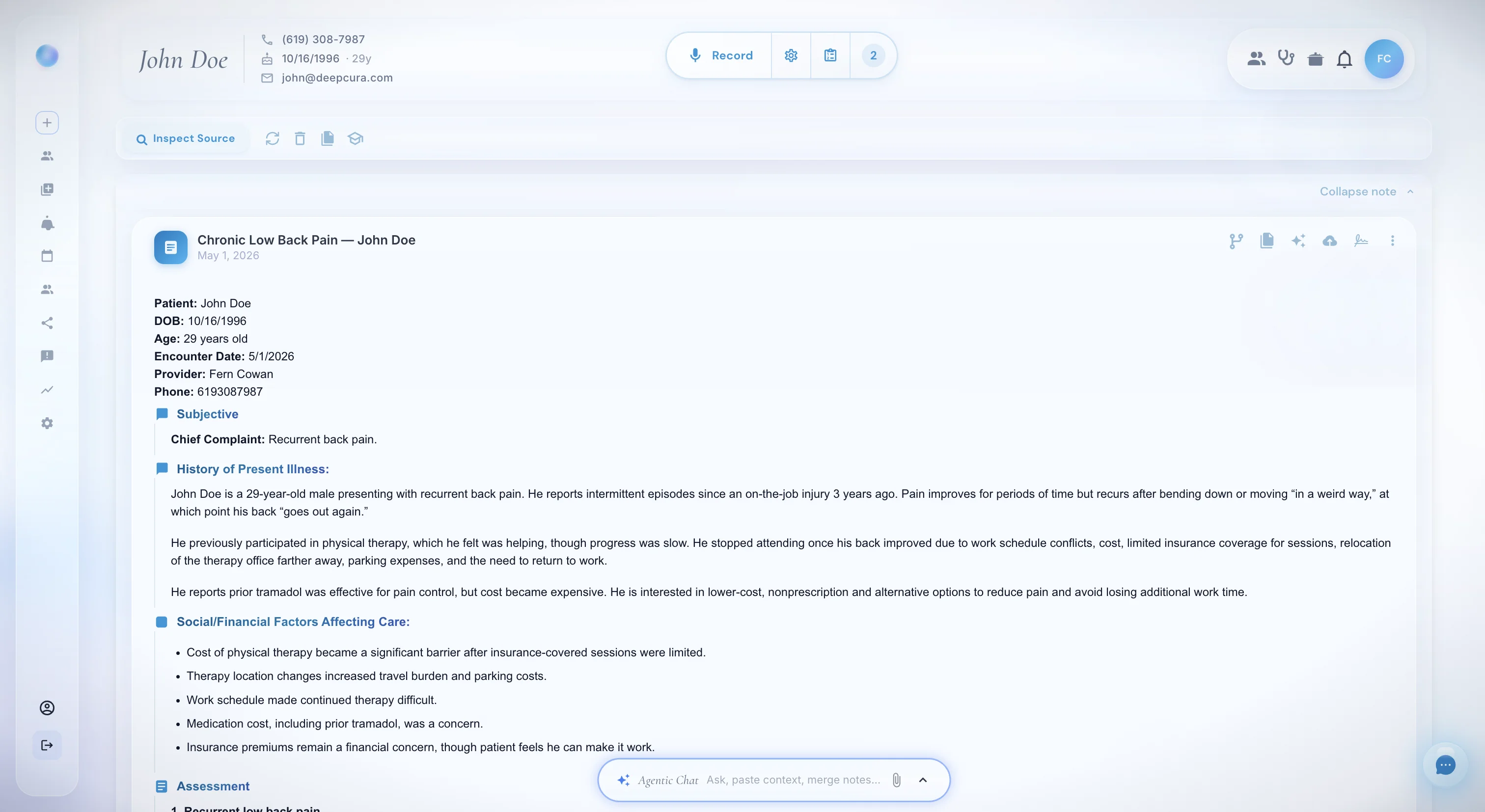
DeepCura's Agentic Chat sits inside every patient chart — type one instruction and the AI chains template retrieval, patient history lookup, ICD-10 coding, and note generation in a single pass.
Three real prompts a clinician can fire today, each chaining two or three backend actions in one query:
- "Pull the last visit, add F48.9 as a new diagnosis, and reformat with my SOAP template." → agent chains fetch recent transcript → list templates → load SOAP template → emits the rewritten note.
- "Apply my Cardiology Follow-Up template to today's encounter and write a referral letter to Dr. Martinez." → list templates → load Cardiology template → generate note → generate referral letter in sequence.
- "Change the metformin dose to 1000 mg in the most recent note and update the plan section." → fetch recent transcript → edit the targeted field → re-emit the full note with no other changes.
This is what agentic actually means in clinical software: the model decides which backend function to call, in what order, and how to combine the results — all from one natural-language sentence. Freed's AI chat can review and discuss a previous note. DeepCura's Agentic Chat orchestrates the entire encounter — and every tool call is audited inside the saved transcript so you can see exactly what context the agent pulled.
And on the annual plan, DeepCura ($999/yr) is actually $249 cheaper than Freed Premier on annual billing ($104/mo billed annually = $1,248/yr) — while including a full roster of extra AI agents beyond the scribe.
What Is Freed AI?
Freed AI is an ambient AI medical scribe designed to automate clinical documentation. It listens to patient encounters in real time — whether in-person or via telehealth — and generates structured clinical notes that clinicians can review, edit, and transfer into their EHR. The company was founded with a focused mission: build the simplest possible AI scribe and do that one thing well.
Unlike broader clinical AI platforms that bundle scribing with intake automation, billing tools, AI receptionists, and EHR integrations, Freed AI has historically stayed deliberately narrow. It began as a scribe, and only a scribe. That focus has been both its greatest strength and its most significant limitation. However, as of early 2026, Freed AI is expanding into adjacent workflows — an AI receptionist ("Front Desk") and revenue cycle tools are both available through an Early Access program, signaling a shift toward a broader platform strategy.
Freed AI supports both mobile and desktop usage, making it accessible across clinical environments. The platform is HIPAA compliant and provides a Business Associate Agreement (BAA) to covered entities. On the Apple App Store, Freed AI holds a 4.8 out of 5 rating — one of the highest-rated AI scribe apps available. It has gained particular traction among primary care physicians, family medicine practitioners, and solo clinicians who value speed and simplicity over feature breadth.
How Freed AI Works
The Freed AI workflow is designed to be as frictionless as possible. Here is how a typical encounter works:
Start a visit. The clinician opens the Freed AI app on their phone or desktop and taps a button to begin recording. There is no complex configuration — just press start and begin the patient conversation.
The AI listens. Freed AI captures the ambient audio of the clinical encounter, processing the conversation between the clinician and patient in real time. The platform uses speaker diarization to distinguish between voices, though performance is best in standard two-speaker encounters.
The encounter ends. When the visit is complete, the clinician stops the recording. Freed AI processes the audio and generates a structured clinical note, typically within one to two minutes.
Review and transfer. The generated note appears in the Freed AI interface, formatted as a SOAP note, H&P, progress note, or another supported template. The clinician reviews the note, makes any necessary edits, and copies it into their EHR — usually via copy-paste or a basic integration.
The entire process requires no IT setup, no EHR configuration, and no training beyond a few minutes of familiarization. For clinicians accustomed to spending 10-15 minutes per note on after-hours documentation, the time savings are immediate and meaningful.
Freed AI Pricing
Freed AI now uses tiered pricing across three individual plans:
- Starter — $39/month: Up to 40 notes/month, basic ambient scribing, specialty templates, live support
- Core — $79/month: Unlimited notes, instant template builder, AI clinician assistant for editing
- Premier — $119/month: Everything in Core plus EHR push (Chrome extension-based, not native API write-back), visit summaries, patient context, ICD-10 coding, CPT codes (beta), and AI assistant with medical knowledge base
- Groups — Custom pricing: Premier features plus admin dashboards, SSO, dedicated account manager, medical assistant users (alpha), patient sharing (beta)
The Premier plan at $119/month is where Freed AI bundles its more advanced features including EHR push and billing code suggestions. However, the EHR push operates via a Chrome browser extension — it automates note transfer at the browser level rather than writing structured data directly into EHR fields via native API integration. This is a meaningful distinction for practices that need bidirectional data flow with their EHR.
Freed AI offers a 7-day free trial with no credit card required. In the context of the broader AI scribe market, Freed AI's Premier plan at $119/month sits close to full-platform solutions like DeepCura at $129/month — which includes native EHR write-back for athenahealth, eClinicalWorks, AdvancedMD, OptiMantra, Epic, DrChrono, CharmHealth, and Cerner, a 24/7 AI receptionist, billing automation, and fax management. The question for any practice is whether Freed AI's scribe-focused approach at $119/month delivers better value than a full-platform solution for just $10 more.
Here is how each Freed AI pricing tier compares against a full-platform alternative:
| Plan | Price | Notes included | EHR Push | Billing Codes | Key Limitation |
|---|---|---|---|---|---|
| Freed AI Starter | $39/mo | 40 | ✗ | ✗ | Note cap, no EHR push |
| Freed AI Core | $79/mo | Unlimited | ✗ | ✗ | No EHR push, no coding |
| Freed AI Premier | $119/mo | Unlimited | Chrome extension | Beta | No native API write-back |
| DeepCura | $59/mo with FREED50 (first 6 months, then $129) | Up to ~1,000 standard notes/mo (credits) | Native API | ✓ | — Full platform included |
At the Starter tier ($39/month), the Freed AI scribe offers genuine value for clinicians who generate fewer than 40 notes per month — roughly 2 notes per working day. At the Core tier ($79/month), unlimited notes make sense for busier clinicians who do not need EHR push or billing codes. The inflection point is the Premier tier ($119/month) — at that price, the $10 gap to DeepCura ($129/month) is almost impossible to justify. For $10 more per month, you get separate AI agents orchestrating every communication channel in your practice: the agentic scribe, AI receptionist (self-serve — no sales call to test), AI nurse for pre-visit intake, the AI Inbox that clears fax, email, phone, and SMS from one queue on command, AI marketing, AI billing with E&M integrity checks, AI fax management, AI payment collection, and AI prior authorization. You also get Ambient Data — every value spoken in the visit becomes a coded, evidence-linked chart entry you approve — plus real-time SMS during AI receptionist calls for 100% accuracy on patient details, native EHR API write-back for athenahealth, eClinicalWorks, AdvancedMD, OptiMantra, Epic, DrChrono, CharmHealth, and Cerner, and the ability to choose your AI engine (GPT, Claude, or Gemini). Critically, those nine agents share one patient context rather than nine separate databases, so what the scribe hears is what the inbox agent knows. Freed AI is expanding into some of these areas (AI receptionist and revenue cycle are in Early Access as of March 2026), but you cannot even test those features without booking a sales call — and they are not yet generally available or included in standard pricing tiers.
Freed AI Scribe: Key Features
Ambient Encounter Capture
Freed AI records clinical encounters using ambient dictation — AI-powered ambient audio capture that processes the natural conversation between clinician and patient. There is no need for the physician to dictate into a microphone or follow a structured template during the encounter. The AI listens to the organic flow of the visit and extracts clinically relevant information.
SOAP and Custom Note Generation
Notes are generated in standard clinical formats, including SOAP notes, H&P formats, and progress notes. Freed AI also supports custom note templates, allowing clinicians to define the structure and sections that match their documentation preferences and specialty requirements.
Mobile App Support
Freed AI is available on mobile devices, making it usable in exam rooms, at the bedside, or during telehealth visits conducted from a phone or tablet. The mobile experience mirrors the desktop workflow — start recording, conduct the visit, and receive a generated note.
HIPAA Compliance and BAA
Freed AI maintains HIPAA-compliant infrastructure and provides a Business Associate Agreement (BAA) to covered entities. The platform is also SOC 2 Type II certified and HITECH-compliant. Audio and note data are encrypted in transit and at rest, and Freed AI states that patient recordings are not stored. These compliance credentials meet and in some areas exceed baseline requirements for clinical AI tools.
Custom Note Templates
Beyond the standard SOAP and H&P formats, Freed AI allows clinicians to create and save custom templates. This is useful for specialists who need documentation structures that do not fit neatly into generic formats — for example, a psychiatry intake note or a dermatology procedure note. Need templates before committing to an AI scribe? Start with our doctor's note template collection.
Multi-Specialty Support
Freed AI supports documentation across multiple medical specialties, though it was originally built with a primary care focus. The platform handles common specialties reasonably well, though clinicians in highly specialized fields may find that the AI requires more post-generation editing compared to specialty-tuned alternatives.
What the Freed AI Scribe Does Well
Simplicity and ease of setup. This is Freed AI's defining advantage. A clinician can download the app, create an account, and begin using the tool in under five minutes. There is no IT department to involve, no EHR integration to configure, and no multi-week onboarding process. For solo practitioners and small practices without dedicated technical staff, this matters enormously.
Clean, distraction-free interface. The Freed AI interface is minimal by design. There are no dashboards full of analytics, no complex navigation menus, and no feature bloat. The screen shows what you need — a record button, your generated notes, and basic editing tools. Clinicians who are frustrated by overly complex software will appreciate this approach.
Good note accuracy for primary care encounters. In standard primary care visits — a single clinician, a single patient, common presenting complaints — Freed AI generates notes that require minimal editing. The AI captures chief complaints, history of present illness, review of systems, and assessment and plan elements with reasonable fidelity. Most clinicians report starting with a note that is 85-90% complete.
Affordable entry point at $39/month. Freed AI's tiered pricing means clinicians can start with basic scribing at $39/month (Starter) and scale up to $79/month (Core) for unlimited notes or $119/month (Premier) for EHR push and billing codes. Clinicians who save even 30 minutes per day on documentation are getting substantial value relative to the cost at any tier.
Fast note turnaround. Notes are typically generated within one to two minutes of ending the encounter. There is no batch processing delay and no need to wait until end-of-day for your documentation. This allows clinicians to review and finalize notes between patients rather than accumulating a documentation backlog.
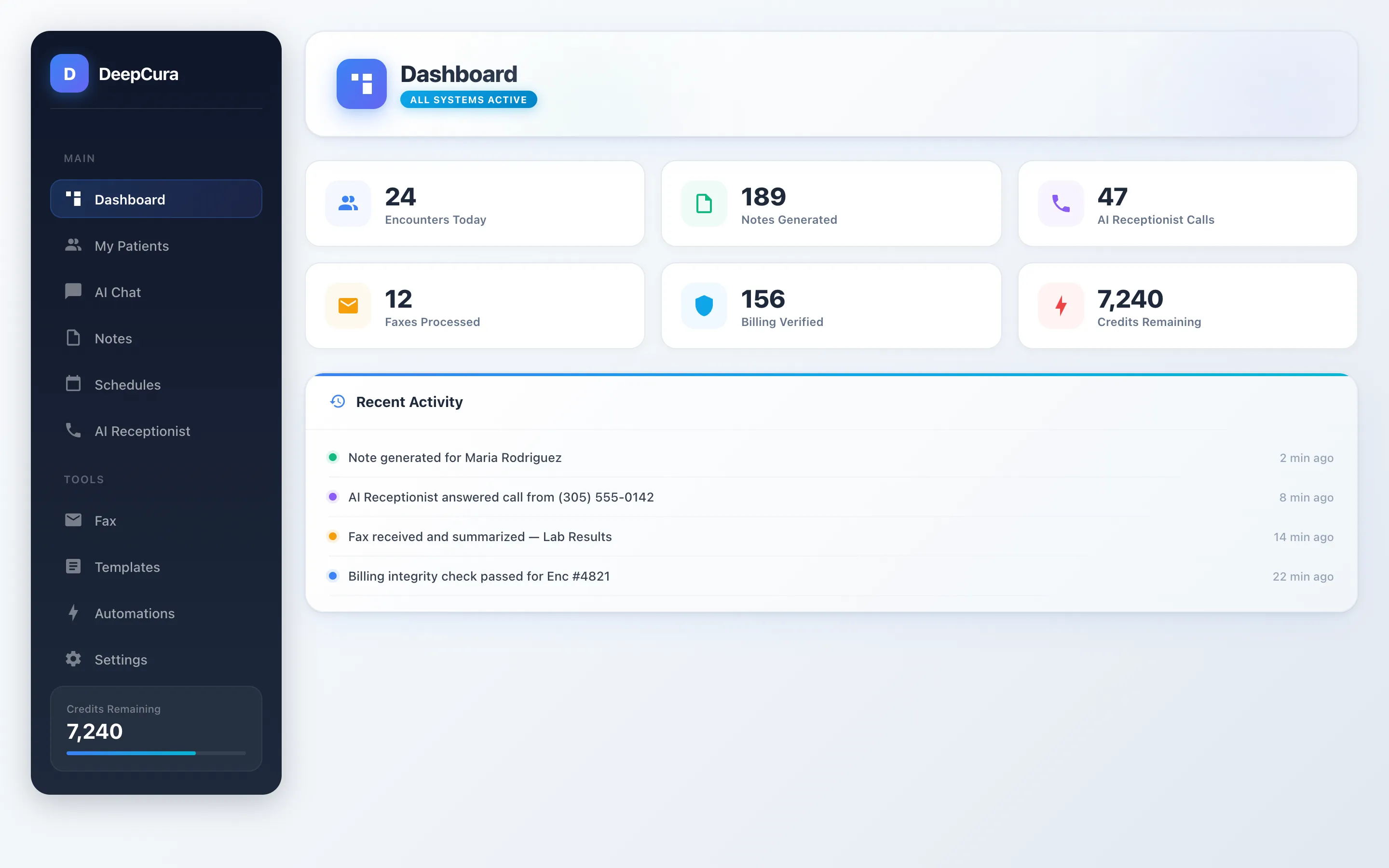 Screenshot: DeepCura UI — full dashboard with patient management, AI receptionist, notes, and automation.
Freed AI Scribe Accuracy by Specialty
Note accuracy varies significantly depending on the medical specialty and encounter complexity. The Freed AI scribe was built with primary care as its foundation, and performance reflects that origin:
- Primary Care / Family Medicine: This is where the Freed AI scribe performs best. Standard office visits with a single presenting complaint produce notes that are 85-90% complete. Common conditions like hypertension management, diabetes follow-ups, and wellness visits are captured reliably with minimal editing required.
- Internal Medicine: Multi-problem visits with complex medication lists require more post-generation editing. The AI handles individual problems well but sometimes misorders or conflates assessment elements when patients present with four or more active conditions simultaneously.
- Psychiatry: Mental health encounters involve nuanced clinical language, affect descriptions, and risk assessments that demand precise documentation. The Freed AI scribe captures the broad clinical narrative but frequently requires clinician editing for diagnostic precision and safety documentation.
- Orthopedics and Surgical Specialties: Procedure-heavy encounters with specific anatomical terminology and surgical planning language challenge any ambient scribe. Standard musculoskeletal evaluations are handled adequately, but operative planning and complex procedure documentation often need significant revision.
- Pediatrics: Well-child visits with developmental milestones, growth parameters, and immunization reviews are handled reasonably well. Three-way conversations between parent, clinician, and child are less reliably processed than standard two-speaker encounters. For a detailed comparison of AI scribes for pediatric documentation, see our Best AI Scribe for Pediatrics guide.
- Cardiology and Other Subspecialties: Highly specialized terminology, complex diagnostic workups, and condition-specific documentation requirements push the limits of a generalist AI scribe. Subspecialists should expect more editing time compared to primary care colleagues.
- Chiropractic and Integrative Medicine: Practitioners in alternative and integrative medicine report that Freed AI struggles with non-conventional clinical vocabulary. In a published case study by OptiMantra, Dr. Tori D.C. of San Juan Chiropractic stated that "Freed AI took weeks to learn the word subluxation — a term I use multiple times during a single visit" [9]. After switching to DeepCura, she reduced weekly charting time from over 15 hours to just 2 hours — with notes that accurately captured integrative care terminology from the first use.
For any specialty, testing the Freed AI scribe with your 10 most common encounter types during the 7-day free trial is the best way to evaluate real-world accuracy before committing.
Where Freed AI Falls Short
The output ends at the note — the chart is still yours to maintain. Freed automates the document; the structured chart stays hand-fed. There is no mechanism that turns spoken diagnoses, med changes, or lab values into coded, longitudinal chart entries; no per-value evidence trail back to the visit audio; and no way to ask questions across patients ("every diabetic whose latest A1c is above 9"). DeepCura's Ambient Data does all three — staged entries carrying the verbatim quote and the second of audio behind them, an approve/edit/reject review gate, and population panels with care-gap lists built from what was said in the room.
AI receptionist in Early Access only — and you cannot even test it without booking a sales call. As of March 2026, Freed AI has announced an AI receptionist product ("Front Desk") available through an Early Access program — however, it is not yet generally available or included in standard pricing tiers. Worse, there is no way to test Freed AI's receptionist or AI calling capabilities on your own. You must book a sales call and go through a demo process before you can evaluate the product. DeepCura's AI receptionist and AI calling features are fully launched and self-serve — any practice can sign up, configure their receptionist, and test it with real calls in minutes without ever speaking to a sales representative. For a platform that prides itself on simplicity, gating its newest features behind a sales wall is a contradiction. For options, see our ranking of the best AI medical receptionists in 2026.
No real-time SMS during AI calls. This is a capability gap that directly impacts documentation accuracy. When DeepCura's AI receptionist is on a live call with a patient, it can simultaneously send an SMS to the patient to confirm spellings, collect insurance details, or verify appointment preferences — all in real time, while the conversation is still happening. This dual-channel approach ensures 100% accuracy on critical details like medication names, insurance IDs, and callback numbers that are notoriously error-prone over voice alone. Freed AI's Early Access receptionist does not offer this real-time SMS verification during calls. The difference is the difference between "mostly accurate" and "100% accurate" — and in healthcare, that gap matters.
Specialty and alternative medicine terminology challenges. Freed AI was built with conventional primary care as its foundation, and while the platform now lists Functional/Integrative Medicine among its supported specialties, some practitioners outside the primary care scope have reported terminology gaps. In a third-party case study published by OptiMantra, a chiropractic and integrative medicine provider documented switching from Freed AI to DeepCura after the platform repeatedly failed to recognize core clinical terms used in every visit [9]. The provider reported an 87% reduction in weekly charting time after switching — from over 15 hours to just 2 hours — along with a drop from 10-20 manual clicks per chart to just 2 clicks with DeepCura's native EHR integration. Freed AI's "Learn my format" feature may help address some of these gaps over time, but practices in chiropractic, acupuncture, functional medicine, naturopathy, and other integrative specialties should test thoroughly during the free trial.
No native EHR API integration. Freed AI's Premier plan ($119/month) includes EHR push, but this operates via a Chrome browser extension — it automates note transfer at the browser level rather than writing structured data directly into EHR fields via native API integration. The extension supports dozens of browser-based EHRs including Athena, DrChrono, SimplePractice, Elation, and others. However, there is no bidirectional data flow that reads patient context from the chart, pushes diagnoses, triggers order entry, or writes billing codes into the EHR's charge system. Practices using EHR systems like Epic, eClinicalWorks, or Athena that need native API write-back will find this gap significant. For athenahealth users specifically, see our guide to the best AI scribe for athenahealth, which covers the AI agents that automate the full Athena workflow. For eClinicalWorks users, see our eClinicalWorks AI Scribe guide covering the AI agents with FHIR R4 write-back. For AdvancedMD users, see our AdvancedMD AI Scribe guide covering the AI agents with direct write-back.
Billing and coding features are Premier-gated — and the codes stand alone. Freed AI's Premier plan ($119/month) includes ICD-10 coding and CPT code suggestions (beta), and Freed has recently added E&M integrity checking — real progress. However, lower tiers have no billing or coding assistance at all, and the suggested codes are derived from the note alone. DeepCura's codes sit on top of an evidence-linked coded chart: every diagnosis and value behind a billed level traces to the verbatim moment it was said, which is the documentation trail that survives an audit or arms an appeal. Freed AI's broader revenue cycle tools remain in Early Access. See our guide to full billing automation for what a complete stack covers.
No fax management. At the time of writing, Freed AI's public documentation does not mention inbound fax processing, document routing, or fax-based referral management. Practices that still receive a high volume of faxed records — which remains the reality for most clinical offices — will need to handle this workflow separately. DeepCura's fax agent summarizes every inbound fax, auto-matches it to the right patient (MRN first, then phone plus date of birth, then name — an ambiguous match is surfaced, never guessed), and after a one-click pairing stages the document's contents as evidence-linked chart suggestions for your review.
No unified inbox — and nothing that clears one. This is the widest 2026 gap, and it is structural rather than incremental. Freed's public documentation describes no fax queue, no email triage, no missed-call worklist, and no bulk disposition tooling; its product surface begins and ends with the encounter. DeepCura's AI Inbox puts fax, email, phone, and SMS in one queue and puts an agent on top of it: say "zero my inbox" and it returns a single checklist of every action it proposes — the fax it would file to a named chart, the exact words it would text each missed caller, the emails it would draft — priced before you commit, with a server-enforced confirm gate, guardrails that refuse to batch weak patient matches or possible duplicates, TCPA opt-out enforcement at send time, and an audit entry on the patient timeline for every executed item. For a practice, the difference is not "Freed lacks a feature" — it is that the entire administrative half of the day is outside Freed's product boundary.
Limited clinical AI chat. Freed AI includes an AI chat agent that allows clinicians to ask about and discuss details from previous notes — useful for visit preparation. However, based on publicly available documentation, this chat feature is focused on reviewing historical patient information rather than providing real-time clinical decision support such as differential diagnosis generation, drug interaction checking, or evidence-based recommendations during encounters. Clinicians who want broader AI-assisted clinical reasoning should see our guide to the best ChatGPT for doctors.
Only 1 AI agent vs a full roster — and they do not share a brain. Freed AI is fundamentally a single-purpose tool: one AI agent that listens and generates notes. DeepCura deploys separate AI agents across every communication channel a medical practice uses: (1) the Agentic Scribe for ambient documentation and coded chart capture, (2) AI Receptionist for inbound/outbound patient calls, (3) AI Nurse for pre-visit intake and consents, (4) AI Inbox for clearing fax, email, phone, and SMS from one queue, (5) AI Marketing for practice websites and patient materials, (6) AI Billing for E&M integrity and claims, (7) AI Fax for inbound processing and routing, (8) AI Payment Collection for patient balance outreach via Stripe, and (9) AI Prior Authorization for payer submissions. All nine are included for $129/month — just $10 more than Freed AI's single-agent Premier plan at $119/month. The count matters less than the wiring: these agents read and write one shared patient timeline, so the inbox agent drafting a reply already knows what the scribe heard in the room last week. Nine tools bolted together would not do that; nine roles on one context do.
No choice of AI engine. Based on publicly available information, clinicians cannot select which underlying AI model generates their notes. Freed AI uses its own model pipeline, and at the time of writing, there is no publicly documented ability to switch between different AI engines that may perform better for specific specialties or documentation styles.
No patient intake automation. Pre-visit intake and patient questionnaires are not available in Freed AI based on current public documentation. However, Freed AI does now offer visit preparation features including patient summaries from previous visits and an AI chat agent for reviewing prior notes. The platform does not automate the patient-facing intake process itself. For practices that need to streamline patient intake, see our guide to patient intake form templates with free downloads for 8 specialties.
Venture-backed with potential pricing risk. Freed AI has been recognized by CB Insights as one of the 50 Most Promising Digital Health Startups, and the company's rapid growth and expansion into new product areas (Front Desk, Revenue Cycle) suggest significant external investment. While venture funding is not inherently negative, it can introduce uncertainty about long-term pricing stability. VC-funded companies face pressure to increase revenue as they scale, which can lead to price increases, feature gating, or strategic pivots that affect existing users. Bootstrapped competitors, by contrast, may have more pricing flexibility and aligned long-term incentives.
Who Is Freed AI Best For?
Freed AI is a strong fit for a specific type of clinician and practice:
- Solo practitioners who need ambient scribing and nothing else. If your documentation workflow is the primary pain point and everything else — reception, billing, fax, intake — is already handled, Freed AI solves the problem cleanly.
- Clinicians who want the simplest possible tool. If you are not comfortable with complex software, do not want to configure integrations, and just want to press a button and get a note, Freed AI delivers.
- Practices that do not need native EHR API write-back. If your workflow already involves copying notes into your EHR and you are comfortable with that process — or if Freed AI's Chrome extension-based EHR push (Premier, $119/month) is sufficient — the lack of native API integration is not a drawback.
- Budget-conscious solo providers. Starting at $39/month for basic scribing (Starter) or $79/month for unlimited notes (Core), Freed AI offers some of the most affordable entry points in the AI scribe market. For clinicians who are price-sensitive and need only core scribing, it represents good value.
- Primary care and general practice physicians. Freed AI's note accuracy is strongest in primary care encounters. If the majority of your visits are standard office visits, you will get the best results from the platform.
Who Should Consider Alternatives?
Not every practice will find Freed AI sufficient. Consider looking at other platforms if you fall into any of these categories:
- Multi-provider practices that need team management, collaboration tools, and centralized administration.
- Integrative, chiropractic, and alternative medicine practitioners whose clinical vocabulary extends beyond conventional medicine. A published third-party case study documented a provider switching from Freed AI to DeepCura and reducing weekly charting time from 15+ hours to 2 hours, citing Freed AI's inability to learn specialty terminology [9].
- Clinics needing native EHR API integration with bidirectional write-back to Epic, eClinicalWorks, Athena, or OptiMantra. Freed AI's Premier plan offers Chrome extension-based EHR push, but not native API write-back.
- Practices that need a fully launched AI receptionist today for handling calls, scheduling, and triage. Freed AI's Front Desk product is in Early Access and not yet generally available.
- Practices that want the visit itself to update the chart — Freed's structured output ends at the note; there is no coded longitudinal chart, no per-value evidence trail, and no population layer to query across patients.
- Offices that process a high volume of faxes and need automated inbound fax routing and document management.
- Front desks drowning in four separate queues — a fax tray, a shared email account, a missed-call list, and unread texts — that want one queue and an AI that proposes every disposition at once for a single confirm.
- Practices looking for a single platform that replaces multiple point solutions rather than adding another tool to an already fragmented stack — one where every agent reads and writes the same patient context instead of each tool keeping its own island of data.
A chart that fills itself. An inbox that clears itself. AI agents on one shared context. No sales call required to test. If you want the visit itself to update a coded, evidence-linked patient chart — plus an AI Inbox that triages fax, email, phone, and SMS from one queue and proposes every disposition for your one-click approval, native EHR API write-back, a fully launched 24/7 AI receptionist with real-time SMS during live calls, population care-gap panels, and inbound faxes that pair themselves to the right patient and stage chart updates — DeepCura includes all of it for $129/month. That is $10 more than Freed AI's single-agent Premier plan, and you can test every feature yourself without booking a sales call.
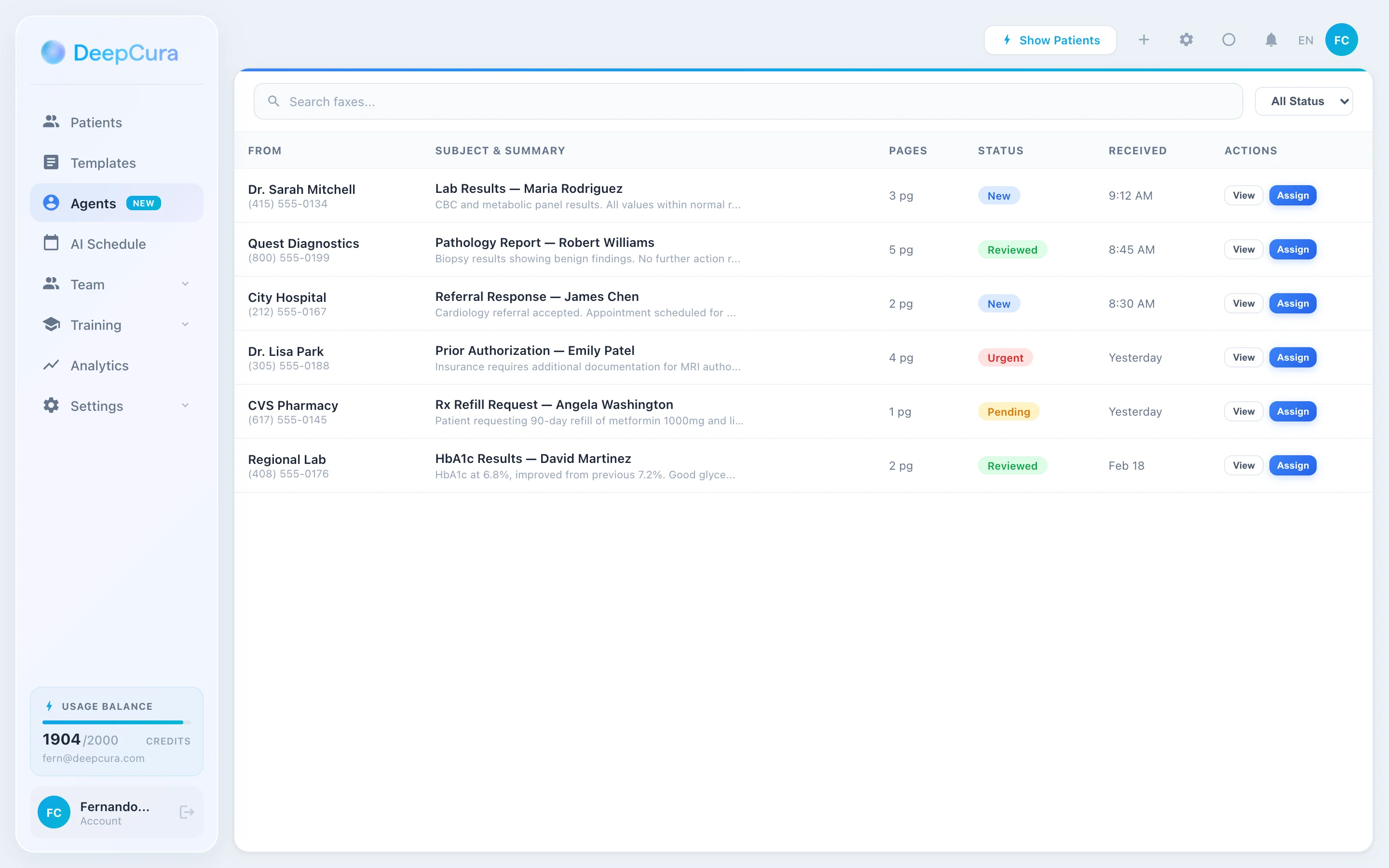 Screenshot: DeepCura UI — inbound fax management with AI-summarized faxes and automated processing.
Freed AI Scribe vs Full-Platform Solutions
The Freed AI scribe's core strength remains the encounter itself, though the platform has expanded into pre-visit summaries, post-visit letters, and billing codes. To evaluate whether that scope is enough for your practice, here is how Freed AI compares across every phase — before, during, and after the visit.
Pre-Visit Automation
| Feature | Freed AI | DeepCura |
|---|---|---|
| AI Patient Intake | ✗ | ✓ |
| AI Receptionist (Phone) | Early Access (sales call required to test) | ✓ (self-serve, test in minutes) |
| Real-Time SMS During AI Calls | ✗ | ✓ |
| Pre-Visit Summary | ✓ (from Freed notes) | ✓ |
Freed AI has expanded its pre-visit capabilities. The platform now offers visit summaries that pull context from previous Freed-generated notes, and an AI chat agent for reviewing prior visit details. Freed AI has also announced an AI receptionist ("Front Desk") available through an Early Access program, though it is not yet generally available — and you cannot even try it without booking a sales call first. There are no automated patient intake forms. DeepCura's AI receptionist is fully launched and self-serve — any practice can sign up, configure their receptionist, and test it with real calls in minutes. It answers patient calls 24/7, handles scheduling and triage, generates pre-visit summaries, and can send real-time SMS messages to patients during the call to verify spellings, insurance details, and appointment preferences with 100% accuracy.
During the Visit
| Feature | Freed AI | DeepCura |
|---|---|---|
| AI Medical Scribe | ✓ | ✓ |
| Custom Note Templates | Limited | ✓ |
| 50+ Specialties | ✓ | ✓ |
| Clinical AI Chat (Copilot) | Limited (note review) | ✓ (full clinical reasoning) |
This is where the Freed AI scribe delivers its core value. Both platforms offer ambient scribing across 50+ medical specialties. The key differences: DeepCura includes a clinical AI copilot for real-time clinical reasoning during encounters — differential diagnosis support, drug interaction checks, and evidence-based recommendations. Freed AI offers an AI chat agent focused on reviewing and discussing previous notes, along with a "Magic Edit" feature for AI-assisted note refinement. Custom note templates are available on both platforms, though Freed AI restricts advanced template features to higher pricing tiers.
Post-Visit Automation
| Feature | Freed AI | DeepCura |
|---|---|---|
| AI Billing / ICD-10 Coding | ✓ (ICD-10; CPT beta) | ✓ |
| Coded Chart Updates from the Visit (Review-Gated) | ✗ | ✓ (evidence-linked) |
| Population Panels & Care-Gap Lists | ✗ | ✓ |
| E&M Integrity Verification | ✓ (recently added) | ✓ (evidence-backed) |
| EHR Integration (Native API) | ✗ (Chrome extension on Premier) | ✓ |
| AI Prior Authorization | ✗ | ✓ |
| AI Referral Letters | ✓ (14+ letter types) | ✓ |
| AI Patient Instructions | ✓ | ✓ |
| AI Tasks & Alerts | ✗ | ✓ |
| AI Fax Management (Auto-Pair + Chart Suggestions) | ✗ | ✓ |
| AI Inbox (Fax + Email + Phone + SMS in One Queue) | ✗ | ✓ |
| Bulk Dispositions with Preview → Confirm → Execute | ✗ | ✓ |
| AI Payment Collection (Stripe) | ✗ | ✓ |
Post-visit is where meaningful differences emerge between Freed AI and a full clinical AI platform. Freed AI has expanded its post-visit capabilities — it now generates ICD-10 codes, CPT codes (beta), patient instructions, and 14+ types of post-visit letters including referrals, sick notes, and caregiver letters, and it recently added E&M integrity checking. However, there is still no coded chart that updates from the visit, no prior authorization automation, no fax management, and no payment collection.
DeepCura automates all of these post-visit workflows with dedicated AI agents — and, uniquely among the two platforms, the visit itself updates the chart: spoken diagnoses, med changes, and values stage as coded, evidence-linked entries you approve in seconds. The billing agent validates E&M codes against note content to prevent downcoding and audit risk. The prior authorization agent drafts and submits requests. The fax management agent summarizes inbound faxes, auto-pairs them to the right patient, and stages their contents as reviewable chart suggestions. The payment collection agent handles patient balance outreach through Stripe — without staff involvement. For practices using EHR systems like athenahealth, see how the full AI workflow integrates with Athena.
Platform Capabilities
| Feature | Freed AI | DeepCura |
|---|---|---|
| Unified Patient Timeline (Calls, Faxes, Payments, Notes) | ✗ | ✓ |
| Shared Context Across Every Agent | ✗ (scribe output is self-contained) | ✓ (one timeline, every agent) |
| AI Inbox — Fax, Email, Phone & SMS in One Queue | ✗ | ✓ |
| AI Agents | 1 (scribe only) | Full roster — scribe, receptionist, nurse, inbox, marketing, billing, fax, payments, prior auth |
| Choose AI Engine (GPT, Claude, Gemini) | ✗ | ✓ |
| Self-Serve Testing (no sales call) | ✗ (Early Access features require sales call) | ✓ |
| Real-Time SMS During AI Calls | ✗ | ✓ |
| Team Collaboration | Basic | ✓ |
| Analytics Dashboard & Wellness | ✗ | ✓ |
| Starting Price | $39/mo (1 agent) | $129/mo (every agent included) |
The platform capabilities gap is where the $10 price difference between Freed AI Premier ($119/month) and DeepCura ($129/month) becomes almost absurd. Every DeepCura agent writes to one unified patient timeline — calls, faxes, texts, emails, payments, and notes land on a single chart-level view — while Freed's output lives inside the scribe alone. That shared timeline is what makes the AI Inbox possible in the first place: an agent can only propose "text these six missed callers, file this referral to Elena Vasquez, draft replies to these two labs" if it can read the charts, the schedule, and all four channels from the same context. DeepCura deploys a roster of AI agents that orchestrate every communication channel — Freed AI has 1. DeepCura lets you test every feature, including the AI receptionist and AI calls, without ever booking a sales call — Freed AI gates its newest capabilities behind a sales process. DeepCura's AI receptionist sends real-time SMS during live calls to verify patient details with 100% accuracy — Freed AI's Early Access receptionist does not. And DeepCura lets practices choose between GPT, Claude, and Gemini — selecting the engine that performs best for their specialty. Freed AI uses its own model pipeline with no publicly documented option to switch.
For multi-provider practices, DeepCura includes team collaboration tools, role-based access, and an analytics dashboard that tracks documentation metrics, clinician efficiency, and practice wellness indicators. Freed AI offers team features on its custom-priced Groups plan, including admin dashboards, SSO, and a team template library.
For a direct side-by-side comparison, see our DeepCura vs Freed AI breakdown.
See DeepCura in Action
Watch how DeepCura handles the full clinical workflow — from AI receptionist calls and patient intake through ambient scribing, automated billing, and native EHR write-back.

Frequently Asked Questions
Is Freed AI HIPAA compliant?
Yes. Freed AI is HIPAA compliant and provides a Business Associate Agreement (BAA) to covered entities. The platform is also SOC 2 Type II certified and HITECH-compliant. Data is encrypted in transit and at rest, and Freed AI states that patient recordings are not stored. As with any clinical AI tool, HIPAA compliance is a shared responsibility — your practice must also ensure proper access controls, staff training, and configuration.
How much does Freed AI cost?
Freed AI uses tiered pricing: Starter at $39/month (40 notes/month), Core at $79/month (unlimited notes), and Premier at $119/month (EHR push, ICD-10 coding, CPT codes). A Groups plan with custom pricing is available for multi-provider practices. Freed AI offers a 7-day free trial with no credit card required.
Does Freed AI integrate with my EHR?
Freed AI's Premier plan ($119/month) includes EHR push via a Chrome browser extension — it automates note transfer at the browser level for dozens of browser-based EHRs including Athena, DrChrono, SimplePractice, and Elation. Lower tiers (Starter and Core) are limited to manual copy-paste workflows. The EHR push is unidirectional — there is no bidirectional data flow that reads patient context from the chart or pushes structured diagnoses, orders, or billing codes into the EHR via native API. Practices that need native EHR API integration with Epic, eClinicalWorks, Athena, or other major platforms should consider alternatives with native API write-back.
Is Freed AI accurate?
Freed AI produces reasonably accurate clinical notes, particularly for standard primary care encounters. Most clinicians report that generated notes are 85-90% complete and require some review and editing before finalization. Accuracy can vary based on specialty complexity, audio quality, the number of speakers in the room, and how closely the encounter follows common clinical patterns. Complex multi-problem visits and highly specialized terminology may require more significant post-generation editing.
Can Freed AI handle specialty encounters?
Freed AI supports documentation across multiple medical specialties and offers custom note templates. However, the platform was originally built with a primary care focus, and clinicians in highly specialized fields — such as cardiology, orthopedics, or psychiatry — may find that the AI requires more editing compared to specialty-tuned platforms like DeepScribe. If specialty accuracy is your top priority, test Freed AI with your most common encounter types during the free trial to assess performance in your specific discipline.
Does Freed AI offer a free trial?
Yes. Freed AI offers a free trial that allows clinicians to test the platform with real clinical encounters before subscribing. This is a useful opportunity to evaluate note accuracy, workflow fit, and time savings in your specific practice environment. We recommend conducting at least 15-20 encounters across your most common visit types during the trial to get a reliable sense of performance.
What are the best Freed AI alternatives?
The best alternative depends on what you need beyond ambient scribing. DeepCura is the strongest option for practices that want AI agents orchestrating every communication channel from one shared patient context — agentic scribe, AI receptionist (with real-time SMS during calls), AI nurse, the AI Inbox that clears fax/email/phone/SMS from a single queue, AI marketing, AI billing, AI fax, AI payment collection, and AI prior auth — all for $129/month. DeepCura also lets you test every feature without booking a sales call. DeepScribe is the leading choice for oncology practices and large health systems that want specialty-tuned AI with human QA review. Ambience Healthcare is the enterprise leader for large health systems on Epic or Cerner that need deep EHR integration and Chart Awareness. Nuance DAX Copilot is the leading choice for large health systems on Microsoft infrastructure. Heidi Health serves international clinics with multi-language support. Suki AI offers a voice-first clinical assistant for hands-free EHR interaction. For a comprehensive comparison, see our Best AI Medical Scribes in 2026 ranking.
Does Freed AI have agentic chat that can chain multiple actions in one query?
No. Freed AI's chat capability is limited to reviewing and discussing details from previously generated notes — useful for visit preparation, but not agentic. There is no chat orchestrator that can chain template retrieval, patient history lookup, ICD-10 coding, and note generation from a single multi-step instruction. DeepCura's Agentic Chat is an LLM-driven orchestrator (Claude, GPT, or Gemini) that autonomously fires multiple backend tool calls from one natural-language prompt — for example, "pull the last visit, apply my Cardiology Follow-Up template, and add F48.9 to the problem list" triggers fetch-transcript → list-templates → load-template → generate-note in one pass, with every tool call audited inside the saved transcript.
Does Freed AI have a unified inbox for faxes, emails, calls, and texts?
No. At the time of writing, Freed AI's public documentation describes no inbound fax processing, no unified communications queue, and no bulk disposition tooling — its product surface is the encounter and the note. DeepCura's AI Inbox puts fax, email, phone, and SMS in one queue with an AI agent on top: ask it to "zero my inbox" and it returns one checklist of everything it proposes — which fax it would file to which chart, the exact words it would text each missed caller, which emails it would draft — with the credit cost stated before you commit. Nothing executes until you confirm, unchecking a row is binding, and a duplicate confirm can never send a second text. The agent is also forbidden from batching the risky cases: weak patient matches, possible duplicate faxes, and illegible documents stay human decisions, and it drafts emails rather than sending them.
Do DeepCura's AI agents share context with each other?
Yes — that is the core architectural difference. All of the agents read from and write to a single patient timeline rather than each keeping its own data. In practice, the AI Inbox agent can pull one patient's entire history across all four channels at once, read the coded patient brief the ambient scribe built from visit conversations, query your whole panel with the same cohort engine behind the Population Panel, and ask the scheduling agent about real availability — all while clearing the queue. Every action it executes is recorded on that same timeline, attributed as "AI Inbox on behalf of" the clinician. Freed AI's structured output lives inside the scribe; there is no second agent for it to feed.
Does Freed AI update the patient chart, or just write notes?
Freed AI's output is the note plus code suggestions (ICD-10 on Premier; CPT in beta) — its structured output is scoped to the encounter document. It does not maintain a longitudinal, coded patient chart from what is said across visits. DeepCura's Ambient Data does exactly that: spoken diagnoses, med changes, and lab values stage as coded chart entries — each carrying the verbatim quote and the second of visit audio behind it — which you approve, edit, or reject. Approved entries build trendable series, custom ambient trackables, and practice-wide population panels with care-gap lists and CSV export.
Is Freed AI worth it?
For the right clinician, yes — at the lower tiers. If you are a solo practitioner whose primary pain point is documentation and nothing else, the Starter plan at $39/month delivers real value. However, at the Premier tier ($119/month), the math breaks down. For $10 more, DeepCura ($129/month) gives you a full roster of AI agents instead of 1 — including an AI Inbox that clears fax, email, phone, and SMS from one queue on command, an AI receptionist that sends real-time SMS during live calls for 100% accuracy, a chart that fills itself from conversation with evidence attached to every entry, native EHR write-back, billing automation, fax management, and AI prior authorization — all reading and writing the same patient context. You can also test every DeepCura feature yourself without booking a sales call. Notably, practitioners in integrative and alternative medicine specialties have reported switching from Freed AI to DeepCura due to persistent terminology limitations — with one published case study documenting an 87% reduction in charting time after making the switch [9].
Final Verdict
Freed AI is a solid, focused ambient AI scribe that does exactly what it promises — captures clinical encounters and generates usable clinical notes with minimal setup and a clean interface. For solo practitioners and small practices whose primary pain point is after-hours documentation, it remains one of the simplest solutions available in 2026.
Its strength is its simplicity. There is no feature bloat, no complex onboarding, and no IT overhead. A clinician can go from download to first generated note in under five minutes. That frictionless experience is genuinely valuable for physicians who have been skeptical of clinical technology.
Its limitation is equally clear: Freed AI's core product remains primarily a scribe — one AI agent doing one job. The Premier plan ($119/month) adds Chrome extension-based EHR push, ICD-10 coding, CPT codes (beta), referral letters, and patient instructions. Freed AI is expanding — an AI receptionist ("Front Desk") and revenue cycle tools are both in Early Access as of March 2026 — but you cannot test these features without booking a sales call, and they are not yet generally available. There is no ambient chart capture — spoken values never become coded, longitudinal chart data — no per-entry evidence trail, no population queries, no native EHR API write-back, no fax management, no unified inbox across fax, email, phone, and SMS, and no real-time SMS during AI calls in the current generally available product. Practices that need these capabilities today will either need to wait for Freed AI's Early Access features to mature, or look to full-platform alternatives. This pattern is already playing out: in a third-party case study published by OptiMantra, a chiropractic provider documented switching from Freed AI to DeepCura after experiencing persistent terminology gaps and excessive manual clicks — and reported cutting weekly charting time from 15+ hours to just 2 hours [9].
For clinicians evaluating their options, the math is simple. Freed AI's Starter plan at $39/month is excellent value for basic scribing. But at the Premier tier ($119/month), paying $10 more for DeepCura ($129/month) gets you a full roster of AI agents instead of 1, native EHR write-back, billing automation, an AI receptionist you can test yourself without a sales call, real-time SMS during AI calls, and your choice of AI engine. And beyond the agent count sit two structural differences. Freed's output ends at the note, while DeepCura's scribe builds the chart itself — coded, evidence-linked entries you approve, which become trends, custom trackables, and population-wide care-gap lists. And Freed has no inbox at all, while DeepCura's AI Inbox collapses fax, email, phone, and SMS into one queue an agent can clear on command, proposing every disposition for a single confirm. Both run on the same patient timeline, so what the scribe hears the inbox knows. One agent writing documents for $119, or nine agents sharing one living chart for $129 — the decision almost makes itself. Review our DeepCura vs Freed AI comparison and our Best AI Medical Scribes in 2026 ranking to find the right fit for your practice. For unfiltered clinician opinions, see our best AI medical scribe according to Reddit guide. For cardiology-specific features and comparisons, see our Best AI Scribe for Cardiology guide. You can also read our reviews of Abridge, Suki AI, and Heidi Health to compare alternatives side by side.
Competitor pricing re-verified September 27, 2026 · other competitor details March 31, 2026 · DeepCura platform capabilities updated August 3, 2026 (AI Inbox launch)
Trademarks, product names, and screenshots referenced in this article are the property of their respective owners. Their use here is for editorial commentary, comparison, and identification purposes under nominative fair use. This review reflects independent analysis based on publicly available information and is not affiliated with or endorsed by Freed AI.
References
[1] Freed AI, "AI Medical Scribe — Ambient Clinical Documentation," Freed.ai. getfreed.ai
[2] U.S. Department of Health and Human Services, "HIPAA for Professionals," HHS.gov. hhs.gov/hipaa/for-professionals
[3] U.S. Department of Health and Human Services, "Business Associate Contracts — Sample BAA Provisions," HHS.gov. hhs.gov/hipaa/for-professionals/covered-entities/sample-business-associate-agreement-provisions
[4] DeepCura, "AI Medical Scribe Platform — Ambient Scribing, AI Receptionist, EHR Integration," DeepCura.com. deepcura.com
[5] Nuance Communications, "Dragon Ambient eXperience (DAX) Copilot," Nuance.com. nuance.com
[6] Heidi Health, "AI-Powered Clinical Documentation," HeidiHealth.com. heidihealth.com
[7] Suki AI, "Voice AI Assistant for Clinicians," Suki.ai. suki.ai
[8] Apple App Store, "Freed — AI Scribe Assistant," Apple Inc. apps.apple.com/us/app/freed-ai-scribe-assistant/id6449428266
[9] OptiMantra, "San Juan Chiropractic Cut Charting Time with DeepCura + OptiMantra Integration," OptiMantra Case Studies. optimantra.com/case-studies/san-juan-chiropractic-cut-charting-time-with-deepcura-optimantra-integration
[10] Freed AI, "Pricing," getfreed.ai/pricing, accessed 2026-09-27 (Starter $39, Core $79, Premier $119 per month on monthly billing; Premier is lower billed annually).