
From 60+ minutes of writing to a few minutes of review. That is how AI changes the biopsychosocial assessment.
This guide gives you everything you need:
- Step-by-step writing guide — biological, psychological, and social domains broken down with examples
- Free copy-paste template — adapt to your practice, any specialty
- AI shortcut — how ambient documentation tools generate a complete BPS assessment from the encounter, cutting writing time by 90%
Whether you are a social worker, therapist, psychiatrist, or primary care provider, a thorough BPS assessment is essential — it just does not need to take an hour anymore.
This guide is designed for licensed clinicians working in behavioral health, integrated care, and primary care settings. The template and writing steps follow current best practices and can be adapted to meet your organization's documentation standards.
What Is a Biopsychosocial Assessment?
A biopsychosocial assessment (BPS assessment) is a comprehensive clinical evaluation that examines a patient through three interconnected lenses: biological, psychological, and social. Rooted in George Engel's 1977 biopsychosocial model, this framework recognizes that health and illness are shaped by the complex interplay of physical conditions, mental processes, and social circumstances rather than by any single factor in isolation.
Unlike a standard medical history that focuses primarily on symptoms and diagnoses, a BPS assessment captures the full picture of a patient's functioning. It explores how chronic pain affects mood, how family dynamics influence treatment adherence, how employment status impacts access to care, and how trauma history shapes coping strategies.
Who uses biopsychosocial assessments? BPS assessments are a standard tool across behavioral health and integrated care settings. They are routinely completed by:
- Licensed clinical social workers (LCSWs)
- Licensed professional counselors (LPCs)
- Psychologists and psychiatrists
- Primary care providers in integrated care settings
- Substance abuse counselors
- Case managers and care coordinators
The assessment serves as the foundation for treatment planning, guiding clinicians toward interventions that address root causes rather than surface symptoms. It is typically completed during intake and updated periodically throughout care.
The Three Domains of a Biopsychosocial Assessment
Each domain captures a distinct dimension of the patient's experience. Together, they reveal patterns and interactions that no single domain could explain on its own.
Biological Domain
The biological domain addresses the patient's physical health, genetics, neurological functioning, and physiological factors that influence their presenting concerns.
- Medical history and current conditions
- Current medications and side effects
- Family medical and psychiatric history
- Substance use (alcohol, drugs, tobacco)
- Sleep patterns and appetite changes
- Pain levels and physical functioning
- Relevant lab results or imaging
- Genetic or neurological factors
Psychological Domain
The psychological domain examines the patient's mental health, cognitive functioning, emotional state, and internal coping resources.
- Mental health history and diagnoses
- Current symptoms and severity
- Cognitive functioning and orientation
- Coping mechanisms and resilience
- Trauma history (ACEs, PTSD)
- Emotional regulation and affect
- Motivation and readiness for change
- Previous treatment history
Social Domain
The social domain captures the patient's external environment, relationships, and socioeconomic factors that shape their health outcomes.
- Family dynamics and relationships
- Social support network
- Housing stability and safety
- Employment and financial status
- Education level
- Cultural and religious background
- Legal involvement
- Community resources and access to care
When documenting across all three domains, pay close attention to where they overlap. A patient's chronic pain (biological) may drive depression (psychological) and social withdrawal (social). Identifying these cross-domain interactions is what makes a BPS assessment more valuable than three separate evaluations.
How to Write a Biopsychosocial Assessment: Step-by-Step
Follow these seven steps to create a thorough, well-organized biopsychosocial assessment. Each step builds on the previous one, moving from data collection through integration to treatment planning.
Step 1: Gather Patient Information
Start by collecting data from multiple sources: the patient interview, medical records, referral documents, intake questionnaires, and collateral contacts such as family members or previous providers. Use structured intake forms organized by BPS domain to ensure comprehensive coverage. Review any prior assessments to identify longitudinal patterns.
Step 2: Assess the Biological Domain
Document the patient's medical history, current medications and their side effects, family medical and psychiatric history, substance use patterns (including frequency, quantity, and last use), sleep quality, appetite changes, pain levels, and any relevant neurological or genetic factors. Note any recent lab results, hospitalizations, or changes in physical functioning.
Step 3: Assess the Psychological Domain
Evaluate current mental health symptoms, their onset and duration, and severity. Document psychiatric history, previous diagnoses, and past treatment including therapy, medications, and hospitalizations. Assess cognitive functioning, trauma history (including adverse childhood experiences), coping strategies, emotional regulation, personality traits, and the patient's motivation and readiness for treatment.
Step 4: Assess the Social Domain
Examine the patient's family structure and relationship quality, social support network, living situation and housing stability, employment and financial status, educational background, cultural and religious identity, legal involvement (current or past), and access to community resources and healthcare. Screen for social determinants of health that may affect treatment.
Step 5: Integrate Findings Across Domains
This is the most critical step. Analyze how biological, psychological, and social factors interact and influence one another. For example, how does chronic pain (biological) contribute to depression (psychological) and social isolation (social)? Identify risk factors, protective factors, and feedback loops between domains. This integration is what distinguishes a BPS assessment from three separate evaluations.
Step 6: Document Clinical Impressions
Write a clinical summary that synthesizes your findings into a cohesive narrative. Include your diagnostic impressions (using DSM-5 or ICD-10 criteria), functional assessment, risk assessment (suicidal ideation, self-harm, harm to others), and your professional interpretation of the patient's overall presentation. State the clinical rationale for your diagnostic conclusions.
Step 7: Develop the Treatment Plan
Based on your integrated assessment, create a treatment plan with measurable, time-bound goals that address factors across all three domains. Specify recommended interventions (therapy modality, medication management, case management), referrals (medical, legal, housing), session frequency, and criteria for measuring progress. Align goals with the patient's stated preferences and readiness for change.
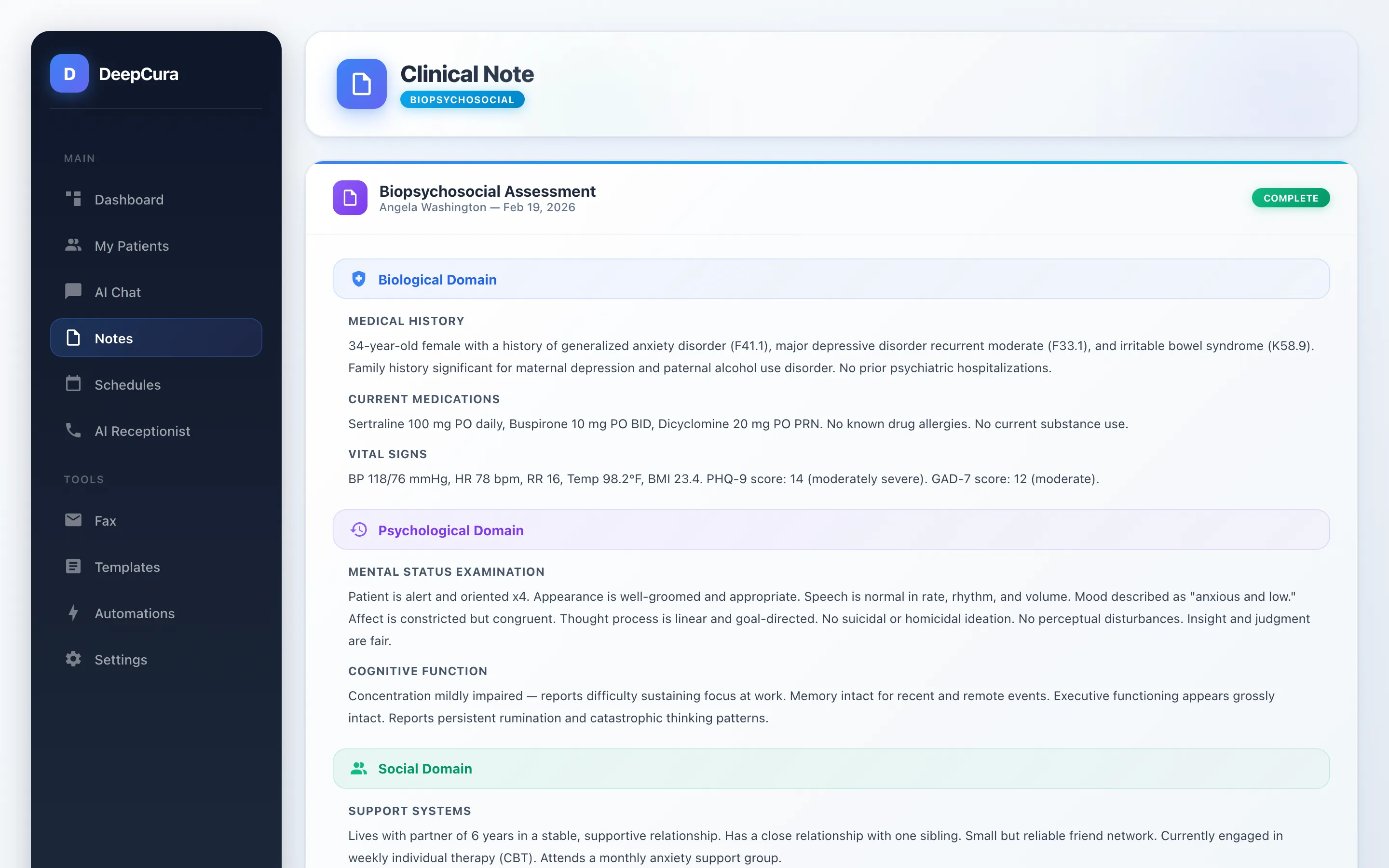
Biopsychosocial Assessment Template
Use this template as a framework for structuring your BPS assessments. Adapt it to your practice setting, specialty, and documentation requirements.
This is a free template you can copy and adapt. For a faster workflow, DeepCura's AI scribe automatically generates structured biopsychosocial notes during patient sessions, eliminating the need to fill out templates manually.
Identifying Information
- Patient name, date of birth, date of assessment
- Referral source and reason for referral
Biological Domain
- Current medical conditions and diagnoses
- Medications (name, dosage, prescriber, adherence, side effects)
- Family medical history (include psychiatric conditions)
- Substance use history (alcohol, tobacco, cannabis, other — frequency, quantity, last use, withdrawal symptoms)
- Sleep patterns (onset, duration, quality, disturbances)
- Appetite and weight changes
- Pain assessment (location, severity 0-10, impact on functioning)
- Recent labs, imaging, or hospitalizations
Psychological Domain
- Presenting concern and symptom onset
- Mental health history (previous diagnoses, hospitalizations, treatment)
- Current symptoms (mood, anxiety, psychosis, dissociation — severity and frequency)
- Trauma history (ACEs, significant life events, PTSD symptoms)
- Cognitive functioning (orientation, memory, concentration, judgment)
- Coping mechanisms (adaptive and maladaptive)
- Emotional regulation and affect during interview
- Motivation and readiness for change (pre-contemplation through maintenance)
Social Domain
- Family composition, dynamics, and relationship quality
- Social support network (friends, community, faith-based)
- Housing situation (stability, safety, adequacy)
- Employment status, work history, and financial stability
- Education level and learning needs
- Cultural, ethnic, and religious identity (impact on health beliefs and treatment preferences)
- Legal involvement (current or past — criminal, family court, probation)
- Access to transportation, insurance, and community resources
Risk Assessment
- Suicidal ideation (current and history — plan, intent, means, protective factors)
- Self-harm behaviors (current and history)
- Homicidal ideation or risk of harm to others
- Overall risk level (low, moderate, high) with clinical rationale
Clinical Impressions and Treatment Plan
- Diagnostic impressions (DSM-5 / ICD-10 codes with supporting rationale)
- Functional assessment and strengths
- Integrated summary — how biological, psychological, and social factors interact
- Treatment goals (measurable, time-bound, across all three domains)
- Recommended interventions (therapy modality, frequency, medication management, case management)
- Referrals (medical, psychiatric, legal, housing, community resources)
- Criteria for progress measurement and reassessment timeline
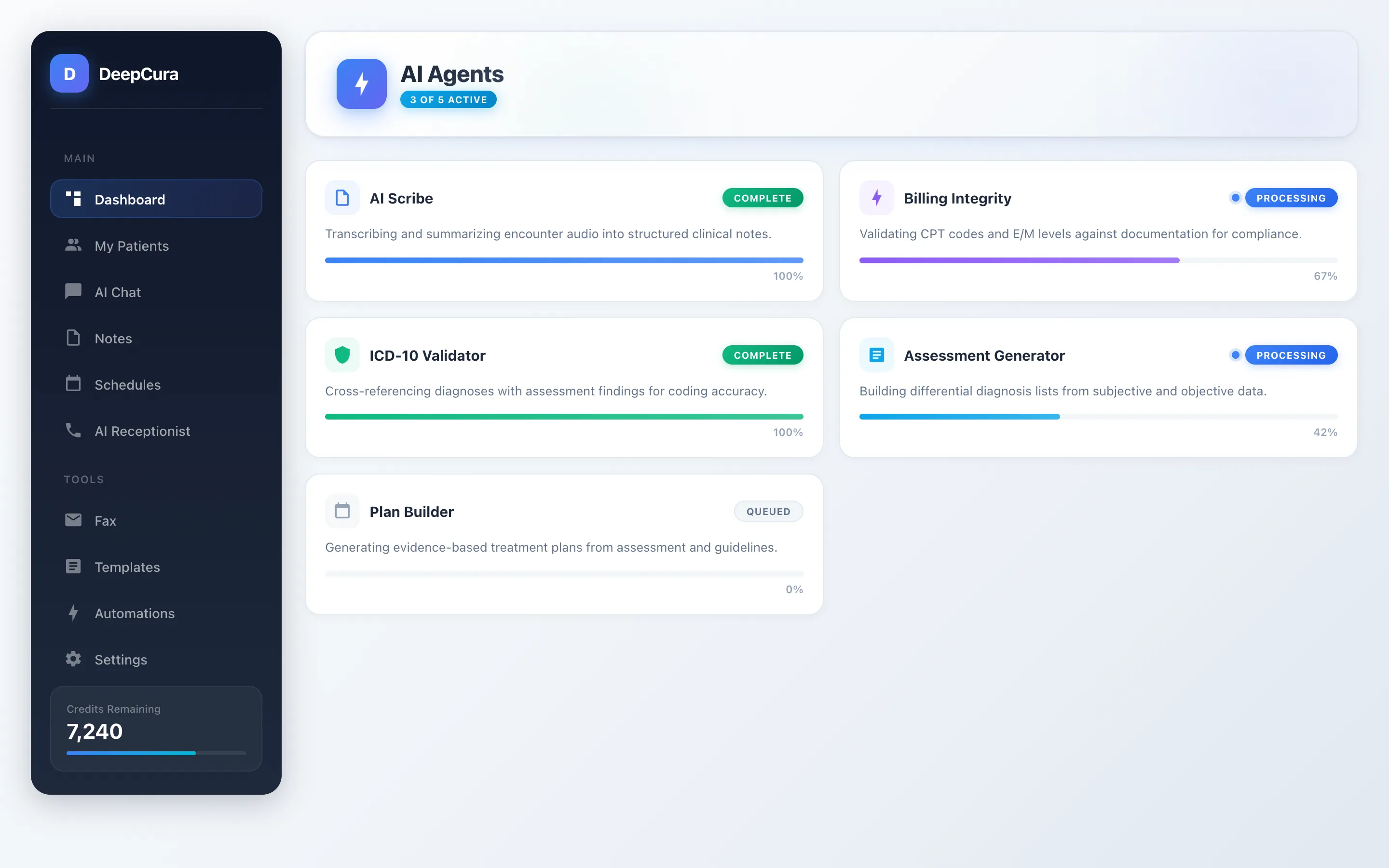
How AI Streamlines Biopsychosocial Assessments
Writing a biopsychosocial assessment manually takes 30 to 60 minutes after the clinical interview. Clinicians often spend more time documenting than they do with the patient. AI-powered clinical documentation tools automate much of this process so you can focus on the conversation that matters most. For a broader look at how AI scribes compare, see our guide to the Best AI Medical Scribes in 2026.
Ambient AI Scribing
An ambient AI scribe captures the clinical interview in real time. It recognizes clinical terminology, distinguishes between BPS domains, and organizes information automatically without requiring manual note-taking during the session. This means you can maintain eye contact and therapeutic rapport instead of typing.
Structured Note Generation
After the session, AI generates structured BPS assessment notes organized by domain. You can choose from SOAP, H&P, progress note, or custom formats. Generated notes include clinical impressions and suggested ICD-10 codes — such as F41.9 for anxiety or F32.9 for depression — that you review and approve before finalizing.
EHR Integration
Completed assessments push directly into your EHR — whether that is Epic, eClinicalWorks, OptiMantra, or Athena. No copy-paste workflows, no switching between systems. Your documentation lands in the patient chart where it belongs.
HIPAA-Compliant Processing
All assessment data is processed in a HIPAA-compliant environment with end-to-end encryption and a signed BAA. Patient data is never used for model training. Your documentation stays between you and your patient.
Significant Time Savings
Clinicians using AI documentation tools report cutting BPS assessment documentation time from 45+ minutes to under 10 minutes. That is time back for patients, supervision, or leaving the office on time. To explore other ways AI supports clinical workflows, see our roundup of the Best ChatGPT for Doctors tools.
Custom Templates
You can customize your BPS assessment template to match your practice's documentation standards. AI documentation tools adapt to your preferred format, section order, and level of detail across all three domains, ensuring generated notes align with your clinical workflow.
If you are evaluating AI documentation tools for your practice, start with a one-week pilot using real BPS assessment sessions. Compare the time spent documenting manually versus reviewing AI-generated notes. Most clinicians see a clear difference after just a few assessments.
For other clinical documentation templates including work and school absence notes, see our Doctor's Note Template guide with 12 copy-paste-ready examples.
Frequently Asked Questions
What is a biopsychosocial assessment?
A biopsychosocial assessment is a comprehensive clinical evaluation that examines a patient across three interconnected domains: biological (medical history, genetics, medications, substance use), psychological (mental health, cognition, coping, trauma), and social (family, housing, employment, culture, legal). It provides a holistic understanding of the patient that informs diagnosis and treatment planning. The biopsychosocial model was introduced by George Engel in 1977 and remains the standard framework for behavioral health and integrated care assessments.
Who needs a biopsychosocial assessment?
Biopsychosocial assessments are used across behavioral health and integrated care settings. They are commonly completed by social workers, licensed professional counselors, psychologists, psychiatrists, primary care providers conducting behavioral health screenings, substance abuse counselors, and case managers. Any patient entering mental health treatment, substance use programs, or integrated care programs typically receives a biopsychosocial assessment as part of the intake process.
How long does a biopsychosocial assessment take?
A thorough biopsychosocial assessment typically takes 45 to 90 minutes for the clinical interview, plus additional time for documentation. The documentation portion alone can take 30 to 60 minutes when done manually. AI-powered clinical documentation tools can reduce documentation time significantly by capturing assessment data during the session and auto-generating structured notes, allowing clinicians to complete assessments in a single session rather than spending hours on paperwork afterward.
What is the difference between a biopsychosocial assessment and a psychosocial assessment?
A psychosocial assessment focuses on two domains — psychological and social factors — while a biopsychosocial assessment adds a third domain: biological factors including medical history, genetics, medications, neurological conditions, and substance use. The biopsychosocial model provides a more complete picture by accounting for how physical health influences mental health and vice versa. In practice, some clinicians use the terms interchangeably, but a true biopsychosocial assessment includes a thorough review of biological and medical factors.
What should be included in a biopsychosocial assessment?
A comprehensive biopsychosocial assessment should include: (1) Biological — medical history, current medications, family medical history, substance use, sleep and appetite patterns, pain assessment, and relevant lab results; (2) Psychological — mental health history, current symptoms, trauma history, cognitive functioning, coping mechanisms, risk assessment (suicidal/homicidal ideation), and previous treatment; (3) Social — family dynamics, social support, housing, employment, education, financial status, cultural background, legal history, and community resources. The assessment concludes with clinical impressions, diagnostic formulation, and a treatment plan.
Can AI help write biopsychosocial assessments?
Yes. AI clinical documentation tools can significantly streamline biopsychosocial assessment documentation. An ambient AI scribe listens during the clinical interview and automatically captures information across all three domains. It then generates structured assessment notes in your preferred format, suggests relevant diagnostic codes (ICD-10), and can push completed assessments directly into your EHR. This reduces documentation time from 30 to 60 minutes to just a few minutes of review, allowing clinicians to focus on the patient rather than paperwork.
How often should a biopsychosocial assessment be updated?
Biopsychosocial assessments should be updated whenever there is a significant change in the patient's condition, at minimum annually for ongoing treatment, and at each new episode of care. Many accreditation bodies and payers require reassessment every 6 to 12 months. Key triggers for updates include changes in medication, new diagnoses, major life events (job loss, divorce, housing changes), hospitalizations, or significant shifts in symptom presentation. Regular updates ensure treatment plans remain aligned with the patient's current needs.
Is there a free biopsychosocial assessment template?
Yes. This guide includes a free biopsychosocial assessment template with structured sections for all three domains — biological, psychological, and social — plus risk assessment, clinical impressions, and treatment planning. You can use it as a framework for paper-based documentation or adapt it for your EHR. For a faster workflow, AI-powered documentation tools can automatically generate structured biopsychosocial notes during patient sessions, eliminating the need to fill out templates manually.
Final Thoughts
The biopsychosocial assessment remains one of the most valuable tools in clinical practice. It ensures that treatment planning accounts for the full complexity of a patient's situation rather than focusing narrowly on symptoms or diagnoses. A well-written BPS assessment leads to more targeted interventions, better treatment adherence, and improved outcomes across all three domains.
The challenge has always been the time it takes to document. Clinicians who conduct thorough assessments often spend more time writing them up than conducting the interview itself. AI-powered documentation tools are changing that equation, making it possible to maintain the depth and quality of a comprehensive BPS assessment without the documentation burden.
If you are looking for ways to streamline your clinical documentation workflow, explore our guides on the Best AI Medical Scribes in 2026 and Best ChatGPT for Doctors for a broader perspective on the tools available to clinicians today. For the most common clinical note format, our SOAP note template guide includes 10 free templates and 6 filled-out examples across specialties. Psychiatrists looking for AI documentation tools can find a dedicated comparison in our Best AI Scribe for Psychiatry guide. For therapists specifically, our Best AI for Therapy Notes in 2026 ranking covers the leading therapy-focused AI documentation tools.
References
[1] Engel, G.L., "The Need for a New Medical Model: A Challenge for Biomedicine," Science, vol. 196, no. 4286, pp. 129–136, 1977. doi.org/10.1126/science.847460
[2] American Psychiatric Association, Diagnostic and Statistical Manual of Mental Disorders, Fifth Edition (DSM-5). Arlington, VA: American Psychiatric Publishing, 2013. psychiatry.org/psychiatrists/practice/dsm
[3] World Health Organization, "International Classification of Diseases, Tenth Revision (ICD-10)," WHO. who.int/classifications/icd/icdonlineversions
[4] Substance Abuse and Mental Health Services Administration (SAMHSA), "Biopsychosocial Assessment and Treatment Planning," SAMHSA. samhsa.gov
[5] Centers for Disease Control and Prevention, "Adverse Childhood Experiences (ACEs)," CDC.gov. cdc.gov/aces
[6] U.S. Department of Health and Human Services, "HIPAA for Professionals," HHS.gov. hhs.gov/hipaa/for-professionals
[7] DeepCura, "AI Medical Scribe Platform — Ambient Scribing, AI Receptionist, EHR Integration," DeepCura.com. deepcura.com