
12 free templates. Copy-paste ready. HIPAA, FMLA, and ADA compliant. Stop drafting doctor's notes from scratch.
Every template below covers a specific scenario:
- Sick leave (1-3 days, extended, employer-specific)
- Return-to-work clearance (with and without restrictions)
- FMLA-referenced medical leave (intermittent and continuous)
- School/university absence verification
- Telehealth visit documentation
- Specialist referral absence notes
Each template follows current HIPAA minimum necessary standards and federal employment law requirements. We also cover how AI documentation tools can generate these notes automatically from encounter data — eliminating templates entirely.
This guide is designed for licensed healthcare professionals — physicians (MD/DO), nurse practitioners, and physician assistants. All templates follow HIPAA minimum necessary standards and current federal employment law requirements. They are not intended for patient self-use.
What Is a Doctor's Note?
A doctor's note — also called a physician's note, medical excuse, or clinical absence verification — is a formal document issued by a licensed healthcare provider confirming that a patient was seen for a medical visit and may require time away from work, school, or other obligations. It serves as third-party verification of a medical encounter without disclosing protected health information beyond what is necessary.
Legal standing. Doctor's notes carry legal weight under several federal and state frameworks. The Family and Medical Leave Act (FMLA) allows employers to request medical certification for absences exceeding three consecutive days, though a simple doctor's note is often sufficient for shorter absences. The Americans with Disabilities Act (ADA) may require documentation to support workplace accommodation requests, but explicitly prohibits employers from demanding specific diagnoses in most cases. Many states with paid sick leave laws — including California, New York, and Washington — restrict when employers can require medical documentation at all, typically prohibiting note requirements for absences of three days or fewer.
Who can issue a doctor's note? Licensed physicians (MD and DO), nurse practitioners (NPs), and physician assistants (PAs) can all issue valid doctor's notes. Some states extend this authority to licensed clinical psychologists and dentists for conditions within their scope of practice. The key requirement is that the issuing provider must have directly examined the patient — notes cannot be issued based on a phone call alone, though telehealth encounters do qualify in all 50 states.
Doctor's note vs. FMLA certification. A standard doctor's note is not the same as FMLA medical certification (DOL Form WH-380). FMLA certification is a detailed, multi-page form required for job-protected leave under federal law and includes specific clinical information about the serious health condition, expected duration, and treatment schedule. A doctor's note is a simpler document that verifies a medical visit and recommends a period of absence. Employers cannot require FMLA-level certification for routine sick days.
What Every Doctor's Note Should Include
A properly structured doctor's note contains enough information to verify the medical encounter and communicate restrictions without disclosing unnecessary clinical details. The following nine elements should appear on every note you issue.
- Practice letterhead or header — Practice name, address, phone number, and provider credentials. This establishes authenticity and gives the employer a point of contact for verification.
- Date of the note — The date the note was written, which may differ from the date of the visit.
- Patient's full name — First and last name matching government identification. Do not include date of birth or medical record number on notes sent to employers.
- Statement of examination — Confirmation that the patient was examined by the provider on a specific date. Example: "I examined [Patient Name] on [Date]."
- Dates of recommended absence — The specific start and end dates during which the patient should be excused from work or school.
- Work or activity restrictions — Any limitations on duties, physical activity, or hours. Be specific: "No lifting over 10 pounds" is enforceable; "light duty" is ambiguous.
- Expected return date — The date the patient is cleared to resume normal activities, or a statement that a follow-up evaluation is required before clearance.
- Provider signature and NPI — The provider's handwritten or electronic signature and National Provider Identifier number.
- Contact information for verification — A phone number or fax number where the employer can verify the note's authenticity.
What NOT to include: Under HIPAA's minimum necessary standard, doctor's notes sent to employers should not include specific diagnoses, treatment details, medication names, or clinical findings unless the patient has provided written authorization. The ADA reinforces this — employers may ask whether an employee can perform essential job functions, but generally cannot demand to know the underlying medical condition. When in doubt, less detail protects your patient.
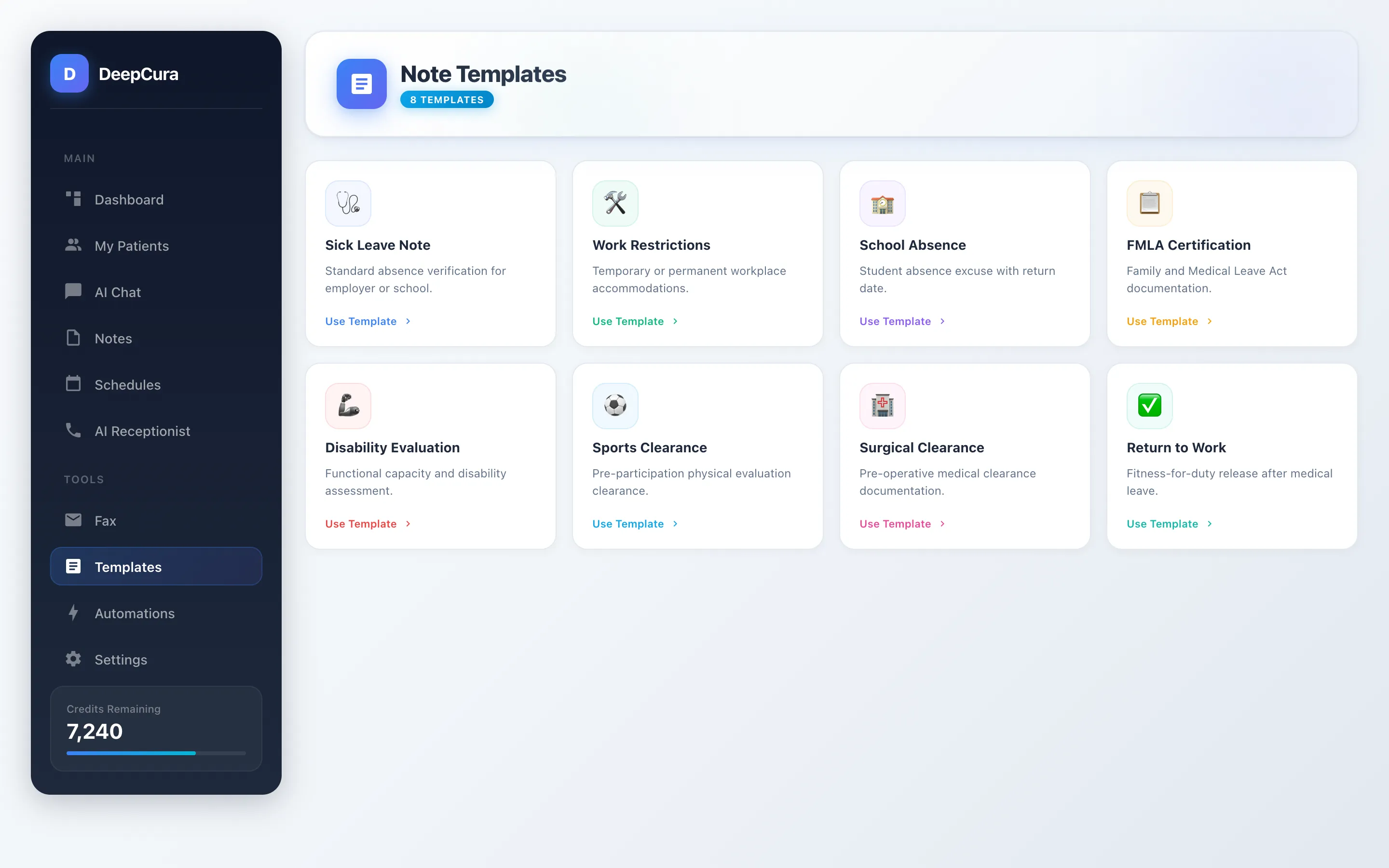
Doctor's Note Templates
The following 12 templates cover the most common clinical scenarios. Each includes placeholder fields in brackets that you can replace with patient-specific information. All templates follow HIPAA minimum necessary standards and include only the information employers and institutions are legally entitled to receive.
1. General Sick Leave Note (for Work)
When to use: Standard short-term absence from work due to illness or injury. This is the most commonly requested doctor's note.
[Practice Name]
[Practice Address]
[Phone Number] | [Fax Number]

Date: [Date]

To Whom It May Concern:

This letter confirms that [Patient Full Name] was seen and examined
at our office on [Date of Visit].

Based on my clinical evaluation, [Patient Name] is advised to be
absent from work from [Start Date] through [End Date].

[Patient Name] is expected to return to work on [Return Date]
without restrictions.

If you require verification of this note, please contact our
office at [Phone Number].

Sincerely,

[Provider Name], [Credentials]
NPI: [NPI Number]
[Practice Name]
2. Work With Restrictions (Modified/Light Duty)
When to use: The patient can work but requires temporary accommodations such as limited lifting, reduced hours, or modified duties.
[Practice Name]
[Practice Address]
[Phone Number] | [Fax Number]

Date: [Date]

To Whom It May Concern:

This letter confirms that [Patient Full Name] was evaluated at our
office on [Date of Visit].

Based on my clinical assessment, [Patient Name] may return to work
on [Return Date] with the following restrictions:

- [Restriction 1, e.g., "No lifting over 10 pounds"]
- [Restriction 2, e.g., "Must be allowed to sit/stand as needed"]
- [Restriction 3, e.g., "Limited to 6-hour shifts"]

These restrictions are effective from [Start Date] through
[End Date], at which time the patient should be re-evaluated.

Please contact our office at [Phone Number] with any questions.

Sincerely,

[Provider Name], [Credentials]
NPI: [NPI Number]
[Practice Name]
3. School Absence Note (K-12 and University)
When to use: Student absences from school or university due to medical visits or illness.
[Practice Name]
[Practice Address]
[Phone Number] | [Fax Number]

Date: [Date]

To Whom It May Concern:

This letter confirms that [Student Full Name] was seen at our
office on [Date of Visit] for a medical appointment.

[Student Name] was/is unable to attend school from [Start Date]
through [End Date] due to a medical condition.

[Student Name] is cleared to return to school on [Return Date].
[Optional: "The student should be excused from physical education
activities until [Date]."]

If you have any questions, please contact our office at
[Phone Number].

Sincerely,

[Provider Name], [Credentials]
NPI: [NPI Number]
[Practice Name]
4. Extended Medical Leave Note (FMLA Reference)
When to use: Absences likely qualifying for FMLA protection (serious health conditions requiring more than three consecutive days away). This note supports the initial absence; the employer may subsequently request formal FMLA certification (WH-380).
[Practice Name]
[Practice Address]
[Phone Number] | [Fax Number]

Date: [Date]

To Whom It May Concern:

This letter confirms that [Patient Full Name] is under my care for
a medical condition that requires an extended period of absence
from work.

[Patient Name] is unable to perform the essential functions of
their position from [Start Date] through [Estimated End Date].

This absence may qualify for protected leave under the Family and
Medical Leave Act (FMLA). If FMLA certification (Form WH-380) is
required, please forward the form to our office and we will
complete it within the allowed timeframe.

[Patient Name] will require a follow-up evaluation on or before
[Follow-Up Date] to reassess work readiness.

Please contact our office at [Phone Number] with any questions.

Sincerely,

[Provider Name], [Credentials]
NPI: [NPI Number]
[Practice Name]
5. Emergency Room Visit Note
When to use: Following an emergency department visit when the patient needs documentation for their employer or school.
[Hospital/ER Name]
[Hospital Address]
[Phone Number]

Date: [Date]

To Whom It May Concern:

This letter confirms that [Patient Full Name] was seen in the
Emergency Department at [Hospital Name] on [Date of Visit] at
approximately [Time].

[Patient Name] was evaluated, treated, and [discharged/admitted]
on [Discharge Date].

[Patient Name] is advised to be absent from work/school from
[Start Date] through [End Date].

[Optional: "The patient should follow up with their primary care
provider within [X] days."]

For verification, please contact the Emergency Department at
[Phone Number].

Sincerely,

[Provider Name], [Credentials]
NPI: [NPI Number]
[Hospital Name] Emergency Department
6. Urgent Care Visit Note
When to use: After an urgent care visit for non-life-threatening conditions requiring work or school absence documentation.
[Urgent Care Center Name]
[Address]
[Phone Number] | [Fax Number]

Date: [Date]

To Whom It May Concern:

This letter confirms that [Patient Full Name] was seen at
[Urgent Care Center Name] on [Date of Visit] for evaluation
and treatment.

Based on my assessment, [Patient Name] should be excused from
work/school from [Start Date] through [End Date].

[Patient Name] may return to normal activities on [Return Date].
[Optional: "A follow-up appointment with the patient's primary
care provider is recommended within [X] days."]

Please contact our office at [Phone Number] for verification.

Sincerely,

[Provider Name], [Credentials]
NPI: [NPI Number]
[Urgent Care Center Name]
7. Return-to-Work Clearance
When to use: Clearing a patient to resume full duties after an illness, injury, or surgical recovery. Often required by employers before the employee can return.
[Practice Name]
[Practice Address]
[Phone Number] | [Fax Number]

Date: [Date]

To Whom It May Concern:

This letter confirms that [Patient Full Name] was evaluated at our
office on [Date of Visit].

Based on my clinical assessment, [Patient Name] is cleared to
return to work effective [Return Date] with:

[ ] Full duties — no restrictions
[ ] Modified duties — the following restrictions apply through
    [End Date]:
    - [Restriction 1]
    - [Restriction 2]

[Optional: "A follow-up evaluation is scheduled for [Date] to
reassess work status."]

Please contact our office at [Phone Number] with any questions.

Sincerely,

[Provider Name], [Credentials]
NPI: [NPI Number]
[Practice Name]
8. Sports Physical / Athletic Clearance
When to use: Clearing a student or athlete to participate in sports or physical activities, or documenting restrictions following an injury.
[Practice Name]
[Practice Address]
[Phone Number] | [Fax Number]

Date: [Date]

To Whom It May Concern:

This letter confirms that [Patient/Student Full Name] was
evaluated at our office on [Date of Visit] for a sports/athletic
physical examination.

Based on my evaluation:

[ ] [Patient Name] is cleared for full athletic participation
    without restrictions.
[ ] [Patient Name] is cleared for participation with the following
    restrictions:
    - [Restriction 1]
    - [Restriction 2]
[ ] [Patient Name] is NOT cleared for athletic participation at
    this time. Re-evaluation is recommended on or after [Date].

Please contact our office at [Phone Number] with any questions.

Sincerely,

[Provider Name], [Credentials]
NPI: [NPI Number]
[Practice Name]
9. Specialist Referral Note
When to use: When referring a patient to another provider and the patient needs documentation of the referral for their employer, insurance, or the receiving specialist.
[Practice Name]
[Practice Address]
[Phone Number] | [Fax Number]

Date: [Date]

To: [Specialist Name / Specialist Practice]
Re: Referral for [Patient Full Name]

Dear [Specialist Name / To Whom It May Concern]:

I am referring [Patient Full Name], DOB [Date of Birth], for
evaluation and management of [general reason for referral, e.g.,
"a musculoskeletal condition" or "a cardiac concern"].

Relevant history: [Brief clinical summary appropriate for
provider-to-provider communication]

[Patient Name] may require additional time away from work pending
the outcome of this evaluation. Please provide the patient with
documentation of the visit for their employer upon completion.

Thank you for seeing this patient. Please send your consultation
report to our office at [Fax Number] or via [EHR system/portal].

Sincerely,

[Provider Name], [Credentials]
NPI: [NPI Number]
[Practice Name]
10. Mental Health Provider Note
When to use: Documenting a mental health encounter for work or school absence purposes. This template is intentionally minimal on clinical detail to protect patient privacy, as mental health conditions carry additional stigma and disclosure risks. For comprehensive mental health documentation, see our guide on how to write a biopsychosocial assessment.
[Practice Name]
[Practice Address]
[Phone Number] | [Fax Number]

Date: [Date]

To Whom It May Concern:

This letter confirms that [Patient Full Name] is currently under
my care and was seen at our office on [Date of Visit].

Based on my clinical evaluation, [Patient Name] requires a period
of absence from work/school from [Start Date] through [End Date]
for medical reasons.

[Optional: "[Patient Name] is able to continue working with the
following accommodations: [accommodation, e.g., 'flexible
scheduling for treatment appointments']."]

[Patient Name] will be re-evaluated on [Follow-Up Date].

If you require additional information, please contact our office
at [Phone Number]. Please note that any disclosure of clinical
details requires the patient's written authorization.

Sincerely,

[Provider Name], [Credentials]
NPI: [NPI Number]
[Practice Name]
11. Telehealth Visit Note
When to use: Documenting a visit conducted via telehealth (video or audio-only) when the patient needs a work or school excuse. Telehealth-issued notes carry the same legal weight as in-person visits in all 50 states.
[Practice Name]
[Practice Address]
[Phone Number] | [Fax Number]

Date: [Date]

To Whom It May Concern:

This letter confirms that [Patient Full Name] was evaluated via
a telehealth visit (video/audio consultation) on [Date of Visit].

The visit was conducted using a HIPAA-compliant telehealth
platform, and the patient was positively identified at the time
of the encounter.

Based on my clinical evaluation, [Patient Name] is advised to be
absent from work/school from [Start Date] through [End Date].

[Patient Name] is expected to return to normal activities on
[Return Date]. [Optional: "An in-person follow-up visit is
recommended within [X] days."]

Please contact our office at [Phone Number] for verification.

Sincerely,

[Provider Name], [Credentials]
NPI: [NPI Number]
[Practice Name]
12. Surgical Clearance / Pre-Operative Note
When to use: Documenting pre-operative medical clearance or communicating expected post-surgical recovery time to an employer.
[Practice Name]
[Practice Address]
[Phone Number] | [Fax Number]

Date: [Date]

To Whom It May Concern:

This letter confirms that [Patient Full Name] is scheduled
for a surgical procedure on [Surgery Date].

Based on my pre-operative evaluation on [Exam Date], [Patient
Name] is medically cleared for surgery.

The anticipated recovery period following surgery is
approximately [X] weeks. [Patient Name] is expected to be absent
from work from [Start Date] through [Estimated Return Date].

[Optional: "Upon return, the patient may require modified duties
for an additional [X] weeks. Specific restrictions will be
provided following the post-operative evaluation."]

A post-operative follow-up is scheduled for [Follow-Up Date],
at which time updated work status documentation will be provided.

Please contact our office at [Phone Number] with any questions.

Sincerely,

[Provider Name], [Credentials]
NPI: [NPI Number]
[Practice Name]
Specialty-Specific Considerations
Different specialties encounter distinct documentation patterns. While the core templates above cover most scenarios, certain specialties have additional requirements or common modifications worth noting.
Primary Care
Primary care providers write the highest volume of work and school absence notes. The general sick leave template (Template 1) and return-to-work clearance (Template 7) cover the vast majority of cases. Primary care notes should always include a clear return date — employers reject notes with open-ended timelines more frequently than any other documentation issue.
Pediatrics
Pediatric notes most often use the school absence template (Template 3) and sports physical template (Template 8). School districts may have their own forms that they require in addition to the provider's note. For extended absences, coordinate with the school nurse to ensure homebound instruction services are initiated when appropriate. Pediatric notes should name the parent or guardian who accompanied the child.
Orthopedics
Orthopedic absence notes almost always include work restrictions (Template 2). Be as specific as possible with lifting limits, positional restrictions, and weight-bearing status. Vague restrictions like "light duty" create disputes between patients and employers. Include specific pound limits, duration of standing/sitting, and any assistive device requirements.
OB/GYN
Pregnancy-related absences have additional FMLA protections. The extended medical leave template (Template 4) is commonly used for pregnancy complications and postpartum recovery. Document estimated delivery dates and anticipated return dates. Be aware that the Pregnancy Discrimination Act prohibits employers from treating pregnancy-related absences differently from other medical absences.
Psychiatry
Mental health notes (Template 10) should contain the least clinical detail of any specialty. Psychiatric diagnoses carry significant stigma and potential employment discrimination risk. Never include diagnosis, medication names, or treatment modality on notes sent to employers unless the patient provides explicit written consent. For detailed mental health documentation between providers, use a full biopsychosocial assessment format instead.
Emergency Medicine
ER visit notes (Template 5) are often requested days after the visit when the patient realizes their employer requires documentation. ER providers should offer absence documentation at discharge as standard practice. Include the time of arrival and discharge, as some employers track partial-day absences.
| Specialty | Most Common Note Type | Key Additions |
|---|---|---|
| Primary Care | General Sick Leave, Return-to-Work | Clear return date, follow-up instructions |
| Pediatrics | School Absence, Sports Physical | Parent/guardian name, school nurse coordination |
| Orthopedics | Work With Restrictions | Specific pound limits, positional and weight-bearing restrictions |
| OB/GYN | Extended Medical Leave | Estimated delivery date, PDA protections |
| Psychiatry | Mental Health Note | Minimal clinical detail, explicit consent for any diagnosis disclosure |
| Emergency Medicine | ER Visit Note | Arrival/discharge time, discharge documentation at point of care |
Legal Requirements and HIPAA Compliance
Understanding the legal framework around doctor's notes protects both your patients and your practice. Three federal laws and a patchwork of state regulations govern what employers can request, what providers should include, and where liability falls.
FMLA (Family and Medical Leave Act)
FMLA provides up to 12 weeks of job-protected unpaid leave per year for employees at covered employers (50+ employees within 75 miles). For FMLA-qualifying absences, employers may request medical certification using DOL Form WH-380-E (employee's own condition) or WH-380-F (family member's condition). A standard doctor's note is not a substitute for FMLA certification, but it is often sufficient for the initial absence before the employer formally requests certification. Employers must allow 15 calendar days for the provider to complete the certification form.
ADA (Americans with Disabilities Act)
The ADA prohibits employers from making disability-related inquiries or requiring medical examinations unless they are job-related and consistent with business necessity. When an employee requests reasonable accommodation, the employer may request documentation from the treating provider, but the documentation should focus on functional limitations rather than diagnosis. Your note should describe what the patient can and cannot do — not what condition they have. The ADA explicitly protects employees from having their medical information disclosed to supervisors or coworkers beyond what is strictly necessary for implementing the accommodation.
State Sick Leave Laws
As of 2026, 15+ states and numerous municipalities have enacted paid sick leave laws, many of which restrict when employers can require doctor's notes. Common provisions include prohibiting note requirements for absences of three days or fewer, prohibiting employers from specifying which provider the employee must see, and requiring employers to pay for the cost of the note if they mandate one. Check your state's specific requirements — a note request that is standard in Texas may be illegal in California for a one-day absence.
Forgery and Fraud
Fabricating, altering, or using a fraudulent doctor's note is a criminal offense in all 50 states, typically classified as forgery or fraud. Penalties range from misdemeanors to felonies depending on the jurisdiction and context. Providers who discover that a note bearing their name or practice information has been fabricated should report it to local law enforcement and document the incident. This guide and all templates are intended exclusively for use by licensed healthcare providers issuing legitimate clinical documentation.
For licensed providers only. All templates in this guide are designed for healthcare professionals documenting actual clinical encounters. Fabricating or altering a doctor's note is a criminal offense (forgery/fraud) in all 50 states and may result in felony charges. If you are a patient who needs a doctor's note, schedule an appointment with your healthcare provider.
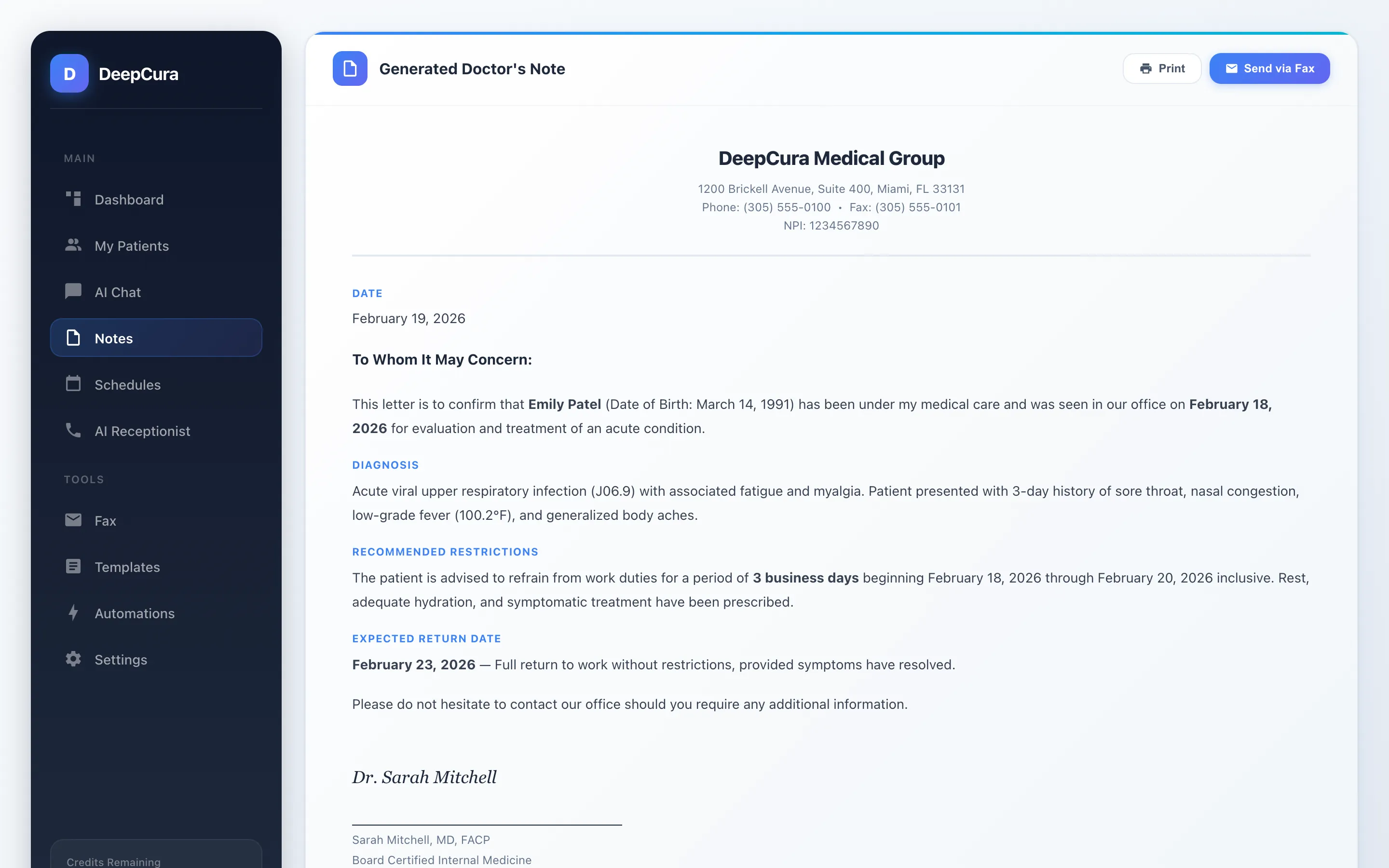
How AI Automates Doctor's Note Generation
The templates above solve the formatting problem, but they do not solve the time problem. Every note still requires manual data entry — pulling patient information, recalling encounter details, typing in dates and restrictions. For providers writing 20+ notes per day, even two minutes per note adds up to nearly an hour of administrative work.
AI clinical documentation tools eliminate this workflow entirely by generating notes — including work and school absence documentation — directly from encounter data.
Ambient AI Scribing
An ambient AI scribe captures the clinical encounter in real time, listening to the natural conversation between provider and patient. When a patient mentions needing a work note, or when the provider discusses restrictions and return dates during the visit, that information is captured automatically. No separate data entry step is required — the note content comes from the encounter itself.
Template-Free Note Generation
Rather than filling in a template after the fact, AI generates the appropriate note format based on the encounter type. A routine sick visit produces a simple absence note. A visit with modified duty discussion produces a restrictions note. An FMLA-related encounter flags the need for formal certification. The AI matches the output to the clinical scenario without the provider choosing a template.
One-Click Work and School Notes
After the encounter, the provider can generate a work or school absence note with a single click. The AI pre-fills patient name, visit date, recommended absence dates, restrictions discussed during the encounter, and return-to-work timeline — all extracted from the ambient recording. The provider reviews, makes any adjustments, and the note is ready. For a comprehensive comparison of AI scribes that offer this capability, see our guide to the Best AI Medical Scribes in 2026.
EHR Integration
Generated notes push directly into the patient's EHR chart — Epic, eClinicalWorks, OptiMantra, or Athena — without copy-paste workflows. The work note becomes part of the clinical record, and the provider has a documented trail of every absence note issued. DeepCura handles this end-to-end: ambient capture, note generation, and EHR push in a single workflow.

For a broader look at how AI tools compare for clinical documentation tasks beyond absence notes, see our roundup of the Best ChatGPT for Doctors in 2026.
Try running your next five encounters with an AI scribe and compare the time spent on work notes to your current workflow. Most providers see an immediate difference. You can start a free trial at app.deepcura.com/register — no credit card required.
Frequently Asked Questions
What should a doctor's note for work include?
A doctor's note for work should include nine essential elements: practice letterhead, the date of the note, the patient's full name, a statement confirming the patient was examined on a specific date, the recommended dates of absence, any work restrictions or modifications, the expected return-to-work date, the provider's signature with NPI number, and contact information for verification. Under HIPAA's minimum necessary standard, the note should not include the patient's specific diagnosis, medications, or treatment details unless the patient has provided written authorization for that disclosure.
Can an employer require a doctor's note?
Yes, with limitations. Employers can generally require a doctor's note for absences, but several laws restrict when and how. Under state paid sick leave laws in states like California, New York, and Washington, employers typically cannot require a note for absences of three days or fewer. The ADA limits the type of medical information employers can request — they can ask about functional limitations but generally cannot demand a specific diagnosis. For FMLA-qualifying absences, employers may request formal medical certification using DOL Form WH-380, which is more detailed than a standard doctor's note. Check your state's specific regulations, as requirements vary significantly.
How do I get a doctor's note for work?
Schedule an appointment with your healthcare provider — a physician (MD/DO), nurse practitioner, or physician assistant. The provider will evaluate your condition during the visit and issue a note documenting the medical encounter and recommending a specific period of absence. Most providers can issue the note at the end of the visit. Telehealth visits also qualify for doctor's notes in all 50 states. If you need a note retroactively for an illness where you did not seek care at the time, some providers will issue documentation at a follow-up visit, though policies vary by practice.
Is a doctor's note from urgent care valid?
Yes. A doctor's note issued by any licensed healthcare provider — including physicians, nurse practitioners, and physician assistants working in urgent care centers — is legally valid. Employers cannot require that a note come from a specific provider or practice type. An urgent care visit note carries the same legal weight as a note from a primary care physician or specialist. The note should include the same essential elements: practice identification, patient name, date of examination, recommended absence dates, and provider signature with credentials.
Can a nurse practitioner write a doctor's note?
Yes. Nurse practitioners (NPs) and physician assistants (PAs) are licensed healthcare providers authorized to evaluate patients and issue medical documentation, including work and school absence notes. In all 50 states, notes issued by NPs and PAs carry the same legal validity as those issued by physicians. Employers cannot reject a legitimate medical note solely because it was issued by an NP or PA rather than an MD or DO.
How long is a doctor's note valid?
A doctor's note does not have a universal expiration date. It is valid for the specific dates and circumstances stated in the note. If the note excuses an absence from February 1 through February 5, it covers that period. For ongoing conditions, employers may request updated documentation at reasonable intervals — FMLA allows recertification every 30 days for ongoing conditions. Return-to-work clearances are valid for the date specified unless the patient's condition changes. If an employer questions the validity of a note for a past absence, the provider's office can verify its authenticity upon request.
What is the difference between a doctor's note and FMLA certification?
A doctor's note is a brief document confirming a medical visit and recommending a period of absence. FMLA certification (DOL Form WH-380-E or WH-380-F) is a detailed, multi-page federal form that documents the specific serious health condition, its probable duration, the treatment schedule, and whether the employee is unable to perform essential job functions. FMLA certification is required for job-protected leave under federal law and provides significantly more clinical detail than a standard doctor's note. A doctor's note may be sufficient for the initial absence notification, but employers can request formal FMLA certification within five business days of the employee's leave request.
Can AI generate doctor's notes automatically?
Yes. AI clinical documentation tools like DeepCura can generate doctor's notes automatically from encounter data. An ambient AI scribe captures the clinical conversation in real time, identifies when a work or school note is needed based on the discussion, and generates a properly formatted note with the patient's name, visit date, absence dates, restrictions, and return date pre-filled from the encounter. The provider reviews and approves the note before it is finalized and pushed to the EHR. This eliminates manual template filling and reduces note generation time from several minutes to a single click. For a broader look at AI documentation tools, see our guide to the Best ChatGPT for Doctors.
Final Thoughts
Doctor's notes are one of the simplest documents in clinical practice, yet they consume a disproportionate amount of provider time when handled inefficiently. The templates in this guide give you a ready-made starting point for 12 of the most common scenarios — from a routine sick day to FMLA-qualifying extended leave.
The legal framework is straightforward once you understand it: include the nine essential elements, follow HIPAA minimum necessary, do not disclose diagnosis to employers without patient authorization, and be specific about restrictions and return dates. These principles apply across every template and every specialty.
For providers looking to eliminate the documentation burden entirely, AI clinical documentation tools represent the next step. Rather than filling in templates after each encounter, ambient AI captures the relevant information during the visit and generates notes automatically. The technology has matured to the point where it is no longer experimental — it is a practical workflow improvement that saves measurable time every day.
For more on how AI is transforming clinical documentation, explore our guides on the Best AI Medical Scribes in 2026, the Best ChatGPT for Doctors, the Best AI Scribe for AthenaHealth, our detailed biopsychosocial assessment writing guide, and our comprehensive SOAP note template with 10 free templates and real-world examples. If you are ready to see how AI-powered note generation works in practice, try DeepCura free.
References
[1] U.S. Department of Labor, "Family and Medical Leave Act (FMLA)," Wage and Hour Division. dol.gov/agencies/whd/fmla
[2] U.S. Department of Labor, "FMLA Certification of Health Care Provider for Employee's Serious Health Condition (Form WH-380-E)." dol.gov/sites/dolgov/files/WHD/legacy/files/WH-380-E.pdf
[3] U.S. Department of Justice, "Americans with Disabilities Act (ADA)," ADA.gov. ada.gov
[4] U.S. Department of Health and Human Services, "HIPAA Minimum Necessary Requirement," HHS.gov. hhs.gov/hipaa/for-professionals/privacy/guidance/minimum-necessary-requirement
[5] U.S. Equal Employment Opportunity Commission, "The Pregnancy Discrimination Act," EEOC.gov. eeoc.gov/pregnancy-discrimination
[6] National Conference of State Legislatures, "Paid Sick Leave," NCSL.org. ncsl.org/labor-and-employment/paid-sick-leave
[7] U.S. Department of Health and Human Services, "HIPAA for Professionals," HHS.gov. hhs.gov/hipaa/for-professionals
[8] DeepCura, "AI Medical Scribe Platform — Ambient Scribing, AI Receptionist, EHR Integration," DeepCura.com. deepcura.com