
AI agents that write back into Epic. 90+ clicks saved per encounter. From solo Epic clinic to 500-bed health system. That is what happens when you bring full-stack clinical AI automation to Epic.
Most ambient documentation tools listen to your encounter and generate a note. That is one step. DeepCura deploys specialized AI agents that handle the entire encounter workflow — and write everything directly back into Epic via FHIR R4:
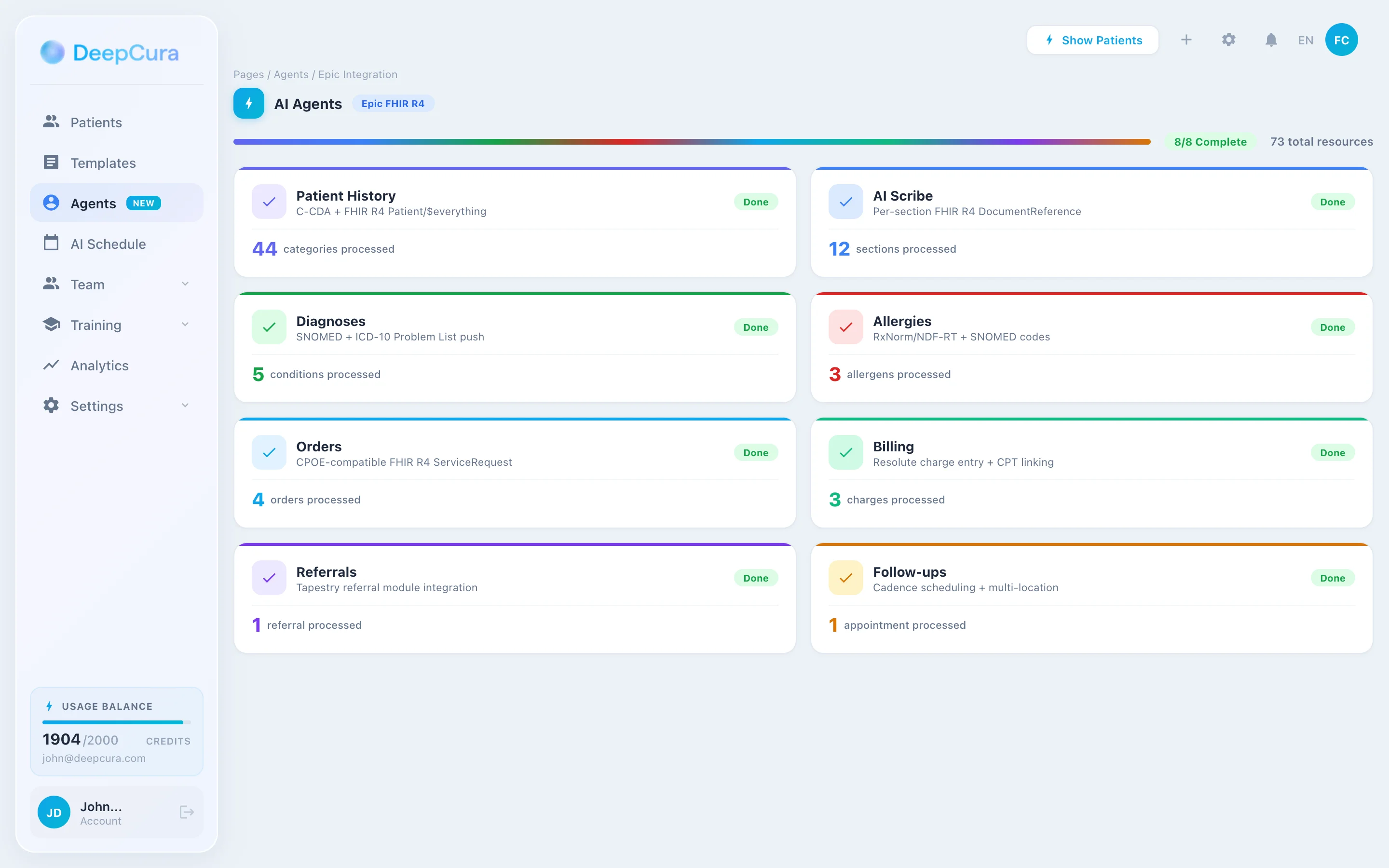
- Patient History — pulls and summarizes the full chart via C-CDA and FHIR R4 Patient/$everything, including cross-department data from ED, inpatient, and outpatient records
- AI Scribe — ambient note generation, pushed per-section into Epic via FHIR R4 DocumentReference
- Diagnoses — extracts problems, maps to SNOMED + ICD-10, writes to Epic's Problem List
- Allergies — captures allergens with severity, validates using RxNorm/NDF-RT and SNOMED codes
- Orders — labs, imaging, DME, vaccines, medications — placed via FHIR R4 ServiceRequest, compatible with Epic's CPOE and BPA clinical decision support
- Billing — CPT codes with linked diagnoses, supporting both Resolute professional billing and hospital billing workflows
- Referrals — specialist search, clinical justification, authorization — integrated with Epic's Tapestry referral module
- Follow-ups — books the appointment via Epic's Cadence scheduling, with multi-location support for health systems
At 20 patients a day, that is ~2,000 clicks eliminated — roughly 5-6 hours of data entry, gone. Epic's built-in ambient tool handles about 2 of these 10 workflow steps. Abridge handles 3. DeepCura handles all of them.
If you are searching for the best AI scribe for Epic, this guide covers how each agent works, how the built-in ambient option and Abridge compare, and whether a third-party Epic AI scribe is worth the investment for your practice or health system.
This guide was last updated in February 2026. All technical claims are based on DeepCura's production Epic FHIR R4 integration. Pricing reflects current publicly available information.
Why Finding the Best AI Scribe for Epic Is So Hard
The landscape of AI-powered clinical documentation for Epic has expanded rapidly. Here is where each option sits on the automation spectrum:
Epic AI Charting (launched February 2026) is Epic's built-in ambient documentation tool. It is free for Epic customers and handles basic ambient scribing — listening to the encounter and generating a clinical note that pushes directly into the chart. This is a solid starting point. But like athenaAmbient on the athenahealth side, it stops at note generation. There is no downstream automation for diagnoses, orders, billing, referrals, or scheduling.
Abridge is an Epic Pal partner with strong ambient scribing and a unique patient-facing after-visit summary feature. Sold on enterprise contracts (pricing not published), it covers ambient documentation and note push-back into Epic, but does not extend into structured clinical workflows like diagnosis management, order entry, or billing automation.
Nuance DAX Copilot has historically had the deepest Epic integration and strong enterprise adoption. Pricing is not published — enterprise contracts vary by organization size — and implementation timelines run 3-6 months. It is positioned for organizations with dedicated IT teams and procurement processes.
Freed AI and DeepScribe generate notes from encounter audio but lack native Epic write-back. The clinician still copies the note manually.
The gap across all of these options is the same: they automate the note, but leave the 80% of encounter work that happens after the note completely manual. DeepCura fills that gap at $129/month per provider (1,000 credits a month; a standard note costs 1 credit) with specialized agents and full FHIR R4 bidirectional write-back.
For a detailed comparison of all AI scribes, see our Best AI Medical Scribes in 2026 ranking, our Freed AI review, and our Heidi Health review.
The 8 AI Agents
DeepCura's Epic integration uses a multi-agent architecture — 8 specialized AI agents that each handle one stage of the clinical workflow. Each agent runs on GPT-4.1 with streaming server-sent events (SSE) for real-time output, and every agent includes a 3-stage validation pipeline: AI extraction, coding standard cross-reference, and clinician confirmation before any data is written to the chart.
Here is what each agent does and why it matters for Epic users.
1. Patient History Summarization
Before the encounter begins, the Patient History agent pulls the patient's complete clinical record from Epic via both C-CDA (Consolidated Clinical Document Architecture) and FHIR R4 Patient/$everything. It processes clinical data across medications, allergies, problems, vitals, immunizations, lab results, procedures, referrals, and more — and generates a concise clinical summary that the provider can review in seconds rather than spending 3-5 minutes clicking through Epic Storyboard tabs.
For hospital-based Epic users, the agent pulls cross-department data — emergency department visits, inpatient stays, and outpatient encounters — into a single unified summary. This is particularly valuable in academic medical centers and multi-facility health systems where patient records span multiple departments and care settings.
2. AI Scribe — Per-Section FHIR R4 Write-Back
The AI Scribe agent captures the ambient encounter audio and generates a comprehensive clinical note with 12 structured SOAP fields — chief complaint, history of present illness, review of systems, past medical history, physical exam, assessment, plan, patient instructions, and more. Each field is formatted in rich HTML compatible with Epic's documentation structure.
DeepCura pushes notes to Epic on a per-section basis via FHIR R4 DocumentReference resources. Rather than dumping the entire note into a single text field, each SOAP section writes to the corresponding field in the chart. This preserves Epic's native formatting and works alongside SmartTexts and SmartPhrases that providers already use in their documentation workflows.
3. Problem and Diagnosis Management
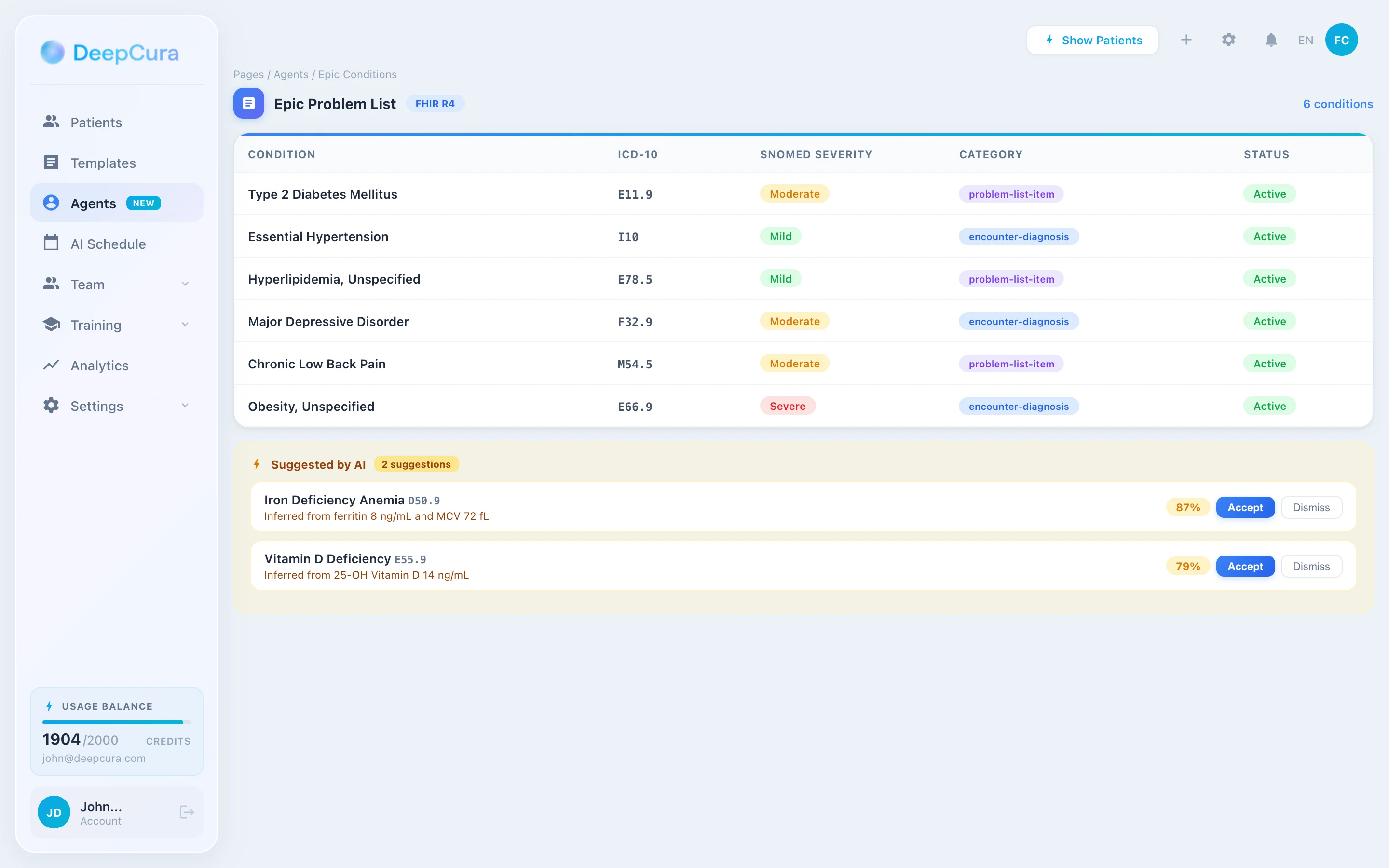
The Problem and Diagnosis agent extracts every clinical problem and diagnosis mentioned during the encounter and maps each one to both SNOMED CT and ICD-10 codes. The agent follows Epic's Problem List Guidance conventions for categorizing conditions as encounter-specific or ongoing chronic problems.
The agent also suggests additional diagnoses based on the patient's current medication list, lab results, and clinical context. For example, if a patient is on metformin and their most recent HbA1c is 7.8%, the agent will suggest Type 2 Diabetes (E11.9) if it is not already on the problem list. Each suggestion includes a confidence score so the provider can make an informed decision. For hospital-based providers, the agent considers DRG coding relevance when flagging conditions that may affect case mix and reimbursement.
4. Allergy Management
The Allergy agent extracts every allergen mentioned during the encounter — medications, foods, and environmental factors — along with severity levels and reaction types. Epic uses RxNorm and NDF-RT codes for drug allergies in addition to SNOMED CT for non-drug allergens, and the agent maps each allergen to the appropriate coding system before writing to the chart.
This is critical for patient safety. Manual allergy entry is error-prone — clinicians often enter free-text descriptions that do not trigger drug interaction alerts. By mapping allergens to standardized codes, the agent ensures that every allergy entry works with Epic's built-in clinical decision support and drug interaction checking.
5. Orders and Medications
The Orders agent handles five distinct order types: Lab Orders, Imaging Orders, DME (Durable Medical Equipment), Vaccines, and Medication prescriptions. For each order mentioned during the encounter, the agent extracts the specific test, study, or medication, adds relevant clinical details (laterality for imaging, dosage for medications), and pushes the order via FHIR R4 ServiceRequest resources.
Orders placed through DeepCura are compatible with Epic's Computerized Provider Order Entry (CPOE) system and trigger Best Practice Advisory (BPA) alerts when applicable — the same clinical decision support that fires on manually entered orders. Each order includes a confidence score: a clearly stated "let's get a CBC and lipid panel" gets a high score and is ready for one-click confirmation, while a tentative "we might want to consider an MRI" gets a lower score and is flagged for provider review.
6. Billing Automation
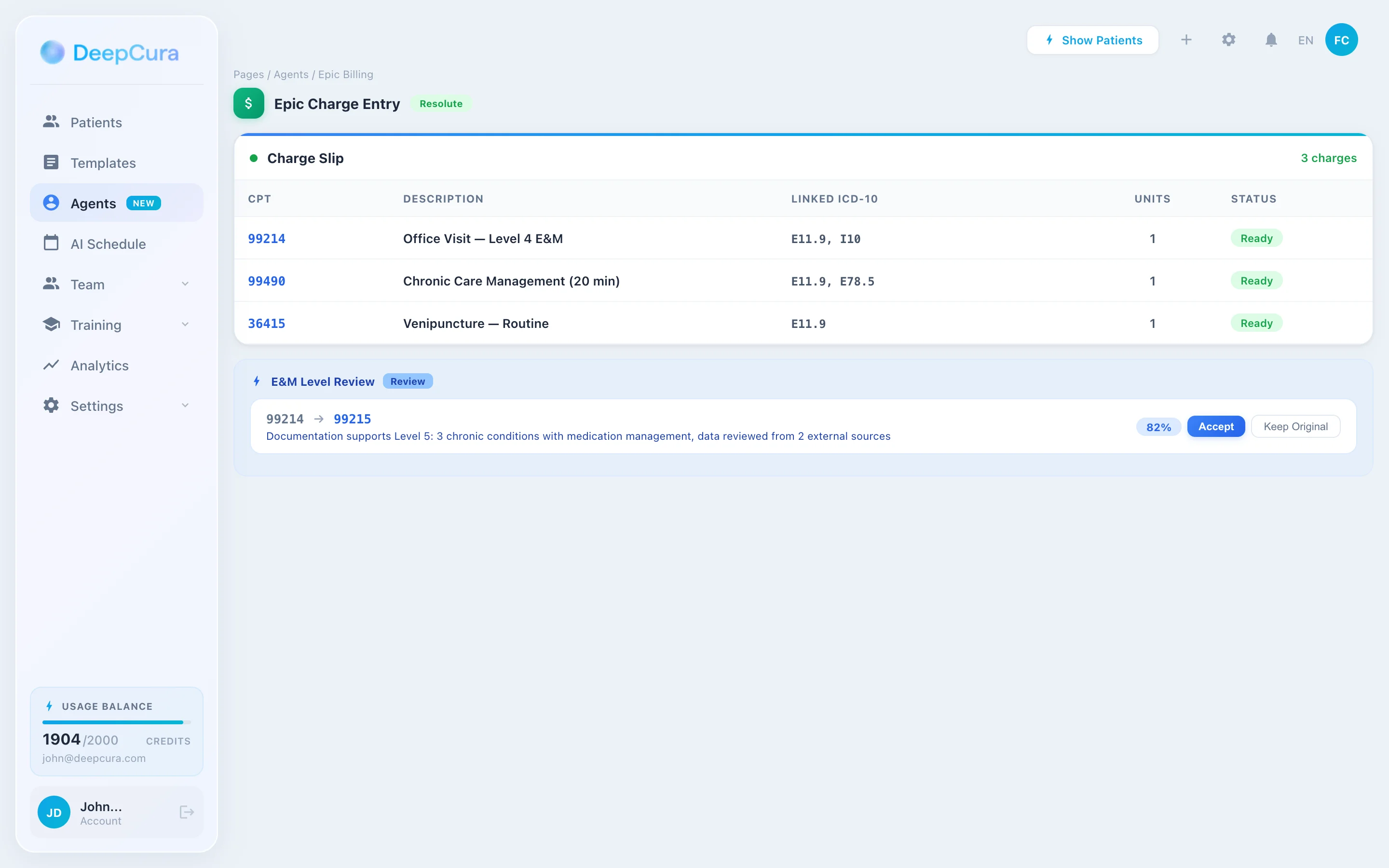
The Billing agent synthesizes the note, diagnosis list, procedures, and time documentation to generate CPT codes with linked ICD-10 pointers. It evaluates medical decision-making complexity against the 2021 E&M guidelines and cross-references the documentation to ensure coding accuracy.
What makes this particularly valuable for Epic users is dual billing workflow support. For ambulatory clinics using Resolute Professional Billing, the agent generates standard charge capture entries. For hospital-based providers, it maps to facility billing structures. In both cases, the agent handles E&M level selection, diagnosis-to-procedure linking, and modifier application — a process that typically requires 15-20 clicks through Resolute's charge entry screens.
7. Referral Creation
The Referral agent picks up specialty referral mentions during the conversation — "let's get a cardiology consult" or "I want neurology to weigh in" — and constructs a structured referral with the target specialty, urgency classification, clinical justification narrative, and relevant supporting documentation references.
For Epic organizations using the Tapestry referral management module, this is a major time saver. The manual Tapestry workflow — navigate to referrals, search the provider directory, select a specialist, enter clinical details across multiple fields, attach supporting documents, and route for authorization — typically runs 15-20 clicks and 3-5 minutes per referral. The agent compresses that into a pre-populated referral record that the clinician confirms with a single click. For health systems with in-network referral requirements, the agent flags when the requested specialty is available within the organization before suggesting external referrals.
8. Follow-up Appointment Booking
The Follow-up agent listens for scheduling intent during the encounter — "let's see you back in three months" or "schedule a follow-up in two weeks" — extracts the timing, and books the appointment via Epic's Cadence scheduling system.
For health systems with multiple locations, the agent supports multi-site scheduling — finding availability across the organization rather than being limited to a single clinic location. This eliminates the post-encounter handoff where the provider tells the patient to schedule at the front desk, the patient waits in line, and the appointment may or may not match what the provider intended.
Bonus: Patient Education Handouts
Beyond the 8 core agents, DeepCura also recommends patient education materials based on the diagnoses and conditions discussed during the encounter. The provider can review and share handouts with a single click — no manual searching through education catalogs.
Three Platforms Compared: What Each One Actually Automates
If you are comparing every Epic AI scribe option available in 2026, this is the head-to-head breakdown — from Epic's free built-in option through mid-tier ambient scribing to full-stack workflow automation.
| Capability | Epic AI Charting (Free) | Abridge (enterprise, not published) | DeepCura ($129/mo) |
|---|---|---|---|
| Ambient AI Scribing | Yes | Yes | Yes |
| SOAP Note Generation | Yes | Yes | Yes (12 fields, rich HTML) |
| Push Notes to Epic | Yes (basic) | Yes | Yes (per-section FHIR R4) |
| Patient History Pull | No | No | Yes (C-CDA + FHIR R4) |
| After-Visit Summaries | No | Yes | No |
| Problem/Diagnosis Push | No | No | Yes (SNOMED + ICD-10) |
| Allergy Management | No | No | Yes |
| Lab/Imaging/Rx Orders | No | No | Yes (5 types) |
| CPT Billing Automation | No | No | Yes |
| Referral Creation | No | No | Yes |
| Follow-up Booking | No | No | Yes |
| Patient Handouts | No | No | Yes |
| Epic App Orchard Listed | Built-in | Yes | Yes |
| Self-Service Signup | Built-in | No (enterprise) | Yes |
| Workflow Automation Score | 2/10 | 3/10 | 10/10 |
Epic's built-in option is the right choice for clinicians who want free ambient documentation with zero setup. It handles the note and that is genuinely useful.
Abridge is the right choice for organizations that prioritize patient-facing after-visit summaries and are willing to pay a premium for enterprise support and Epic Pal partnership status.
DeepCura is the right choice for practices and health systems that want to automate the full encounter workflow — from patient history through billing and scheduling — at a fraction of the cost of enterprise alternatives.
The Administrative Burden in Numbers
Epic's Storyboard interface consolidates patient data, but navigating it still requires significant click depth — especially when CPOE, Resolute, Tapestry, and Cadence are involved. We mapped the manual workflow for a typical primary care encounter:
| Workflow Stage | Manual Clicks | What Happens |
|---|---|---|
| Patient history (Storyboard) | 12-15 | Tab switching, section expansion, cross-department review |
| Note documentation | 20-25 | SmartText selection, field-by-field entry, formatting |
| Diagnoses (Problem List) | 8-10 | Search, select, laterality, confirm — per condition |
| Allergy updates | 5-8 per allergen | RxNorm lookup, severity, reaction type |
| Order entry (CPOE) | 10-14 per order | Search, dosing, BPA review, e-sign |
| Billing (Resolute) | 15-20 | E&M level, diagnosis linking, charge capture |
| Referrals (Tapestry) | 15-20 | Provider search, justification, auth initiation |
| Follow-up (Cadence) | 8-12 | Availability search, slot selection, confirmation |
Total: approximately 95-120 clicks per patient encounter — roughly 4-6 minutes of pure navigation time. Scale that to 20 patients and an 8-hour clinic day, and you are spending 80-120 minutes on clicks alone. Over a year, that is approximately 400-500 hours of administrative navigation.
The financial impact compounds at scale. A 50-provider health system loses roughly 20,000-25,000 hours annually to this overhead. At average physician compensation rates, that represents millions in productivity that could be redirected to patient care, panel expansion, or reduced burnout.
Pricing
Here is how the main AI documentation options for Epic compare on cost:
- Epic's built-in ambient tool: Free (included with Epic subscription), but limited to ambient scribing and basic note generation
- Freed AI: $39-$119/month tiered pricing — no native Epic FHIR integration, no structured write-back
- DeepCura: $129/month per provider (1,000 credits a month; 1 credit per standard note) for every AI agent with full FHIR R4 bidirectional write-back
- Abridge: enterprise pricing (not published) — ambient scribing plus after-visit summaries
- Nuance DAX Copilot: not publicly priced (enterprise contract) — enterprise-grade ambient documentation, 3-6 month implementation
The value proposition is clear: at $129/month, DeepCura automates more workflow stages than any option on this list — including the enterprise-priced alternatives.
Start with a free trial to see every agent in action with your own Epic environment. No credit card required. Sign up at app.deepcura.com/register.
Getting Started: Connect to Epic in 4 Steps
Getting DeepCura connected to your Epic instance is straightforward:
- Sign up at app.deepcura.com/register — free trial, no credit card required.
- Navigate to Settings > EHR > Epic in the DeepCura dashboard and select Epic as your EHR system.
- Authorize via SMART on FHIR — DeepCura uses the SMART App Launch Framework with OAuth 2.0 to securely connect to your Epic instance. The authorization flow is the same standardized process used by all Epic App Orchard applications.
- Verify connection — DeepCura confirms bidirectional access to your Epic environment and runs a connection health check.
For IT administrators and health system evaluators: DeepCura provides SMART on FHIR compliance documentation and supports Epic App Orchard listing verification. For organizations requiring formal IT review before clinician adoption, DeepCura's integration uses the same standardized FHIR R4 APIs and SMART authorization framework that your IT team already evaluates for other App Orchard applications. No custom interfaces, no VPN requirements, no on-premise installation.
Who Benefits Most from Full-Stack Automation?
DeepCura's Epic integration is the strongest fit for these profiles:
- Solo clinicians on Epic who want more than the built-in ambient tool but cannot justify enterprise-tier pricing for Nuance DAX. DeepCura delivers every agent at $129/month with self-service setup.
- Ambulatory clinics on Epic Community Connect where the host organization provides Epic but individual practices need their own AI tooling. DeepCura connects via standard FHIR R4 without requiring host-level IT changes.
- IT administrators evaluating third-party AI tools who need SMART on FHIR compliance documentation, App Orchard verification, and clear security posture before approving clinician adoption.
- Multi-specialty groups that need department-specific documentation configurations — different SOAP templates and billing patterns for primary care, cardiology, orthopedics, and other specialties.
- Health systems comparing Abridge or Nuance costs to a full-stack alternative at a fraction of the per-provider price. At a published $129/month per provider vs. enterprise-contract pricing for Abridge and Nuance, the difference in cost predictability is significant across a 50-200 provider organization.
- Clinicians who tried Epic's built-in ambient tool and found that it handles the note competently but leaves everything else — diagnoses, orders, billing, referrals, scheduling — completely manual.
- Rural and critical access hospitals where hiring human scribes is impractical due to labor market constraints and where enterprise-priced options are not financially viable.
For providers using other EHR systems, DeepCura also integrates with athenahealth, eClinicalWorks, AdvancedMD, and OptiMantra; a Veradigm (Allscripts) integration is in certification. For international and multilingual practices evaluating alternatives, see our Heidi Health review. For a broader look at AI tools for clinical practice, see our guides to the Best ChatGPT for Doctors and the Best AI Medical Receptionist.
See DeepCura in Action
Watch the full platform demo to see how DeepCura handles ambient scribing, AI chat, patient management, and EHR integration across all supported systems.

Frequently Asked Questions
Does DeepCura integrate with Epic?
Yes. DeepCura has a full bidirectional FHIR R4 integration with Epic covering patient history, notes, diagnoses, allergies, orders, billing, referrals, and scheduling. Data flows both directions: DeepCura reads patient context from Epic and writes structured clinical data back into the appropriate chart fields via standardized FHIR R4 resources. The integration uses the SMART on FHIR authorization framework and is compatible with Epic App Orchard requirements.
What is the best AI scribe for Epic EHR?
For practices that want automation beyond basic ambient scribing, DeepCura is the most comprehensive AI scribe for Epic. It is the only platform with specialized AI agents that cover the full encounter workflow — from patient history through billing and scheduling — with direct FHIR R4 write-back at $129/month. Epic AI Charting is a solid free option for basic note generation. Abridge offers strong ambient scribing with after-visit summaries on enterprise pricing (not published). For a full comparison, see our Best AI Medical Scribes in 2026 ranking.
How does Epic AI Charting compare to third-party AI scribes?
Epic AI Charting is a competent free ambient documentation tool that handles note generation and basic chart push. Its main advantage is that it is built into Epic — no separate app, no additional cost, no IT approval process. However, it is limited to ambient scribing and note generation. It does not automate diagnosis entry, allergy management, order placement, billing, referrals, or scheduling. Third-party tools like DeepCura and Abridge extend automation beyond the note, with DeepCura covering the broadest range of workflow stages at a published self-serve price.
Is Abridge better than DeepCura for Epic?
It depends on your priorities. Abridge excels at ambient scribing and offers patient-facing after-visit summaries — a feature DeepCura does not currently provide. Abridge also has Epic Pal partnership status. However, Abridge does not automate diagnosis entry, order placement, billing, referrals, or scheduling. DeepCura covers all of these at $129/month vs. Abridge's enterprise pricing (not published). If your primary need is ambient notes plus patient summaries, Abridge is a strong option. If you want full encounter workflow automation, DeepCura covers significantly more ground at a published self-serve price. For a detailed breakdown, see our DeepCura vs Abridge comparison.
Can DeepCura push notes directly into Epic?
Yes. DeepCura pushes notes into Epic on a per-section basis via FHIR R4 DocumentReference resources. Each SOAP section — chief complaint, HPI, ROS, physical exam, assessment, plan, and more — writes to the corresponding field in Epic's chart structure. This preserves Epic's native formatting and works alongside SmartTexts and SmartPhrases. It is not a single text dump into a free-text field.
How much does an AI scribe for Epic cost?
Pricing ranges from free to enterprise custom. Epic's built-in ambient tool is free. Freed AI costs $39–$119/month but lacks native Epic integration. DeepCura costs $129/month per provider (1,000 credits a month; 1 credit per standard note) for every AI agent with full FHIR R4 write-back. Abridge is enterprise-priced (not published). Nuance DAX Copilot is not publicly priced (enterprise contract), with 3-6 month implementation timelines.
Does DeepCura work with Epic Community Connect?
Yes. DeepCura connects to Epic via standard FHIR R4 APIs and SMART on FHIR authorization. This means it works with Epic Community Connect installations the same way it works with directly hosted Epic instances. The connection is at the FHIR endpoint level, so individual practices on a Community Connect host can authorize DeepCura without requiring configuration changes at the host organization level.
Is DeepCura HIPAA compliant for Epic users?
Yes. DeepCura is fully HIPAA compliant and provides a Business Associate Agreement (BAA) to all covered entities. All data — including encounter audio, generated notes, and Epic FHIR API communications — is encrypted in transit (TLS 1.2+) and at rest (AES-256). The platform maintains SOC 2-aligned security practices and undergoes regular security assessments. By default, visit audio is kept with the encounter, so every AI-suggested chart update links to the exact second it was said.
Final Verdict
Epic's built-in ambient documentation is a fine starting point — it is free, it is native to the platform, and it handles basic note generation competently. Abridge adds patient-facing after-visit summaries and strong ambient scribing at a premium price point. But for practices and health systems that want to automate the full encounter workflow, these options cover roughly 20-30% of the opportunity.
DeepCura covers 100% — making it the best AI scribe for Epic in 2026. Specialized AI agents handle every stage from patient history through billing and follow-up booking, with direct bidirectional FHIR R4 write-back that eliminates manual data entry. At $129/month per provider — a published, self-serve price versus enterprise quotes for Abridge and Nuance — it automates 10x more of the workflow and saves approximately 95-120 clicks per patient encounter.
If you are running your practice on Epic and spending hours per day on documentation and data entry, the math is straightforward. Start a free trial and see every agent in action with your own Epic environment.
For more on AI-powered clinical documentation, explore our AI Medical Scribe platform overview and our Best AI Medical Scribes in 2026 comprehensive comparison.
References
[1] Epic Systems, "Cloud-Based EHR," epic.com. epic.com
[2] Epic Systems, "AI Charting — AI-Powered Clinical Documentation," epic.com. epic.com
[3] Epic Systems, "App Orchard — Epic's App Marketplace," apporchard.epic.com. apporchard.epic.com
[4] Abridge, "AI Documentation for Healthcare," abridge.com. abridge.com
[5] HL7/SMART, "SMART App Launch Framework," smarthealthit.org. smarthealthit.org
[6] HL7, "FHIR R4 Specification," hl7.org/fhir. hl7.org/fhir
[7] SNOMED International, "SNOMED CT — Systematized Nomenclature of Medicine," SNOMED.org. snomed.org
[8] World Health Organization, "International Classification of Diseases, Tenth Revision (ICD-10)," WHO. who.int/classifications/icd
[9] American Medical Association, "CPT — Current Procedural Terminology," AMA-assn.org. ama-assn.org/practice-management/cpt
[10] U.S. Department of Health and Human Services, "HIPAA for Professionals," HHS.gov. hhs.gov/hipaa/for-professionals
[11] DeepCura, "AI Medical Scribe Platform — Ambient Scribing, AI Receptionist, EHR Integration," DeepCura.com. deepcura.com
[12] Nuance Communications/Microsoft, "Dragon Ambient eXperience (DAX) Copilot," Nuance.com. nuance.com