
Disclaimer: This review is based on publicly available information as of March 2026. Features, pricing, and capabilities may have changed. We encourage readers to verify current details directly with the vendor.
$5.3 billion valuation. 250+ health systems. No self-serve signup. Abridge is the most well-funded AI medical scribe on the market — built for enterprise health systems, not individual clinicians.
Here is the picture at a glance:
- Strongest at: Deep Epic integration, linked evidence that traces notes back to transcript, real-time note generation
- Enterprise-only: No self-serve signup, no free trial for individuals, pricing not published (reported around $208/month per provider)
- What it lacks: No AI receptionist, no fax management, no payment collection, no clinical AI chat
- Best for: Large health systems already on Epic that want ambient documentation at scale
This review is an honest assessment of Abridge AI in 2026. We cover what it does, where it excels, where it falls short, pricing, EHR integrations, and how it compares to platforms that serve the full clinical workflow — not just documentation.
This review was last updated in March 2026. Pricing and features reflect publicly available information at the time of writing.
What Is Abridge AI?
Abridge is a generative AI platform for clinical conversations. It uses ambient listening to capture the patient-clinician encounter and generates structured clinical notes using large language models. Founded in 2018 in Pittsburgh, Pennsylvania, Abridge emerged from the Pittsburgh Health Data Alliance — a collaboration between UPMC, Carnegie Mellon University, and the University of Pittsburgh.
The company was founded by Dr. Shiv Rao, a practicing cardiologist, alongside Sandeep Konam and Florian Metze. That clinical-founder origin gives Abridge credibility in a space where many competitors are built by engineers first and clinicians second.
Abridge has raised over $750 million in venture capital across eight funding rounds, including a $300 million Series E in June 2025 that valued the company at $5.3 billion. Its investor list includes Andreessen Horowitz, Khosla Ventures, NVIDIA Ventures, Lightspeed, and CVS Health Ventures. The company has been named Best in KLAS for Ambient AI in both 2025 and 2026, TIME Best Inventions, CNBC Disruptor 50, Forbes AI 50, and Fast Company Most Innovative Companies. On G2, Abridge holds a 4.7 out of 5 rating from verified user reviews.
Unlike full-platform clinical AI solutions that bundle scribing with intake automation, billing, AI receptionists, and broad EHR integrations, Abridge focuses primarily on ambient documentation and revenue cycle intelligence with deep Epic integration. The company has expanded into nursing documentation and real-time prior authorization (via an Availity partnership announced in January 2026), but it remains an enterprise product sold through health system contracts — there is no self-serve option for individual clinicians or small practices.
How Abridge AI Works
The Abridge AI scribe workflow follows the ambient documentation pattern, with some distinctive features that set it apart from lighter-weight competitors.
Start the encounter. The clinician activates Abridge's ambient listening within their EHR workflow (typically Epic). The platform begins capturing the conversation between clinician and patient.
Real-time processing. Unlike scribes that generate notes only after the encounter ends, the Abridge AI scribe begins processing the conversation in real time. Notes and summaries start appearing as the conversation progresses, allowing clinicians to see documentation forming during the visit.
Linked evidence. Each section of the generated note is linked back to the specific portion of the transcript and audio that produced it. Clinicians can click on any part of their note and hear or read the exact conversation segment that informed that clinical detail. This linked evidence feature is unique to Abridge and addresses a critical trust problem with AI-generated documentation — clinicians can verify accuracy without replaying the entire encounter.
Review and approve. The completed note appears in the clinician's EHR, formatted according to their template preferences. For Epic users, this integration is deep — notes flow directly into the appropriate chart sections. The clinician reviews, edits if necessary, and approves.
Patient after-visit summary. Abridge automatically generates a patient-facing summary of the visit, written at an 8th-grade reading level. This summary is delivered to the patient, improving communication and health literacy without requiring the clinician to write it manually.
Abridge AI Pricing
Abridge does not publish transparent pricing. The platform operates on a B2B enterprise model, selling subscription licenses directly to healthcare organizations through negotiated contracts. There is no self-serve signup and no publicly listed price.
Based on industry reporting and health system contract analysis, Abridge pricing falls in the following range:
- Enterprise license: approximately $2,500 per clinician per year (~$208/month)
- Full implementation: $250-$500 per provider per month, depending on integration depth and contract terms
- No individual plan: individual clinicians and small practices cannot purchase Abridge directly
Here is how Abridge's estimated pricing compares against alternatives:
| Plan | Price | Signup | EHR Write-Back | AI Receptionist | Key Limitation |
|---|---|---|---|---|---|
| Abridge (Enterprise) | Not published (reported ~$208+/mo) | Enterprise sales only | Epic (deep), plus Athena, eCW, Cerner, AllScripts, NextGen | ✗ | No self-serve, enterprise-only |
| Freed AI Premier | $119/mo | Self-serve | Scraping-based | ✗ | No native API write-back |
| DeepCura | $129/mo | Self-serve + free trial | Native API (athenahealth, eCW, AdvancedMD, OptiMantra, Epic, DrChrono, CharmHealth, Cerner) | ✓ | — Full platform included |
At a reported ~$208/month per provider (pricing is not published, and full implementations can run much higher), the Abridge AI scribe costs roughly 60% more than DeepCura ($129/month) while offering a narrower feature set. The pricing gap is significant: for a 10-provider practice, Abridge would cost roughly $25,000-$60,000 per year compared to DeepCura at $13,872 per year on volume pricing ($1,156/mo for 10 providers — seats 1–2 at $129, 3–5 at $116, 6–10 at $110). DeepCura includes native EHR write-back for athenahealth, eClinicalWorks, AdvancedMD, OptiMantra, Epic, DrChrono, CharmHealth, and Cerner, a 24/7 AI receptionist, billing automation, fax management, and payment collection — capabilities that Abridge largely does not offer (though it has recently added prior authorization via an Availity partnership).
Abridge AI Scribe: Key Features
Ambient Encounter Capture
The Abridge AI scribe captures clinical conversations through ambient listening, processing the natural dialogue between clinician and patient. The platform uses advanced speaker diarization to identify different voices and extract clinically relevant information from the conversation flow.
Real-Time Note Generation
Unlike most AI scribes that generate notes only after the encounter ends, Abridge processes conversations in real time. Clinicians can see their documentation forming during the visit, allowing them to course-correct or add detail to specific sections before the encounter is complete.
Linked Evidence and Citations
Every section of an Abridge-generated note is linked to the specific transcript and audio segment that produced it. This is Abridge's most distinctive feature — it allows clinicians to verify any clinical detail by clicking through to the source conversation. For organizations concerned about AI accuracy and liability, this traceability is valuable.
Patient After-Visit Summaries
Abridge automatically generates patient-facing visit summaries written at an 8th-grade reading level. These summaries help patients understand their visit without requiring the clinician to write a separate patient communication. This feature is included automatically and does not require additional configuration.
Billing Code Suggestions
The Abridge AI scribe generates ICD-10 and CPT billing code suggestions once the clinical note is created. These codes are derived from the documented encounter and can assist with billing workflows, though they are suggestions rather than validated E&M integrity checks.
Multi-Language Support
Abridge supports clinical encounters conducted in 28+ languages, processing non-English conversations and generating accurate clinical notes. This capability serves health systems with multilingual patient populations.
HIPAA Compliance and BAA
Abridge is HIPAA compliant and provides a Business Associate Agreement (BAA) to covered entities. Data is encrypted in transit and at rest and stored in US-based data centers.
What the Abridge AI Scribe Does Well
The deepest Epic integration in the market. Abridge is Epic's first "Pal" partner through the Pals and Partners program. This is not a surface-level integration — Abridge is embedded directly within Epic workflows, with bidirectional data flow that reads patient context and writes structured documentation back into the chart. For health systems running Epic, this integration depth is unmatched by any competitor.
Linked evidence builds trust in AI-generated notes. The ability to trace any part of a clinical note back to the exact audio and transcript segment that produced it addresses the fundamental trust problem with AI documentation. Clinicians can verify accuracy without replaying the entire encounter. No other AI scribe offers this level of traceability.
Real-time note generation enables in-visit review. Notes forming during the conversation — rather than after — allow clinicians to confirm accuracy and completeness before moving to the next patient. This reduces post-visit editing time and catches documentation gaps during the encounter.
Best in KLAS for two consecutive years. Abridge earned Best in KLAS for Ambient AI in both 2025 and 2026, based on direct feedback from healthcare organizations. KLAS is the most respected independent research organization in health IT — this recognition carries significant weight with health system decision-makers.
Patient after-visit summaries improve communication. Auto-generated, plain-language visit summaries help patients understand their care without adding work for clinicians. This feature supports patient engagement and health literacy goals that many health systems prioritize.
Massive enterprise customer base validates the product. With 250+ health systems including Kaiser Permanente (approximately 25,000 physicians), Mayo Clinic, Johns Hopkins, and Duke Health, Abridge has earned deployment at scale. This level of institutional adoption is strong social proof.
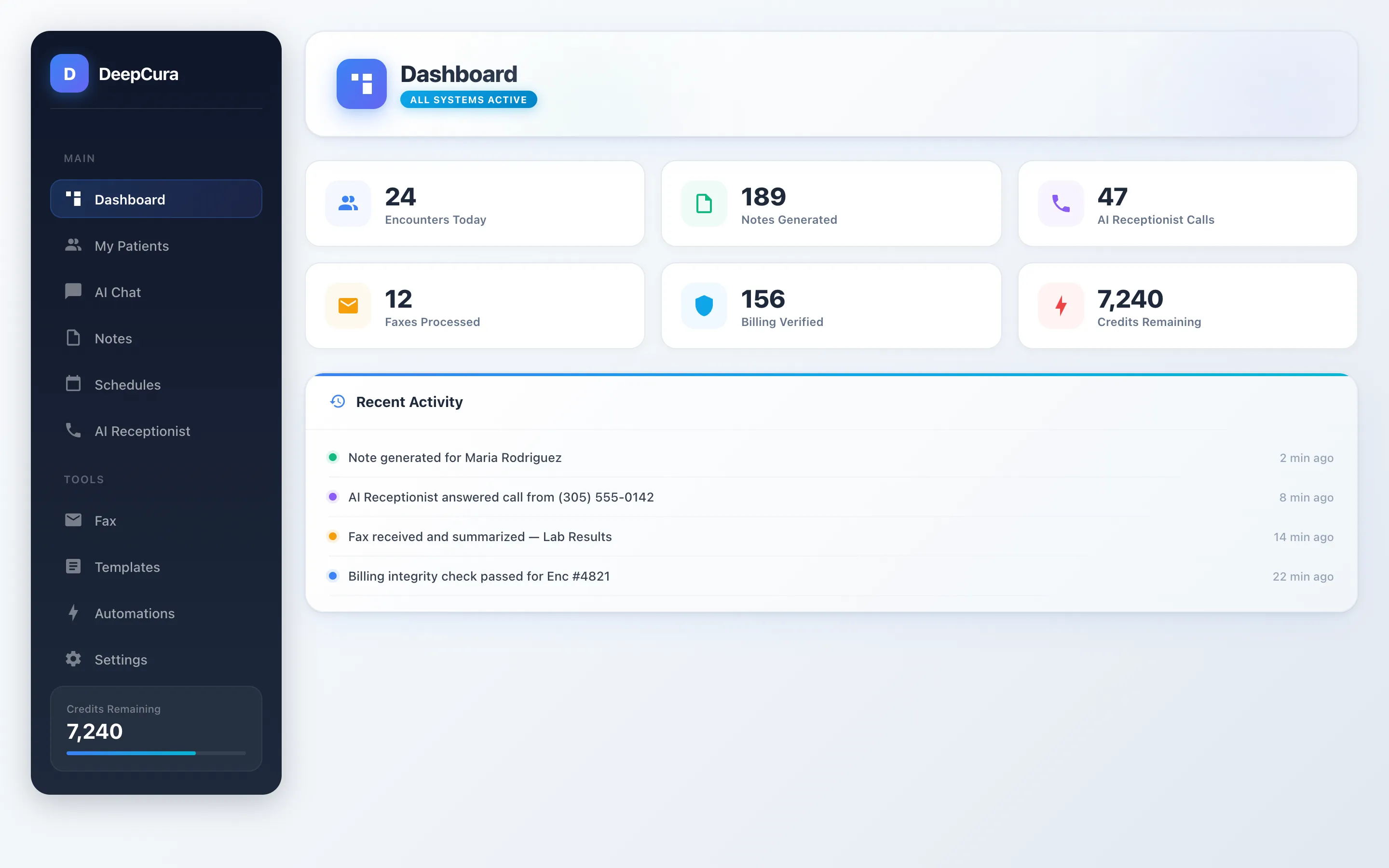 Screenshot: DeepCura UI — full dashboard with patient management, AI receptionist, notes, and automation.
Abridge AI Scribe Accuracy by Specialty
The Abridge AI scribe supports 55+ medical specialties across outpatient, inpatient, and emergency department settings. Here is how accuracy varies by specialty:
- Primary Care / Family Medicine: This is where the Abridge AI scribe performs strongly. Standard office visits with common presenting complaints produce notes requiring minimal editing. The linked evidence feature allows quick verification of any clinical detail.
- Internal Medicine: Complex multi-problem visits are handled competently, though clinicians with four or more active conditions per encounter should expect some post-generation review. Real-time note generation helps catch gaps during the visit.
- Cardiology: As a company founded by a cardiologist, Abridge has particular strength in cardiovascular documentation. Cardiac-specific terminology and complex diagnostic workups are handled well.
- Emergency Medicine: Abridge launched a dedicated ED documentation tool with Emory Healthcare and Johns Hopkins as early adopters. Fast-paced emergency encounters with multiple interruptions present challenges for ambient scribes, but Abridge's real-time processing helps.
- Pediatrics: Seattle Children's deployed Abridge across 18 pediatric specialties, suggesting solid performance in this area. Three-way conversations between parent, clinician, and child remain a challenge for all ambient scribes.
- Surgical and Procedural Specialties: Abridge has a partnership with Hospital for Special Surgery (HSS) for orthopedic documentation. Standard evaluations are handled well; complex operative planning requires more clinician editing.
For any specialty, health systems typically run a pilot period before full deployment to evaluate accuracy in their specific clinical environment.
Where Abridge AI Falls Short
No self-serve signup for individual clinicians or small practices. This is Abridge's most significant limitation for the broader market. Solo practitioners, small group practices, and independent clinics cannot purchase Abridge directly. The enterprise sales process requires organizational procurement, IT involvement, and contract negotiation — a process that can take months. For clinicians who need an AI scribe today, this is a dealbreaker.
No 24/7 AI receptionist. Abridge does not include any patient communication automation. There is no AI receptionist to handle incoming calls, schedule appointments, triage patient requests, or manage prescription refills. Practices using Abridge must maintain their front-desk staffing levels or use separate tools for patient communication. See our ranking of the best AI medical receptionists in 2026.
Epic-centric EHR integration. While Abridge's Epic integration is best-in-class, its support for other EHR systems is less deeply established. Abridge has expanded to support Athenahealth (partnership announced February 2025), eClinicalWorks, Cerner, AllScripts, and NextGen — though these integrations are newer and may not offer the same depth as the Epic integration. There is no confirmed integration with AdvancedMD, OptiMantra, or DrChrono. Practices not on Epic should evaluate the specific integration depth available for their EHR before committing.
No AI fax management. Inbound fax processing, document routing, and fax-based referral management are not part of the Abridge platform. Practices that receive a high volume of faxed records need to handle this workflow separately.
No apparent choice of AI engine. Based on publicly available information, clinicians cannot select which underlying AI model generates their notes. Abridge uses its proprietary Contextual Reasoning Engine, and there does not appear to be an option to switch between different AI engines for specific specialties or documentation styles.
No AI payment collection. Abridge does not handle patient balance outreach or payment processing. While the company has expanded into revenue cycle intelligence (billing code validation and real-time prior authorization via Availity), it does not offer direct patient payment collection.
No clinical AI chat. Abridge does not include a clinical AI assistant for answering medical questions, reviewing evidence, or supporting clinical decision-making during encounters. The platform's AI capabilities are focused on documentation and revenue cycle workflows rather than clinical reasoning. For clinical AI reasoning, see our guide to the best ChatGPT for doctors.
VC-funded with potential pricing risk. At $5.3 billion valuation with $750 million+ raised, Abridge faces immense pressure to grow revenue. This level of venture funding often leads to price increases, feature gating, or strategic pivots that affect existing customers. The enterprise contract model means health systems are locked into multi-year agreements with less pricing flexibility than month-to-month alternatives.
Who Is Abridge AI Best For?
Abridge is a strong fit for specific organizational profiles:
- Large health systems on Epic. If your organization runs Epic and has the IT infrastructure to support a deep ambient AI integration, Abridge offers the best Epic-embedded documentation experience available. The Pals partnership ensures tight workflow integration.
- Academic medical centers. Abridge's Carnegie Mellon and UPMC roots, combined with deployments at Mayo Clinic, Johns Hopkins, and Duke, make it a natural fit for academic institutions that value research partnerships and clinical validation.
- Organizations that prioritize linked evidence. If your compliance or quality team requires the ability to trace AI-generated notes back to source audio, Abridge's linked evidence feature is unique in the market.
- Health systems with dedicated IT procurement teams. Abridge's enterprise sales model requires organizational procurement. Institutions with established vendor evaluation and IT onboarding processes will navigate this more easily.
Who Should Consider Alternatives?
Abridge is not the right fit for every practice. Consider alternatives if:
- You are a solo practitioner or small practice. Abridge does not offer self-serve signup. If you want an AI scribe you can start using today, you need a platform with individual access.
- Your practice runs a non-Epic EHR. While Abridge has added support for Athenahealth, eClinicalWorks, Cerner, AllScripts, and NextGen, these integrations are less established than Epic. If you use AdvancedMD, OptiMantra, or DrChrono, Abridge does not currently offer integration.
- You need more than just documentation. If you want AI receptionist, fax management, billing integrity checks, prior authorization, and payment collection alongside scribing, you need a full-platform solution.
- Budget matters. At a reported $208+/month per provider, Abridge is significantly more expensive than alternatives that offer broader feature sets.
If you need ambient scribing plus native EHR write-back for athenahealth, eClinicalWorks, AdvancedMD, OptiMantra, Epic, DrChrono, CharmHealth, and Cerner, a 24/7 AI receptionist, billing integrity checks, fax management, and payment collection in one platform, DeepCura includes all of these for $129/month — roughly 40% less than Abridge's reported enterprise pricing.
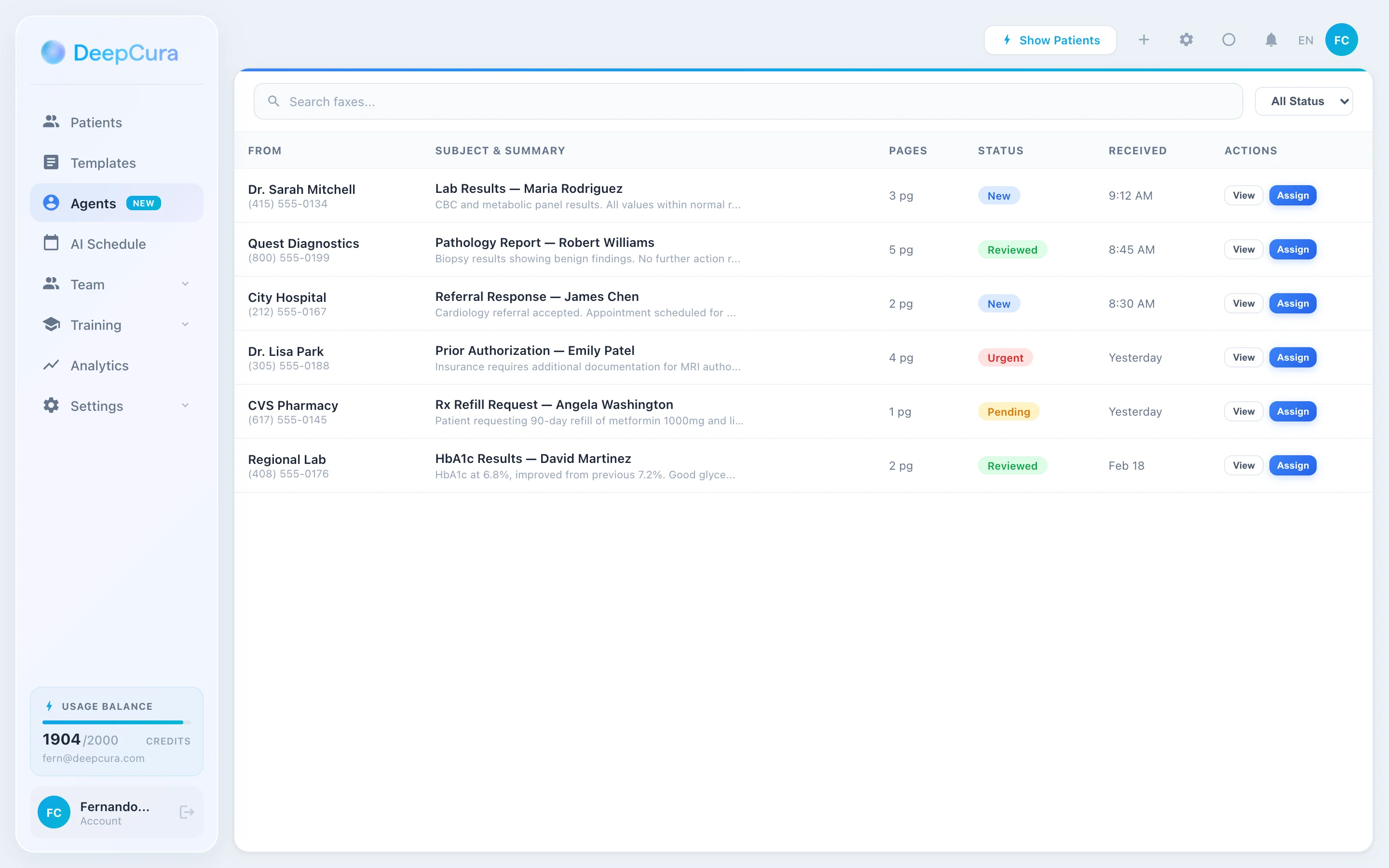 Screenshot: DeepCura UI — inbound fax management with AI-summarized faxes and automated processing.
Abridge AI Scribe vs Full-Platform Solutions
The Abridge AI scribe focuses on clinical documentation with deep Epic integration. To evaluate whether that scope justifies the enterprise pricing, here is how Abridge compares across every phase of the clinical workflow.
Pre-Visit Automation
| Feature | Abridge | DeepCura |
|---|---|---|
| AI Patient Intake | ✗ | ✓ |
| AI Receptionist (Phone) | ✗ | ✓ |
| Pre-Visit Summary | ✗ | ✓ |
Abridge has no pre-visit capabilities. There is no AI receptionist to handle incoming patient calls, no automated intake forms, and no pre-visit summary generation. Practices using the Abridge AI scribe must handle all pre-visit workflows manually. DeepCura's AI receptionist answers patient calls 24/7, handles scheduling and triage, and generates pre-visit summaries.
During the Visit
| Feature | Abridge | DeepCura |
|---|---|---|
| AI Medical Scribe | ✓ | ✓ |
| Real-Time Note Generation | ✓ | ✓ |
| Linked Evidence | ✓ | ✗ |
| Custom Note Templates | ✓ | ✓ |
| 50+ Specialties | ✓ (55+) | ✓ |
| Clinical AI Chat (Copilot) | ✗ | ✓ |
During the encounter, both platforms offer ambient scribing across 50+ specialties. Abridge's key advantage is linked evidence — the ability to trace notes back to source audio. DeepCura's advantage is the clinical AI copilot for real-time clinical reasoning during encounters.
Post-Visit Automation
| Feature | Abridge | DeepCura |
|---|---|---|
| AI Billing / E&M Coding | ✓ (revenue cycle intelligence) | ✓ (integrity checks) |
| EHR Integration (Native API) | ✓ (Epic deep + 5 others) | ✓ (athenahealth, eCW, AdvancedMD, OptiMantra, Epic, DrChrono, CharmHealth, Cerner) |
| Patient After-Visit Summary | ✓ | ✗ |
| AI Prior Authorization | ✓ (via Availity partnership, launched Jan 2026) | ✓ |
| AI Referral Letters | ✗ | ✓ |
| AI Tasks & Alerts | ✗ | ✓ |
| AI Fax Management | ✗ | ✓ |
| AI Payment Collection (Stripe) | ✗ | ✓ |
Post-visit is where the gap remains significant, though Abridge has narrowed it. Abridge offers billing code suggestions, patient after-visit summaries, and — as of January 2026 — real-time prior authorization through an Availity partnership. However, Abridge still lacks the full post-visit automation stack. DeepCura automates seven post-visit workflows with dedicated AI agents: billing validation, prior authorization, referral letters, task management, fax processing, and payment collection through Stripe. For practices using athenahealth, see how the full workflow integrates.
Platform Capabilities
| Feature | Abridge | DeepCura |
|---|---|---|
| Choose AI Engine (GPT, Claude, Gemini) | ✗ | ✓ |
| Self-Serve Signup | ✗ (enterprise only) | ✓ (free trial) |
| Team Collaboration | ✓ | ✓ |
| Analytics Dashboard & Wellness | ✓ (enterprise analytics) | ✓ |
| Starting Price | Not published (reported ~$208+/mo) | $129/mo |
Abridge uses proprietary AI models and requires enterprise procurement. DeepCura offers self-serve signup with a free trial, choice of AI engine, and an analytics dashboard — at roughly 40% lower cost.
For a direct side-by-side comparison, see our DeepCura vs Abridge breakdown. For a broader market overview, see our Best AI Medical Scribes in 2026 ranking.
See DeepCura in Action
Watch how DeepCura handles the full clinical workflow — from AI receptionist calls and patient intake through ambient scribing, automated billing, and native EHR write-back.

Frequently Asked Questions
Is Abridge HIPAA compliant?
Yes. Abridge is HIPAA compliant and provides a Business Associate Agreement (BAA) to covered entities. Data is encrypted in transit and at rest and stored in US-based data centers. As with any clinical AI tool, your organization remains responsible for proper configuration, access controls, and staff training.
How much does Abridge cost?
Abridge does not publish transparent pricing. The platform operates on enterprise contracts with pricing typically around $2,500 per clinician per year (approximately $208/month). Full implementations can range from $250-$500 per provider per month depending on integration depth and contract terms. There is no self-serve option for individual clinicians.
Does Abridge integrate with my EHR?
Abridge has its deepest integration with Epic through the Pals and Partners program. The platform has expanded to support Athenahealth, eClinicalWorks, Cerner, AllScripts, and NextGen, though these integrations are less established than Epic. There is no confirmed integration with AdvancedMD, OptiMantra, or DrChrono. If you are not on Epic, evaluate the specific integration depth available for your EHR before committing.
Can individual clinicians sign up for Abridge?
No. Abridge is sold exclusively through enterprise health system contracts. Individual clinicians, solo practitioners, and small practices cannot purchase Abridge directly. If you need an AI scribe with self-serve signup and a free trial, consider alternatives like DeepCura ($129/month) or Freed AI ($39-$119/month).
What makes Abridge different from other AI scribes?
Abridge's three key differentiators are: (1) linked evidence that traces every part of a note back to the source transcript and audio, (2) real-time note generation during encounters rather than after, and (3) the deepest Epic integration available as Epic's first Pal partner. These features make it particularly strong for large Epic-based health systems.
Is Abridge worth the price?
For large health systems on Epic with dedicated IT teams and enterprise procurement processes, Abridge delivers meaningful value through its deep integration, linked evidence, and real-time documentation. For individual clinicians and small practices, the enterprise-only model and higher pricing make it less practical — particularly when full-platform solutions like DeepCura offer broader automation at $129/month with self-serve access and a free trial.
What are the best Abridge alternatives?
The best alternative depends on your practice size and needs. DeepCura is the strongest option for practices wanting ambient scribing plus an AI receptionist, billing automation, fax management, native EHR write-back for athenahealth, eClinicalWorks, AdvancedMD, OptiMantra, Epic, DrChrono, CharmHealth, and Cerner, and payment collection for $129/month. Freed AI offers the simplest ambient scribe from $39-$119/month. Nuance DAX Copilot is the closest enterprise competitor for large Epic health systems. Heidi Health serves multilingual international practices. For a comprehensive comparison, see our Best AI Medical Scribes in 2026 ranking.
Does Abridge support my specialty?
Abridge supports 55+ medical specialties across outpatient, inpatient, and emergency department settings. Named specialties with confirmed deployments include primary care, cardiology, oncology, orthopedics, neuroscience, emergency medicine, pediatrics (18 specialties at Seattle Children's), psychiatry, gastroenterology, and urology. Health systems typically run a pilot to evaluate accuracy in their specific clinical environment before full deployment.
Final Verdict
Abridge is a technically impressive AI medical scribe that has earned its position as the leading enterprise ambient documentation platform. The linked evidence feature is genuinely unique — no other scribe lets clinicians trace generated notes back to source audio with a single click. The deep Epic integration is best-in-class. And the customer list (Kaiser Permanente, Mayo Clinic, Johns Hopkins) speaks for itself.
But Abridge's strengths are also its limitations. The enterprise-only model means individual clinicians and small practices are excluded entirely. While Abridge has expanded EHR support beyond Epic to include Athenahealth, eClinicalWorks, Cerner, AllScripts, and NextGen, the deepest integration remains Epic-focused, and non-Epic health systems may get a less integrated experience. And at a reported $208+ per provider per month, the pricing is substantially higher than alternatives that offer broader workflow automation.
The fundamental question is whether deep Epic integration and linked evidence justify paying roughly 60% more (on reported pricing) for a platform focused primarily on documentation and revenue cycle — while competitors like DeepCura offer ambient scribing plus an AI receptionist, billing automation, fax management, prior authorization, payment collection, and native write-back for athenahealth, eClinicalWorks, AdvancedMD, OptiMantra, Epic, DrChrono, CharmHealth, and Cerner for $129/month.
For large Epic health systems with enterprise procurement budgets, Abridge remains a top-tier choice. For everyone else — solo practitioners, small practices, multi-EHR organizations, and clinicians who need workflow automation beyond documentation — the value proposition points toward full-platform alternatives. Review our DeepCura vs Abridge comparison and our Best AI Medical Scribes in 2026 ranking to find the right fit. For a broader look at how Abridge compares to all 15 dictation and ambient AI tools, see our Best Medical Dictation Software guide.
Last verified: March 2026
References
[1] Abridge, "Generative AI for Clinical Conversations," Abridge.com. abridge.com
[2] KLAS Research, "Best in KLAS Awards — Ambient AI 2025 and 2026," KLASresearch.com. klasresearch.com
[3] U.S. Department of Health and Human Services, "HIPAA for Professionals," HHS.gov. hhs.gov/hipaa/for-professionals
[4] DeepCura, "AI Medical Scribe Platform — Ambient Scribing, AI Receptionist, EHR Integration," DeepCura.com. deepcura.com
[5] Epic Systems, "Pals and Partners Program," Epic.com. epic.com
[6] TIME, "Best Inventions 2024 and 2025," TIME.com. time.com
[7] CNBC, "Disruptor 50 — 2025," CNBC.com. cnbc.com
[8] G2, "Abridge Reviews," G2.com. g2.com/products/abridge
[9] Freed AI, "AI Medical Scribe — Ambient Clinical Documentation," Freed.ai. getfreed.ai
[10] Heidi Health, "AI-Powered Clinical Documentation," HeidiHealth.com. heidihealth.com