
Disclaimer: This review is based on publicly available information as of March 2026. Features, pricing, and capabilities may have changed. We encourage readers to verify current details directly with the vendor.
Reported from ~$299/month (pricing not published). Voice commands built in. No AI receptionist. Suki AI is the voice-first clinical assistant — combining ambient scribing with spoken commands for ordering, navigation, and chart Q&A.
Here is the picture at a glance:
- Strongest at: Voice-first commands, ambient order staging, 100+ specialties, 80+ languages
- Enterprise-focused: No transparent pricing — reported around $299/month per provider, enterprise contracts
- What it lacks: No AI receptionist, no fax management, no payment collection, no choice of AI engine
- Best for: Health systems on Epic, Oracle Health, or MEDITECH that want voice commands alongside ambient documentation
This review is an honest assessment of Suki AI in 2026. We cover what it does, how its voice-first approach differs from pure ambient scribes, where it excels, where it falls short, and how it compares to platforms that automate the full clinical workflow.
This review was last updated in March 2026. Pricing and features reflect publicly available information at the time of writing.
What Is Suki AI?
Suki AI is an AI-powered voice assistant and ambient clinical intelligence platform for healthcare professionals. Founded in 2017 by Punit Soni — a former Google product manager, VP of Product at Motorola, and CPO of Flipkart — Suki is headquartered in Redwood City, California.
What distinguishes Suki from pure ambient scribes like Freed AI or Abridge is its voice-first philosophy. The Suki AI scribe does not just listen and transcribe — it also accepts voice commands for ordering, charting, navigation, and clinical Q&A. The company's thesis has been that "AI is the new UI" — healthcare software should be invisible and voice-driven rather than requiring doctors to click through forms.
Suki has reportedly raised approximately $168 million in venture capital, including a $70 million Series D in 2024 led by Hedosophia. Strategic investors include Zoom Ventures, Venrock, and March Capital. The company reports partnerships with 400+ health systems and clinics, and received a 93.2/100 overall performance score in the 2024 KLAS Spotlight Report — with 95% of surveyed organizations saying they would buy Suki again. On the Apple App Store, Suki holds a 4.2 out of 5 rating based on 63 reviews.
Like Abridge, Suki is primarily an enterprise product. There is no transparent public pricing, and the sales process involves organizational procurement rather than individual self-serve signup.
How Suki AI Works
The Suki AI scribe combines ambient documentation with voice commands, creating a dual-mode clinical assistant:
Ambient mode. During a patient encounter, Suki listens to the clinician-patient conversation and generates structured clinical notes — SOAP, H&P, progress notes, or custom templates. This works similarly to other ambient AI scribes: the clinician speaks naturally, and Suki extracts clinical content, identifies speakers, and organizes findings into documentation.
Voice command mode. Beyond ambient listening, clinicians can speak direct commands to Suki: "Order metformin 500mg," "Show me the patient's last A1c," "Add hypertension to the problem list." These commands execute within the EHR, allowing hands-free interaction with the medical record during the encounter.
Ambient order staging. When a clinician discusses a treatment plan during the encounter, Suki can automatically structure, code, and stage prescription orders for approval. The clinician mentions a medication in conversation, and Suki prepares the order — structured and coded — ready for a single approval click in the EHR.
Chart Q&A. Clinicians can ask natural-language questions about a patient's chart: "When was the last colonoscopy?" or "What medications is this patient on?" Suki retrieves the answer from the EHR without requiring the clinician to navigate through chart tabs.
Review and approve. The completed note appears in the clinician's EHR for review and approval. For deeply integrated EHRs (Epic, Oracle Health, athenahealth, MEDITECH), notes flow directly into the chart. For other EHRs, a copy-paste or lightweight integration workflow is available.
Suki AI Pricing
Suki does not publish transparent pricing. The platform operates on an enterprise sales model with negotiated contracts. Based on industry analysis at the time of writing:
- Smaller clinics: approximately $299/month per provider (previously marketed as "Suki Compose")
- Larger practices / hospitals: approximately $399/month per provider (previously marketed as "Suki Assistant")
- Enterprise contracts: $350-$500+ per provider per month, depending on EHR integration depth, organization size, and contract terms
Note: Suki's current website does not display these product tier names or pricing. The figures above are based on industry reporting and may not reflect current rates.
Here is how the Suki AI scribe's pricing compares against alternatives:
| Plan | Price | Signup | EHR Write-Back | Voice Commands | Key Limitation |
|---|---|---|---|---|---|
| Suki (smaller clinics) | Not published (reported ~$299/mo) | Enterprise sales | 4 EHRs | ✓ | No self-serve, expensive |
| Suki (larger orgs) | Not published (reported ~$399/mo) | Enterprise sales | 4 EHRs | ✓ | Very expensive |
| DeepCura | $129/mo | Self-serve + free trial | athenahealth, eCW, AdvancedMD, OptiMantra, Epic, DrChrono, CharmHealth, Cerner | ✗ | No voice commands |
| Freed AI Premier | $119/mo | Self-serve | Scraping-based | ✗ | No native write-back |
At a reported $299-$399 per provider per month, the Suki AI scribe is among the most expensive options in the ambient AI scribe market. For a 10-provider practice, Suki would cost roughly $36,000-$48,000+ per year — compared to DeepCura at $13,872 per year on volume pricing ($1,156/mo for 10 providers — seats 1–2 at $129, 3–5 at $116, 6–10 at $110). DeepCura includes native EHR write-back for athenahealth, eClinicalWorks, AdvancedMD, OptiMantra, Epic, DrChrono, CharmHealth, and Cerner, a 24/7 AI receptionist, billing automation, fax management, and payment collection — none of which Suki offers. The $170-$270 monthly price gap per provider is significant, particularly for practices that need more than documentation.
Suki AI Scribe: Key Features
Ambient Clinical Documentation
The Suki AI scribe captures clinical conversations through ambient listening and generates structured notes across 100+ medical specialties. Notes are delivered in SOAP, H&P, progress note, or custom template formats. The platform supports 80+ languages for multilingual encounters.
Voice-First Commands
Suki's distinguishing feature is its voice command system. Clinicians can speak natural-language commands to interact with their EHR: ordering medications, adding diagnoses, navigating charts, and querying patient records — all without touching a keyboard or mouse. This voice-first approach extends Suki beyond pure ambient scribing into an interactive clinical assistant.
Ambient Order Staging
When clinicians discuss treatment plans during an encounter, the Suki AI scribe can automatically structure and code prescription orders. The clinician mentions a medication in conversation, and Suki prepares the order — structured with dosage, frequency, and appropriate codes — ready for a single-click approval in the EHR.
Clinical Coding Assistance
Suki generates ICD-10, HCC, CPT, and E&M billing code suggestions based on the documented encounter. These codes are available for both EHR-integrated and non-integrated workflows.
Chart Q&A
Clinicians can ask natural-language questions about patient records during encounters: "What was the last hemoglobin?" or "When was the last echo?" Suki retrieves answers from the EHR without requiring manual chart navigation.
Custom Note Templates
Suki supports customizable documentation templates that clinicians can adapt to their specialty and documentation preferences. Templates control section structure, content depth, and formatting.
HIPAA Compliance and BAA
Suki is HIPAA compliant and SOC 2 Type 2 certified. The platform provides a Business Associate Agreement (BAA) to all customers. According to previously published information, data is encrypted using TLS 1.2 in transit and AES-256 at rest. Verify current encryption standards directly with Suki via their trust portal (trust.suki.ai).
What the Suki AI Scribe Does Well
The voice-first approach is genuinely differentiated. While most AI scribes are passive listeners, the Suki AI scribe is an active assistant. Voice commands for ordering, charting, and chart Q&A create a hands-free clinical workflow that goes beyond documentation. For clinicians who want to interact with their EHR entirely by voice, Suki is the most mature product available.
Ambient order staging saves meaningful time. Automatically structuring and coding prescription orders from spoken treatment plans eliminates a tedious post-visit task. Clinicians mention a medication during the encounter, and the order is staged and ready for approval — no manual entry required.
100+ specialties and 80+ languages is the broadest coverage available. No other AI scribe claims support across as many specialties or languages. This breadth makes Suki viable for large health systems with diverse specialty departments and multilingual patient populations.
Strong multi-EHR integration. Suki has deep integrations with Epic, Oracle Health (Cerner), athenahealth, and MEDITECH — four of the largest EHR platforms. The athenahealth partnership and the EHR Partnership Program (MEDENT, Azalea Health, WellSky, HealthEdge) extend reach further.
KLAS validation is strong. The 93.2/100 KLAS performance score — with 95% of organizations saying they would buy again — provides independent validation of Suki's value. KLAS ROI validation reports from 2026 reportedly show significant reductions in after-hours documentation and meaningful incremental revenue per provider per month at surveyed health systems.
Active product development. Suki's partnerships with Zoom (telehealth), Google Cloud (Vertex AI), and its nursing consortium initiative show continued investment in expanding capabilities beyond core ambient scribing.
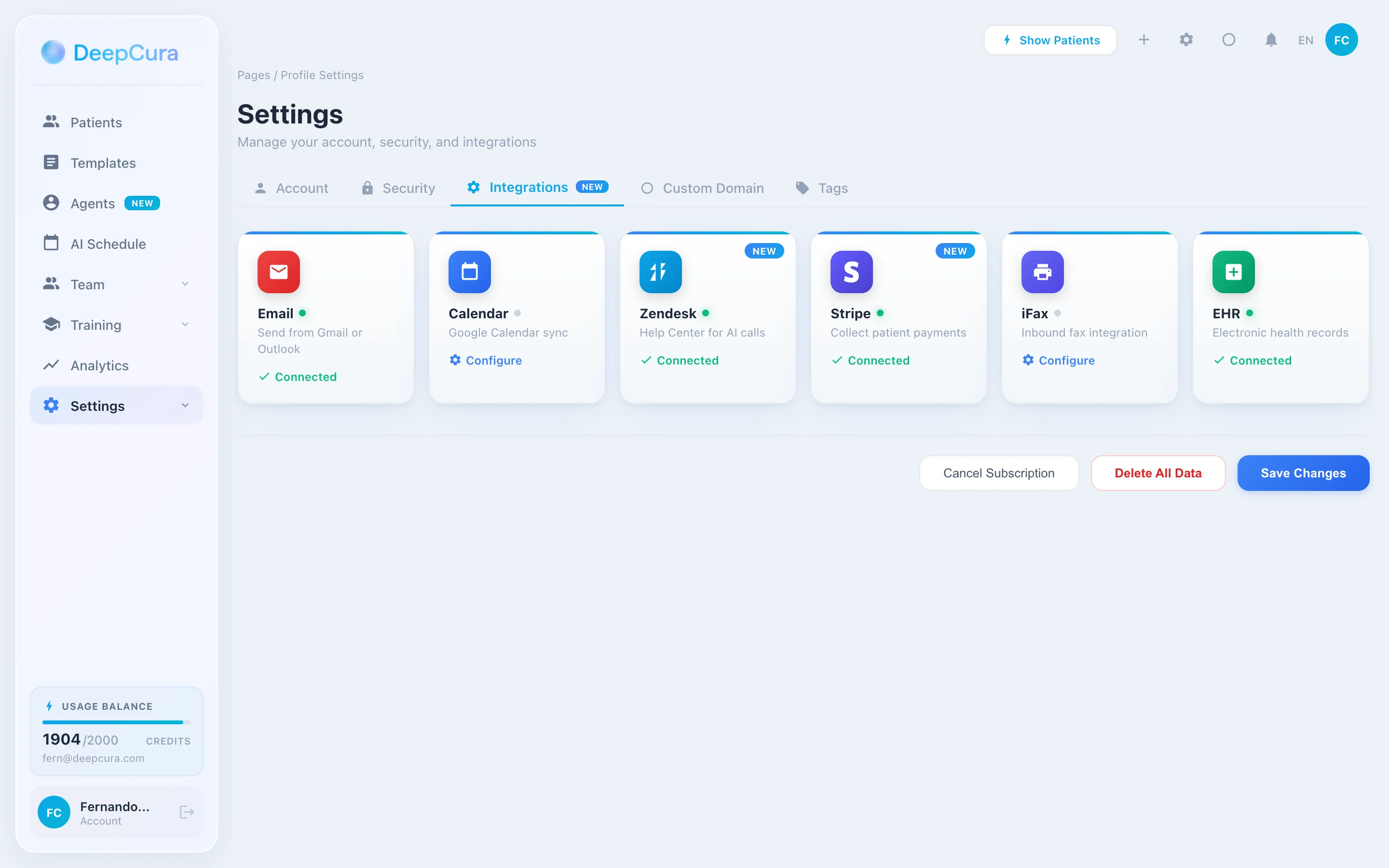 Screenshot: DeepCura UI — EHR integration settings with native connections to Epic, eClinicalWorks, Athena, and more.
Suki AI Scribe Accuracy by Specialty
The Suki AI scribe supports 100+ specialties — the broadest specialty coverage of any AI scribe on the market. Here is how accuracy varies by clinical context:
- Primary Care / Family Medicine: Standard office visits produce reliable notes with minimal editing required. Voice commands for common orders (refills, labs, imaging) add efficiency beyond documentation. Suki has previously claimed 99% accuracy and 0% hallucination rate for voice recognition.
- Internal Medicine: Complex multi-problem encounters are handled competently. The chart Q&A feature is particularly useful for reviewing patient history across multiple conditions without manual chart navigation.
- Cardiology: Cardiac-specific terminology and complex diagnostic language are handled well. Ambient order staging helps with medication adjustments that are common in cardiology visits.
- Psychiatry: Mental health documentation requires nuanced language for affect, risk assessment, and clinical impressions. Like all ambient scribes, the Suki AI scribe captures the broad narrative but psychiatrists should expect to edit for diagnostic precision.
- Emergency Medicine: Fast-paced ED encounters with multiple interruptions and concurrent patients challenge all ambient scribes. Suki's voice command system can be helpful for rapid order entry in emergency settings.
- Surgical Specialties: Standard evaluations and follow-ups are handled well. Complex operative planning and detailed procedural documentation require more post-generation editing. Suki's orthopedic and neurosurgery support has specific template options.
For any specialty, request a pilot period to evaluate accuracy in your specific clinical environment and EHR configuration before committing to an enterprise contract.
Where Suki AI Falls Short
Among the most expensive AI scribes on the market. At a reported $299-$399+ per provider per month, Suki sits above every competitor's published or reported price — including enterprise alternatives like Abridge (reported ~$208/month) and Nuance DAX Copilot (not publicly priced). For the price of one Suki license, a practice could purchase two or more DeepCura licenses ($129/month each) with broader feature coverage.
No 24/7 AI receptionist. Suki does not handle patient communication, call answering, appointment scheduling, or triage. Practices using Suki must maintain front-desk staffing or use separate tools. See our ranking of the best AI medical receptionists in 2026.
No AI fax management. Inbound fax processing, document routing, and fax-based referral management are not part of the Suki platform.
No AI payment collection. Suki does not handle patient balance outreach, payment processing, or revenue cycle automation.
Voice command learning curve. While voice commands are Suki's differentiator, they also introduce complexity. The extensive command vocabulary requires training and practice. Some users report that the commands are powerful once learned but add friction during the onboarding period — particularly for clinicians less comfortable with voice-driven workflows.
Drug recognition issues reported. Some user reviews mention that the Suki AI scribe occasionally fails to recognize discussed medications or places them in incorrect note sections. While not universal, this has been flagged in App Store reviews and industry feedback.
Generic notes after extended use. Some clinicians report that notes become repetitive or formulaic after using Suki for an extended period, with visit-specific details sometimes omitted in favor of templated language.
No choice of AI engine. Clinicians cannot select which underlying AI model generates their documentation. Suki uses its own proprietary models, with no option to switch engines.
Limited clinical reasoning capabilities. Suki has introduced a "Clinical Reasoning" feature that includes patient summaries and Q&A-based clinical insights. However, it does not appear to offer the breadth of a full clinical AI copilot for evidence-based reasoning, drug interaction checks, or differential diagnosis support. For dedicated clinical reasoning AI, see our guide to the best ChatGPT for doctors.
Limited EHR breadth. While Suki integrates deeply with 4 major EHRs (Epic, Oracle Health, athenahealth, MEDITECH), it does not support eClinicalWorks, AdvancedMD, OptiMantra, or DrChrono — all of which DeepCura supports with native write-back.
Who Is Suki AI Best For?
Suki AI is a strong fit for specific organizational profiles:
- Health systems on Epic, Oracle Health, or MEDITECH that want voice commands alongside ambient documentation. The deep integrations enable hands-free EHR interaction that lighter-weight scribes cannot match.
- Clinicians who prefer voice-driven workflows. If you are comfortable speaking commands and want to minimize keyboard and mouse interaction during encounters, Suki's voice-first approach is the most mature available.
- Large organizations that value validated ROI. KLAS validation data showing meaningful incremental revenue per provider per month provides a clear business case for enterprise procurement teams.
- Multi-specialty health systems needing support across 100+ specialties and 80+ languages from a single platform.
Who Should Consider Alternatives?
Suki is not the right fit for every practice. Consider alternatives if:
- Budget is a constraint. At a reported $299-$399/month per provider, Suki is 2-3x more expensive than alternatives offering broader feature sets.
- You are a solo practitioner or small practice. Enterprise sales processes and pricing models are not designed for individual clinicians.
- You need automation beyond documentation. If you want AI receptionist, fax management, billing integrity, prior authorization, and payment collection alongside scribing, you need a full-platform solution.
- You prefer simplicity over voice commands. If you just want to press record and get a note, simpler ambient scribes may be a better fit than learning Suki's voice command vocabulary.
If you need ambient scribing plus native EHR write-back for athenahealth, eClinicalWorks, AdvancedMD, OptiMantra, Epic, DrChrono, CharmHealth, and Cerner, a 24/7 AI receptionist, billing integrity checks, fax management, and payment collection in one platform, DeepCura includes all of these for $129/month — less than half of Suki's reported lowest tier.
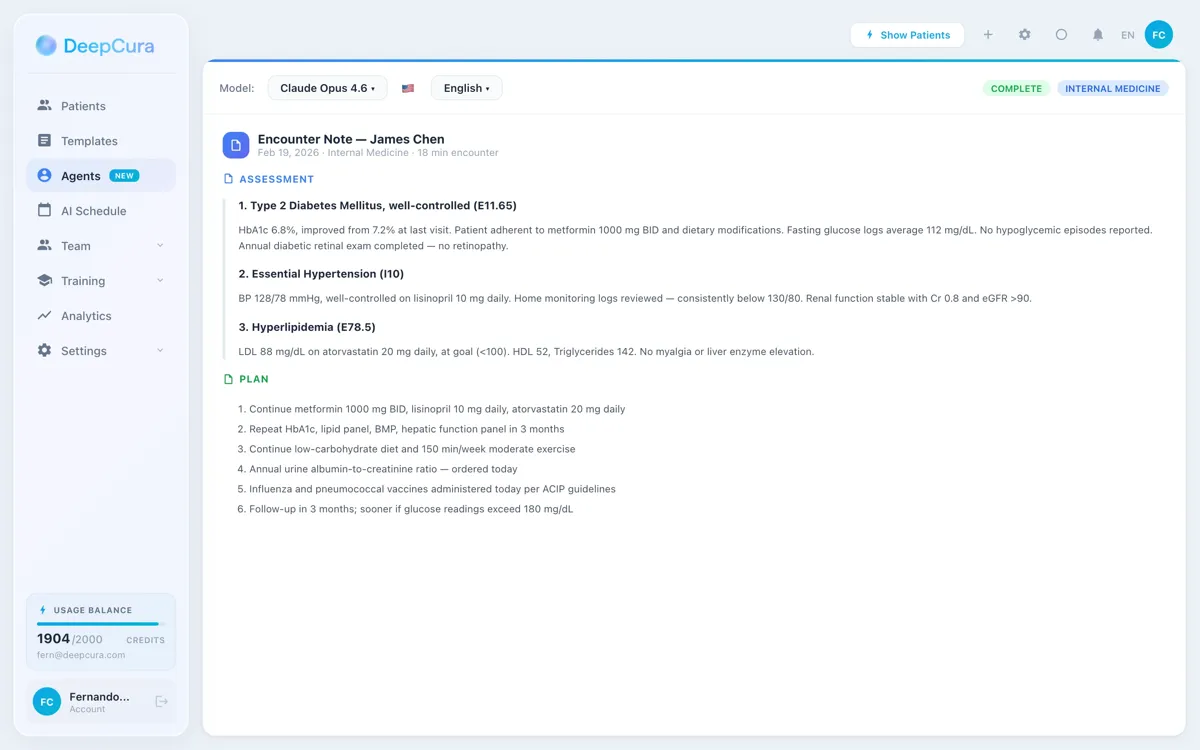 Screenshot: DeepCura UI — AI scribe with model selector for choosing between Claude, GPT-4o, or Gemini.
Suki AI Scribe vs Full-Platform Solutions
The Suki AI scribe combines ambient documentation with voice commands. To evaluate whether that combination justifies the premium pricing, here is how Suki compares across the full clinical workflow.
Pre-Visit Automation
| Feature | Suki AI | DeepCura |
|---|---|---|
| AI Patient Intake | ✗ | ✓ |
| AI Receptionist (Phone) | ✗ | ✓ |
| Pre-Visit Summary | ✓ (patient summaries) | ✓ |
Suki now offers patient summaries that provide a concise overview of a patient's history before each visit, but has no AI receptionist or automated intake. DeepCura's AI receptionist handles patient calls 24/7, manages scheduling and triage, and generates pre-visit summaries.
During the Visit
| Feature | Suki AI | DeepCura |
|---|---|---|
| AI Medical Scribe | ✓ | ✓ |
| Voice Commands | ✓ | ✗ |
| Ambient Order Staging | ✓ | ✗ |
| Chart Q&A | ✓ | ✗ |
| Custom Note Templates | ✓ | ✓ |
| 100+ Specialties | ✓ | ✓ (50+) |
| 80+ Languages | ✓ | ✓ |
| Clinical AI Chat (Copilot) | Limited (Clinical Reasoning) | ✓ |
During the encounter is where Suki shows its strongest differentiation. Voice commands, ambient order staging, and chart Q&A are capabilities that DeepCura and most competitors do not offer. Suki has introduced a Clinical Reasoning feature with patient summaries and Q&A-based insights, though DeepCura includes a more comprehensive clinical AI copilot for real-time clinical reasoning.
Post-Visit Automation
| Feature | Suki AI | DeepCura |
|---|---|---|
| AI Billing / E&M Coding | Basic suggestions | ✓ (integrity checks) |
| EHR Integration (Native API) | ✓ (4 EHRs) | ✓ (athenahealth, eCW, AdvancedMD, OptiMantra, Epic, DrChrono, CharmHealth, Cerner) |
| AI Prior Authorization | ✗ | ✓ |
| AI Referral Letters | ✗ | ✓ |
| AI Tasks & Alerts | ✗ | ✓ |
| AI Fax Management | ✗ | ✓ |
| AI Payment Collection (Stripe) | ✗ | ✓ |
Post-visit automation is where Suki's scope ends and DeepCura's full platform begins. Suki offers billing code suggestions, but no validated E&M integrity checks, no prior authorization, no referral letters, no fax management, and no payment collection. DeepCura automates all seven post-visit workflows. For athenahealth users specifically, see how the full workflow integrates.
Platform Capabilities
| Feature | Suki AI | DeepCura |
|---|---|---|
| Choose AI Engine (GPT, Claude, Gemini) | ✗ | ✓ |
| Self-Serve Signup | ✗ (enterprise only) | ✓ (free trial) |
| Team Collaboration | ✓ | ✓ |
| Analytics Dashboard & Wellness | ✗ | ✓ |
| Starting Price | Not published (reported ~$299/mo) | $129/mo |
Suki costs more than double DeepCura while offering a narrower feature set beyond the encounter itself. The voice command system is powerful, but practices must weigh whether that capability alone justifies the premium.
For a direct side-by-side comparison, see our DeepCura vs Suki breakdown. For a broader market overview, see our Best AI Medical Scribes in 2026 ranking.
See DeepCura in Action
Watch how DeepCura handles the full clinical workflow — from AI receptionist calls and patient intake through ambient scribing, automated billing, and native EHR write-back.

Frequently Asked Questions
Is Suki AI HIPAA compliant?
Yes. Suki AI is HIPAA compliant and SOC 2 Type 2 certified. The platform provides a Business Associate Agreement (BAA) to all customers. For current encryption and infrastructure details, visit Suki's trust portal at trust.suki.ai.
How much does Suki AI cost?
Suki does not publish transparent pricing. Based on industry analysis, pricing has been reported at approximately $299-$399/month per provider depending on organization size, with enterprise contracts ranging from $350-$500+ per provider per month. Contact Suki directly for current pricing.
Does Suki AI integrate with my EHR?
Suki has deep integrations with Epic, Oracle Health (Cerner), athenahealth, and MEDITECH. The EHR Partnership Program extends to MEDENT, Azalea Health, and WellSky. However, there is no integration with eClinicalWorks, AdvancedMD, Veradigm, OptiMantra, or DrChrono. A non-integrated copy-paste mode is available for other EHRs.
What is the difference between Suki and other AI scribes?
Suki's key differentiator is its voice-first approach. While most AI scribes only listen passively and generate notes, the Suki AI scribe also accepts voice commands for ordering medications, navigating charts, querying patient records, and staging orders. It is an interactive clinical assistant, not just a passive scribe.
Can individual clinicians sign up for Suki?
Suki primarily sells through enterprise contracts. While smaller clinic options may exist, the sales process still involves organizational procurement rather than individual self-serve signup. Clinicians wanting immediate self-serve access should consider alternatives like DeepCura ($129/month with free trial) or Freed AI ($39-$119/month).
Is Suki AI worth the price?
Suki's value depends on how much you value voice commands alongside ambient scribing. For health systems on Epic or MEDITECH that want hands-free EHR interaction, the KLAS-validated ROI data can justify the investment. For practices that need broader automation (receptionist, fax, billing, payments) or operate on non-supported EHRs, the premium pricing is harder to justify when full-platform alternatives cost half the price.
What are the best Suki AI alternatives?
DeepCura is the strongest option for practices wanting ambient scribing plus AI receptionist, billing automation, fax management, and EHR write-back for athenahealth, eClinicalWorks, AdvancedMD, OptiMantra, Epic, DrChrono, CharmHealth, and Cerner for $129/month. Freed AI offers the simplest ambient scribe from $39-$119/month. Abridge is the closest enterprise competitor with deep Epic integration. Heidi Health serves multilingual international practices at $150/user/month billed yearly (free tier available). For a comprehensive comparison, see our Best AI Medical Scribes in 2026 ranking.
Does Suki support my specialty?
Suki supports 100+ medical specialties — the broadest coverage of any AI scribe. Confirmed specialties include primary care, cardiology, gastroenterology, dermatology, rheumatology, emergency medicine, neurosurgery, orthopedic surgery, psychiatry, oncology, pediatrics, OB/GYN, and many more. Support extends across outpatient, inpatient, and emergency department settings.
Final Verdict
Suki AI is the most feature-rich clinical voice assistant on the market. The combination of ambient scribing, voice commands, ambient order staging, and chart Q&A creates a hands-free clinical workflow that no other product matches. For clinicians who want to interact with their EHR entirely by voice, Suki is the most mature and capable option available.
The tradeoff is clear: Suki is also among the most expensive AI scribes on the market. At a reported $299-$399+ per provider per month, it costs more than double most competitors — including platforms that offer broader workflow automation. Voice commands and ambient order staging are powerful features, but they primarily help during the encounter itself. While Suki has added patient summaries for pre-visit preparation and basic clinical reasoning capabilities, it still lacks an AI receptionist, fax management, prior authorization, and payment collection.
For health systems on Epic, Oracle Health, or MEDITECH with enterprise budgets and clinicians who will fully adopt voice-driven workflows, Suki delivers strong ROI backed by KLAS validation. For everyone else — solo practitioners, small practices, budget-conscious organizations, and practices that need automation beyond documentation — the pricing premium is difficult to justify when DeepCura offers ambient scribing plus seven additional AI agents for $129/month.
The fundamental question is whether voice commands during encounters are worth paying 2-3x more for a platform that does less everywhere else. Review our DeepCura vs Suki comparison and our Best AI Medical Scribes in 2026 ranking to evaluate the tradeoff for your practice. For a broader comparison of all 15 dictation and ambient AI tools, see our Best Medical Dictation Software guide.
Last verified: March 2026
References
[1] Suki AI, "AI-Powered Voice Assistant for Clinicians," Suki.ai. suki.ai
[2] KLAS Research, "Suki Assistant — 2024 KLAS Spotlight Report (93.2/100)," KLASresearch.com. klasresearch.com
[3] KLAS Research, "Suki ROI Validations 2026," KLASresearch.com. klasresearch.com
[4] U.S. Department of Health and Human Services, "HIPAA for Professionals," HHS.gov. hhs.gov/hipaa/for-professionals
[5] DeepCura, "AI Medical Scribe Platform — Ambient Scribing, AI Receptionist, EHR Integration," DeepCura.com. deepcura.com
[6] Freed AI, "AI Medical Scribe — Ambient Clinical Documentation," Freed.ai. getfreed.ai
[7] Heidi Health, "AI-Powered Clinical Documentation," HeidiHealth.com. heidihealth.com
[8] Abridge, "Generative AI for Clinical Conversations," Abridge.com. abridge.com
[9] Zoom Communications, "Zoom Ventures Invests in Suki AI," Zoom.com. zoom.com
[10] Google Cloud, "Vertex AI Partnership with Suki," Cloud.Google.com. cloud.google.com
[11] Apple App Store, "Suki — AI-Powered Voice Assistant," Apple Inc. apps.apple.com/us/app/suki/id1425102117