
Doctors of Chiropractic spend 90-150 minutes per day on documentation across initial exams, daily progress (SOAP) notes, re-evaluations, and treatment plan updates — and that documentation directly determines whether CMT codes 98940 (1-2 spinal regions), 98941 (3-4 spinal regions), 98942 (5 spinal regions), and 98943 (extraspinal) get paid by Medicare and commercial insurance. Medicare requires PART criteria (Pain, Asymmetry, Range of motion abnormality, Tissue tone changes) plus a documented subluxation at a specific spinal level for every CMT claim, and the AT modifier must distinguish active treatment from non-covered maintenance care. The 2024 OIG Work Plan listed chiropractic services among targeted audit categories for the seventh consecutive year, with documentation deficiencies (missing PART, vague subluxation listings, AT modifier misuse) cited as the leading cause of denied and recouped claims.
We ranked 6 AI scribes on the criteria that matter most for chiropractic documentation:
- PART criteria and subluxation documentation — does the AI capture Pain, Asymmetry, Range of motion abnormality, and Tissue tone changes at each adjusted segment, and document the specific spinal level subluxation (C1-C7, T1-T12, L1-L5, sacrum, pelvis, ilium) required for Medicare CMT billing?
- CMT and CPT code support — does it differentiate 98940 (1-2 regions), 98941 (3-4 regions), 98942 (5 regions), 98943 (extraspinal), and modalities 97014/97032/97035/97110/97112/97140/97530, with correct AT modifier and ABN handling?
- Orthopedic and neurologic test capture — does it structure SLR, Kemp's, FABER (Patrick's), Spurling's, Adson's, Phalen's, Tinel's, Yeoman's, Yergason's, Hawkins-Kennedy, Empty Can, and Drop Arm test results with positive/negative findings?
- Technique-specific note structures — does it support Gonstead, Diversified, Activator, Thompson, SOT (Sacro-Occipital Technique), Cox Flexion-Distraction, Logan Basic, and Webster Technique documentation conventions?
All products were evaluated in February-April 2026. Pricing reflects publicly available rates. AI scribe adoption among chiropractors trails physician/APP adoption; integration depth with chiropractic-specific PMS (ChiroTouch, ChiroSpring, ChiroFusion, Genesis) varies meaningfully across vendors.
Disclosure & methodology. This comparison is published by DeepCura, which is included in the ranking. Pricing and feature claims for competitor products reflect publicly available information as of the evaluation period above and may change — verify directly with each vendor before procurement. This article is editorial commentary; it is not medical, legal, billing, or compliance advice. CPT® is a registered trademark of the American Medical Association. ACA, ICA, NCMIC, ChiroTouch, ChiroSpring, Genesis, and other organization and product names referenced are trademarks of their respective owners; DeepCura is not affiliated with or endorsed by these organizations. References are nominative and used for descriptive comparison only.
Why Chiropractors Need an AI Scribe
The Documentation Reality in a Chiropractic Practice
A typical chiropractic practice generates documentation across four distinct visit types, each with different content requirements and audit risk:
- Initial exam (99202-99205, 99203 typical for new chiropractic patient) — 60-90 minutes of history, orthopedic and neurologic testing, ROM measurements, static and motion palpation findings, postural analysis, gait analysis, and treatment plan with goals and frequency
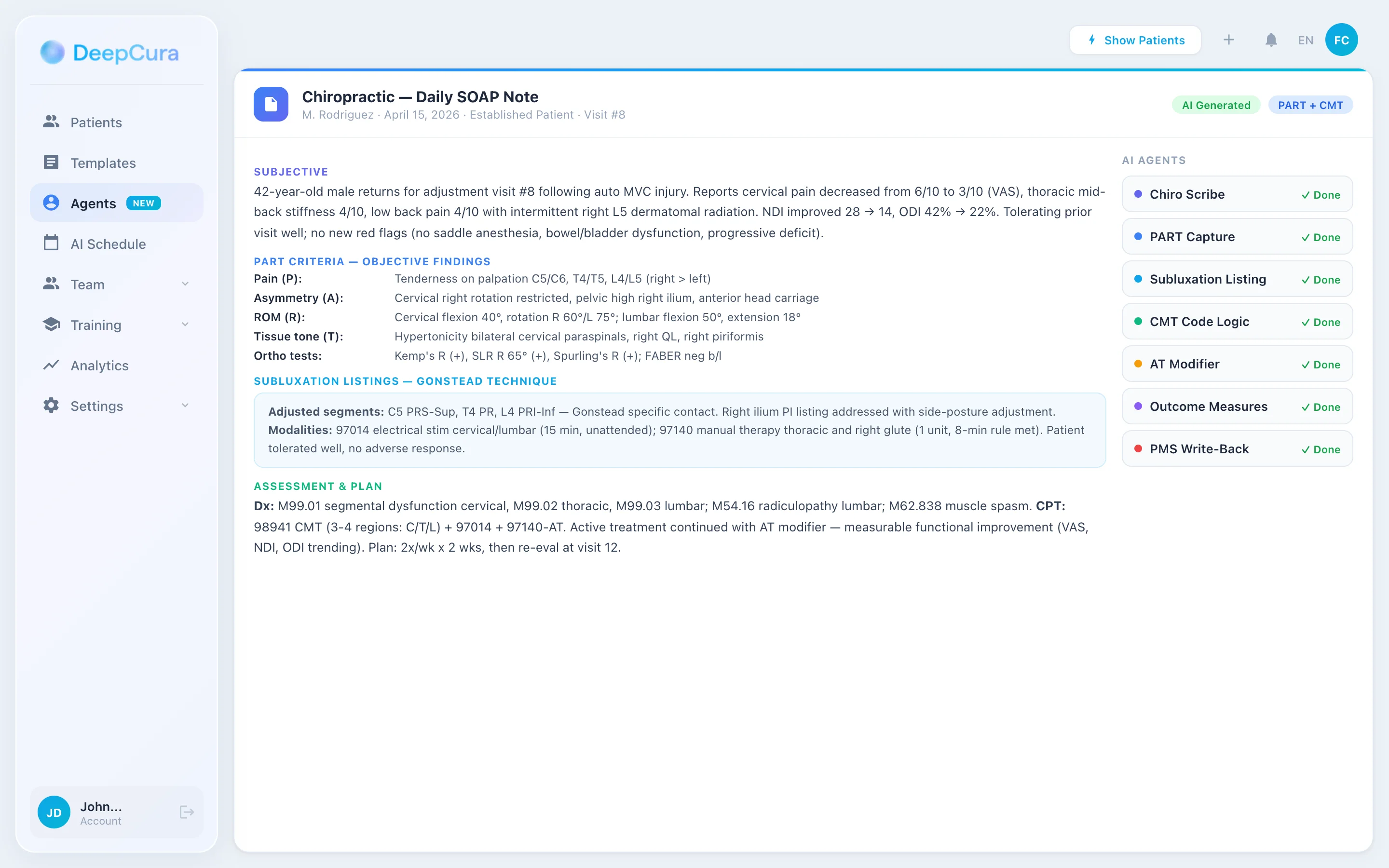
- Daily progress (SOAP) notes for each adjustment visit — typically 5-15 minutes documented per visit, generated 15-40 times per day in busy practices, requiring PART criteria at each adjusted level, subluxation listing, technique used, modalities, and patient response
- Re-evaluation (99213-99214 established patient) — 30-day or 12-visit re-evaluation with outcome measure trends (VAS, NDI, ODI, RMDQ), updated functional goals, and treatment plan modifications
- Discharge or maintenance transition — final functional outcomes, MMI determination, transition from active treatment (AT modifier) to maintenance/wellness care (no AT modifier, often non-covered by Medicare)
Across a 30-patient day, that produces 30+ daily SOAP notes, plus 1-2 initial exams (at 60-90 minutes each) or 2-3 re-evaluations. The documentation burden is significant — and unlike physician documentation, every line of a chiropractic SOAP note is potentially audited because Medicare and commercial payers actively review chiropractic claims for AT modifier abuse, vague subluxation listings, and missing PART criteria.
What General-Purpose AI Scribes Miss in Chiropractic Practice
Most AI medical scribes are built around the physician encounter — HPI, focused exam, MDM, plan. Chiropractic documentation is fundamentally different in ways that break general-purpose scribes:
- PART criteria — the audit-critical four-letter requirement. Every Medicare CMT claim requires documented PART findings: Pain (subjective complaint, location, character, severity), Asymmetry (postural, palpatory, X-ray), Range of motion abnormality (cervical, thoracic, lumbar, with degrees where measured), and Tissue tone changes (hypertonicity, fibrosis, edema, tenderness on palpation). A general-purpose scribe that produces a generic SOAP note without explicit PART structure invites Medicare denial.
- Subluxation listings at specific spinal levels. Medicare requires documentation of the specific vertebral level being adjusted — C1, C2 atlas/axis, C3-C7 mid/lower cervical, T1-T12 thoracic, L1-L5 lumbar, sacrum, ilium (left/right), coccyx — often using listing systems specific to technique (Gonstead listings like ASRP, PRI; Diversified naming; Activator levels). A scribe that says "adjusted neck and back" produces an unbillable note.
- CMT code differentiation by region count. 98940 (1-2 spinal regions), 98941 (3-4 spinal regions), 98942 (5 spinal regions), 98943 (extraspinal — extremity, TMJ, ribs). The AI must count distinct spinal regions adjusted (the five regions are cervical, thoracic, lumbar, sacral, pelvic) and select the correct CMT code. Mis-counting drives both undercoding (lost revenue) and overcoding (audit risk).
- AT modifier — active treatment vs maintenance. The AT (Active Treatment) modifier is required on every Medicare CMT claim where the chiropractor is providing active treatment toward documented functional improvement. Removing AT signals maintenance/wellness care, which Medicare does not cover. The documentation must support the AT designation with clear functional goals, measurable outcomes, and progress trends — or with an ABN (Advance Beneficiary Notice) when transitioning to maintenance.
- Orthopedic and neurologic test panels. SLR (Straight Leg Raise) for radiculopathy, Kemp's for facet involvement, FABER/Patrick's for SI joint, Spurling's for cervical radiculopathy, Adson's for thoracic outlet, Phalen's and Tinel's for carpal tunnel, Yeoman's for SI joint, Yergason's and Speed's for biceps tendinopathy, Hawkins-Kennedy and Empty Can for impingement, Drop Arm for rotator cuff tear. Each test has a specific positive finding pattern. A general-purpose scribe rarely structures these correctly.
- ROM measurement specificity. Cervical (flexion 45-60°, extension 60-75°, lateral flexion 45°, rotation 80°), thoracic (flexion 20-45°, rotation 30-40°), lumbar (flexion 60°, extension 25°, lateral flexion 25°). Documentation should capture both normative ranges and patient-specific limitations with degrees where goniometric measurement is performed.
- Technique-specific listings and conventions. Gonstead uses specific listings (ASRP, PRI-La, PI ilium, AS ilium); Diversified names segments differently; Activator uses pelvic deficiency analysis with leg length checks; Thompson uses drop-table testing; SOT uses category I/II/III pelvic blocking; Cox Flexion-Distraction documents disc decompression; Logan Basic documents sacral apex contact. The AI must support the technique-specific vocabulary the practice uses.
- Modality CPT alignment. 97014 / 97032 (electric stimulation, unattended/attended), 97035 (ultrasound), 97110 (therapeutic exercise), 97112 (neuromuscular re-education), 97124 (massage), 97140 (manual therapy), 97150 (group therapeutic procedures), 97530 (therapeutic activities). The 8-minute rule and supervised vs constant attendance distinctions matter for billing compliance.
- Outcome assessment integration. VAS (Visual Analog Scale 0-10), NDI (Neck Disability Index 0-50), ODI (Oswestry Disability Index 0-100%), RMDQ (Roland-Morris Disability Questionnaire 0-24), QuickDASH, LEFS (Lower Extremity Functional Scale), HOOS, KOOS. Active treatment documentation requires periodic outcome reassessment with measurable change.
Audit, Compliance, and Personal Injury Stakes
Chiropractic documentation has direct compliance and revenue consequences. The OIG has listed chiropractic services in its Work Plan continuously for over a decade, with documentation deficiencies (missing PART, vague subluxation, improper AT modifier) cited as the leading cause of denied and recouped claims. The 2009 OIG report on chiropractic services found that nearly half of chiropractic claims to Medicare contained inadequate documentation to support medical necessity — a finding that has informed audit strategy ever since.
Beyond Medicare, personal injury (PI) work — auto accidents, slip-and-fall, work-comp — requires documentation specifically structured for IME (Independent Medical Examination) review, plaintiff/defense attorney production, and FCE (Functional Capacity Evaluation) integration. PI documentation must establish causation (mechanism of injury, temporal relationship), severity (objective findings with measurable limitations), and treatment necessity (active treatment toward measurable functional goals).
An AI scribe that supports PART criteria, subluxation listings, technique-specific conventions, CMT code differentiation, AT modifier reasoning, and PI-grade narrative depth directly affects both audit defensibility and revenue capture in a chiropractic practice.
Quick Comparison — Top AI Scribes for Chiropractors
| Rank | Tool | Price | Chiropractic-Specific | EHR / PMS Integration | Best For |
|---|---|---|---|---|---|
| 1 | DeepCura | $129/mo | Custom PART + CMT + technique templates | athenahealth, eCW, AdvancedMD, OptiMantra, Epic, DrChrono, CharmHealth, Cerner + custom mapping | Best Overall |
| 2 | Freed AI | $39–$119/mo | Generic SOAP, AT-friendly | Browser-based EHR push (Premier) | Solo DC |
| 3 | DeepScribe | Custom (not published) | Customizable templates | Custom builds | Customization |
| 4 | Heidi Health | Free / $150/mo (billed yearly) | Generic templates, adaptable | Limited write-back | Free tier trial |
| 5 | Suki AI | Not publicly priced | Voice-first ambient + dictation | Epic, Cerner, athenahealth | Voice-first |
| 6 | Nuance DAX Copilot | Custom enterprise | Enterprise multi-disciplinary | Epic, Cerner deep | Multi-disciplinary enterprise |
For a broader cross-specialty comparison, see our Best AI Medical Scribes in 2026 ranking. For physical therapy practice tool selection, see our best AI scribe for physical therapy guide.
What to Look For in a Chiropractic AI Scribe
Chiropractic documentation is not generic SOAP. Before choosing a tool, evaluate it against these eight criteria:
1. PART Criteria Structure. The AI must produce explicit PART findings (Pain, Asymmetry, Range of motion abnormality, Tissue tone changes) at each adjusted segment, structured as separate documentation elements rather than buried in narrative. Medicare auditors look for the four-letter pattern.
2. Subluxation Listings at Specific Spinal Levels. The AI should document subluxations at specific vertebral levels (C1-C7, T1-T12, L1-L5, sacrum, ilium left/right, coccyx) using either generic naming or technique-specific listings (Gonstead ASRP/PRI/PI/AS; Diversified naming; Activator pelvic deficiency).
3. CMT Code Differentiation (98940-98943). The AI must count the distinct spinal regions adjusted (cervical, thoracic, lumbar, sacral, pelvic — 5 total) and select 98940 (1-2 regions), 98941 (3-4 regions), or 98942 (5 regions). Extraspinal adjustments code as 98943. Modality codes (97014, 97032, 97035, 97110, 97112, 97124, 97140, 97150, 97530) must align with documented services and the 8-minute rule.
4. AT Modifier and ABN Handling. Active Treatment vs maintenance care distinction with documented functional goals, outcome trends, and ABN issuance for non-covered maintenance care. The AI should flag documentation gaps that risk losing AT designation.
5. Orthopedic and Neurologic Test Panels. Structured documentation of SLR, Kemp's, FABER (Patrick's), Spurling's, Adson's, Phalen's, Tinel's, Yeoman's, Yergason's, Speed's, Hawkins-Kennedy, Empty Can, Drop Arm, with explicit positive/negative findings and laterality.
6. ROM Measurement Capture. Cervical, thoracic, lumbar ROM documentation with degrees where measured, normative range comparisons, and trend across visits.
7. Technique-Specific Conventions. Support for Gonstead, Diversified, Activator, Thompson, SOT, Cox Flexion-Distraction, Logan Basic, Pierce-Stillwagon, Webster Technique documentation conventions.
8. PMS Integration. Bidirectional integration with chiropractic-specific PMS (ChiroTouch, ChiroSpring, ChiroFusion, Genesis Chiropractic Software, Platinum System, Eclipse, Atlas) for SOAP push and patient demographic pull. General EHR integration alone is insufficient if the practice runs on a chiropractic PMS.
Detailed Reviews
1. DeepCura — Best Overall for Chiropractic Documentation
DeepCura is a customizable clinical AI platform that combines ambient scribing, clinical decision support, evidence search, practice automation, and bidirectional EHR integration — $129 per provider per month (or $999/yr) with 1,000 credits a month across every AI agent; a standard note costs 1 credit (3 on premium models, 15 on the deepest reasoning tier). For chiropractors, particularly those operating solo, in small group practices, or in multidisciplinary clinics, DeepCura's customizable templates and 1,000 credits per provider per month deliver the strongest fit because no off-the-shelf scribe ships with PART/CMT/subluxation/technique structure out of the box.
For DCs, the key differentiator is template flexibility. DeepCura's custom template builder lets practice leads encode chiropractic-specific templates: an initial exam template with chief complaint, OPQRST history, full orthopedic and neurologic test panel (SLR, Kemp's, FABER, Spurling's, Adson's, Phalen's, Tinel's, Yeoman's, Yergason's, Hawkins-Kennedy, Empty Can, Drop Arm), ROM measurements (cervical/thoracic/lumbar), static and motion palpation findings, postural and gait analysis, outcome measure baselines (VAS, NDI, ODI, RMDQ), treatment plan with measurable goals and CMS-compliant frequency justification; a daily SOAP template with subjective response since last visit, PART criteria at each adjusted level, subluxation listing per technique convention (Gonstead/Diversified/Activator), CMT code calculation (98940/98941/98942 + 98943 if extraspinal), modality documentation with 8-minute rule (97014/97032/97035/97110/97112/97140/97530), patient response and tolerance, and home care recommendations; a 30-day re-evaluation template with outcome measure trending, functional goal progress, and treatment plan modification with AT modifier reasoning.
CDS Mode (3 credits per encounter) generates clinical decision support — particularly valuable for new patient evaluations involving radiculopathy red flags (cauda equina, progressive neurologic deficit, suspected fracture), atypical presentations requiring imaging or referral consideration, and PI cases where causation analysis affects both treatment plan and legal documentation.
DeepEvidentia — DeepCura's evidence search engine — pulls from PubMed, Cochrane, ACA (American Chiropractic Association) clinical guidelines, ICA technical references, ACA Council on Diagnostic Imaging position papers, NCMIC risk management guidance, and CMS chiropractic LCDs (Local Coverage Determinations). Useful for DCs verifying current evidence on technique application, treatment frequency, and imaging appropriateness.
Strengths:
- Custom templates per visit type (initial exam, daily SOAP, re-evaluation, discharge, PI exam) with PART criteria, technique-specific listings, and CMT code logic
- Subluxation listing capture by technique (Gonstead, Diversified, Activator, Thompson, SOT, Cox, Logan, Webster)
- Orthopedic and neurologic test panel structuring with laterality and positive/negative findings
- ROM measurement capture (cervical, thoracic, lumbar) with goniometric degrees
- AT modifier reasoning with functional goal tracking and trend
- PI-grade narrative depth for IME review and attorney production
- Outcome measure integration (VAS, NDI, ODI, RMDQ, QuickDASH, LEFS)
- Multiple AI engines matched to documentation complexity (1-15 credits)
- 1,000 credits per provider per month (1 credit per standard note)
- Bidirectional integration with major EHRs and chiropractic PMS via custom field mapping (ChiroTouch, ChiroSpring, Genesis via integration partner work)
Limitations:
- Custom template builder requires meaningful initial setup (10-20 hours per practice to encode chiropractic-specific templates and technique conventions)
- Native integration with chiropractic-specific PMS (ChiroTouch, ChiroSpring, ChiroFusion) requires verifying integration depth — may need clipboard or browser-extension approach for some PMS
- Multi-technique practices (one DC using Gonstead, another using Activator) require separate templates per technique
Pricing: $129/month per provider — all features included. Free trial available, no credit card required.
Verdict: DeepCura is the strongest choice for chiropractic practices that need PART criteria structure, technique-specific listings, CMT code differentiation, and AT modifier handling at a per-provider price point that is economically viable at solo and small group scale. The flexibility cost is upfront setup time, but the per-provider pricing and 1,000 monthly credits make it the strongest fit for chiropractic at scale.
DeepCura: Customizable AI Scribe for Chiropractors
PART criteria, subluxation listings, CMT 98940-98943 logic, orthopedic test panels, ROM capture, and AT modifier reasoning — $129/mo · 1,000 credits/mo (1 credit per standard note). Start your free trial.
+1 (415) 549-1829Available 24/7 · Set up in seconds · No credit card required
2. Freed AI — Best for Solo DC Practices
Freed AI is the most accessible ambient scribe for solo and small chiropractic practices. The product is built around the physician encounter model and produces SOAP-format notes by default, but the ambient capture quality is strong and chiropractors can adapt the output to chiropractic conventions through custom prompt configuration.
For a solo DC running 20-30 visits per day, Freed at $79–$119/month with unlimited notes is one of the most cost-effective ambient scribes on the market. The Premier tier at $119/month ($104 billed annually) adds EHR push (browser-based EHR push into the practice PMS) and ICD-10 coding suggestion — useful for general medical ICD codes (M54.5 lumbago, M54.2 cervicalgia, M99.01-M99.07 segmental dysfunction by region, M62.83 muscle spasm, M53.3 sacrococcygeal disorders) but PART criteria, technique-specific listings, and CMT code logic require manual addition or post-edit.
Strengths:
- Strong ambient capture quality
- Most accessible price point for solo and small group DC practices ($39–$119/month)
- Unlimited notes on Core ($79) and Premier ($119; $104 billed annually) tiers
- Browser-based EHR push works with most chiropractic PMS via clipboard or browser-based EHR push
Limitations:
- No native PART criteria structure
- No native subluxation listing convention support
- No native CMT code calculation by region count
- AT modifier reasoning requires manual addition
- No native technique-specific (Gonstead/Activator/Thompson) vocabulary
Pricing: $39/month (Starter, 40 notes), $79/month (Core, unlimited), $119/month (Premier, unlimited + EHR push + ICD-10; $104 billed annually).
Verdict: Best for solo DCs who want fast ambient capture at the lowest defensible price point and are willing to either post-edit for chiropractic conventions or build their own template prompts. Read our Freed AI review.
3. DeepScribe — Best for Customizable Chiropractic Templates
DeepScribe offers customizable AI scribe templates with deeper specialty configuration than the off-the-shelf consumer-grade tools. For chiropractic practices that have an internal template-building resource and are willing to invest in custom configuration, DeepScribe can produce chiropractic-conventional notes with PART structure, subluxation listings, and modality alignment.
The trade-off is price — DeepScribe uses custom/enterprise pricing (not published), so budget for a quote rather than a list price. DeepScribe also lacks DeepCura's bundled CDS, evidence search, and AI receptionist features.
Pricing: Custom / enterprise quote — not published.
Verdict: Best for chiropractic practices willing to pay a premium for custom-template ambient capture without the broader DeepCura platform features. Read our DeepScribe review.
4. Heidi Health — Best Free Tier for Chiropractic Trial
Heidi Health offers a usable free tier (limited notes per month) that lets individual DCs test ambient AI documentation at zero cost. The product has multi-specialty templates available and adapts to chiropractic workflows with custom configuration. Heidi is particularly popular in Australia, NZ, and the UK, where chiropractic documentation conventions align reasonably with Heidi's defaults.
US chiropractic conventions (Medicare PART, AT modifier, CMT code differentiation) require manual configuration on Heidi. PMS integration is limited (clipboard or email).
Pricing: Free tier (limited notes per month); Clinician plan $150/user/month billed yearly (higher month-to-month); enterprise tier higher.
Verdict: Best for individual DCs who want to test ambient AI documentation at zero cost before committing to a paid tool. Read our Heidi Health review.
5. Suki AI — Best Voice-First Chiropractic Tool
Suki AI offers a voice-first ambient and dictation product. For DCs who prefer voice command over passive ambient capture (some chiropractic settings — adjusting room with patient face-down, treatment table with motion, brief room-to-room transitions — make ambient capture less reliable than voice command), Suki provides a workable interaction model.
Suki's strengths are EHR integration depth (Epic, Cerner, athenahealth — though most chiropractic practices do not run on these EHRs), the voice-first paradigm, and a mature commercial deployment record. Limitations for chiropractic-specific use: Suki's primary focus is physician/APP rather than DC-specific templates, and PART/CMT/subluxation structure requires custom configuration.
Pricing: Not published — contact sales.
Verdict: Best for chiropractic settings where voice-first dictation fits the workflow better than ambient capture, particularly in multidisciplinary clinics already using Epic or Cerner.
6. Nuance DAX Copilot — Best for Multi-Disciplinary Enterprise
Nuance DAX Copilot (Microsoft) is the incumbent enterprise AI scribe with deep Epic and Cerner integration. For multidisciplinary clinics with chiropractors integrated alongside MDs, DOs, NPs, PTs, and other clinicians on a shared Epic or Cerner platform, DAX Copilot offers consistent infrastructure across roles.
Limitations for solo and small chiropractic practices: enterprise-only, multi-year contracts, custom implementation. Most chiropractic practices do not have the procurement scale or EHR platform to deploy DAX Copilot.
Pricing: Custom enterprise. Multi-year contracts.
Verdict: Best for multidisciplinary clinics where chiropractors are part of an integrated team on Epic or Cerner enterprise infrastructure.
Head-to-Head — Chiropractic Documentation Features
| Feature | DeepCura | Freed | DeepScribe | Heidi | Suki | Nuance DAX |
|---|---|---|---|---|---|---|
| PART Criteria Structure | ✓ | Manual | ✓ Custom | Custom | Custom | ✓ Enterprise |
| Subluxation Listings (specific levels) | ✓ | Manual | ✓ Custom | Custom | Custom | ✓ Enterprise |
| Technique-Specific (Gonstead/Activator/Thompson/SOT) | ✓ | Manual | ✓ Custom | Custom | Custom | ✓ Enterprise |
| CMT Code Logic (98940-98943) | ✓ | Manual | ✓ Custom | Custom | Custom | ✓ Enterprise |
| Modality CPT Alignment (97014/97032/97035/97110/97140) | ✓ | Manual | ✓ Custom | Custom | Custom | ✓ Enterprise |
| AT Modifier Reasoning | ✓ | Manual | ✓ Custom | Custom | Custom | ✓ Enterprise |
| Ortho/Neuro Test Panels | ✓ | Generic | ✓ Custom | Custom | Custom | ✓ Enterprise |
| ROM Measurement Capture | ✓ | Generic | ✓ Custom | Custom | Custom | ✓ Enterprise |
| Outcome Measures (VAS/NDI/ODI/RMDQ) | ✓ | Manual | ✓ Custom | Custom | Custom | ✓ Enterprise |
| PI Narrative Depth | ✓ | Limited | ✓ Custom | Limited | Limited | ✓ Enterprise |
| AI Receptionist (intake) | ✓ | ✗ | ✗ | ✗ | ✗ | ✗ |
| Clinical Decision Support | ✓ (CDS Mode) | ✗ | Limited | ✗ | ✗ | Limited |
| EHR / PMS Bidirectional | athenahealth, eCW, AdvancedMD, OptiMantra, Epic, DrChrono, CharmHealth, Cerner + custom | Browser-based EHR push | Custom builds | Limited | Epic/Cerner/athenahealth | Epic/Cerner deep |
| Price | $129/mo all features | $39–$119/mo | Custom (not published) | Free / $150/mo (billed yearly) | Not publicly priced | Enterprise custom |
Chiropractic Workflow with DeepCura
DeepCura's tiered credit system lets DCs match AI resources to documentation complexity — fast for routine adjustments, deeper for initial exams and PI documentation.
Routine Daily SOAP (1 Credit) — Established Patient Adjustment Visit
For a 5-15 minute established patient adjustment visit — subjective response since last visit, PART criteria at each adjusted level, subluxation listing, technique used (Gonstead listing or Diversified naming), modalities applied, patient tolerance, and next visit plan — the 1-credit model generates a complete chiropractic SOAP note in under 30 seconds. Speed-optimized for the high-volume practice where a DC sees 30-50 patients per day and needs documentation completion before the patient leaves the table.
Re-Evaluation and Treatment Plan Update (3 Credits CDS) — 30-Day or 12-Visit Re-Eval
For 30-day or 12-visit re-evaluations — outcome measure trending (VAS from 7 to 3, NDI from 32 to 14, ODI from 48% to 22%), functional goal progress assessment, treatment frequency adjustment, AT modifier reasoning, ABN consideration if transitioning to maintenance — CDS Mode generates the structured re-evaluation narrative with documented progress, plan modifications, and audit-defensible AT continuation reasoning.
Initial Exam and PI Documentation (15 Credits) — New Patient Eval, PI Cases, Complex Multi-Region Cases
For new patient initial examinations with full orthopedic and neurologic testing, ROM measurements, postural and gait analysis, outcome measure baselines, treatment plan with measurable goals; for personal injury cases requiring causation analysis, mechanism of injury documentation, severity grading, and IME-grade narrative depth; for complex multi-region or multi-technique cases — the maximum-depth model produces the comprehensive narrative that supports both clinical decision-making and downstream documentation review (audits, IME, attorney production).
From Adjustment to Documentation in Real Time
DeepCura templates for daily SOAP, re-evaluations, initial exams, and PI documentation with PART criteria, subluxation listings, CMT logic, and outcome measure integration — $129/mo. Start your free trial.
+1 (415) 549-1829Available 24/7 · Set up in seconds · No credit card required
Clinical Decision Support and Evidence Search for Chiropractors
CDS Mode outputs are documentation-aid suggestions for clinician review. They are not diagnoses, treatment recommendations, or substitutes for clinical judgment. The chiropractor retains full responsibility for examination findings, red-flag triage, and treatment decisions within their scope of practice. DeepCura is not an FDA-cleared medical device.
CDS Mode — Decision Support for Red Flags and Atypical Presentations
DCs encounter cases that require careful clinical reasoning beyond routine subluxation analysis. CDS Mode provides decision support for:
- Red flag screening — cauda equina syndrome (saddle anesthesia, bowel/bladder dysfunction, bilateral leg weakness — emergent referral), progressive neurologic deficit (worsening weakness or sensory loss requiring MRI), suspected fracture (history of significant trauma, point tenderness, neurologic findings — imaging required before manipulation), suspected vertebral artery dissection (sudden severe headache with neck pain, especially after trauma — emergent referral)
- Imaging appropriateness — when X-ray is indicated (acute trauma, age over 50, suspected fracture, treatment failure at 4-6 weeks), when MRI is appropriate (radiculopathy with neurologic findings persistent over 6 weeks, suspected disc herniation with progressive deficit, suspected stenosis), when CT or specialist imaging is needed
- Atypical presentation analysis — chest pain in a chiropractic patient (cardiac differential before MSK assumption), severe headache (vascular vs MSK differential), leg pain with claudication features (vascular vs neurogenic differential)
- Treatment plan calibration — frequency justification (3x/wk vs 2x/wk vs 1x/wk based on acuity, severity, prior response), duration justification (active treatment cap before re-evaluation), technique selection in the context of patient findings
For a new patient with low back pain radiating below the knee, CDS Mode flags: lumbar radiculopathy (most likely; consider SLR, dermatomal sensory exam, motor testing of L4/L5/S1, deep tendon reflexes), facet syndrome differential, sacroiliac differential, hip pathology differential (FABER, FADIR), red flag screening (cauda equina, progressive deficit), imaging considerations (defer X-ray if no red flags and no fracture suspicion; consider MRI if neurologic findings persist over 4-6 weeks despite conservative care).
DeepEvidentia — Evidence at the Adjusting Table for DCs
DeepEvidentia provides real-time access to PubMed, Cochrane, ACA clinical guidelines, ICA technical references, ACA Council on Diagnostic Imaging position papers, NCMIC risk management guidance, and CMS chiropractic LCDs.
Example queries DCs actually ask:
- "Chiropractic frequency for acute low back pain — evidence base for 3x weekly initial care" — returns evidence on initial care frequency from systematic reviews
- "Vertebral artery dissection risk — pre-screening protocols for cervical manipulation" — returns NCMIC and ACA guidance on cervical manipulation safety screening
- "PART documentation requirements — Medicare LCD" — returns CMS chiropractic LCDs with required documentation elements
- "Cox flexion-distraction evidence base for lumbar disc herniation" — returns systematic review evidence on flexion-distraction for disc herniation
- "Activator vs manual adjustment outcomes for cervical pain" — returns comparative effectiveness research
- "Webster Technique evidence for breech presentation" — returns chiropractic obstetric care literature
For DCs maintaining current evidence in clinical decision-making, evidence access at the adjusting table reduces friction in staying current with the chiropractic research base.
Pricing Comparison
| Tool | Monthly | Notes included | Chiropractic-Specific | Best Plan |
|---|---|---|---|---|
| DeepCura | $129/mo | Up to ~1,000 standard notes/mo (credits) | ✓ Custom PART/CMT/Technique | Single plan, all features |
| Freed AI | $39–$119/mo | 40-unlimited | Manual conventions | Premier ($119; $104 billed annually) |
| DeepScribe | Custom (not published) | Unlimited | ✓ Custom | Custom-built tier |
| Heidi Health | Free / $150/mo (billed yearly) | Free tier limited | Limited | Free or Clinician |
| Suki AI | Not publicly priced | Unlimited | Custom | Enterprise contract |
| Nuance DAX Copilot | Enterprise custom | Enterprise | ✓ Enterprise | Enterprise contract |
See DeepCura in Action
Watch how DeepCura handles the full chiropractic workflow — daily SOAP with PART criteria and subluxation listings, technique-specific documentation (Gonstead, Diversified, Activator), CMT code calculation, modality CPT alignment, AT modifier reasoning, and outcome measure integration.

Frequently Asked Questions
What is the best AI scribe for chiropractors?
DeepCura is the strongest cross-functional choice for chiropractic practices that need PART criteria structure, subluxation listings at specific spinal levels, CMT code differentiation (98940-98943), AT modifier reasoning, and technique-specific documentation conventions (Gonstead, Diversified, Activator, Thompson, SOT, Cox, Logan, Webster). For solo DCs prioritizing the lowest accessible price, Freed AI Premier at $119/month ($104 billed annually) with manual chiropractic adaptation is also viable. For enterprise multidisciplinary clinics on Epic or Cerner, Nuance DAX Copilot is the path-of-least-resistance.
Do AI scribes capture PART criteria for Medicare CMT billing?
DeepCura supports custom PART criteria capture (Pain, Asymmetry, Range of motion abnormality, Tissue tone changes) at each adjusted segment with structured documentation that supports Medicare CMT billing. DeepScribe supports custom PART configuration. Other tools (Freed, Heidi, Suki) require manual addition or template prompt engineering since PART is not a default ambient scribe pattern.
Can AI scribes calculate CMT codes (98940 vs 98941 vs 98942)?
DeepCura's custom templates can include CMT code calculation logic based on the count of distinct spinal regions adjusted (cervical, thoracic, lumbar, sacral, pelvic — 5 total: 1-2 = 98940, 3-4 = 98941, 5 = 98942) plus 98943 for extraspinal adjustments. Other tools require manual code selection by the DC or biller.
Do AI scribes support Gonstead, Diversified, Activator, and other chiropractic techniques?
DeepCura's custom templates can be configured for Gonstead listings (ASRP, PRI-La, PI ilium, AS ilium), Diversified naming, Activator pelvic deficiency analysis, Thompson drop-table testing, SOT category I/II/III, Cox Flexion-Distraction, Logan Basic, and Webster Technique conventions. Other tools require manual technique vocabulary addition through prompts or post-edit.
Can AI scribes handle the AT modifier and Medicare maintenance care distinction?
DeepCura's templates can be configured to track functional goal progress, outcome measure trends (VAS, NDI, ODI, RMDQ), and treatment response — the documentation that supports continued AT modifier billing for active care, and signals when transition to maintenance care (no AT, ABN issuance) is appropriate. The AI does not bill on its own — but it produces the documentation that supports the AT modifier defensibly.
Do AI scribes integrate with chiropractic-specific PMS (ChiroTouch, ChiroSpring, ChiroFusion, Genesis)?
DeepCura integrates with major chiropractic PMS via custom field mapping; depth varies by PMS. Practices on chiropractic-specific PMS should verify integration depth during evaluation — some integrations are bidirectional API, others are clipboard or browser-extension. Freed's Premier tier offers browser-based EHR push that works with most chiropractic PMS.
Are AI scribes appropriate for personal injury (PI) and IME-grade documentation?
DeepCura's CDS Mode and 15-credit deep narrative model support PI-grade documentation with causation analysis, mechanism of injury, severity grading, objective findings with measurable limitations, and IME-defensible structure. The narrative depth supports attorney production and defense/plaintiff IME review. Most consumer-grade ambient scribes produce shorter narrative output that requires DC supplementation for PI cases.
How much do AI scribes for chiropractors cost?
Solo-friendly options run $39–$150/month per DC (Freed $39–$119, DeepCura $129, Heidi Clinician $150). DeepScribe and Suki do not publish pricing (custom quotes). Nuance DAX Copilot is custom enterprise. For solo and small group DC practices, the $79–$130/month accessible-price tier offers the best feature-to-cost ratio with DeepCura providing the extensive chiropractic-specific template support at that price point.
Final Verdict
For chiropractic practices, the choice comes down to four profiles:
Best overall: DeepCura at $129/month — customizable PART criteria templates, subluxation listings (specific spinal levels with technique-conventional naming), CMT code logic (98940-98943), AT modifier reasoning, orthopedic and neurologic test panels (SLR, Kemp's, FABER, Spurling's, Adson's, Phalen's, Tinel's, Yeoman's, Yergason's, Hawkins-Kennedy, Empty Can, Drop Arm), ROM measurement capture, outcome measure integration (VAS, NDI, ODI, RMDQ, QuickDASH, LEFS), and PI-grade narrative depth. The strongest choice for chiropractic practices that need audit-defensible CMT documentation at a per-provider price point that scales economically.
Best for solo DC at lowest price: Freed AI Premier at $119/month ($104 billed annually) — strong ambient capture quality with browser-based EHR push, suitable for solo DCs willing to either post-edit for chiropractic conventions or build custom prompts. Lacks native PART/CMT/technique support but the ambient capture core is strong.
Best for free-tier chiropractic trial: Heidi Health — free tier (limited notes) lets individual DCs test ambient AI documentation at zero cost before committing to a paid tool.
Best for multi-disciplinary enterprise: Nuance DAX Copilot — for clinics where chiropractors are part of an integrated team on Epic or Cerner enterprise infrastructure with multi-year procurement processes.
For a broader cross-specialty comparison, see our Best AI Medical Scribes in 2026 ranking. For physical therapy practice tool selection, see our best AI scribe for physical therapy and best AI scribe for orthopedics guides. For practices needing after-hours intake and scheduling automation, see our Best AI Medical Receptionist guide. For free copy-paste clinical templates, see our SOAP note template reference. If you are evaluating PMS alongside the scribe decision, see our best EMR for small practices ranking.
References
[1] Office of Inspector General, "Work Plan — Chiropractic Services," U.S. Department of Health and Human Services. oig.hhs.gov/reports-and-publications/workplan
[2] Centers for Medicare & Medicaid Services, "Medicare Benefit Policy Manual, Chapter 15, Section 240 — Chiropractic Services," CMS Manual System. cms.gov/regulations-and-guidance/guidance/manuals
[3] Office of Inspector General, "Inappropriate Medicare Payments for Chiropractic Services (OEI-07-09-00500)," HHS OIG, 2009. oig.hhs.gov/oei/reports/oei-07-09-00500.pdf
[4] American Chiropractic Association, "Documentation Standards and Clinical Compass," ACA. acatoday.org/practice-management/clinical-resources
[5] National Chiropractic Mutual Insurance Company (NCMIC), "Risk Management — Documentation and Cervical Manipulation Safety," NCMIC. ncmic.com/learning-center
[6] American Medical Association, "Current Procedural Terminology (CPT) — 98940-98943 Chiropractic Manipulative Treatment," CPT Professional Edition, 2026.
[7] World Health Organization, "WHO Guidelines on Basic Training and Safety in Chiropractic," WHO. who.int/publications/i/item/9241593717
[8] Bronfort G, Haas M, Evans R, Leininger B, Triano J, "Effectiveness of manual therapies: the UK evidence report," Chiropractic & Osteopathy, 18:3, 2010. pubmed.ncbi.nlm.nih.gov/20184717
[9] Globe G, Farabaugh RJ, Hawk C, et al., "Clinical Practice Guideline: Chiropractic Care for Low Back Pain," Journal of Manipulative and Physiological Therapeutics, 39(1), 1-22, 2016. pubmed.ncbi.nlm.nih.gov/26804581
[10] Council on Chiropractic Guidelines and Practice Parameters (CCGPP), "Best Practices Recommendations for Chiropractic Care," CCGPP. ccgpp.org
[11] Federation of Chiropractic Licensing Boards, "Official Directory of Chiropractic Licensure and Practice Acts," FCLB. fclb.org