
The best AI scribe for pediatrics is one that handles well-child visits, captures multi-speaker conversations with parents, and documents growth parameters, developmental milestones, and immunizations — not just adult SOAP notes. A single pediatric patient generates 31 well-child visits before age 21, each requiring Bright Futures-aligned documentation with age-specific anticipatory guidance, developmental screening results, and vaccine administration records. That volume — on top of acute sick visits, behavioral consultations, and adolescent encounters — makes pediatrics one of the most documentation-intensive specialties in medicine.
We ranked 7 AI scribes — including pediatric-capable and general-purpose tools — on the criteria that matter most for pediatric documentation:
- Well-child visit templates — does the AI generate age-specific WCV notes aligned with AAP Bright Futures guidelines?
- Growth parameter tracking — does it capture and document height, weight, BMI, and head circumference with percentile context?
- Multi-speaker capture — can it differentiate parent/caregiver speech from clinician speech in three-way encounters?
- Immunization documentation — does it structure vaccine administration, VFC eligibility, and catch-up schedules?
- EHR integration — bidirectional write-back to pediatric and general medical EHRs
All products were evaluated in February–March 2026. Pricing reflects publicly available rates. Custom-priced products were assessed based on disclosed enterprise ranges and verified customer reports.
Why Pediatricians Need a Specialized AI Scribe
The Documentation Burden in Pediatrics
Pediatric practices operate at high patient volumes. A typical pediatrician handles 20–30 patients daily — a mix of well-child visits, acute sick visits, behavioral consultations, and adolescent encounters. Each well-child visit requires structured documentation covering growth parameters, developmental milestones, anticipatory guidance, immunization review, and screening results. Acute visits demand rapid documentation turnaround to keep the schedule moving.
The American Academy of Pediatrics recommends 31 well-child visits from birth through age 21, each with age-specific content requirements defined by the Bright Futures guidelines. At the newborn and infant stages, visits occur every few weeks. By school age, annual visits still require comprehensive developmental and behavioral screening. This volume of structured, preventive documentation is unique to pediatrics and creates a documentation burden that general-purpose AI scribes are not designed to handle.
What General-Purpose AI Scribes Miss
Most AI medical scribes are built for adult primary care — chief complaint, history of present illness, physical exam, assessment and plan. Pediatric encounters are fundamentally different:
- Multi-speaker dynamics require capturing the parent or caregiver as the primary historian while the clinician examines the child. A two-year-old is not providing their own history. General-purpose scribes optimized for two-speaker adult encounters may attribute parent statements to the patient or miss caregiver concerns entirely.
- Growth parameter documentation requires not just recording height, weight, and head circumference but contextualizing them with age- and sex-specific percentiles using WHO standards (0–2 years) or CDC growth charts (2–20 years). A general-purpose scribe may note "weight 10.2 kg" but miss that this represents a drop from the 50th to the 15th percentile — a clinically significant finding.
- Developmental screening involves standardized instruments like the ASQ-3 (Ages and Stages Questionnaire) and M-CHAT-R/F (Modified Checklist for Autism in Toddlers) that must be documented with scores and interpretations, not just narrative observations.
- Immunization documentation is a regulatory and clinical requirement at every well-child visit. AI scribes must capture vaccine names, lot numbers, administration sites, VIS (Vaccine Information Statement) dates, and VFC (Vaccines for Children) eligibility — structured data that general narrative scribes typically miss.
The High-Volume Economics
Pediatric practices operate on thin margins with high patient volume. A pediatrician seeing 30 patients per day who saves 3 minutes of documentation per encounter reclaims 90 minutes daily — equivalent to 4–5 additional patient slots per day. At average pediatric reimbursement rates, that translates to significant additional revenue capacity per provider. The ROI on a $129/month AI scribe is measured in weeks, not months.
Quick Comparison — 7 AI Scribes for Pediatrics
| Rank | Tool | Price | Pediatric-Specific | Ambient | WCV Templates | EHR | Best For |
|---|---|---|---|---|---|---|---|
| 1 | DeepCura | $129/mo | Full-platform + peds templates | Passive | Bright Futures-aligned | athenahealth, eCW, AdvancedMD, OptiMantra, Epic, DrChrono, CharmHealth, Cerner (bidirectional) | Best Overall |
| 2 | Freed AI | $39–$119/mo | General-purpose | Passive | SOAP only | Scraping-based | Simplest Ambient Scribe |
| 3 | Abridge | Enterprise (not published) | General-purpose + linked evidence | Passive | Custom | Epic, 6+ | Enterprise with Evidence |
| 4 | Twofold | $69/mo | Pediatric-aware templates | Passive | Template library | Limited | Budget Pediatric Templates |
| 5 | Heidi Health | Free / $150/mo (billed yearly) | General-purpose | Passive | SOAP, custom | Limited | Multilingual Pediatrics |
| 6 | S10.AI | $199/mo (Solo) · $159 (Practice) | Template library | Passive | Template-based | Limited | Budget with Templates |
| 7 | Nuance DAX | Not publicly priced | General + Epic-optimized | Passive | Custom | Epic, Cerner, 40+ | Enterprise Hospital Pediatrics |
For a broader comparison across all specialties, see our Best AI Medical Scribes in 2026 ranking.
DeepCura: AI Scribe Built for Pediatrics
Well-child visit templates, growth tracking, multi-speaker capture, immunization docs, and bidirectional EHR integration — $129/mo · 1,000 credits/mo (1 credit per standard note). Start your free trial.
+1 (415) 549-1829Available 24/7 · Set up in seconds · No credit card required
What to Look for in a Pediatric AI Scribe
Not all AI scribes handle pediatric encounters equally. Before choosing a tool, evaluate it against these eight criteria:
1. Well-Child Visit Templates. Can the AI generate age-specific well-child visit notes aligned with AAP Bright Futures periodicity guidelines? Look for structured sections covering growth parameters, developmental milestones, nutritional assessment, anticipatory guidance topics appropriate to the patient's age, and screening results. A 2-month WCV note should look fundamentally different from a 15-year-old annual physical.
2. Multi-Speaker Capture. Pediatric encounters involve at least three participants — clinician, parent/caregiver, and child. The AI must accurately attribute statements to the correct speaker. When a mother says "he's been pulling at his ears for three days," the scribe should document that as caregiver-reported history, not a direct patient statement. This is non-negotiable for pediatric documentation accuracy.
3. Growth Parameter Tracking. Does the scribe capture height, weight, BMI (for age 2+), and head circumference (for age 0–3) with appropriate percentile context? The AI should recognize when a clinician discusses growth chart trends and document them using WHO standards (0–2 years) or CDC growth charts (2–20 years). A weight drop crossing two percentile lines is a clinical red flag that must be documented prominently.
4. Immunization Documentation. The scribe should capture vaccine names, administration details, and any discussion of the immunization schedule. Integration with immunization registries and support for VFC (Vaccines for Children) documentation is a significant differentiator. At minimum, the AI should accurately document which vaccines were discussed, administered, or deferred and the reason for deferral.
5. Acute Visit Efficiency. Pediatric practices handle high volumes of acute sick visits — otitis media, pharyngitis, URI, gastroenteritis, rashes. The AI should generate structured notes quickly for these common presentations, including appropriate ICD-10 coding suggestions and return-to-care instructions. Speed matters when you have 30+ patients on the schedule.
6. Developmental Screening Documentation. Can the scribe document standardized screening results from instruments like the ASQ-3, M-CHAT-R/F, PHQ-A (adolescent depression), and CRAFFT (adolescent substance use)? The AI should capture screening scores, interpretation, and follow-up recommendations as structured data, not buried in narrative text.
7. Adolescent Confidentiality. For patients aged 12–21, the AI must support documentation practices that respect adolescent confidentiality laws. Sensitive topics discussed during the confidential portion of the visit — sexual health, substance use, mental health — may need to be documented separately or flagged for restricted access depending on state law. An AI scribe that does not differentiate confidential from shared documentation creates legal and ethical risk.
8. EHR Integration. Does the scribe integrate with your pediatric or general medical EHR — and does it write structured data (growth parameters, immunizations, screening scores) or just push a text blob? Bidirectional integration that pulls the patient's existing growth chart and immunization history into the AI context is the gold standard.
Detailed Reviews
1. DeepCura — Best Overall for Pediatrics
DeepCura is a full-stack clinical AI platform that combines ambient AI scribing with practice automation — AI receptionist, billing, fax management, patient intake, and bidirectional EHR integration — all for $129 per provider per month (or $999/yr) with 1,000 credits a month across every AI agent; a standard note costs 1 credit (3 on premium models, 15 on the deepest reasoning tier).
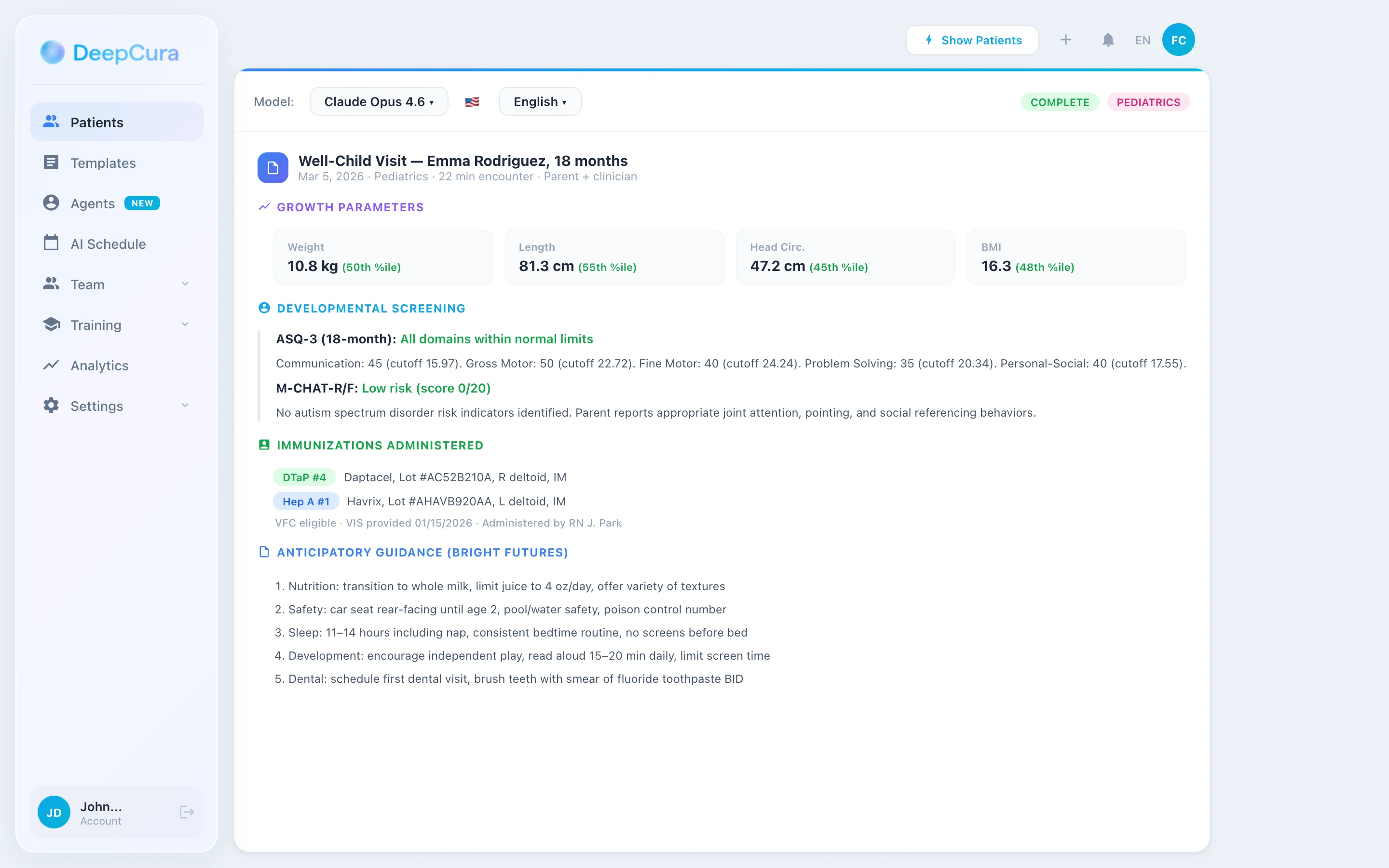
For pediatric documentation specifically, DeepCura's ambient scribe captures the full clinical encounter passively, including multi-speaker conversations between clinician, parent, and child. The AI generates structured pediatric notes including well-child visit documentation with age-appropriate content sections, growth parameter documentation with percentile context, developmental milestone tracking, immunization review, and anticipatory guidance aligned with Bright Futures recommendations. Clinicians can choose between multiple leading AI engines (including models from OpenAI, Anthropic, and Google) — a flexibility no other scribe offers.
DeepCura's multi-speaker handling is a critical differentiator for pediatrics. The ambient engine accurately attributes caregiver-reported history to the parent and clinician observations to the provider, producing notes that reflect the actual dynamics of a pediatric encounter rather than flattening everything into a single-narrator format.
Strengths:
- Passive ambient listening with no manual recording steps
- Multi-speaker capture accurately attributes parent vs. clinician statements
- Well-child visit templates aligned with Bright Futures periodicity
- Growth parameter documentation with percentile tracking
- Developmental screening documentation (ASQ-3, M-CHAT-R/F results)
- Immunization review and documentation
- Choose AI engine (OpenAI, Anthropic, Google)
- Bidirectional EHR write-back with athenahealth, eClinicalWorks, AdvancedMD, OptiMantra, Epic, DrChrono, CharmHealth, and Cerner
- AI receptionist handles calls, scheduling, and triage 24/7
- Billing automation with ICD-10/CPT coding and E&M integrity checks
- 1,000 credits/mo across all AI agents (1 credit per standard note)
Limitations:
- No direct immunization registry integration (immunizations documented in notes, pushed to EHR)
- Growth chart visualization is EHR-dependent (DeepCura writes the data; the EHR renders the chart)
Pricing: $129/month per provider — all features included. Free trial available, no credit card required.
Verdict: DeepCura is the strongest overall choice for pediatricians who want both specialized documentation quality and a full-platform solution that handles everything from parent calls to EHR write-back.
DeepCura: Built for Pediatric Workflows
Multi-speaker ambient capture, well-child visit templates, growth tracking, developmental screening docs, and EHR write-back — all for $129/mo with 1,000 credits/mo (1 credit per standard note). Start your free trial.
+1 (415) 549-1829Available 24/7 · Set up in seconds · No credit card required
2. Freed AI — Simplest Ambient Scribe
Freed AI offers the most streamlined ambient scribing experience — click record, see your encounter, and get a structured note. It requires minimal setup and has a clean interface that appeals to clinicians who want simplicity over feature depth.
Freed captures pediatric encounters through passive ambient listening and generates notes in SOAP and custom formats. The AI handles common pediatric presentations reasonably well but does not have pediatric-specific features like structured well-child visit templates, growth percentile documentation, or developmental screening capture. Multi-speaker handling is functional but less reliable than purpose-built solutions — parent statements may occasionally be attributed to the patient.
EHR integration works through browser-based scraping rather than native API write-back, which means notes are pushed into the chart via screen overlay rather than written directly to structured fields.
Strengths:
- Dead-simple setup and clean interface
- Fast note generation for common pediatric presentations
- SOAP and custom note formats
- Affordable entry point at $39/month
Limitations:
- No well-child visit templates or Bright Futures alignment
- No growth percentile documentation
- No developmental screening capture
- Multi-speaker attribution inconsistent with parent/child/clinician dynamics
- No native EHR integration (browser scraping only)
- No practice automation (no AI receptionist, billing, or fax)
Pricing: $39/month (Starter, 40 notes), $79/month (Core, unlimited), or $119/month (Premier, unlimited with EHR push and ICD-10 coding; $104 billed annually).
Verdict: Best for pediatricians who want a dead-simple ambient scribe for acute sick visits and do not need well-child visit structure, growth tracking, or practice automation. Read our Freed AI review for the full breakdown.
3. Abridge — Enterprise with Linked Evidence
Abridge differentiates itself through "linked evidence" — every AI-generated statement in the note is linked back to the specific moment in the encounter recording where that information was discussed. This traceability is valuable for quality assurance and medicolegal documentation.
For pediatric encounters, Abridge's ambient scribe captures multi-speaker conversations and generates structured notes with evidence linking. The platform integrates deeply with Epic and supports custom note templates that can be configured for well-child visits. However, pediatric-specific features like growth percentile tracking and developmental screening documentation are not built into the AI — they depend on template configuration and EHR-side tools.
Strengths:
- Linked evidence connects note content to source audio
- Strong multi-speaker capture in pediatric encounters
- Deep Epic integration with bidirectional write-back
- Custom template support for well-child visits
Limitations:
- No built-in growth percentile or developmental screening documentation
- Pediatric template configuration requires setup effort
- No practice automation features
- Enterprise pricing (not published) for fewer features than DeepCura
Pricing: Enterprise pricing only — not published; contact sales.
Verdict: Strong choice for pediatric practices embedded in the Epic ecosystem that value evidence-linked documentation. The premium price is harder to justify for independent practices when DeepCura offers more pediatric-specific features plus full practice automation for $129/month. Read our Abridge review for details.
4. Twofold — Budget Pediatric Templates
Twofold positions itself as a pediatric-aware AI scribe with template support for well-child visits and common pediatric presentations. The platform offers passive ambient capture and generates notes using configurable templates that include growth parameter sections and immunization documentation.
Twofold's pediatric template library is a genuine differentiator at its price point. Templates are pre-configured for common age-specific well-child visit formats, and the AI populates growth parameter fields and immunization review sections from the encounter conversation. However, the depth of documentation is template-driven rather than AI-driven — the scribe fills in template fields rather than intelligently extracting and structuring pediatric-specific clinical content.
Strengths:
- Pre-built pediatric well-child visit templates
- Growth parameter documentation in template fields
- Immunization review sections in templates
- Budget-friendly at $69/month
Limitations:
- Template-driven documentation (fields may be empty if not explicitly discussed)
- Multi-speaker handling is limited compared to enterprise solutions
- No developmental screening score capture
- No adolescent confidentiality documentation support
- No EHR integration (copy-paste workflow)
- No practice automation
Pricing: $69/month ($49/month billed annually). Free plan also available with limited notes.
Verdict: Reasonable budget option for pediatricians who want pre-built well-child visit templates at a low price point. The template-driven approach means documentation quality depends heavily on how explicitly the clinician discusses each element during the encounter.
5. Heidi Health — Multilingual Pediatrics
Heidi Health stands out for its multilingual support, offering AI scribing in 110+ languages — a significant advantage for pediatric practices serving diverse immigrant and refugee populations where language concordance with parents is essential for accurate history-taking.
The platform offers a generous free tier with limited notes and affordable paid plans. Heidi handles pediatric encounters through ambient listening and generates SOAP-format notes. Pediatric-specific features (well-child visit templates, growth tracking, developmental screening) are limited compared to purpose-built solutions.
Strengths:
- 110+ languages for multilingual pediatric practices
- Free tier available for evaluation
- Clean ambient listening interface
- Affordable paid plans
Limitations:
- No well-child visit templates or Bright Futures alignment
- No growth percentile documentation
- No developmental screening capture
- Limited multi-speaker attribution
- No native EHR integration
- No practice automation
Pricing: Free tier available. Clinician plan at $150/user/month billed yearly (higher month-to-month).
Verdict: Best choice for multilingual pediatric practices that serve diverse patient populations. The free tier makes it easy to evaluate. Limited in pediatric-specific documentation depth. Read our Heidi Health review for the full analysis.
6. S10.AI — Budget with Template Variety
S10.AI positions itself as a cost-effective ambient scribe with a template library that includes pediatric visit formats. The platform captures encounters passively and generates notes using customizable templates.
S10.AI offers reasonable template variety for pediatric workflows at a lower price point than enterprise solutions. However, pediatric-specific documentation quality is template-dependent rather than AI-driven, and growth tracking, developmental screening, and immunization documentation require manual template configuration rather than automatic extraction from the clinical conversation.
Pricing: $199/month (Solo) or $159/month per provider (Practice).
Verdict: Solid option for pediatricians who want template-based documentation flexibility. Similar limitations to Twofold — template fields may be incomplete if elements are not explicitly discussed during the encounter.
7. Nuance DAX Copilot — Enterprise Hospital Pediatrics
Nuance DAX Copilot (Microsoft) is the enterprise standard for ambient clinical documentation, with its deepest integration in the Epic ecosystem and compatibility with 40+ EHR systems including Cerner and Athena. For hospital-based pediatric departments and children's hospitals, DAX offers seamless integration and institutional-grade security.
DAX handles pediatric encounters through ambient listening and generates notes within your EHR workflow. Documentation quality for pediatrics benefits from Epic's native well-child visit tools — DAX captures the encounter and writes into Epic's structured pediatric templates, which already include growth chart integration and immunization documentation. Multi-speaker handling is strong, accurately differentiating parent and clinician speech.
The tradeoff is cost: DAX is sold on enterprise contracts — pricing is not published, and implementation fees, commitments, and volume discounts are negotiated per deployment.
Pricing: Not publicly priced — enterprise contract with volume discounts.
Verdict: The default choice for hospital-based pediatric departments, especially those on Epic where the integration with native well-child visit templates is seamless. Enterprise contract pricing puts it out of reach for most independent pediatric practices.
Head-to-Head — Pediatric Documentation Features
| Feature | DeepCura | Freed AI | Abridge | Twofold | Heidi Health | S10.AI | Nuance DAX |
|---|---|---|---|---|---|---|---|
| Ambient Listening | ✓ | ✓ | ✓ | ✓ | ✓ | ✓ | ✓ |
| WCV Templates | ✓ (Bright Futures) | ✗ | Custom | ✓ (pre-built) | ✗ | Template | ✓ (Epic-native) |
| Growth Tracking | ✓ (percentiles) | Basic | Basic | ✓ (template) | Basic | Basic | ✓ (Epic charts) |
| Immunization Docs | ✓ (structured) | Basic | Basic | ✓ (template) | Basic | Template | ✓ (Epic-native) |
| Multi-Speaker | ✓ (3-way) | Limited | ✓ (3-way) | Limited | Limited | Limited | ✓ (3-way) |
| Dev Screening | ✓ (ASQ-3, M-CHAT) | ✗ | ✗ | ✗ | ✗ | Template | Custom |
| Adolescent Privacy | ✓ | ✗ | ✗ | ✗ | ✗ | ✗ | ✓ |
| Acute Visit Speed | ✓ | ✓ | ✓ | ✓ | ✓ | ✓ | ✓ |
| Choose AI Engine | ✓ | ✗ | ✗ | ✗ | ✗ | ✗ | ✗ |
| Notes included | ~1,000 standard/mo (credits) | Unlimited (Core+) | Unlimited | Unlimited (paid) | Unlimited (paid) | Unlimited (paid) | Unlimited |
| Bidirectional EHR | ✓ (athenahealth, eCW, AdvancedMD, OptiMantra, Epic, DrChrono, CharmHealth, Cerner) | ✗ | ✓ (Epic, 6+) | ✗ | ✗ | Limited | ✓ (Epic, 40+) |
| AI Receptionist | ✓ | ✗ | ✗ | ✗ | ✗ | ✗ | ✗ |
| Billing Automation | ✓ | ✗ | ✗ | ✗ | ✗ | ✗ | ✓ |
| Linked Evidence | ✗ | ✗ | ✓ | ✗ | ✗ | ✗ | ✗ |
| 110+ Languages | ✓ (34) | ✗ | ✗ | ✗ | ✓ | ✗ | ✗ |
| Price | $129/mo | $39–$119/mo | Enterprise (not published) | $69/mo | Free / $150/mo (billed yearly) | $199/mo (Solo) · $159 (Practice) | Not publicly priced |
How AI Scribes Handle Key Pediatric Workflows
Well-Child Visits and Bright Futures
The well-child visit is the backbone of pediatric practice — and the most documentation-intensive encounter type in pediatrics. The AAP Bright Futures guidelines define specific content requirements for each visit age, including surveillance domains (physical, developmental, behavioral, social), screening instruments to administer, anticipatory guidance topics, and immunization schedule milestones.
An AI scribe optimized for well-child visits should generate notes that include:
- Growth parameters with age- and sex-specific percentiles and trend documentation
- Developmental milestones appropriate to the visit age (gross motor, fine motor, language, social-emotional)
- Nutritional assessment — breastfeeding/formula status for infants, dietary counseling for older children
- Screening results — vision, hearing, lead, anemia, autism (M-CHAT-R/F at 18 and 24 months), depression (PHQ-A for adolescents)
- Anticipatory guidance — safety, nutrition, sleep, media use, physical activity topics appropriate to the patient's age
- Immunization review — vaccines administered, deferred, or discussed with documentation of VIS provision
DeepCura and Nuance DAX (via Epic templates) provide the most complete well-child visit documentation. Twofold offers template-based WCV notes at a budget price point. General-purpose scribes like Freed AI and Heidi Health generate SOAP notes that may capture well-child content in narrative form but lack the structured, age-specific format that Bright Futures requires.
Acute Sick Visits
Pediatric acute visits — ear infections, sore throats, coughs, rashes, fevers, GI complaints — are high-volume, fast-turnaround encounters. A pediatrician may see 15–20 acute visits per day alongside scheduled well-child visits, each requiring a focused note documenting the chief complaint, relevant history, physical exam findings, assessment with appropriate ICD-10 codes, and plan including return-to-care criteria.
AI scribes perform most consistently on acute sick visits because these encounters follow predictable patterns similar to adult primary care. All seven tools in our comparison generate adequate acute visit notes. The differentiators are speed (how quickly the note is available after the encounter), ICD-10 coding accuracy for common pediatric diagnoses, and documentation of parent-reported history versus clinician-observed findings.
Developmental Screening Documentation
Developmental screening is a core component of pediatric preventive care. The AAP recommends standardized developmental screening at the 9-, 18-, and 30-month visits (using instruments like the ASQ-3) and autism-specific screening at 18 and 24 months (using the M-CHAT-R/F). Additional screening for behavioral and mental health concerns — including the PSC (Pediatric Symptom Checklist), PHQ-A, and CRAFFT — is recommended at various ages.
AI scribes vary in how they handle screening documentation. DeepCura captures screening scores and interpretations as structured data within the note. Nuance DAX relies on Epic's native screening tools. S10.AI and Twofold offer template fields for screening scores. Freed AI, Abridge, and Heidi Health may capture screening discussion in narrative text but do not extract structured screening data.
The clinical significance of structured screening documentation extends beyond individual encounters. Structured data enables trend tracking across visits, automated flagging of abnormal results, and quality reporting for HEDIS measures — all of which are increasingly important for value-based pediatric care contracts.
Adolescent Confidentiality
Adolescent encounters present a unique documentation challenge that most AI scribes are not designed to handle. State laws vary, but most grant adolescents (typically age 12–18) the right to confidential healthcare services for reproductive health, mental health, substance use, and STI testing/treatment. Pediatricians routinely conduct a confidential portion of the adolescent visit using frameworks like HEEADSSS (Home, Education/Employment, Eating, Activities, Drugs, Sexuality, Suicide/Depression, Safety).
The information disclosed during the confidential portion of the visit must be documented carefully. Some content should appear in the medical record but may need restricted access from the parent portal. Other content — particularly regarding reproductive health or substance use — may be subject to state-specific confidentiality protections.
DeepCura and Nuance DAX support documentation workflows that respect adolescent confidentiality — the AI can generate separate note sections for the shared and confidential portions of the encounter. Most other scribes in our comparison do not differentiate confidential from shared documentation, which means clinicians must manually segment their notes post-generation.
Immunization Documentation
Immunization documentation at every well-child visit requires capturing multiple data points: vaccine name, manufacturer, lot number, expiration date, administration site, route, dose in series, VIS (Vaccine Information Statement) edition date and provision date, administering provider, and any adverse reactions. For practices participating in the VFC (Vaccines for Children) program, eligibility documentation is required for each administered dose.
No AI scribe in our comparison directly captures lot numbers or VIS dates from ambient listening — this level of detail is typically entered directly into the EHR's immunization module. What AI scribes can document is the clinical discussion: which vaccines were recommended, administered, or deferred; parental concerns about vaccination; informed consent discussions; and catch-up scheduling for missed doses.
DeepCura structures this immunization discussion into a dedicated note section. Nuance DAX leverages Epic's immunization module for structured documentation. Twofold and S10.AI provide template fields. Freed AI, Abridge, and Heidi Health capture immunization discussion in narrative text.
Pricing Comparison
| Tool | Monthly | Annual | Notes included | Best Plan |
|---|---|---|---|---|
| DeepCura | $129/mo | $999/yr | Up to ~1,000 standard notes/mo (credits) | Single plan, all features |
| Freed AI | $39–$119/mo | — | 40–unlimited | Core ($79) or Premier ($119; $104 billed annually) |
| Abridge | Enterprise (not published) | — | Unlimited | Enterprise only |
| Twofold | $69/mo | $49/mo annual | Unlimited | Personal ($69) or Free (limited) |
| Heidi Health | Free tier; Clinician priced higher month-to-month | $150/mo (billed yearly) | Limited–unlimited | Free tier to evaluate |
| S10.AI | $199/mo (Solo) · $159 (Practice) | — | Unlimited | Single plan |
| Nuance DAX | Not publicly priced | — | Unlimited | Enterprise contract |
Cost per Note at 30 Patients/Day
At 30 patients per day (22 working days/month = 660 encounters/month):
| Tool | Monthly Cost | Cost per Note |
|---|---|---|
| DeepCura | $129 | $0.20 |
| Freed AI (Premier) | $119 | $0.18 |
| S10.AI (Solo) | $199 | $0.30 |
| Twofold | $69 | $0.10 |
| Heidi Health (Clinician, billed yearly) | $150 | $0.23 |
| Abridge | Not published | — |
| Nuance DAX | Not publicly priced | — |
Note: Cost per note does not account for the total value each platform delivers. DeepCura's $0.20/note includes AI receptionist, billing automation, EHR write-back, and fax management.
See DeepCura in Action
Watch how DeepCura handles the full clinical workflow — from AI receptionist calls and patient intake through ambient scribing, automated billing, and native EHR write-back.

Frequently Asked Questions
What is the best AI scribe for pediatrics?
DeepCura is the best overall AI scribe for pediatrics in 2026. It combines passive ambient listening with well-child visit templates aligned to Bright Futures guidelines, multi-speaker capture for parent-clinician-child encounters, growth parameter tracking with percentiles, developmental screening documentation, and bidirectional EHR integration — all for $129/month with 1,000 credits a month (1 credit per standard note). For budget-conscious practices, Twofold offers pediatric templates at $69/month.
Can AI scribes handle well-child visits?
Yes, but quality varies significantly. DeepCura generates structured well-child visit notes with age-specific content sections covering growth parameters, developmental milestones, anticipatory guidance, screening results, and immunization review. Nuance DAX leverages Epic's native well-child visit templates. Twofold offers pre-built WCV templates. General-purpose scribes like Freed AI and Heidi Health capture well-child content in SOAP format but lack the structured, age-specific documentation that Bright Futures guidelines require.
Do AI scribes work with parent-child-clinician conversations?
Multi-speaker accuracy varies by platform. DeepCura, Abridge, and Nuance DAX accurately differentiate parent/caregiver speech from clinician speech in three-way encounters, correctly attributing caregiver-reported history to the parent. Freed AI, Heidi Health, S10.AI, and Twofold handle multi-speaker encounters with varying reliability — parent statements may sometimes be attributed to the patient or the clinician.
How do AI scribes handle immunization documentation?
AI scribes capture the clinical discussion around immunizations — which vaccines were recommended, administered, or deferred, parental concerns, and catch-up scheduling. They do not directly capture lot numbers, VIS dates, or administration site details, which are typically entered into the EHR's immunization module. DeepCura structures immunization discussions into a dedicated note section. Nuance DAX integrates with Epic's immunization tools.
Is ambient listening safe for pediatric encounters?
Yes, when the platform is HIPAA compliant with a signed BAA, recordings are deleted after note generation, and data is not used for model training. For pediatric encounters, the key consideration is that ambient listening captures everything in the room — including parent conversations, child vocalizations, and sensitive adolescent discussions. Ensure your chosen platform supports documentation workflows that respect adolescent confidentiality requirements.
How much does an AI scribe for pediatrics cost?
Pricing ranges from free to enterprise custom. Heidi Health offers a free tier. Freed AI starts at $39/month (Core at $79, Premier at $119). Twofold costs $69/month. S10.AI costs $199/month (Solo) or $159/month per provider (Practice). DeepCura is $129/month with 1,000 credits a month (1 credit per standard note) and full practice automation. Abridge is enterprise-priced (not published). Nuance DAX is not publicly priced (enterprise contract). For most pediatric practices, the $69–$129/month range offers the best balance of features and value.
Can AI scribes document developmental screening results?
Limited support exists across the market. DeepCura captures standardized screening scores (ASQ-3, M-CHAT-R/F, PHQ-A, CRAFFT) and interpretations as structured note sections. Nuance DAX relies on Epic's native screening tools. S10.AI and Twofold provide template fields for screening scores. Freed AI, Abridge, and Heidi Health may capture screening discussion in narrative text but do not extract structured screening data with scores and interpretations.
Do AI scribes support adolescent confidentiality documentation?
Limited support. DeepCura and Nuance DAX support documentation workflows that allow clinicians to generate separate note sections for the shared and confidential portions of the adolescent encounter. Most other AI scribes do not differentiate confidential from shared documentation — clinicians must manually edit notes to segment sensitive information after generation. This is an important consideration for any pediatric practice seeing adolescent patients.
Final Verdict
For pediatricians and pediatric practices, the choice comes down to three profiles:
Best overall: DeepCura at $129/month delivers the strongest combination of pediatric documentation quality (well-child visit templates, growth tracking, multi-speaker capture, developmental screening, adolescent confidentiality) and full-platform value (AI receptionist, billing, EHR write-back, 1,000 credits/mo). It is the only platform where pediatric documentation tools come bundled with complete practice automation.
Best for simplicity: Freed AI at $79–$119/month is the simplest ambient scribe on the market. It handles acute pediatric visits well but lacks well-child visit structure, growth tracking, and developmental screening documentation. Best for pediatricians who only need basic ambient notes and nothing else.
Best for enterprise children's hospitals: Nuance DAX Copilot (enterprise contract, not publicly priced) for pediatric departments already embedded in the Epic ecosystem. The integration with Epic's native well-child visit templates, growth charts, and immunization module creates a seamless documentation workflow that no other platform can match at the enterprise level.
Start Your Free Trial — Built for Pediatric Workflows
Well-child visit templates, growth tracking, multi-speaker capture, immunization docs, AI receptionist, billing automation, and EHR write-back — $129/mo · 1,000 credits/mo (1 credit per standard note). No credit card required.
+1 (415) 549-1829Available 24/7 · Set up in seconds · No credit card required
For a broader look at AI scribes across all specialties, see our Best AI Medical Scribes in 2026 ranking. For psychiatry-specific documentation, see our Best AI Scribe for Psychiatry guide. For clinical AI chat tools, see Best ChatGPT for Doctors. For practices that need phone automation alongside documentation, see our Best AI Medical Receptionist guide. For a comparison of traditional dictation vs. ambient AI tools, see our 15 best medical dictation software guide. For AI vs. traditional transcription services, see our best medical transcription software comparison. If you are choosing an EHR for a small practice, see our best EMR for small practices ranking. For free copy-paste clinical note templates including pediatric formats, see our SOAP note template guide. For pediatric same-day walk-in visits including laceration repair, splinting, and fever workups, see our best AI scribe for urgent care guide. For NP/PA-led pediatric practice and well-child documentation, see our best AI scribe for nurses ranking. For other specialty guides, see our rankings for dermatology, cardiology, neurology, emergency medicine, orthopedics, family medicine, internal medicine, chiropractors, functional medicine, and dentistry.
References
[1] American Academy of Pediatrics, "Bright Futures: Guidelines for Health Supervision of Infants, Children, and Adolescents, 4th Edition," AAP. brightfutures.aap.org
[2] Palpallatoc, R.A. et al., "Electronic Health Record Documentation Burden in Pediatric Primary Care," Pediatrics, 2023. pubmed.ncbi.nlm.nih.gov
[3] Centers for Disease Control and Prevention, "Vaccines for Children Program (VFC)," CDC. cdc.gov/vaccines/programs/vfc
[4] Squires, J. & Bricker, D., "Ages and Stages Questionnaires, Third Edition (ASQ-3)," Paul H. Brookes Publishing. agesandstages.com
[5] Robins, D.L. et al., "Modified Checklist for Autism in Toddlers, Revised with Follow-Up (M-CHAT-R/F)," Pediatrics, 2014. mchatscreen.com
[6] U.S. Department of Health and Human Services, "HIPAA for Professionals," HHS.gov. hhs.gov/hipaa/for-professionals
[7] DeepCura, "AI Medical Scribe Platform — Ambient Scribing, AI Receptionist, EHR Integration," DeepCura.com. deepcura.com
[8] World Health Organization, "WHO Child Growth Standards," WHO. who.int/tools/child-growth-standards
[9] Centers for Disease Control and Prevention, "CDC Growth Charts," CDC. cdc.gov/growthcharts
[10] American Academy of Pediatrics, "Periodicity Schedule," AAP. aap.org/en/practice-management/care-delivery-approaches/periodicity-schedule
[11] Society for Adolescent Health and Medicine, "Confidentiality Protections for Adolescents and Young Adults in the Health Care Billing and Insurance Claims Process," Journal of Adolescent Health, 2016. pubmed.ncbi.nlm.nih.gov
[12] Centers for Disease Control and Prevention, "Recommended Child and Adolescent Immunization Schedule," CDC. cdc.gov/vaccines/schedules/hcp/imz/child-adolescent