
The medical transcription industry has declined steadily since 2020, with the Bureau of Labor Statistics reporting a 5% projected employment decline through 2034. AI did not kill it — it replaced it. The trend is accelerating, and the reason is straightforward: AI medical transcription now produces structured clinical notes in under two minutes at a fraction of the cost of human transcriptionists. What once required a certified medical transcriptionist, a 24-hour turnaround window, and $8-$25 per encounter now happens in real time for a flat monthly fee.
This guide compares the seven best medical transcription software tools in 2026 — from AI ambient scribes that generate finished SOAP notes during the encounter to traditional human transcription services that still serve a purpose for complex legal and specialty cases. The landscape has changed dramatically, and the right choice depends on your practice size, specialty, budget, and tolerance for post-generation editing.
If you are evaluating the input side of clinical documentation — how you speak to the system — see our guide to medical dictation software. This post focuses on the output: the transcription itself, the quality of the generated text, and the total cost of converting clinical audio into usable documentation.
All products were evaluated between January and March 2026. Pricing reflects publicly available rates at the time of review.
Medical Transcription in 2026: What Has Changed
Traditional medical transcription followed a simple but slow workflow. The clinician dictated notes into a recording device or called a transcription hotline. A certified medical transcriptionist — often working from home or through a transcription service — listened to the audio and typed the encounter into a structured clinical document. Turnaround ranged from 4 to 48 hours depending on urgency and staffing. The finished document was delivered back to the practice, reviewed by the clinician, and manually entered into the patient chart. This model worked. It produced high-accuracy documentation. It also cost $8-$25 per encounter and created a bottleneck that scaled linearly with patient volume.
AI medical transcription has collapsed that entire workflow into a single step. Modern ambient AI scribes listen to the patient encounter in real time, process the conversation through large language models trained on medical terminology, and produce structured clinical notes — SOAP, H&P, progress notes, or custom formats — in under two minutes. There is no recording to send out, no transcriptionist to wait on, and no manual entry into the EHR. The note appears on screen before the patient leaves the exam room.
What remains of traditional human transcription occupies a narrower niche than it did five years ago. Practices that handle complex medico-legal documentation, multi-provider surgical cases, or highly specialized terminology that AI models still struggle with continue to use human transcriptionists. Some large health systems maintain hybrid workflows where AI handles the first pass and human editors review for accuracy. But for the vast majority of standard clinical encounters — primary care, internal medicine, family practice, dermatology, psychiatry — AI transcription has become the default.
The most significant shift is conceptual. Medical transcription software in 2026 does not just transcribe — it generates structured clinical documentation. The old model converted speech to text. The new model converts conversation to clinical notes. That distinction matters because the output is no longer raw text that a clinician must organize. It is a formatted, coded, EHR-ready document. This is what the market now calls an AI medical scribe — transcription, note generation, and clinical structuring in one step.
AI vs. Traditional Medical Transcription
Before diving into specific products, here is how AI and traditional human transcription compare across the dimensions that matter most to clinical practices.
| Feature | AI Medical Transcription | Traditional Human Transcription |
|---|---|---|
| Turnaround Time | Under 2 minutes | 4-24 hours (standard), 1-2 hours (STAT) |
| Cost per Encounter | $2-$6 (flat monthly fee / volume) | $8-$25 per encounter |
| Monthly Cost (20 encounters/day) | $39-$129/mo (flat fee) | $3,200-$10,000/mo |
| Accuracy Rate | 90-95% (improving) | 98%+ (experienced transcriptionist) |
| Medical Vocabulary | Pre-trained, improving | Expert-level (certified MTs) |
| HIPAA Compliance | Built-in (BAA included) | Depends on vendor |
| Scalability | Scales with plan (flat monthly fee; note/credit caps vary by tool) | Limited by staffing |
| Formatting | Structured notes (SOAP, H&P) | Any format (flexible) |
| EHR Integration | Available (varies by tool) | Manual upload/paste |
| 24/7 Availability | Yes | Limited shifts |
The accuracy gap is the number that skeptics cite most often. Human transcriptionists with certification and specialty experience consistently deliver 98%+ accuracy. AI medical transcription tools currently operate in the 90-95% range for standard encounters, with accuracy improving as models are fine-tuned on larger clinical datasets. The practical question is whether that gap matters for your workflow. Most clinicians using AI transcription report that reviewing and correcting a 92%-accurate AI-generated note takes 30-60 seconds — far less time than waiting 4-24 hours for a human transcription to arrive.
DeepCura: AI Transcription + Full Clinical Platform
Real-time ambient transcription, SOAP note generation, EHR integration, and billing automation. $129/mo · 1,000 credits/mo (1 credit per standard note) — no per-minute fees.
+1 (415) 549-1829Available 24/7 · Set up in seconds · No credit card required
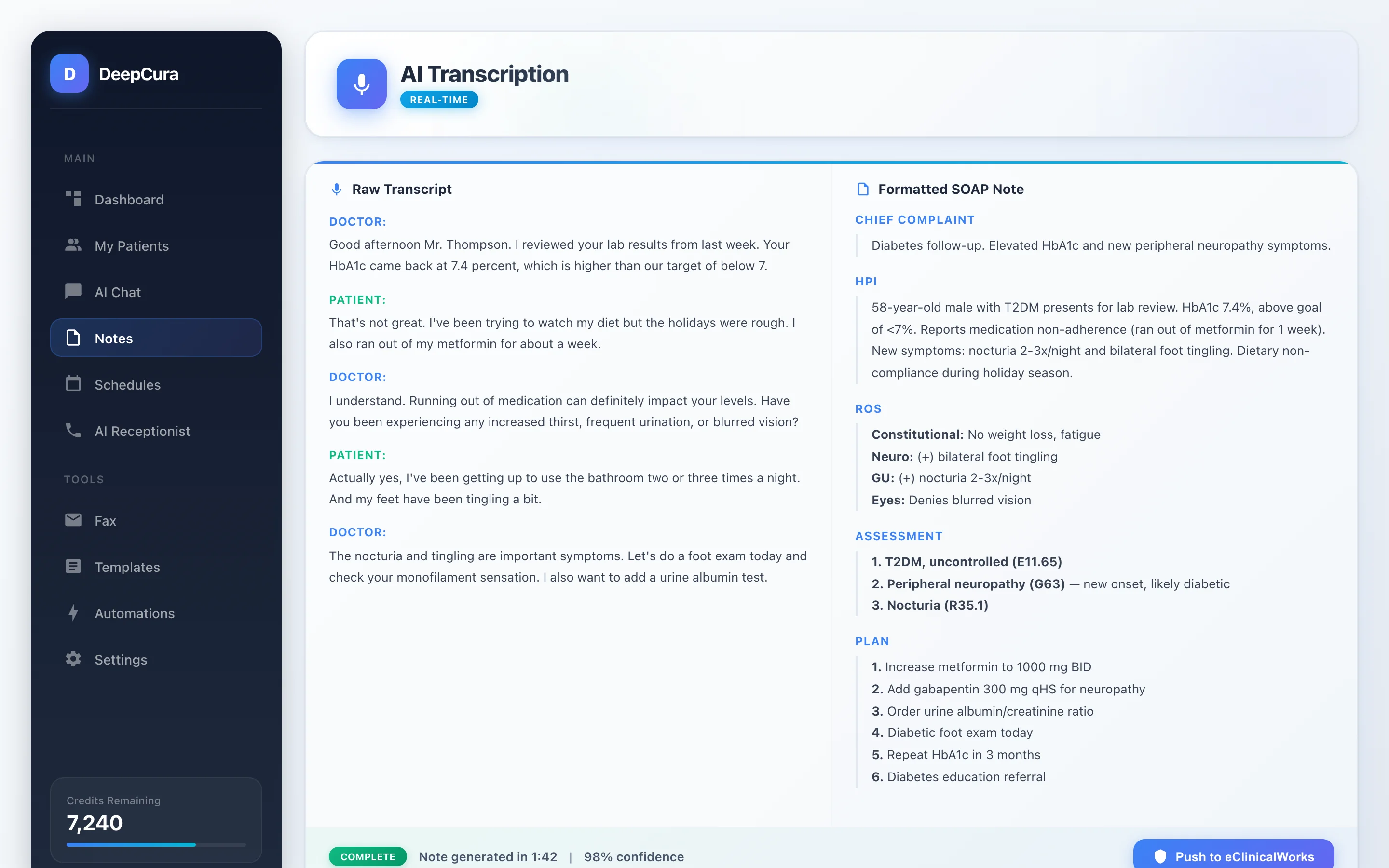 Screenshot: DeepCura AI scribe — real-time transcription with structured SOAP note output.
Top 7 Medical Transcription Software Tools
#1. DeepCura — Best Full-Platform AI Transcription
DeepCura is the top-ranked medical transcription software for practices that want AI transcription embedded in a complete clinical platform — not bolted on as a standalone tool. The platform captures ambient audio during patient encounters and generates structured clinical notes in SOAP, H&P, progress note, or custom formats in under two minutes. But transcription is just the entry point. DeepCura routes the transcribed encounter into a full workflow: structured note generation, ICD-10 and CPT code suggestions, EHR filing, billing automation, and patient communication.
What separates DeepCura from transcription-only tools is the depth of what happens after the audio is converted to text. The AI does not simply produce a raw transcript — it generates a complete, structured clinical document ready for the patient chart. Clinicians choose their preferred AI engine (GPT-4o, Claude, or Gemini) and their preferred note format. The platform supports custom templates, so a psychiatry intake note looks different from an orthopedic follow-up, and both match the documentation standards the clinician expects. Need templates before committing? Start with our doctor's note template collection.
The EHR integration layer is where DeepCura pulls furthest ahead of transcription-only alternatives. Notes push directly into athenahealth, eClinicalWorks, AdvancedMD, OptiMantra, Epic, DrChrono, CharmHealth, and Cerner via native API write-back — not scraping, not copy-paste. Bidirectional data flow means the platform pulls patient demographics and appointment context before the encounter starts, producing more accurate and complete notes from the first word.
Beyond transcription and notes, DeepCura includes a 24/7 AI receptionist for phone calls and scheduling, AI-powered fax summarization, billing automation with E&M integrity checks, and AI prior authorization drafting. At $129/month per provider with 1,000 credits a month (1 credit per standard note), there are no per-word or per-minute charges — each standard note draws 1 credit from the monthly 1,000, so the flat fee covers up to ~1,000 standard notes a month (extra credits are $59/mo for 2,000). The cost is the same whether a practice generates 5 notes per day or 40. For a deeper look at how ambient dictation works in practice, see our dedicated guide.
Pros: Full clinical platform beyond transcription, structured note output in multiple formats, native EHR integration (athenahealth, eClinicalWorks, AdvancedMD, OptiMantra, Epic, DrChrono, CharmHealth, and Cerner), choice of AI engine, 1,000 credits/mo at a flat rate (1 credit per standard note), AI receptionist and billing included
Cons: Newer platform with a smaller user community than legacy tools, no on-premise deployment option
Verdict: DeepCura is the best medical transcription software for practices that want AI transcription integrated into a complete clinical workflow — from patient call to finished, EHR-filed note. At $129/month, it replaces transcription services, scribing tools, fax services, and answering services in a single platform.
#2. Freed AI — Best Simple AI Transcription
Freed AI takes the opposite approach to DeepCura. Where DeepCura builds a full clinical operating system around transcription, Freed AI builds the simplest possible transcription-to-note tool and stops there. The platform listens to patient encounters via ambient audio capture, generates structured clinical notes, and delivers them within one to two minutes. No EHR write-back, no billing, no receptionist, no fax management. Just notes.
That simplicity is Freed AI's core strength. Setup takes minutes. The interface is clean and uncluttered. Clinicians who only need a transcription tool that produces SOAP notes — and are comfortable with a copy-paste workflow to move those notes into their EHR — will find Freed AI fast and friction-free. The mobile app mirrors the desktop experience, making it usable in exam rooms, at the bedside, or during telehealth visits.
Freed AI's pricing starts at $39/month for the Starter tier (40 notes per month), $79/month for Core (unlimited notes), and $119/month for Premier (adds scraping-based EHR push and beta billing codes). At the Premier tier, the $10 gap to DeepCura's $129/month — which includes native API EHR write-back, AI receptionist, billing automation, and fax management — creates a difficult value comparison. For budget-conscious solo practitioners who generate fewer than 40 notes per month, the $39/month Starter tier is genuine value.
See our full Freed AI review and our DeepCura vs. Freed AI comparison.
Pros: Simple and fast setup, affordable at $39/mo starter tier, clean interface, strong mobile app
Cons: No native EHR write-back (scraping-based at Premier tier), no broader workflow features, note cap on Starter plan
#3. Heidi Health — Best for International Practices
Heidi Health has built a strong position in the international medical transcription market, particularly in Australia, the UK, and New Zealand, where it originated. The platform offers ambient AI transcription with structured note generation, custom templates, and multilingual support — a combination that makes it the strongest option for practices operating outside the United States or serving multilingual patient populations.
The template system is Heidi Health's standout feature for transcription quality. Clinicians can build detailed custom templates that define exactly how the AI structures the transcribed encounter — specifying sections, required fields, and formatting rules that match their documentation standards. This level of template customization produces more consistent transcription output than tools that rely on generic SOAP or H&P formats alone. Heidi Health also offers an AI receptionist feature and supports multiple languages for encounter transcription.
Where Heidi Health falls short for US-based practices is EHR integration. The platform's integrations are limited compared to tools built for the American healthcare market, with no native write-back to Epic, eClinicalWorks, or Athena. For international practices using systems like Best Practice, MedicalDirector, or Cliniko, this is less of a concern. Pricing: a free tier is available; the Clinician plan is $150/user/month billed yearly. For practices that need strong US EHR integration alongside their transcription tool, DeepCura or Dragon Medical One are stronger options.
See our Heidi Health review and our DeepCura vs. Heidi Health comparison.
Pros: Strong template customization, multilingual transcription support, AI receptionist, solid international EHR support
Cons: Limited US EHR integration, smaller US user base, fewer billing automation features than full-platform alternatives
#4. Dragon Medical One — Best Traditional Dictation Engine
Dragon Medical One from Nuance (now part of Microsoft) is not an ambient transcription tool. It is the gold standard for active dictation — the clinician speaks directly into a microphone, and Dragon converts speech to text with the highest accuracy of any tool on this list. For practices that prefer traditional dictation over ambient listening, Dragon Medical One remains unmatched.
Dragon's medical vocabulary is the deepest in the industry, covering over 90 medical specialties with terminology that includes drug names, procedures, anatomical terms, and clinical abbreviations. The speech recognition engine has been refined over two decades of healthcare-specific training data. Accuracy rates for experienced users consistently exceed 99% — higher than any ambient AI scribe and comparable to the best human transcriptionists. Dragon also supports voice commands for EHR navigation, allowing clinicians to dictate directly into Epic, Cerner, or other supported systems without touching the keyboard.
The limitation is the workflow model itself. Dragon requires active dictation — the clinician must speak into the system deliberately, narrating findings and assessments rather than simply conducting a natural patient conversation. There is no ambient mode, no automatic note structuring from conversation, and no AI-powered clinical note generation. The output is raw dictated text, not a structured SOAP note. For practices that want the transcription to happen passively during the encounter — the model that ambient AI scribes like DeepCura provide — Dragon's active dictation model is a step backward. For those who prefer to dictate notes after the patient leaves, Dragon's speech-to-text output is among the best available. Learn more about the distinction in our guide to medical dictation software.
Pros: Highest accuracy dictation engine available (99%+), deepest medical vocabulary (90+ specialties), deep EHR integration with Epic and Cerner, proven over two decades
Cons: Requires active dictation (no ambient mode), no automatic note structuring, no AI-generated clinical notes, enterprise pricing
#5. DeepScribe — Best for Specialty Accuracy
DeepScribe occupies a unique position in the medical transcription software market: it combines AI ambient transcription with a human quality assurance review layer that checks every note before delivery. This hybrid approach produces transcription output that is more accurate than AI-only tools — but at enterprise pricing and with a turnaround measured in hours rather than minutes.
The platform's specialty-tuned AI models are its core differentiator. DeepScribe has invested heavily in building transcription models trained on specialty-specific clinical data, with oncology as the flagship. Over 3.1 million oncology visits per year feed the training data for cancer care documentation, producing transcription output that captures the nuances of treatment planning, staging terminology, and multi-drug regimen documentation with a depth that generalist tools cannot match. The platform also supports cardiology, urology, orthopedics, and neurology with specialty-specific templates and AI models.
The trade-off is delivery time and cost. Because every note passes through human QA review, notes arrive hours after the encounter rather than in under two minutes. Pricing is not published; third-party estimates put it at $350-$500 per month per provider — roughly 3x DeepCura's $129/month. For large health systems and oncology practices where note accuracy is more important than instant turnaround, DeepScribe delivers genuine value. For standard primary care or family medicine encounters, the cost and delay are difficult to justify.
See our DeepScribe review.
Pros: Specialty-tuned AI models (strongest in oncology), human QA review on every note, bidirectional EHR integration, enterprise-grade security
Cons: Enterprise pricing (not published; est. $350-$500/mo), hours-long note delivery, no free trial, no AI receptionist or billing features
#6. Nuance DAX Copilot — Best Enterprise Solution
Nuance DAX Copilot (Dragon Ambient eXperience) is Microsoft's enterprise ambient AI transcription solution, and it represents the deepest integration of AI transcription into the Epic EHR ecosystem. DAX Copilot listens to patient encounters, generates structured clinical notes, and pushes documentation directly into Epic — with a level of integration depth that no competitor currently matches in enterprise settings.
The platform leverages Microsoft's Azure OpenAI infrastructure and Nuance's decades of healthcare speech recognition expertise. Clinical notes are generated in real time and appear within the Epic workflow, minimizing context switching for clinicians. DAX Copilot supports multiple note types and has been deployed at scale across major health systems, including partnerships with the University of Michigan Health, Stanford Health Care, and other large academic medical centers. The system handles multi-specialty documentation and benefits from the massive clinical training data that Nuance has accumulated through Dragon Medical over 20+ years.
The barrier for most practices is access and cost. DAX Copilot is an enterprise product — there is no self-serve sign-up, no monthly subscription for individual providers, and no free trial. Pricing is negotiated per health system and typically requires a multi-year commitment. Smaller practices, independent clinics, and solo providers are effectively priced out. For large health systems already running Epic and Microsoft infrastructure, DAX Copilot is the natural choice. For everyone else, platforms like DeepCura offer comparable ambient transcription with broader workflow features at $129/month.
Pros: Deepest Epic integration available, proven at scale across major health systems, backed by Microsoft Azure infrastructure, two decades of medical speech data
Cons: Enterprise-only (no individual subscriptions), opaque pricing requiring sales negotiation, limited to large health systems, no receptionist or billing automation features
#7. TranscribeMe Medical — Best Human Transcription Service
TranscribeMe Medical represents the other end of the spectrum — a human-powered transcription service that uses AI for the first pass and human editors for quality assurance and final delivery. For practices that need the highest possible accuracy on complex, multi-speaker, or legally sensitive clinical documentation, TranscribeMe delivers what AI-only tools cannot guarantee: human-verified transcription with a 99%+ accuracy commitment.
The workflow is straightforward. Clinicians upload audio recordings or use TranscribeMe's recording tools to capture encounters. The audio passes through an AI engine for initial transcription, then routes to trained human editors who review, correct, and finalize the document. Standard turnaround is 4-12 hours, with STAT service available for faster delivery at a premium. Pricing is per audio minute — typically $1.50-$3.00 per minute of recorded audio — making it significantly more expensive than flat-rate AI subscriptions at scale.
TranscribeMe's value proposition is narrow but real. For medical-legal transcription, complex surgical cases with multiple speakers, specialty terminology that AI models handle poorly, or documentation that may be subject to legal scrutiny, the human QA layer provides a level of accuracy assurance that AI alone does not. TranscribeMe is not HIPAA-specific — practices must verify compliance and ensure a Business Associate Agreement is in place before transmitting protected health information. The service supports medical terminology and clinical formatting, but it is a transcription service rather than a clinical platform. There is no note structuring, no SOAP generation, no EHR integration, and no workflow automation beyond converting audio to text.
Pros: Highest accuracy available (99%+), human QA review, good for complex legal and multi-speaker transcription, flexible formatting
Cons: Expensive per-encounter ($1.50-$3.00/audio minute), slow turnaround (4-12 hours), not real-time, no structured note generation, no EHR integration, HIPAA compliance must be verified independently
When to Choose AI vs. Traditional Transcription
The decision between AI medical transcription and traditional human transcription is not about which technology is universally better. It is about which model fits your practice's specific documentation needs, budget constraints, and quality requirements.
Choose AI medical transcription if:
- You want instant note generation — structured clinical documentation in under two minutes, available before the patient leaves the exam room.
- Budget is a priority. A flat monthly fee of $39-$129 replaces per-encounter charges that can reach $10,000+ per month at higher volumes.
- Your practice handles standard encounter types across common specialties — primary care, family medicine, internal medicine, psychiatry, dermatology, pediatrics.
- You want structured notes automatically. AI tools generate SOAP, H&P, and custom-format notes from conversation, not raw transcripts that require manual organization.
- EHR integration matters. AI platforms like DeepCura push completed notes directly into the patient chart via native API, eliminating copy-paste workflows entirely.
- You want a complete clinical workflow. Modern AI transcription tools like DeepCura bundle note generation with billing codes, AI receptionist services, fax management, and prior authorization — turning transcription into the starting point of a broader automation pipeline.
Choose traditional human transcription if:
- You need 99%+ accuracy for legal, forensic, or regulatory documentation where any AI-generated error creates liability.
- Your practice involves highly specialized vocabulary — rare disease subspecialties, complex surgical procedures, or emerging treatment protocols — where AI models lack sufficient training data.
- You prefer to dictate in free-form narrative style and want exact verbatim transcription rather than AI-interpreted structured notes.
- Your encounters involve complex multi-speaker dynamics — surgical teams, multidisciplinary rounds, or group therapy sessions — where speaker diarization remains a challenge for ambient AI.
- Turnaround time is not critical. If notes are not needed same-day and accuracy is the absolute priority, human transcription remains the gold standard.
For most practices in 2026, AI transcription is the right choice. The cost savings are dramatic, the time savings are immediate, and the accuracy gap has narrowed to the point where a 30-second review catches the few errors that remain. Human transcription still has its place — but that place has shrunk considerably. For a broader view of how AI scribes compare across the full market, see our best AI medical scribes ranking.
Pricing: AI vs. Human Transcription Cost Analysis
Cost is the dimension where AI medical transcription delivers the most dramatic advantage. The following table compares monthly costs at different encounter volumes for three representative options: DeepCura (full-platform AI at $129/month, 1,000 credits a month — 1 credit per standard note), Freed AI (simple AI at $79/month Core tier), and traditional human transcription services.
| Monthly Volume | AI Transcription (DeepCura) | AI Transcription (Freed AI) | Human Transcription |
|---|---|---|---|
| 100 encounters | $129 ($1.29/encounter) | $79 ($0.79/encounter) | $800-$2,500 |
| 200 encounters | $129 ($0.65/encounter) | $79 ($0.40/encounter) | $1,600-$5,000 |
| 400 encounters | $129 ($0.32/encounter) | $79 ($0.20/encounter) | $3,200-$10,000 |
| 600 encounters | $129 ($0.22/encounter) | $79 ($0.13/encounter) | $4,800-$15,000 |
The economics are not subtle. At 400 encounters per month — roughly 20 encounters per working day, a typical volume for a busy primary care or family medicine practice — DeepCura costs $129 total versus $3,200-$10,000 for human transcription. That is a 25x-78x cost difference. Even at the lowest volume (100 encounters/month), AI transcription saves $671-$2,371 per month compared to human alternatives.
The break-even point is remarkably low. At DeepCura's $129/month flat rate, AI transcription pays for itself after roughly 10-15 encounters per month compared to human transcription at $8-$25 per encounter. Any volume above that threshold represents pure savings. A practice generating 20 encounters per day saves $36,000-$118,000 annually by switching from human transcription to AI — before accounting for the additional value of instant turnaround, structured note output, and EHR integration.
The cost comparison also understates the total savings. Human transcription requires staff time for managing the transcription workflow — uploading recordings, tracking turnaround, reviewing returned documents, and manually entering finished notes into the EHR. AI transcription eliminates every step of that workflow. The note appears in the EHR automatically. The staff time previously dedicated to transcription management — conservatively 30-60 minutes per day in a busy practice — becomes available for patient care, scheduling, or other revenue-generating activities. For practices exploring how AI fits into the broader clinical workflow, our guide to best ChatGPT for doctors covers the wider landscape of clinical AI tools.
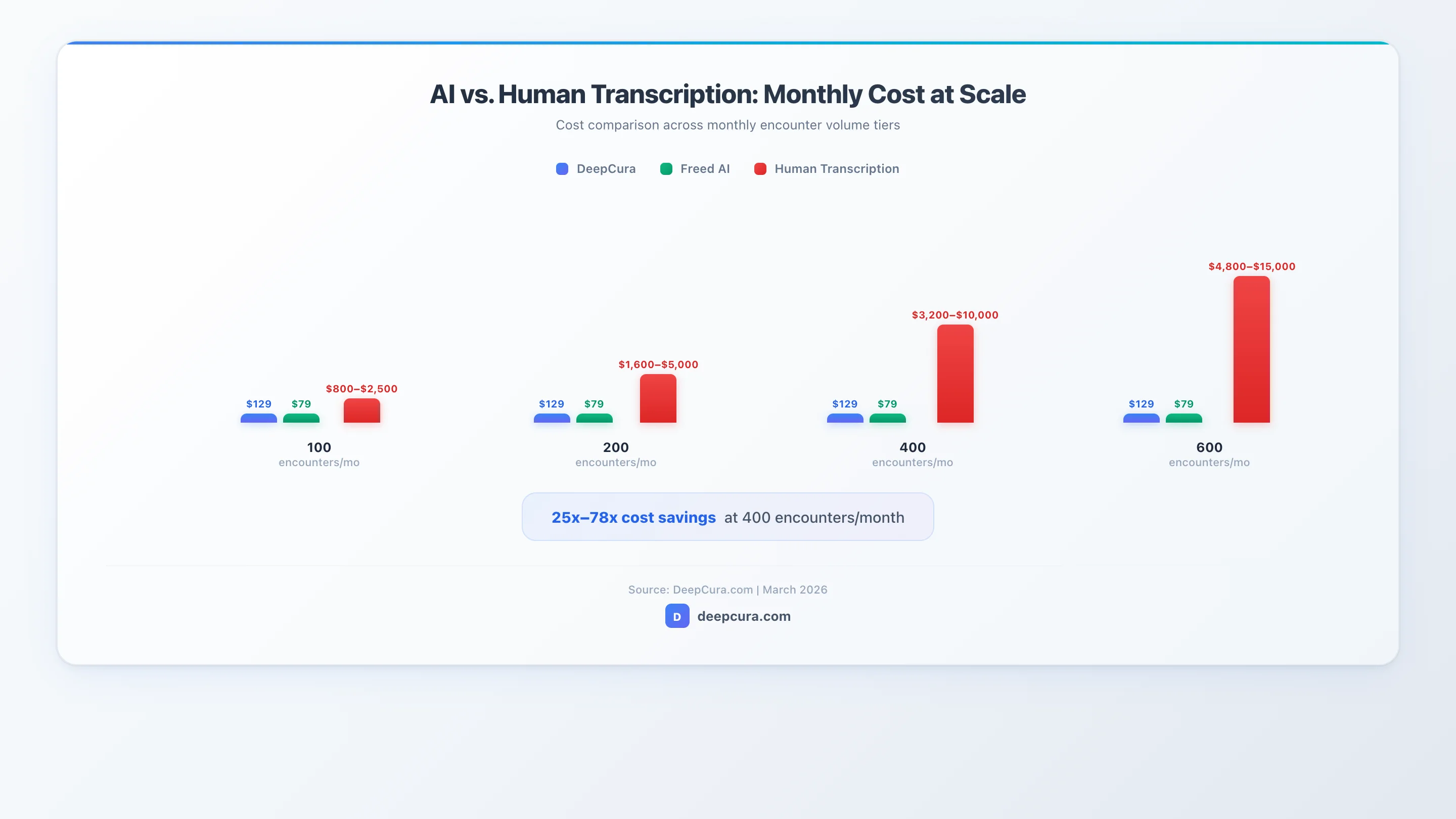 Infographic: AI transcription vs. human transcription — cost per encounter at 50, 200, 500, and 1,000 encounters/month.
Replace Your Transcription Service with AI
DeepCura generates structured clinical notes from ambient conversation in under 2 minutes. No per-minute or per-word fees. $129/mo flat · 1,000 credits/mo (1 credit per standard note).
+1 (415) 549-1829Available 24/7 · Set up in seconds · No credit card required

Frequently Asked Questions
What is medical transcription software?
Medical transcription software converts spoken clinical audio — whether dictated by a clinician or captured from ambient patient conversations — into written text. Traditional medical transcription software recorded dictation and delivered typed documents via human transcriptionists. Modern AI medical transcription software goes further: it listens to encounters in real time, generates structured clinical notes (SOAP, H&P, progress notes), suggests billing codes, and pushes completed documentation directly into EHR systems.
Is AI medical transcription accurate enough for clinical use?
Yes. AI medical transcription tools in 2026 achieve 90-95% accuracy for standard clinical encounters, and the accuracy continues to improve as models are trained on larger clinical datasets. Most clinicians report that reviewing and correcting an AI-generated note takes 30-60 seconds — far less time than waiting hours for a human transcription to arrive. For standard primary care, family medicine, internal medicine, and psychiatry encounters, AI accuracy is sufficient for clinical use. Highly specialized or legally sensitive cases may still benefit from human review.
How much does medical transcription software cost?
AI medical transcription software ranges from $39/month (Freed AI Starter, 40-note cap) to $129/month (DeepCura, 1,000 credits/mo — 1 credit per standard note — with full clinical platform). Human transcription services cost $1.50-$3.00 per audio minute or $8-$25 per encounter, translating to $3,200-$10,000+ per month for a practice seeing 20 patients per day. DeepCura at $129/month includes AI transcription, structured note generation, EHR integration, AI receptionist, billing automation, and fax management.
Can AI transcription software replace human medical transcriptionists?
For most standard clinical encounters, yes. AI transcription delivers comparable output in under two minutes at a fraction of the cost. Human transcription remains valuable for complex medico-legal documentation, multi-speaker surgical cases, rare subspecialty terminology, and situations where 99%+ accuracy is a regulatory requirement. The majority of practices handling routine outpatient encounters can fully replace human transcription with AI tools.
Does medical transcription software integrate with EHR systems?
Integration varies significantly by product. DeepCura offers native API write-back to athenahealth, eClinicalWorks, AdvancedMD, OptiMantra, Epic, DrChrono, CharmHealth, and Cerner. Dragon Medical One integrates with Epic and Cerner for direct dictation. Nuance DAX Copilot has the deepest Epic integration at the enterprise level. Freed AI offers scraping-based EHR push at its Premier tier. Human transcription services typically have no EHR integration — documents are delivered as files that staff must manually enter.
What is the difference between medical dictation and medical transcription software?
Medical dictation software handles the input — how clinicians speak into the system. Traditional dictation requires the clinician to narrate findings into a microphone. Medical transcription software handles the output — converting that audio into written documentation. Modern AI ambient tools merge both functions: they passively capture the natural patient conversation (no active dictation required) and automatically generate structured clinical notes. For a detailed comparison of dictation tools, see our guide to medical dictation software.
Is AI medical transcription HIPAA compliant?
All AI medical transcription tools listed in this guide offer HIPAA-compliant infrastructure and sign Business Associate Agreements (BAAs) with covered entities. This includes DeepCura, Freed AI, Heidi Health, DeepScribe, Dragon Medical One, and Nuance DAX Copilot. For human transcription services like TranscribeMe, HIPAA compliance must be verified independently — always confirm BAA availability before transmitting protected health information.
What is the best medical transcription software for small practices?
For small practices, the choice depends on budget and workflow needs. DeepCura at $129/month is the best value for practices that want a full clinical platform — AI transcription, structured notes, EHR integration, AI receptionist, and billing in a single tool. Freed AI at $39/month (Starter) or $79/month (Core) is the budget-friendly option for practices that only need basic transcription-to-note generation without broader workflow automation.
Try DeepCura Free — No Credit Card Required
AI transcription + ambient scribe + EHR integration + billing automation. One platform, $129/mo. Join 6,000+ clinicians.
+1 (415) 549-1829Available 24/7 · Set up in seconds · No credit card required
References
[1] U.S. Bureau of Labor Statistics, "Medical Transcriptionists — Occupational Outlook Handbook," BLS.gov. bls.gov/ooh/healthcare/medical-transcriptionists.htm
[1a] Sinsky, C., et al., "Allocation of Physician Time in Ambulatory Practice: A Time and Motion Study in 4 Specialties," Annals of Internal Medicine, 2016. annals.org/aim/article-abstract/2546704
[2] Association for Healthcare Documentation Integrity (AHDI), "Standards for Clinical Documentation," AHDI.org. ahdionline.org
[3] U.S. Department of Health and Human Services, "HIPAA for Professionals," HHS.gov. hhs.gov/hipaa/for-professionals
[4] DeepCura, "AI Medical Scribe Platform — Ambient Scribing, AI Receptionist, EHR Integration," DeepCura.com. deepcura.com
[5] Nuance Communications, "Dragon Medical One — Clinical Speech Recognition," Nuance.com. nuance.com/healthcare/provider-solutions/speech-recognition/dragon-medical-one.html
[6] Freed AI, "AI Medical Scribe — Ambient Clinical Documentation," Freed.ai. getfreed.ai
[7] Heidi Health, "AI-Powered Clinical Documentation," HeidiHealth.com. heidihealth.com
[8] DeepScribe, "Ambient AI Scribe for Healthcare," DeepScribe.ai. deepscribe.ai
[9] TranscribeMe, "Medical Transcription Services," TranscribeMe.com. transcribeme.com/medical-transcription