
94% first-pass claim acceptance. Full EHR. Billing, patient portal, telehealth, and e-prescribing — from under $99/month.
That is what the best EMR for small practices delivers in 2026. Yet most 1–5 provider clinics are still overpaying for hospital-grade systems that were never designed for lean operations.
We evaluated 27 platforms to rank the 10 best EMRs for small practices — and because vendors use the two terms interchangeably, this is equally a ranking of the best EHR for small practices (the difference is smaller than you think). Every system was scored on five criteria that matter when every dollar counts:
- Total cost — monthly fee plus hidden charges (interfaces, onboarding, support tiers)
- Usability — time from login to finished note, click count, learning curve
- Built-in billing — claims, ERA/EOB posting, denial management without a third-party add-on
- Patient engagement — portal, online scheduling, intake forms, telehealth
- AI readiness — native AI features or integration with AI scribes like DeepCura
Whether you are opening a new practice or escaping an enterprise EHR that is bleeding your budget, this guide gives you the shortlist.
Disclosure: DeepCura integrates with several EMR systems listed below (Optimantra, athenahealth, eClinicalWorks, and AdvancedMD). All products were evaluated independently in March–April 2026 using the five criteria above, and the rankings were last reviewed and updated on August 25, 2026. Pricing reflects publicly available rates at the time of review. Some vendors offer custom quotes — contact them directly for exact pricing. Rankings reflect the editorial judgment of the author.
Before you read a single review, get your number. Set your provider count and the features you need — the calculator prices all 10 ranked systems for your practice: real-world EMR software pricing, including the add-on costs most vendors keep in the fine print:
Estimated Cost Calculator
What will an EMR actually cost your practice?
Estimated monthly software cost for all 10 ranked systems, including the add-ons most small practices need. Pricing & feature availability verified August 2026.
Providers
Monthly collections (for % pricing)
$50,000 / month, whole practice
- 01SimplePracticeBehavioral healthLowest est.$196 /mo est.From-price
- Behavioral health focus — not built for medical specialties
- Tiers run $49/$79/$99 — confirm with the vendor which tier includes insurance claim filing
- e-Rx is an add-on: $49/mo per clinician + $89 one-time setup
- 02OptimantraBest value all-in-one$224 /mo est.
- Claims processing billed at $0.25/claim on top of subscription
- EPCS e-Rx add-on listed at $38/mo (assumed per prescriber)
- No long-term contract; 30-day cancellation
- 03Practice FusionSimple charting$298 /mo est.From-price
- No built-in billing — requires a separate third-party service (cost not included)
- No telehealth capability
- 04CharmHealthBudget-friendly$300 /mo est.
- Assumes 300 encounters/provider/mo at $0.50 each
- Free tier exists (≤50 encounters/mo, limited features)
- 05DrChronoiPad / mobile-first$398 /mo est.From-price
- From-price — final quote scales with plan tier and add-ons
- 06TebraSolo + patient marketing$198–$798 /mo est.Quote req.
- Custom quotes only — range reflects published third-party estimates
- Telehealth requires a third-party add-on
- 07Elation HealthIndependent primary care$698 /mo est.From-price
- Billing is an add-on through partners, quoted separately (cost not included)
- 08eClinicalWorksGrowing 3+ provider clinics$898 /mo est.From-price
- Implementation can take 3–6 months; contract terms apply
- 09AdvancedMDMulti-specialty groups$1,458 /mo est.Quote req.
- Full EHR + practice management bundle ($729, assumed per provider) used because billing is selected
- Vendor quotes vary by module mix — confirm directly
- 10athenahealthBest overall / RCM$2,000–$3,500 /mo est.Quote req.
- Percentage-of-collections model — scales with your revenue
- 3-year initial contract with early-termination fees
Whichever EMR you choose, the AI layer is flat-rate: DeepCura adds ambient AI scribing, an AI receptionist, and billing automation for $129/mo per provider — it works alongside athenahealth, Optimantra, eClinicalWorks, AdvancedMD, and Epic, and is not one of the ranked EMRs above.
Assumptions, formulas & sources
Where a vendor prices per encounter, the calculator assumes 300 encounters per provider per month. Percentage-based pricing uses your collections input. One-time costs (implementation, data migration, e-Rx setup fees, interfaces) and per-claim fees are excluded from monthly figures and noted per vendor instead. “From-price” means the vendor advertises a starting price and your final quote may be higher; “Quote req.” means the vendor sells through custom quotes.
- CharmHealth: $0.50 per encounter with a $25/mo minimum; free tier up to 50 encounters/mo. Source: CharmHealth published encounter-based pricing (charmhealth.com), verified August 2026.
- SimplePractice: Starter $49/clinician/mo (Essential $79 and Plus $99 tiers also available) + optional e-Rx add-on $49/mo per clinician (+$89 one-time setup, excluded from the monthly figure). Source: SimplePractice published plan tiers $49/$79/$99 and e-Rx add-on pricing (simplepractice.com), verified August 2026.
- Optimantra: $99/mo first provider + $49/mo each additional + optional EPCS e-Rx add-on $38/mo (assumed per prescriber); claims at $0.25/claim excluded from the monthly figure. Source: Optimantra published pricing (optimantra.com), verified August 2026.
- Tebra: Custom-quoted; published third-party estimates suggest $99–$399/provider/mo depending on modules. Source: Tebra does not publish list pricing (tebra.com); the $99–$399/provider range reflects published third-party estimates, verified August 2026.
- Practice Fusion: From $149/provider/mo; former free tier discontinued. Source: Practice Fusion published pricing (practicefusion.com), verified August 2026.
- AdvancedMD: Base EHR from $169/provider/mo; EHR + PM bundle $729/mo when billing is needed (per-provider assumption). Source: AdvancedMD published pricing ranges (advancedmd.com), verified August 2026.
- DrChrono: From $199/provider/mo; higher tiers and add-ons quoted by vendor. Source: DrChrono published from-pricing (drchrono.com), verified August 2026.
- Elation Health: From $349/provider/mo; partner billing add-on quoted separately. Source: Elation Health published from-pricing (elationhealth.com), verified August 2026.
- eClinicalWorks: From $449/provider/mo. Source: eClinicalWorks published pricing (eclinicalworks.com), verified August 2026.
- athenahealth: 4–7% of monthly collections (industry-reported range; uses your collections input) — billing/RCM is what the percentage buys. Source: athenahealth prices via custom percentage-of-collections quotes (athenahealth.com); the 4–7% range is industry-reported, not vendor-published. Verified August 2026.
Disclaimer: Estimates only — not vendor quotes or offers. Figures are computed from publicly listed prices, industry-reported ranges, and vendor feature and contract information as published, verified in August 2026; vendors change pricing, features, and terms at any time, and most sell through custom quotes, so your actual price may differ. Monthly figures exclude one-time costs (implementation, data migration, setup fees, interfaces) and usage-based fees unless noted. All product names, logos, and brands are property of their respective owners; their use here is for identification only and does not imply affiliation with or endorsement by those vendors. DeepCura is a separate AI platform that integrates with several systems listed (see the disclosure at the top of this article) and is not a ranked entry. This tool is informational and is not financial, legal, or purchasing advice — confirm current pricing directly with each vendor before making a decision.
What Is the Best EMR for a Small Practice?
The best EMR for a small practice in 2026 is athenahealth if you want revenue cycle management handled for you — its 94%+ first-pass claim acceptance is the strongest in the category. Optimantra is the best-value pick at $99/month for EHR, billing, patient portal, telehealth, and e-prescribing in one platform with no long-term contract. And CharmHealth is the cheapest EMR that still covers the clinical basics, from $25/month.
Those three answers cover most 1–5 provider clinics. The full ranking below explains when the other seven systems — from DrChrono's iPad-first charting to SimplePractice's behavioral-health focus — are the better fit, and the cost table further down shows what each pricing model really adds up to.
Quick Comparison: 10 Best EMRs for Small Practices
| Rank | EMR | Starting Price | Portal | e-Rx | Billing | Telehealth | Best For |
|---|---|---|---|---|---|---|---|
| 1 | athenahealth | % of collections | ✓ | ✓ | ✓ | ✓ | Best Overall |
| 2 | Optimantra | $99/mo | ✓ | ✓ | ✓ | ✓ | Best Value |
| 3 | Elation Health | $349/mo | ✓ | ✓ | Add-on | ✓ | Independent Primary Care |
| 4 | DrChrono | $199/mo | ✓ | ✓ | ✓ | ✓ | iPad / Mobile-First |
| 5 | CharmHealth | $25/mo | ✓ | ✓ | ✓ | ✓ | Budget-Friendly |
| 6 | Tebra | Contact | ✓ | ✓ | ✓ | Add-on | Solo Practitioners |
| 7 | eClinicalWorks | $449/mo | ✓ | ✓ | ✓ | ✓ | Growing Practices |
| 8 | Practice Fusion | $149/mo | ✓ | ✓ | Limited | ✗ | Budget Option |
| 9 | AdvancedMD | $169/mo | ✓ | ✓ | ✓ | ✓ | Multi-Specialty |
| 10 | SimplePractice | $49/mo | ✓ | Add-on | ✓ | ✓ | Behavioral Health |
Add AI Scribing to Any EMR — $129/mo
DeepCura integrates with Optimantra, athenahealth, eClinicalWorks, Epic, and AdvancedMD. Ambient AI documentation, AI receptionist, billing automation, and bidirectional EHR write-back — 1,000 credits/mo (1 credit per standard note). Start your free trial.
+1 (415) 549-1829Available 24/7 · Set up in seconds · No credit card required
EMR vs EHR: What's the Difference for a Small Practice?
Technically, an EMR (electronic medical record) is a digital chart used inside a single practice, while an EHR (electronic health record) is built to share patient data across organizations — labs, hospitals, pharmacies, and other providers. That distinction mattered when the terms were coined. In 2026, it has mostly collapsed: the systems on this list are full EHR platforms — cloud-based, with e-prescribing, lab connections, and data sharing built in or available as add-ons — and vendors market the same product under both names.
The practical takeaway: whether you searched for the best EMR or the best EHR for your small practice, you are evaluating the same category of software. What actually separates the winners is price transparency, built-in billing, and how well the system pairs with an AI layer — the three areas where small practices lose (or save) the most money, and the areas this ranking weights most heavily. (Running a therapy-led practice? That market has its own leaders — see our best EHR for private practice ranking.)
Reviews of the 10 Best EMRs for Small Practices
1. athenahealth — Best Overall EMR for Small Practices
athenahealth is the most widely recognized EMR system for small practices in the US — and for good reason. Instead of a flat monthly fee, athena charges a percentage of collections (typically 4–7% per industry reporting, depending on practice size and volume — athenahealth itself quotes each practice individually), aligning their incentives directly with your revenue. The revenue cycle management engine handles claims scrubbing, denial management, and payer follow-up automatically — delivering a 94%+ first-pass acceptance rate across the network.
For small practices that prioritize getting paid, athenahealth's RCM is unmatched. The platform also includes a strong patient portal (athenaPatient) with self-scheduling, a large payer network, and an automatic coding rules engine. The breadth of the athenahealth network means it is easy to find trained staff and consultants familiar with the system.
Strengths:
- Industry-leading RCM with 94%+ first-pass claim acceptance (up to 98%+ for athenaOne users)
- Percentage-based pricing aligns incentives with your collections
- Massive payer network and automatic coding rules engine
- Strong patient portal (athenaPatient) with self-scheduling
- Large installed base — easy to find trained staff
- DeepCura AI integration for ambient scribing with bidirectional write-back
Limitations:
- Expensive for high-volume practices — percentage of collections adds up quickly
- Requires a 3-year initial contract with automatic 1-year renewals and early termination fees
- Charting interface feels dated compared to newer systems
- Implementation takes 8–12 weeks
Pricing: Percentage of collections (industry-reported range: typically 4–7%; not a vendor-published rate). Contact for a custom quote.
Verdict: The gold standard EMR system for small practices that want best-in-class revenue cycle management. If maximizing collections is your top priority and you can commit to a multi-year contract, athenahealth is the safest bet. For practices that need more flexibility or lower upfront costs, see Optimantra below.
2. Optimantra — Best Value EMR for Small Practices
Optimantra is a cloud-based, all-in-one EHR platform built specifically for small and mid-size practices. Unlike enterprise EMR systems that demand dedicated IT staff and six-figure implementation budgets, Optimantra bundles EHR, practice management, billing, a patient portal, telehealth, and e-prescribing into a single platform — starting at $99/month for the first provider ($49/month for each additional), with no long-term contract required.
What sets Optimantra apart is the combination of affordability and breadth. Most sub-$200/month EHRs force you to bolt on third-party billing, a patient portal, or a telehealth solution. Optimantra offers all of these within one platform. The charting engine includes templates for 15+ specialties — integrative medicine, functional medicine, acupuncture, chiropractic, naturopathy, primary care, mental health, med spa, physical therapy, and more — making it one of the few platforms that works for both conventional and holistic practices without heavy customization.
The integrated billing module handles claims submission and ERA/EOB auto-posting ($0.25/claim). Lab integrations with Quest and LabCorp are included, EPCS-certified e-prescribing is available as an add-on ($38/month), and the HIPAA-compliant patient portal supports online scheduling, digital intake forms, and secure messaging.
For practices that want to go further, Optimantra integrates directly with DeepCura's AI scribe — adding ambient documentation, an AI receptionist, a chart-native healthcare CRM whose fields fill themselves from the visit, and automated billing with bidirectional write-back into the Optimantra chart.
Strengths:
- All-in-one platform: EHR + practice management + billing + patient portal + telehealth + e-prescribing
- Templates for 15+ specialties — integrative, functional, primary care, mental health, chiropractic, acupuncture, med spa, and more
- Affordable: $99/mo for the first provider, $49/mo for additional providers, no long-term contract
- Integrated claims management with ERA/EOB auto-posting and claims analytics
- HIPAA-compliant patient portal with online scheduling, intake forms, and secure messaging
- Lab integrations (Quest, LabCorp, Rupa Health, and more) with EPCS-certified e-prescribing available
- Cloud-based — accessible from any browser, no local server required
- DeepCura AI integration for ambient scribing, AI receptionist, and automated billing
- Dedicated onboarding with managed training, daily office hours, and live support
Limitations:
- Smaller user community than athenahealth or eClinicalWorks — fewer third-party forums and resources
- Insurance billing and e-prescribing are priced as add-ons (not included in base subscription)
- Mobile app is functional but not as polished as DrChrono's iPad-native experience
Pricing: From $99/month for the first provider ($49/month additional). 30-day cancellation policy — no long-term contract. Free trial available.
Verdict: Optimantra delivers the best value-to-feature ratio among all EMR systems for small practices in 2026. No other EHR at this price point combines practice management, billing, telehealth, patient portal, and templates for 15+ specialties — all without requiring a long-term contract. Pair it with DeepCura's AI platform and you have a full clinical AI + EHR stack for under $250/month.
3. Elation Health — Best for Independent Primary Care
Elation Health was built by primary care physicians for primary care physicians. The charting workflow mirrors how PCPs think — problem-based, longitudinal, with deep clinical decision support. It is consistently rated the most "doctor-friendly" EHR for independent practices.
Strengths:
- Designed specifically for primary care and direct primary care (DPC) workflows
- Intuitive charting that follows clinical reasoning, not billing codes
- Strong clinical decision support with drug-interaction and allergy checking
- Active independent-physician community and strong DPC support
Limitations:
- Premium pricing ($349+/mo) puts it out of reach for budget-conscious practices
- Billing is an add-on through partners, not built in
- Limited specialty templates outside primary care
Pricing: From $349/month per provider.
Verdict: The best charting experience for PCPs who can afford the premium. If you run a DPC or concierge practice, Elation is worth the investment.
4. DrChrono — Best for iPad/Mobile-First Practices
DrChrono pioneered the iPad EHR. If you chart at the bedside, in the exam room, or on the go, its mobile-first design is unmatched. The app supports Apple Pencil for drawing on diagrams, voice dictation, and photo capture directly into the chart.
Strengths:
- Best-in-class iPad app with Apple Pencil support
- Custom form builder for any specialty
- Built-in billing with ERA posting
- Medical speech-to-text for mobile charting
- API-friendly for custom integrations
Limitations:
- Desktop/web interface is less polished than the iPad app
- Customer support responsiveness varies by plan tier
- Pricing scales quickly with add-ons
Pricing: From $199/month per provider.
Verdict: The clear winner for practices that chart primarily on tablets. Less compelling if you are desktop-bound.
5. CharmHealth — Best Budget-Friendly EHR
CharmHealth offers a surprisingly complete EHR at rock-bottom prices. The free tier covers basic charting (up to 50 encounters/month), while the paid Encounter plan charges $0.50/encounter with a $25/month minimum. It is particularly popular among integrative medicine, naturopathic, and functional medicine practices.
Strengths:
- Free tier available for solo providers (up to 50 encounters/month)
- Encounter-based pricing from $25/mo minimum — among the most affordable EHRs on the market
- Telehealth, patient portal, and e-prescribing included on paid plans
- Templates for integrative medicine, naturopathy, and other specialties
- RCM services available as an add-on
Limitations:
- Free tier is very limited — missing key features like e-prescribing and telehealth
- UI feels dated compared to Optimantra or Elation Health
- Smaller support team with slower response times
- Limited third-party integrations
Pricing: Free tier available (50 encounters/month). Paid plans from $25/month minimum ($0.50/encounter).
Verdict: Best for bootstrapped solo providers who need a functional EHR at minimal cost. Upgrade to Optimantra when you need a more complete, modern platform.
Stop Typing — Start Talking to Your Patients
DeepCura's ambient AI scribe listens to the encounter and writes the note for you. Works with Optimantra, athenahealth, eClinicalWorks, Epic, and AdvancedMD. $129/mo · 1,000 credits/mo (1 credit per standard note). Start your free trial.
+1 (415) 549-1829Available 24/7 · Set up in seconds · No credit card required
6. Tebra — Best for Solo Practitioners
Tebra (formerly Kareo + PatientPop) combines EHR, billing, and patient marketing in one platform. For solo practitioners who need to attract patients and manage their practice, Tebra's built-in reputation management and online-presence tools are a unique differentiator.
Strengths:
- EHR + billing + patient marketing in one platform
- Built-in reputation management and online review collection
- Modern, clean interface
- Works well for both private-pay and insurance-based practices
Limitations:
- Telehealth requires a third-party add-on
- Pricing adds up when combining all modules
- Customer support has mixed reviews on G2 and Capterra
Pricing: Custom quotes — contact Tebra for pricing (published ranges suggest $99–$399/month per provider depending on modules).
Verdict: Best for solo providers who need practice marketing alongside their EHR. Less cost-effective if you already handle your own patient acquisition.
7. eClinicalWorks — Best for Growing Multi-Provider Clinics
eClinicalWorks is one of the most widely deployed EHRs in the US, powering over 180,000 providers. The platform is feature-rich — population health management, chronic care management, patient engagement, and revenue cycle are all built in. The complexity and pricing, however, make it better suited for practices with 3+ providers.
Strengths:
- Comprehensive feature set: EHR, PM, RCM, population health, telehealth, and patient portal
- healow patient engagement ecosystem (scheduling, check-in, secure messaging)
- Strong for multi-provider and multi-location practices
- DeepCura AI integration for ambient scribing with CCDA write-back
- Large installed base — easy to find trained staff
Limitations:
- Starting at $449/mo per provider — expensive for small practices
- Interface has a steep learning curve
- Implementation can take 3–6 months
- Customer support quality varies
Pricing: From $449/month per provider.
Verdict: Powerful but expensive. Best for growing practices with 3+ providers that need population health and chronic care management. Overkill for most 1–2 provider clinics.
8. Practice Fusion — Best Budget EHR Option
Practice Fusion is a straightforward, no-frills cloud-based EHR that covers the basics: charting, e-prescribing, and lab integrations. It previously offered a free ad-supported tier, but that has been discontinued — current pricing starts at $149/month per provider. A 14-day free trial is available.
Strengths:
- Simple interface — minimal learning curve, fast onboarding
- e-Prescribing included (EPCS-certified)
- Lab integrations (Quest, LabCorp)
- No long-term contracts
- Lower price point than enterprise EHRs
Limitations:
- No built-in billing — requires a third-party service
- No telehealth capability
- Limited customization and specialty templates
- Owned by Veradigm (formerly Allscripts) — corporate roadmap uncertain
Pricing: From $149/month per provider. 14-day free trial available.
Verdict: A viable option for practices that want simple, affordable charting without bells and whistles. If you need billing, telehealth, or specialty templates, Optimantra offers significantly more for only $50 less per month. For Practice Fusion users specifically looking to add AI scribing, see our Best AI Scribe for Practice Fusion guide — a two-click, no-training workflow at $65/month.
9. AdvancedMD — Best for Multi-Specialty Groups
AdvancedMD targets small-to-medium multi-specialty groups that need one platform for primary care, dermatology, orthopedics, mental health, and other disciplines under one roof. The platform includes EHR, practice management, billing, patient engagement, and telemedicine.
Strengths:
- Strong multi-specialty template library
- Unified billing across all specialties
- Robust reporting and analytics dashboard
- Patient experience management tools
- DeepCura AI integration for ambient documentation
Limitations:
- Pricing varies widely by module — the full EHR + PM bundle runs $729/mo, well above most small-practice budgets
- Complex setup for multi-location configurations
- Steeper learning curve than simpler systems
Pricing: Base plans from $169/month per provider. Practice management add-on is $429/month. Full EHR + PM bundle is $729/month. Contact for custom quotes.
Verdict: Best for multi-specialty groups with 5+ providers. The full-bundle cost is hard to justify for solo or 2–3 provider practices, though the base tier is more accessible.
10. SimplePractice — Best for Behavioral Health
SimplePractice dominates the therapy and behavioral health market. It is purpose-built for therapists, counselors, psychologists, and social workers — with treatment plans, progress notes, outcome measures, and insurance billing tailored to mental health workflows.
Strengths:
- Purpose-built for mental health — treatment plans, progress notes, outcome measures
- Beautiful, modern interface with minimal learning curve
- Affordable: Starter plan at $49/mo, Essential at $79/mo, Plus at $99/mo
- Built-in telehealth and client portal
- Insurance billing with claim submission
- Monarch directory listing for client acquisition
- e-Prescribing available as an add-on ($49/mo per clinician)
Limitations:
- Not suitable for medical practices outside behavioral health
- e-Prescribing is a paid add-on ($49/mo + $89 setup), not included in base plans
- Limited lab integrations
- Reporting is basic compared to full-featured EHRs
Pricing: Starter plan from $49/month per provider. Essential $79/month. Plus $99/month.
Verdict: The obvious choice for therapists, counselors, and social workers — see our full best EHR for private practice ranking for how it compares against TherapyNotes, Sessions Health, and the other therapy-first platforms. Not designed for medical specialties — if you need robust e-prescribing or lab integration out of the box, look at Optimantra or Elation Health instead.
How AI Is Transforming Small Practice EMRs
The best EMR for a small practice in 2026 is not just an EHR — it is an EHR paired with an AI layer that eliminates the documentation burden entirely.
DeepCura integrates with Optimantra, athenahealth, eClinicalWorks, AdvancedMD, Epic, DrChrono, CharmHealth, and Cerner to add capabilities that no standalone EMR offers:
- AI Medical Scribe — ambient listening that generates SOAP notes, H&Ps, and specialty-specific templates in real time
- AI Receptionist — 24/7 phone answering, appointment booking, payment collection, and patient triage without front-desk staff
- AI Billing — automated CPT/ICD-10 coding suggestions and claim pre-population
- AI Fax Management — incoming fax summarization and routing
- Bidirectional EHR Write-Back — notes push directly into your EMR chart with zero copy-paste
The Optimantra + DeepCura stack gives small practices a complete AI-powered clinical platform for under $250/month per provider — less than what many practices pay for athenahealth or eClinicalWorks alone. Read our guide to AI for doctors and our breakdown of the best AI medical scribes for a deeper comparison.
See DeepCura in Action
Watch how DeepCura's AI scribe works alongside your EMR — ambient documentation, real-time note generation, and one-click EHR write-back.

EHR Feature Comparison for Small Practices
| Feature | athena | Optimantra | Elation | DrChrono | Charm | Tebra | eCW | Fusion | AdvMD | Simple |
|---|---|---|---|---|---|---|---|---|---|---|
| Cloud-Based | ✓ | ✓ | ✓ | ✓ | ✓ | ✓ | ✓ | ✓ | ✓ | ✓ |
| Built-in Billing | ✓ | ✓ | Add-on | ✓ | ✓ | ✓ | ✓ | ✗ | ✓ | ✓ |
| Patient Portal | ✓ | ✓ | ✓ | ✓ | ✓ | ✓ | ✓ | ✓ | ✓ | ✓ |
| Telehealth | ✓ | ✓ | ✓ | ✓ | ✓ | Add-on | ✓ | ✗ | ✓ | ✓ |
| e-Prescribing | ✓ | Add-on | ✓ | ✓ | ✓ | ✓ | ✓ | ✓ | ✓ | Add-on |
| Lab Integration | ✓ | ✓ | ✓ | ✓ | ✓ | ✓ | ✓ | ✓ | ✓ | Limited |
| AI Scribe Ready | ✓ | ✓ | Limited | Limited | ✗ | ✗ | ✓ | ✗ | ✓ | ✗ |
| 15+ Specialties | ✓ | ✓ | PCP only | Custom | ✓ | Limited | ✓ | Limited | ✓ | MH only |
| No Setup Fees | ✗ | ✓ | ✗ | ✓ | ✓ | ✓ | ✗ | ✓ | ✗ | ✓ |
| No Contract | ✗ | ✓ | ✓ | ✓ | ✓ | ✓ | ✗ | ✓ | ✗ | ✓ |
| Price | % rev | $99/mo | $349/mo | $199/mo | $25/mo | Contact | $449/mo | $149/mo | $169/mo | $49/mo |
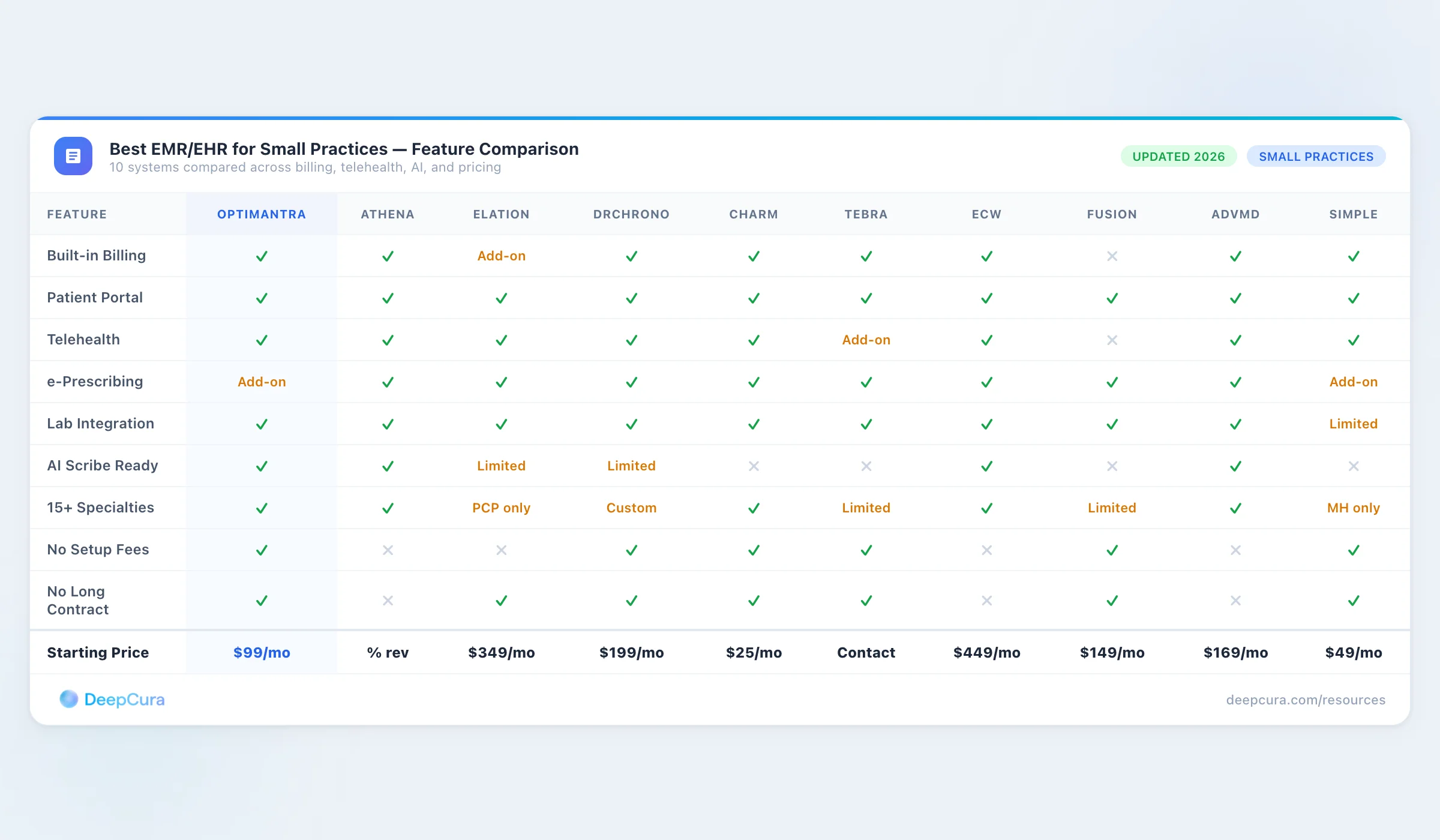
Two quick reads of this table. First, every system here is a web-based EMR — cloud-hosted, nothing to install, accessible from any browser. Second, if you run a telemedicine-first or hybrid practice, the telehealth column narrows the field fast: athenahealth, Optimantra, Elation Health, DrChrono, CharmHealth, eClinicalWorks, AdvancedMD, and SimplePractice all include video visits, Tebra requires an add-on, and Practice Fusion has none.
Common EMR Systems: Examples and Vendor Names
Searching for EMR systems examples turns up a market of 500+ vendors, but most US clinicians encounter the same twenty or so names. The most common EMR systems fall into three groups:
- Hospital and enterprise EHRs — Epic, Oracle Health (formerly Cerner), MEDITECH, and Veradigm (formerly Allscripts). These dominate health systems and hospital-owned groups, but their cost and complexity make them the systems small practices are usually escaping, not adopting (see how much Epic costs for a small clinic in the FAQ).
- Ambulatory EMRs built for independent practices — the ten systems ranked on this page: athenahealth, Optimantra, Elation Health, DrChrono, CharmHealth, Tebra (formerly Kareo), eClinicalWorks, Practice Fusion, AdvancedMD, and SimplePractice. NextGen and Greenway Health also serve this market, skewing toward larger ambulatory groups.
- Specialty-specific systems — TherapyNotes and Sessions Health for therapy practices, ICANotes for psychiatry, Jane for allied health and wellness. If your practice is therapy-led, our best EHR for private practice guide ranks these in depth.
Different EMR systems assume different practice sizes. The enterprise names expect dedicated IT staff and six-figure budgets; every EMR vendor in our top-10 list sells directly to 1–5 provider practices with self-serve or lightly assisted onboarding. That dividing line matters more than any feature checklist.
Specialty programs sometimes need a system built around their own record rather than a general EMR. Wound centers are the clearest case; the wound care EMR and software guide compares wound-specific EMRs, imaging apps, general EHR templates and AI documentation by program type.
Cheapest EMR Systems for Small Practices
If budget is your primary constraint, these are the most affordable EMR systems available in 2026:
| EMR | Starting Price | What You Get |
|---|---|---|
| CharmHealth | $25/mo (or free tier) | Basic EHR with encounter-based pricing. Free tier limited to 50 encounters/month |
| SimplePractice | $49/mo | Full behavioral health EHR with telehealth and portal |
| Optimantra | $99/mo | All-in-one: EHR + billing + portal + telehealth + 15+ specialty templates |
| Practice Fusion | $149/mo | Simple cloud charting with e-prescribing — no billing |
The cheapest EMR is not always the best investment. CharmHealth's free tier lacks billing and telehealth. Practice Fusion has no built-in billing. For most small practices, the $99/month range (Optimantra) hits the sweet spot — low cost EMR with the features you actually need to run a practice without bolt-on subscriptions.
Best EMR for Solo Practice
Solo practitioners need an EMR that handles everything without dedicated staff. The best EMR for solo practice combines charting, billing, scheduling, and patient communication in one system — because you cannot afford to manage four different platforms.
Our top picks for solo providers:
- Optimantra ($99/mo) — All-in-one with no contract. Best for solo practitioners who need billing, portal, and telehealth without hiring an IT team.
- Tebra (contact for pricing) — EHR + built-in patient marketing and reputation management. Best for solo providers building their patient base.
- CharmHealth ($25/mo) — Cheapest EMR system for solo providers on a tight budget. Encounter-based pricing keeps costs predictable.
- SimplePractice ($49/mo) — Best for solo therapists, counselors, and behavioral health providers.
For solo practitioners looking to eliminate documentation time entirely, adding an AI scribe like DeepCura ($129/mo) to any of these EMR systems saves 1–2 hours per day on charting.
Best EMR for Small Pediatric Practice
Pediatric practices have unique EMR requirements — growth charts, immunization tracking, well-child visit templates, and parent portal access. The best EMR for a small pediatric practice needs these features without the complexity of a hospital-grade system.
Our top picks for small pediatric practices:
- athenahealth — Strong pediatric templates, immunization registry integration, and automatic vaccine schedule tracking. The percentage-based pricing works well for high-volume pediatric practices.
- Optimantra — Affordable pediatric templates with growth chart tracking. At $99/mo, it is the most cost-effective option for small pediatric offices.
- DrChrono — Customizable templates that can be built for any pediatric workflow. iPad-based charting works well for exam-room documentation with children present.
- eClinicalWorks — Comprehensive pediatric module with population health tools for tracking immunization compliance across your patient panel.
How Much Does an EMR Cost for a Small Practice?
EMR costs for small practices vary widely depending on features, number of providers, and pricing model — published EMR software pricing rarely tells the whole story:
| Price Range | Examples | What You Get |
|---|---|---|
| Free – $50/mo | CharmHealth (free tier), SimplePractice ($49) | Basic charting. Usually missing billing, telehealth, or both |
| $99 – $199/mo | Optimantra ($99), Practice Fusion ($149), DrChrono ($199) | Mid-range EMR systems with most features included |
| $349 – $449/mo | Elation Health ($349), eClinicalWorks ($449) | Premium EMR systems with advanced clinical features |
| % of collections | athenahealth (4–7%) | No fixed cost — scales with revenue. Can be cheapest or most expensive depending on volume |
| $729+/mo | AdvancedMD (full bundle) | Enterprise-grade multi-specialty with complete PM |
Hidden costs to watch for: Implementation fees ($500–$5,000), data migration ($1,000–$3,000), e-prescribing add-ons ($38–$49/mo), interface fees for labs or clearinghouses, and early termination penalties (especially athenahealth and eClinicalWorks).
The most affordable EMR for a small practice without sacrificing essential features is Optimantra at $99/month with no long-term contract and no setup fees.
Frequently Asked Questions
What is the best EMR for a small medical practice?
athenahealth is the best overall EMR system for small practices that prioritize revenue cycle management, with a 94%+ first-pass claim acceptance rate. For practices that need the best value, Optimantra combines EHR, practice management, billing, patient portal, telehealth, and e-prescribing in one platform starting at $99/month per provider — with no long-term contracts and templates for 15+ specialties.
What is the best EHR for small practices?
The best EHR for small practices in 2026 is athenahealth if revenue cycle management is your priority, or Optimantra if overall value is — $99/month for EHR, billing, patient portal, telehealth, and e-prescribing in one platform. Behavioral health practices should look at SimplePractice, and independent primary care at Elation Health. Vendors use EMR and EHR interchangeably, so this ranking applies equally to both.
What is the difference between an EMR and an EHR?
An EMR (electronic medical record) is a digital chart used within a single practice, while an EHR (electronic health record) is designed to share patient data across organizations. In practice the terms are now used interchangeably — every major system sold to small practices today is a full EHR with e-prescribing and lab connectivity, whether the vendor calls it an EMR or not.
How much does an EMR cost for a small practice?
EMR costs for small practices range from $25/month (CharmHealth encounter-based) to $449+/month per provider (eClinicalWorks). The sweet spot for most small practices is $99–199/month per provider. Optimantra starts at $99/month per provider. CharmHealth offers a free tier (up to 50 encounters/month) with paid plans from $25/month.
How much does Epic cost for a small clinic?
Epic does not publish pricing and does not primarily sell direct to small clinics. Industry pricing analyses put a small-clinic Epic implementation at roughly $100,000–$300,000 upfront with $50,000–$150,000 per year in ongoing costs, and hosted access at around $200 per user per month before implementation fees. The usual route for practices under 10 providers is Epic Community Connect — leasing access through a host health system. For an independent 1–5 provider practice, every system ranked on this page delivers the core clinical feature set for a small fraction of that cost.
What is the best free EMR system for small practices?
CharmHealth is the best free EMR system for small practices — its free tier covers basic charting up to 50 encounters/month. Practice Fusion offers a 14-day free trial but no longer has a permanent free EHR tier — its paid plans start at $149/month. Free and low-cost EHRs typically lack built-in billing, telehealth, and advanced features — most practices outgrow them within 6–12 months.
What is the easiest EMR to learn?
SimplePractice and Elation Health are consistently rated the easiest to learn. SimplePractice has a modern, intuitive interface purpose-built for therapists. Elation Health mirrors how primary care physicians think — problem-based and longitudinal. For a balance of ease-of-use and broad specialty coverage, Optimantra offers guided onboarding and a clean interface across 15+ specialties.
Can I use an AI scribe with my existing EMR?
Yes. DeepCura integrates with Optimantra, athenahealth, eClinicalWorks, AdvancedMD, Epic, DrChrono, CharmHealth, and Cerner. The AI scribe listens to your patient encounter in real time, generates structured clinical notes, and writes them directly into your EMR — eliminating manual documentation entirely.
What EMR do most small practices use?
athenahealth and eClinicalWorks hold the largest market share among small practices nationally. However, newer cloud-native platforms like Optimantra, Elation Health, and Tebra are gaining share rapidly thanks to modern interfaces, transparent pricing, and no long-term contracts. The market is shifting away from legacy systems toward purpose-built, all-in-one solutions.
Should I choose an EMR based on my specialty?
Absolutely — specialty fit is one of the most important selection criteria. SimplePractice is built for behavioral health. Elation Health excels in primary care. Optimantra supports 15+ specialties including integrative medicine, functional medicine, acupuncture, and chiropractic — making it the most versatile choice for practices that span multiple specialties or plan to expand their services.
Final Verdict
For small practices in 2026, athenahealth is the best EMR overall thanks to its unmatched revenue cycle management and massive payer network. If you want billing handled for you and can commit to a long-term contract, athena is the safest choice — whether you started your search for the best EMR or the best EHR for a small practice, it tops both lists.
For practices that need the best value — maximum features at minimum cost with no contracts — Optimantra at $99/month is the strongest option. No other EMR system matches its combination of affordability, feature completeness (EHR + billing + portal + telehealth + e-prescribing), and specialty breadth (15+ specialties).
Pair either with DeepCura's AI platform and you get ambient AI scribing, an AI receptionist, automated billing, and bidirectional EHR write-back — eliminating documentation burden entirely.
The bottom line: Stop overpaying for enterprise EMR systems designed for hospital networks. Small practices deserve purpose-built tools at small-practice prices.
References
[1] Office of the National Coordinator for Health IT, "Health IT Quick Stats," HealthIT.gov. healthit.gov/data/quick-stats
[2] Centers for Medicare & Medicaid Services, "Promoting Interoperability Programs," CMS.gov. cms.gov/promoting-interoperability
[3] U.S. Department of Health and Human Services, "HIPAA Security Rule," HHS.gov. hhs.gov/hipaa
[4] HL7 International, "FHIR R4 Specification," HL7.org. hl7.org/fhir/R4
[5] American Medical Association, "Reducing the Burden That EHR Use Places on Physicians," AMA. ama-assn.org
[6] Medical Group Management Association, "Annual Regulatory Burden Report," MGMA. mgma.com
[7] KLAS Research, "Small Practice Ambulatory EMR Report 2025," KLAS. klasresearch.com
[8] Optimantra, "All-in-One EHR for Small Practices," Optimantra. optimantra.com
[9] DeepCura, "AI Medical Scribe with EHR Integration," DeepCura. deepcura.com
[10] G2, "Best EHR Software for Small Business 2026," G2. g2.com/categories/electronic-health-records-ehr
[11] Software Finder, "Epic EMR Pricing Guide 2026," SoftwareFinder.com (accessed 2026-08-25). softwarefinder.com/emr-software/epic/pricing