Doctors spend 16 minutes per encounter on EHR activities. Medical dictation software cuts that to under 2 minutes. That is not a marketing claim — it is the measurable difference between typing notes manually and using voice-driven clinical documentation tools that have matured dramatically since 2024.
Medical dictation software has evolved through three distinct generations. First came tape recorders and transcription services. Then Dragon NaturallySpeaking brought real-time voice-to-text to clinical desktops. Now, ambient AI tools listen to natural patient conversations and generate structured clinical notes without the doctor ever speaking into a microphone. The category has split into two camps: traditional dictation — where the doctor actively speaks into a device — and ambient AI, where software passively captures the encounter and produces documentation automatically.
This guide ranks the 9 best medical dictation software tools for doctors in 2026. Here is what it covers:
- ✓Quick comparison table with pricing, EHR integration, and best-fit use cases
- ✓Traditional dictation vs. ambient AI — which approach is better and for whom
- ✓Detailed reviews of each product with pros, cons, and verdicts
- ✓Pricing comparison across all 9 tools
- ✓Specialty recommendations for primary care, cardiology, radiology, oncology, and more
- ✓Decision framework for choosing the right dictation doctor tool for your practice
All products were evaluated between January and March 2026. Pricing reflects publicly available rates at the time of review and may have changed.
Quick Comparison Table
| Rank | Product | Type | Price | EHR Integration | Best For |
|---|---|---|---|---|---|
| 1 | DeepCura | Full-platform AI | $129/mo | 8 EHR systems (native API) | Doctors who want one platform for everything |
| 2 | Dragon Medical One | Traditional dictation | $79-$99/mo | Epic, Cerner | Legacy dictation users who want voice-to-text |
| 3 | Freed AI | Ambient AI scribe | $39-$119/mo | Scraping-based (Premier) | Solo practitioners who need simple ambient notes |
| 4 | Heidi Health | Ambient AI scribe | $99/mo | Basic | International clinicians with template needs |
| 5 | Suki AI | Voice AI assistant | $299/mo | Multiple | Doctors who prefer voice-first workflows |
| 6 | DeepScribe | AI scribe + human QA | Custom | Epic, Cerner | Oncology practices and large health systems |
| 7 | Nuance DAX Copilot | Enterprise ambient AI | $369+/mo | Epic (deep) | Enterprise health systems on Epic |
| 8 | Mobius Conveyor | AI dictation | $150/mo | Multiple | General medical AI dictation |
| 9 | nVoq | Cloud speech recognition | Custom | Multiple EHRs | Health systems needing embedded speech-to-text |
DeepCura: Beyond Dictation — Full Clinical AI
Ambient scribing + AI receptionist + EHR integration + billing automation. Everything medical dictation software should be. $129/mo.
Screenshot: DeepCura AI scribe — ambient dictation with choice of AI engine (GPT, Claude, Gemini).
What Is Medical Dictation Software?
Medical dictation software converts a clinician's spoken words into written clinical documentation. The category traces back to the 1960s and 1970s, when physicians dictated notes onto cassette tapes and medical transcriptionists typed them into patient records — a workflow that survived largely unchanged for four decades. The process was slow, expensive, and error-prone. A single transcribed note could take 24 to 48 hours to reach the chart, and transcription services charged $0.10 to $0.25 per line.
The first major disruption came in 1997 when Dragon NaturallySpeaking introduced real-time speech-to-text on desktop computers. Nuance Communications acquired Dragon and built Dragon Medical — a version trained on medical terminology — which became the de facto standard for clinical dictation. By 2015, Dragon Medical had an estimated 500,000 physicians using the platform. Doctors spoke into microphones, watched their words appear on screen in real time, and manually corrected recognition errors. It was faster than transcription, but it still required the doctor to actively dictate — interrupting the natural flow of the patient encounter.
The third generation — ambient AI — arrived in force between 2023 and 2025. Instead of requiring physicians to speak into a microphone, ambient medical dictation software listens to the natural conversation between doctor and patient. It then generates structured clinical notes — SOAP notes, H&P documents, progress notes — automatically. The doctor reviews and approves. No microphone. No voice commands. No formatting. This is where the category stands in 2026: a split between traditional dictation tools like Dragon Medical One and ambient AI platforms like DeepCura that generate complete documentation from passive listening. Both qualify as medical dictation software, but they solve the problem in fundamentally different ways.
Dictation vs. Ambient AI: Which Approach Is Better?
The medical dictation software market is divided into two architectures. Traditional dictation requires the doctor to speak into a microphone — either during or after the encounter — and converts that speech to text. Ambient AI listens passively to the natural patient conversation and generates structured notes without any active dictation. The choice between these two approaches determines your workflow, your documentation quality, and how much time you actually save.
Traditional dictation works like this: the clinician opens a microphone application, speaks the content of the note — including formatting commands like "new paragraph" or "period" — and the software converts speech to text in real time. The doctor then reviews the output, corrects recognition errors, formats the note, and transfers it to the EHR. Dragon Medical One is the gold standard for this approach. The doctor is in full control of what gets documented, but the trade-off is significant workflow disruption. You must dictate separately from the patient conversation, either during the encounter (which can feel impersonal) or after it (which adds to the documentation backlog).
Ambient AI works differently. The software captures the natural conversation between clinician and patient — no microphone pointing, no voice commands, no separate dictation step. After the encounter, the AI processes the conversation and generates a structured clinical note in the format of your choice (SOAP, H&P, progress note, custom template). The clinician reviews the generated note, makes any corrections, and approves it. The documentation burden drops from active creation to passive review.
| Feature | Traditional Dictation | Ambient AI |
|---|---|---|
| Input Method | Doctor speaks into microphone | AI listens to natural conversation |
| Output | Raw text (doctor formats) | Structured clinical note (SOAP, H&P) |
| Editing Required | Moderate (formatting, corrections) | Minimal (review and approve) |
| Workflow Disruption | High (must dictate separately) | None (passive listening) |
| Learning Curve | Moderate (voice commands) | Low (just talk normally) |
| EHR Integration | Basic (paste text) | Advanced (structured data push) |
| Cost Range | $79-$99/mo | $39-$299+/mo |
| Best For | Doctors comfortable with dictation | Doctors who want hands-free notes |
For most clinicians in 2026, ambient AI is the better approach. It eliminates the dictation step entirely, produces structured output that integrates more cleanly with EHR systems, and requires less post-generation editing. Traditional dictation still has a place for physicians who want granular control over every word in the note — particularly surgeons dictating operative reports or radiologists generating structured interpretations — but the majority of clinical documentation is better served by ambient AI. The rest of this guide evaluates both types of medical dictation software so you can make the right choice for your practice.
#1. DeepCura — Best Full-Platform AI
Editor's Choice — Best Overall
DeepCura is not just medical dictation software — it is a complete clinical AI platform that happens to include the most capable ambient dictation engine on the market. Where every other tool on this list does one thing (dictation, scribing, or voice recognition), DeepCura combines ambient AI scribing with native EHR integration, a 24/7 AI receptionist, automated billing with ICD-10 and CPT code suggestions, AI fax management, and clinical AI chat — all for $129/month per provider.
The ambient scribe listens to patient encounters and generates structured clinical notes in SOAP, H&P, progress note, or any custom format. What sets DeepCura apart from other medical dictation software is the choice of AI engine. Clinicians select between GPT-4o, Claude, and Gemini — picking the model that performs best for their specialty, documentation style, and clinical language. No other dictation doctor tool offers this level of control over the underlying AI. Notes are delivered instantly after the encounter ends, and they push directly into your EHR via native API write-back — not scraping, not copy-paste, but structured bidirectional data flow.
DeepCura integrates natively with 8 EHR systems: Epic, eClinicalWorks, athenahealth, OptiMantra, AdvancedMD, Veradigm, CharmHealth, and DrChrono. The integration reads patient demographics and appointment schedules from the EHR and writes completed notes, diagnoses, and billing codes back into the chart. For practices using athenahealth, eClinicalWorks, AdvancedMD, or Epic, DeepCura eliminates the manual data entry that makes traditional dictation software feel outdated.
Beyond dictation, DeepCura automates the workflows that consume the other 80% of administrative time. The AI receptionist answers patient calls 24/7 — scheduling, triage, prescription refill requests, and appointment reminders — without staff involvement. The billing agent validates E&M codes against documentation to prevent downcoding and audit risk. The fax management agent summarizes inbound faxes with AI and routes them to the correct provider. The prior authorization agent drafts submission letters. The clinical AI chat answers medical questions in a HIPAA-compliant environment. For the dictation doctor who has been cobbling together Dragon plus a scribe plus a fax service plus an answering service, DeepCura replaces the entire stack.
Pros: Single platform for all clinical AI, native EHR write-back to 8 systems, choice of AI engine (GPT, Claude, Gemini), 24/7 AI receptionist, ICD-10/CPT billing automation, instant note delivery, free trial
Cons: Newer platform with a smaller user community than Dragon, no mobile app yet, cloud-only (no on-premise deployment)
Verdict: DeepCura is the best medical dictation software for doctors who want ambient AI plus a complete clinical platform. At $129/month, it replaces dictation software + AI scribe + receptionist + fax service + billing tool — and everything connects natively.
#2. Dragon Medical One — Best Legacy Dictation
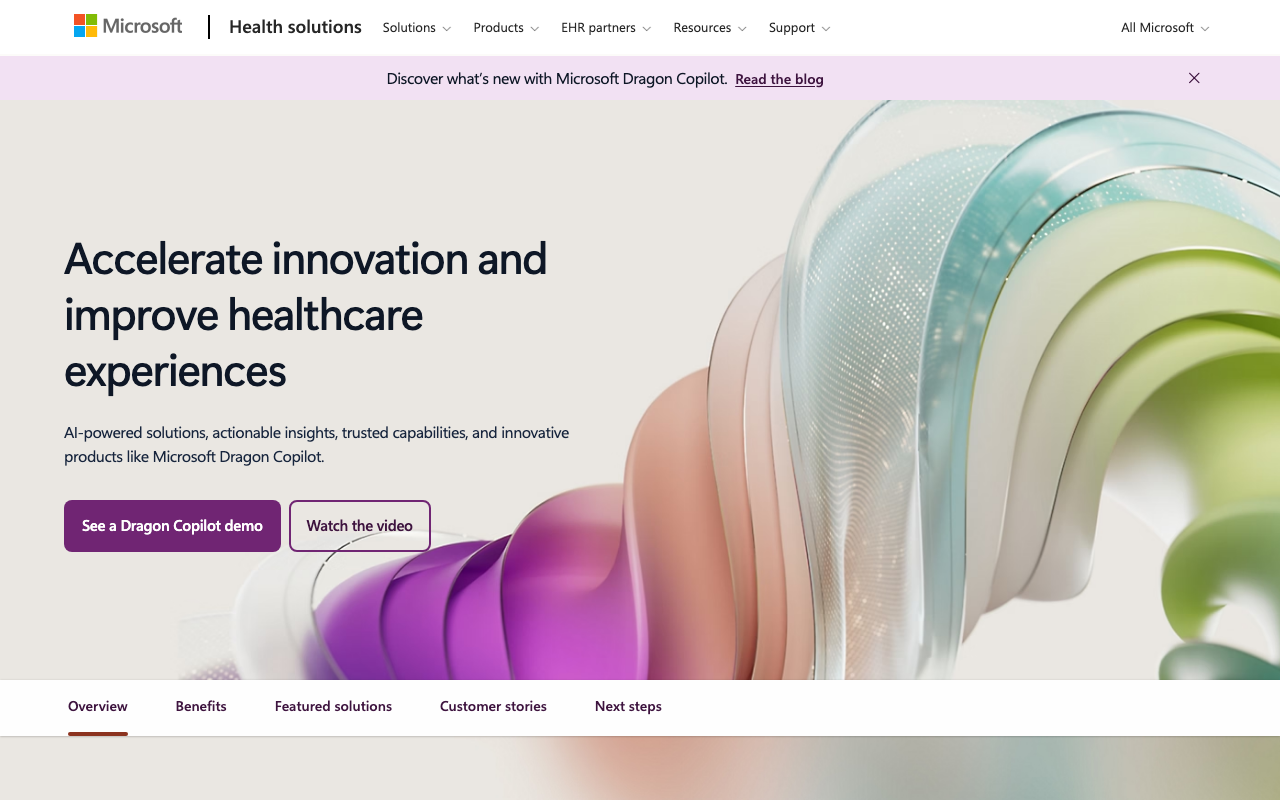
Dragon Medical One from Nuance Communications (now Microsoft) is the gold standard for traditional medical dictation software. It has been the dominant voice-to-text tool in healthcare for over 20 years, with an estimated 500,000+ physicians trained on its platform. If you have ever dictated a clinical note by speaking into a microphone, you have almost certainly used Dragon.
The core product is a cloud-based speech recognition engine trained on an enormous medical vocabulary — over 90 specialty word sets covering everything from cardiology to orthopedics to psychiatry. Dragon Medical One achieves recognition accuracy above 99% for trained users, which is the highest in the traditional dictation category. Physicians speak into a microphone (desktop, handheld, or headset), and Dragon converts speech to text in real time within the EHR. Voice commands allow formatting — "new paragraph," "bold that," "go to next field" — so the doctor can control the note structure without touching the keyboard.
Dragon Medical One integrates most deeply with Epic and Cerner (now Oracle Health), where it can be embedded directly into the EHR workflow. Physicians dictate inside the EHR window, and the text populates the appropriate fields. This embedded experience is seamless for organizations that have completed the integration. Outside of Epic and Cerner, Dragon supports a broader range of EHR systems through its PowerMic and Dragon Medical Direct add-ons, though the integration depth is shallower — typically operating as a floating dictation window rather than embedded within EHR fields.
The fundamental limitation of Dragon Medical One in 2026 is architectural: it is still a dictation tool. The doctor must actively speak into a microphone. There is no ambient listening, no automatic note structuring, no AI-generated SOAP notes, and no post-encounter documentation automation. Dragon converts speech to text — nothing more. The doctor still formats the note, still corrects errors, still navigates the EHR manually. For physicians who are comfortable with this workflow and prefer granular control over every word, Dragon remains unmatched. For physicians who want the AI to handle documentation while they focus on the patient, Dragon is a generation behind.
Pros: Proven accuracy (99%+), largest medical vocabulary, deep Epic and Cerner integration, 20+ years of clinical validation, works offline
Cons: No ambient listening — requires active dictation into a microphone, no automatic note structuring (SOAP, H&P), no billing automation, no AI receptionist, aging architecture being overtaken by ambient AI
Verdict: Dragon Medical One remains the gold standard for traditional medical dictation but is being overtaken by ambient AI tools that require no active dictation. If you prefer to control every word in the note, Dragon delivers. If you want the AI to write the note while you see the patient, look at DeepCura or the ambient options below.
#3. Freed AI — Best Simple Ambient Scribe
Freed AI is the simplest ambient medical dictation software on the market. It does one thing — listen to patient encounters and generate clinical notes — and it does that one thing well. Setup takes under five minutes. The interface is minimal. The notes are delivered within one to two minutes. For solo practitioners who want to stop typing notes and nothing else, Freed AI is the fastest path from problem to solution.
Freed AI uses tiered pricing: Starter at $39/month (40 notes/month), Core at $79/month (unlimited notes), and Premier at $119/month (EHR push, ICD-10 coding, CPT codes in beta). The Premier plan includes EHR push, but this is scraping-based — it automates the copy-paste action rather than writing structured data directly into EHR fields via native API write-back. There is no bidirectional data flow, no AI receptionist, no fax management, and no billing automation beyond beta coding suggestions.
The inflection point for any dictation doctor evaluating Freed AI is the Premier tier. At $119/month, you are $10 away from DeepCura at $129/month — which includes native EHR write-back across 8 systems, a 24/7 AI receptionist, billing integrity checks, fax management, and choice of AI engine. For basic ambient scribing at $39/month, Freed AI is genuine value. At $119/month, the math changes.
For a detailed analysis, read our full Freed AI review or see the DeepCura vs Freed AI comparison.
Pros: Simplest setup (under 5 minutes), affordable entry at $39/mo, clean interface, fast note turnaround
Cons: No native EHR integration (scraping-based on Premier), no AI receptionist, no billing automation, no fax management, no choice of AI engine
Verdict: Best medical dictation software for solo doctors who only need basic ambient scribing. At the Premier tier ($119/mo), consider DeepCura at $129/mo for the full platform.
#4. Heidi Health — Best for Template Customization
Heidi Health is an ambient AI scribe built in Australia with a distinctive strength: deep template customization and multilingual support. Where most medical dictation software offers a handful of preset note formats, Heidi lets clinicians build note structures field by field — defining exactly which sections appear, how information flows from transcript to note, and how the final document is organized. For doctors with specific documentation requirements that do not fit standard SOAP or H&P templates, Heidi's template engine is the best in the category.
Heidi Health supports documentation in 12+ languages across three localized markets — Australian Medicare, UK NHS, and US clinical note formats. This multilingual capability is a genuine differentiator for US practices serving diverse patient populations where encounters occur in Spanish, Mandarin, or other languages. At $99/month per provider for the Pro plan, Heidi includes unlimited notes, the template customization engine, and an AI receptionist feature for handling patient calls. However, EHR integration remains basic — primarily copy-paste workflows rather than native API write-back — and there is no billing automation, no fax management, and no clinical AI chat.
Heidi's US presence is growing but remains smaller than domestic competitors. Practices evaluating Heidi should test the template engine during the trial period and verify that the AI receptionist meets their call-handling requirements.
See our Heidi Health review or DeepCura vs Heidi Health comparison.
Pros: Best template customization in the category, 12+ language support, AI receptionist, active product development
Cons: Limited EHR integration (basic copy-paste), smaller US user base, no billing automation, no fax management
Verdict: Best medical dictation software for international clinicians and practices that need deep template customization. For a full-platform alternative with native EHR write-back and billing, DeepCura at $129/month is $19 more with significantly broader capabilities.
#5. Suki AI — Best Voice-First Assistant
Suki AI takes a different approach to medical dictation software. Rather than passively listening to encounters (ambient) or converting speech to text (traditional dictation), Suki functions as a conversational voice assistant that doctors interact with during and between patient visits. You can dictate notes, ask clinical questions, navigate your EHR by voice, and issue commands — all through natural speech. The interaction model is closer to having a virtual medical assistant than using dictation software.
Suki integrates with multiple EHR systems and supports voice-based EHR navigation — meaning doctors can open charts, enter orders, and move between fields using voice commands rather than mouse clicks and keyboard inputs. For physicians who spend significant time clicking through EHR screens, this voice navigation capability reduces a pain point that traditional medical dictation software ignores entirely. Suki also supports both ambient listening and active dictation modes, giving clinicians flexibility in how they interact with the tool.
At $299/month per provider, Suki is the most expensive tool in this ranking outside of enterprise-only products. The price reflects the breadth of voice interaction features, but it does not include an AI receptionist, fax management, or billing automation. For the dictation doctor who strongly prefers voice-first interaction and wants EHR voice navigation, Suki is the best fit. For everyone else, the $299/month price tag is difficult to justify when DeepCura offers ambient scribing plus a full clinical platform for $129/month.
Pros: Most natural voice interaction of any medical dictation software, EHR voice navigation, dual-mode (ambient + dictation), HIPAA compliant
Cons: Premium pricing at $299/mo, no AI receptionist or fax management, narrower feature set than full-platform alternatives, voice-first model is not ideal for every clinical setting
Verdict: Best medical dictation software for doctors who strongly prefer voice-first interaction and want to navigate their EHR by voice. At $299/month for fewer features than DeepCura at $129/month, most practices will get more value elsewhere.
#6. DeepScribe — Best for Oncology
DeepScribe has built its ambient AI scribe around a distinctive differentiator: human quality assurance review on every note. After the AI generates a note from the encounter, a human reviewer verifies accuracy, corrects errors, and ensures clinical completeness before the note reaches the clinician. This human-in-the-loop model adds a safety layer that purely automated medical dictation software cannot match — but it also means notes arrive hours after the encounter rather than in minutes.
DeepScribe's deepest investment is in oncology. With over 3.1 million oncology visits captured annually, the platform has built specialty-tuned AI models trained on cancer care documentation — treatment planning, staging, multi-drug regimens, and tumor board summaries. Major health systems including Ochsner Health (46 hospitals) and Pearl Health (3,500+ providers) use DeepScribe. The platform integrates bidirectionally with Epic, athenahealth, eClinicalWorks, and specialty EHRs including Flatiron Health's OncoEMR.
DeepScribe does not publish pricing, but market reports estimate $350-500 per month per provider. There is no free trial and no self-serve sign-up — practices must go through enterprise sales. There is no AI receptionist, no billing automation, no fax management, and no clinical AI chat. For large oncology practices that need specialty-tuned documentation with human QA review and can absorb the enterprise pricing, DeepScribe delivers. For everyone else, the pricing and limited scope point toward alternatives.
See our DeepScribe review for the full analysis.
Pros: Specialty-tuned oncology AI (3.1M visits/year), human QA review on every note, bidirectional EHR write-back, enterprise-grade security (SOC 2)
Cons: Enterprise pricing ($350-500/mo estimated), no free trial, notes delivered hours later (not instant), no AI receptionist, no billing automation, no fax management
Verdict: Best medical dictation software for oncology practices and large health systems that need specialty-tuned documentation with human-reviewed quality assurance. For practices outside oncology or those that need instant notes and full workflow automation, DeepCura at $129/month is a fraction of the cost with broader capabilities.
#7. Nuance DAX Copilot — Best Enterprise Ambient
Nuance DAX Copilot — Dragon Ambient eXperience Copilot — is Microsoft's enterprise ambient AI documentation platform. It represents the evolution of Dragon Medical One from traditional dictation to ambient AI, and it has the deepest Epic integration of any tool on this list. DAX Copilot captures clinical encounters through ambient listening and generates structured notes that push directly into Epic fields — with a level of integration depth that only a Microsoft-owned product embedded in the Epic ecosystem can achieve.
DAX Copilot is deployed across large health systems including UC Health, Stanford Health Care, and WellSpan Health. The ambient capture quality is excellent, and the Epic workflow integration is seamless for organizations that have completed the months-long implementation process. DAX Copilot also supports Cerner/Oracle Health and a growing list of other EHR systems, though Epic remains the primary integration.
The barrier for most doctors is accessibility and cost. DAX Copilot is enterprise-only — there is no self-serve sign-up, no individual provider plan, and no free trial. Pricing is custom and typically starts at $369 per provider per month, with multi-year commitments. Deployment requires months of IT configuration, Epic integration work, and organizational change management. Individual physicians and small practices cannot purchase DAX Copilot independently. The product is also scribe-only — there is no AI receptionist, no billing automation, no fax management, and no clinical AI chat.
Pros: Deepest Epic integration available, proven at enterprise scale (thousands of providers), excellent ambient capture quality, Microsoft/Azure security posture
Cons: Enterprise-only (inaccessible to independent practices), expensive ($369+/mo estimated), scribe-only — no receptionist, billing, or fax, months-long deployment timeline
Verdict: Best medical dictation software for enterprise health systems running Epic. If your organization has the budget and Epic infrastructure, DAX Copilot is the gold standard for enterprise ambient documentation. For everyone else, DeepCura provides ambient scribing plus full clinical AI at a fraction of the cost with zero enterprise overhead.
#8. Mobius Conveyor — Best Lightweight AI Dictation
Mobius Conveyor from Mobius MD is a lightweight AI-powered medical dictation tool that combines speech recognition with AI-assisted note generation. Available as a mobile app and desktop application, Conveyor lets clinicians dictate directly into their device and receive AI-structured clinical notes — functioning as a hybrid between traditional dictation and ambient scribing.
The platform supports multiple clinical specialties and offers AI-powered note structuring from dictated input. Clinicians speak their notes, and the AI organizes the dictated content into structured clinical documentation. Mobius Conveyor integrates with EHR systems for note transfer, though the integration depth is more limited than native API solutions like DeepCura or Dragon Medical One. The tool is available at $150/month with a free trial.
Mobius Conveyor occupies a middle ground in the medical dictation software market — more AI-powered than traditional dictation engines but less comprehensive than full-platform ambient AI tools. It lacks ambient listening (the clinician must actively dictate), has no AI receptionist, no billing automation, and no fax management. For clinicians who prefer a simple, mobile-friendly dictation tool with AI note structuring at a mid-range price point, Conveyor is a reasonable option.
Pros: Mobile-friendly, AI-assisted note structuring from dictation, free trial available, straightforward pricing at $150/mo
Cons: No ambient listening (active dictation required), limited EHR integration depth, no AI receptionist or billing, smaller user community than established alternatives
Verdict: A lightweight AI dictation tool for clinicians who want AI-structured notes from active dictation at a mid-range price. For ambient AI that listens to patient conversations, look at DeepCura or Freed AI instead.
#9. nVoq — Best Embedded Speech Engine
nVoq takes a different approach to medical dictation software. Rather than selling directly to physicians as a standalone product, nVoq provides a cloud-based speech recognition engine that EHR vendors and health IT companies embed within their own platforms. When you dictate inside an EHR and the voice recognition just works — without installing Dragon or any other standalone product — there is a good chance nVoq is the engine powering it.
nVoq integrates with multiple EHR systems as an embedded speech recognition layer. The technology powers dictation within platforms from companies like PointClickCare, MatrixCare, Netsmart, and dozens of others — primarily in the long-term care, behavioral health, and home health segments. For clinicians in these settings, nVoq provides medical dictation functionality without requiring a separate product or additional cost beyond what the EHR vendor charges.
The limitation is that nVoq is not a product you purchase directly. It is an infrastructure component that your EHR vendor either includes or does not. There is no consumer-facing product, no ambient AI listening, no structured note generation, and no clinical AI features. nVoq is pure speech-to-text — the dictation engine behind the scenes. For health systems evaluating embedded dictation capabilities within their existing EHR, nVoq is worth asking about. For individual physicians looking for medical dictation software to install and use, nVoq is not the right fit.
Pros: Embedded in multiple EHR systems, no separate installation required, seamless within existing EHR workflow, strong in long-term care and behavioral health
Cons: Not a standalone product — requires EHR vendor adoption, no ambient AI listening, no structured note generation, no clinical AI features, limited visibility to end users
Verdict: Best embedded speech recognition engine for health systems that want dictation built into their EHR without a separate product. Not a standalone medical dictation software solution for individual physicians.
Pricing Comparison
| Product | Monthly Price | Notes/Month | EHR Integration | AI Receptionist | Billing Codes |
|---|---|---|---|---|---|
| DeepCura | $129 | Unlimited | Native API (8 EHRs) | Yes | Yes |
| Dragon Medical One | $79-$99 | Unlimited | Epic, Cerner | No | No |
| Freed AI | $39-$119 | 40-Unlimited | Scraping (Premier) | No | Beta (Premier) |
| Heidi Health | $99 | Unlimited | Basic | Yes | No |
| Suki AI | $299 | Unlimited | Multiple | No | No |
| DeepScribe | Custom | Unlimited | Epic, Cerner | No | No |
| Nuance DAX Copilot | $369+ | Unlimited | Epic (deep) | No | No |
| Mobius Conveyor | $150 | Unlimited | Multiple | No | No |
| nVoq | Custom | Unlimited | Multiple (embedded) | No | No |
The pricing landscape for medical dictation software in 2026 splits into three tiers. Budget-tier tools like Freed AI start at $39/month but limit functionality to basic scribing. Mid-tier tools like Dragon Medical One ($79-$99), Heidi Health ($99), and DeepCura ($129) offer more complete feature sets at accessible price points. Enterprise-tier tools like Suki AI ($299), Nuance DAX Copilot ($369+), and DeepScribe (custom) command premium pricing with narrower feature sets or enterprise-only availability.
The best value depends on what you need. If you only need basic ambient scribing, Freed AI at $39/month delivers. If you want medical dictation software that also handles EHR write-back, reception, billing, and fax, DeepCura at $129/month is the only tool that bundles everything at a mid-tier price. If you need the deepest possible Epic integration and your organization has the budget, Nuance DAX Copilot is the enterprise standard.
Infographic: Medical dictation software pricing at a glance — from free tiers to enterprise plans.
How to Choose Medical Dictation Software for Your Practice
Choosing the right medical dictation software comes down to five factors: practice size, budget, EHR system, workflow preferences, and which administrative burdens you want to automate beyond documentation. Here is a decision framework.
Solo practitioner on a tight budget. Start with Freed AI at $39/month (Starter) for basic ambient scribing. If you need unlimited notes, move to Freed AI Core at $79/month. But before committing to Freed AI's Premier tier at $119/month, evaluate DeepCura at $129/month — the $10 difference buys native EHR write-back, an AI receptionist, billing automation, and fax management that Freed AI does not include at any price.
Solo or small practice wanting a complete solution. DeepCura at $129/month is the clear choice. It replaces medical dictation software, an AI scribe, a phone answering service, a fax processing service, and a billing validation tool — all in one platform with native EHR integration. The total cost of assembling these capabilities from separate vendors typically exceeds $500/month.
Doctor who prefers traditional dictation. If you want to control every word in the note by speaking into a microphone, Dragon Medical One ($79-$99/month) remains the best traditional medical dictation software. The accuracy is unmatched, the medical vocabulary is the largest in the industry, and the Epic/Cerner integration is proven. Just be aware that you are choosing active dictation over passive ambient AI — a workflow that most physicians are moving away from.
Enterprise health system on Epic. Nuance DAX Copilot is the deepest Epic integration available. If your organization has the IT resources, the multi-year budget commitment, and the months-long implementation timeline, DAX Copilot delivers enterprise-grade ambient documentation within Epic. For health systems that want ambient AI without the enterprise overhead, DeepCura offers a self-serve alternative at a fraction of the cost.
Specialty-specific needs. Clinicians who prefer AI-assisted active dictation should evaluate Mobius Conveyor as a lightweight alternative. Oncology practices should evaluate DeepScribe for specialty-tuned AI with human QA review. All other specialties are well-served by DeepCura or the ambient AI tools on this list — see the specialty table below.
Voice-first workflow. If you strongly prefer talking to your software — dictating, asking questions, and navigating your EHR by voice — Suki AI at $299/month offers the most natural voice interaction. For most doctors, the ambient AI approach (DeepCura, Freed AI) is more practical and less expensive.
Try DeepCura Free — No Credit Card Required
Ambient AI dictation + receptionist + EHR integration + billing. Everything in one platform for $129/mo. Join 6,400+ providers.
Medical Dictation Software by Specialty
Different specialties have different documentation patterns, terminology requirements, and workflow constraints. The right medical dictation software depends on what you document most often and how your encounters are structured.
| Specialty | Recommended Tool | Why |
|---|---|---|
| Primary Care | DeepCura or Freed AI | High-volume visits, standard documentation, benefit most from ambient AI |
| Cardiology | DeepCura or Suki AI | Complex terminology, structured reporting, need EHR integration |
| Orthopedics | DeepCura or Dragon Medical One | Procedure-heavy, specific anatomical terms, operative reports |
| Psychiatry | DeepCura or Heidi Health | Nuanced language, custom templates, longer encounter notes |
| Oncology | DeepScribe | Specialty-tuned AI with human QA, treatment planning, staging |
| Radiology | Dragon Medical One | Structured reporting, precise dictation control, deep medical vocabulary |
| Pediatrics | DeepCura or Freed AI | Well-child visits, developmental notes, high-volume scheduling |
| Surgery | Dragon Medical One | Operative reports, precise dictation control, anatomical terminology |
| Emergency Medicine | DeepCura | Fast turnaround, high-volume, complex multi-system encounters |
| Dermatology | DeepCura or Heidi Health | Lesion descriptions, procedure notes, custom templates |
| Behavioral Health | DeepCura or nVoq (embedded) | Nuanced clinical language, longer sessions, embedded EHR dictation |
Primary care and family medicine physicians — the largest user segment for medical dictation software — benefit most from ambient AI tools like DeepCura that handle high-volume visits with minimal clinician effort. Surgical specialties that require precise control over operative report language may prefer Dragon Medical One's traditional dictation. Radiology benefits from Dragon Medical One's deep medical vocabulary and precise dictation control for structured reporting. For a broader comparison of AI scribes by specialty, see our comprehensive ranking.

Frequently Asked Questions
What is the best medical dictation software in 2026?
DeepCura is the best medical dictation software in 2026 for doctors who want a complete clinical platform. It combines ambient AI scribing with native EHR integration across 8 systems, a 24/7 AI receptionist, ICD-10/CPT billing automation, fax management, and clinical AI chat — all for $129/month. For traditional dictation specifically, Dragon Medical One remains the gold standard. For the simplest ambient scribe at the lowest price, Freed AI starts at $39/month.
Is Dragon Medical still the best dictation software for doctors?
Dragon Medical One remains the best traditional dictation software for doctors who prefer speaking into a microphone and controlling every word in the note. Its medical vocabulary and speech recognition accuracy are unmatched. However, ambient AI tools like DeepCura have surpassed Dragon for most clinical workflows in 2026. Ambient AI listens to natural patient conversations and generates structured notes automatically — no microphone, no voice commands, no formatting. Most physicians moving to new medical dictation software in 2026 are choosing ambient AI over traditional dictation.
What is the difference between medical dictation and ambient AI scribing?
Medical dictation requires the doctor to actively speak into a microphone, and the software converts speech to text. The doctor then formats and edits the note. Ambient AI scribing listens passively to the natural conversation between doctor and patient, then generates a complete structured clinical note (SOAP, H&P, progress note) automatically. Dictation is active input — ambient AI is passive listening. Ambient AI produces structured output that requires less editing and integrates more cleanly with EHR systems.
How much does medical dictation software cost?
Medical dictation software costs range from $39 to $400+ per month per provider. Freed AI starts at $39/month for basic ambient scribing. Dragon Medical One costs $79-$99/month for traditional dictation. DeepCura costs $129/month for a full clinical AI platform including ambient scribing, EHR integration, AI receptionist, and billing. Suki AI costs $299/month. Nuance DAX Copilot runs $369+ per month at the enterprise level. DeepCura at $129/month offers the best value for practices that need more than basic scribing.
Does medical dictation software integrate with EHR systems?
EHR integration varies widely across medical dictation software. DeepCura has native API integration with 8 EHR systems (Epic, eClinicalWorks, athenahealth, OptiMantra, AdvancedMD, Veradigm, CharmHealth, DrChrono) with bidirectional data flow. Dragon Medical One integrates deeply with Epic and Cerner. Nuance DAX Copilot has the deepest Epic integration. Freed AI offers scraping-based EHR push on its Premier plan ($119/month). Most other tools are limited to copy-paste workflows. For practices where EHR integration is a priority, verify the specific integration depth before purchasing.
Can medical dictation software suggest billing codes?
Only DeepCura offers integrated ICD-10 and CPT code suggestions with E&M integrity verification as part of its medical dictation software platform. Freed AI includes beta billing code suggestions on its Premier plan ($119/month) without E&M validation. Dragon Medical One, Suki AI, DeepScribe, Nuance DAX Copilot, and most other tools have no billing automation. For practices concerned about coding accuracy and audit risk, see our guide to AI-assisted medical coding.
Is medical dictation software HIPAA compliant?
All 9 tools listed in this guide are HIPAA compliant and provide Business Associate Agreements (BAAs) to covered entities. This includes DeepCura, Dragon Medical One, Freed AI, Heidi Health, Suki AI, DeepScribe, Nuance DAX Copilot, Mobius Conveyor, and nVoq. General-purpose speech-to-text tools — including Apple Dictation, Google Speech-to-Text, and Windows Speech Recognition — are not HIPAA compliant and should not be used for clinical documentation containing protected health information.
What is the best free medical dictation software?
There is no production-grade free medical dictation software suitable for clinical use. DeepCura and Freed AI both offer free trials with no credit card required, which is the closest option to free. Windows and macOS have built-in speech-to-text functionality, but these tools are not HIPAA compliant, are not trained on medical vocabulary, and cannot generate structured clinical notes. Using general-purpose free dictation tools for clinical documentation creates HIPAA liability and produces poor results with medical terminology.
Can medical dictation software replace a human medical transcriptionist?
Yes, for the vast majority of clinical documentation. Modern medical dictation software — particularly ambient AI tools like DeepCura — generates clinical notes that match or exceed the quality of human transcription for standard encounters. The AI processes encounters faster (minutes vs. hours), costs less ($39-$129/month vs. $1,500+/month for a transcriptionist), and eliminates the turnaround delay. Complex subspecialty documentation and operative reports may still benefit from human review, but the economic case for dedicated transcriptionists has largely disappeared. For more detail, see our guide to medical transcription software.
What is the best medical dictation software for solo doctors?
For solo doctors, the best medical dictation software depends on budget and needs. DeepCura at $129/month is the best value for solo providers who want a complete platform — ambient scribing, native EHR write-back, AI receptionist, billing automation, and fax management replace multiple separate services. Freed AI at $39/month (Starter) is the best budget option for solo doctors who only need basic ambient scribing and nothing else. Dragon Medical One at $79-$99/month is best for solo doctors who prefer traditional dictation with a microphone.
Stop Dictating — Start Practicing
DeepCura's ambient AI listens while you see patients. No microphone, no commands. SOAP notes, EHR push, billing codes — automatically. $129/mo.
References
[1] Nuance Communications, "Dragon Medical One — Clinical Speech Recognition," Nuance.com. nuance.com
[2] American Medical Association, "AMA Physician Burnout & Satisfaction Report — Administrative Burden Findings," AMA-Assn.org. ama-assn.org
[3] U.S. Department of Health and Human Services, "HIPAA for Professionals," HHS.gov. hhs.gov/hipaa/for-professionals
[4] DeepCura, "AI Medical Scribe Platform — Ambient Scribing, AI Receptionist, EHR Integration," DeepCura.com. deepcura.com
[5] Freed AI, "AI Medical Scribe — Ambient Clinical Documentation," Freed.ai. getfreed.ai
[6] Suki AI, "Voice AI Assistant for Clinicians," Suki.ai. suki.ai
[7] DeepScribe, "AI-Powered Ambient Medical Documentation," DeepScribe.ai. deepscribe.ai
[8] Mobius MD, "Conveyor — AI-Powered Medical Dictation," Mobius.md. mobius.md