
The best AI scribe for orthopedics is one that captures special tests by name, documents laterality without ambiguity, and generates operative notes — not just SOAP notes. Orthopedic surgeons see 30 to 40 patients on clinic days, toggling between post-op checks, new injury evaluations, workers' comp exams, and pre-surgical consults. Each encounter demands precise anatomical language, range-of-motion measurements, imaging interpretation, and CPT codes that shift with every joint and approach.
We ranked 7 AI scribes on the criteria that matter most for orthopedic documentation:
- Anatomical precision — does the AI use correct laterality, joint-specific terminology, and anatomical landmarks?
- Special test capture — does it recognize McMurray's, Lachman's, Neer's, Hawkins, and other named tests from the clinical conversation?
- Surgical documentation — can it generate operative notes, procedure summaries, and post-op templates?
- Physical exam specificity — does it document ROM in degrees, strength grading (0–5), and gait patterns?
- Coding accuracy — does it suggest lateralized ICD-10 codes and CPT codes with correct modifiers?
All products were evaluated in February–March 2026. Pricing reflects publicly available rates. Custom-priced products were assessed based on disclosed enterprise ranges and verified customer reports.
Why Orthopedic Surgeons Need a Specialized AI Scribe
The Documentation Burden in Orthopedics
Orthopedic surgeons carry one of the heaviest documentation loads in medicine. A typical clinic day involves 30 to 40 patient encounters — each requiring a note that documents the injury or condition, physical examination findings, imaging review, assessment, and a treatment plan that may range from conservative management to surgical scheduling. High-volume joint replacement surgeons document even more: pre-operative evaluations, operative reports, and post-operative follow-ups that span weeks of care.
The coding complexity compounds the problem. Orthopedics has among the most granular CPT and ICD-10 code sets in medicine, with laterality modifiers, approach-specific surgical codes, and fracture classification systems that directly impact reimbursement. A missed modifier or laterality error on a knee arthroscopy can trigger a claim denial. The ICD-10 code for knee pain (M25.569) alone has three laterality variants (right, left, unspecified), and every joint in the body follows a similar pattern.
What General-Purpose AI Scribes Miss
Most AI medical scribes are built for primary care workflows — chief complaint, HPI, physical exam, assessment and plan. Orthopedic encounters are fundamentally different:
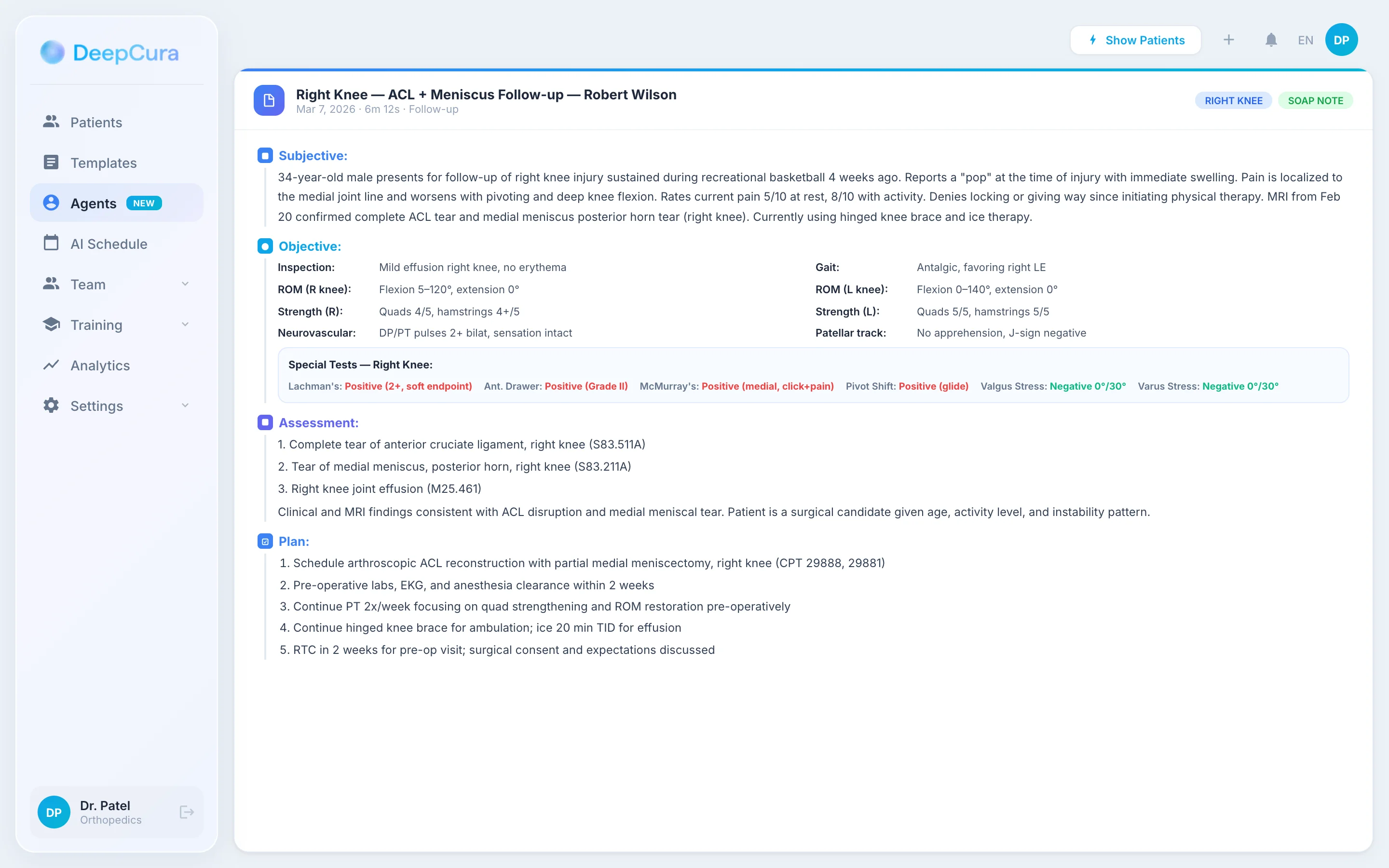
- Special tests are the backbone of orthopedic diagnosis. A general-purpose scribe may note "knee exam performed" but miss that the clinician performed a positive McMurray's test with medial joint line pain, a negative Lachman's, and a 2+ anterior drawer — findings that directly determine whether the patient needs an MRI, physical therapy, or surgical referral.
- Laterality errors are not just documentation gaps — they are patient safety events. Orthopedics requires unambiguous left/right documentation on every finding, every imaging reference, and every procedure. An AI scribe that defaults to "knee pain" without laterality creates downstream coding and safety problems.
- Range of motion in orthopedics is measured in degrees and compared to the contralateral side. "Limited ROM" is insufficient. The note must say "right knee flexion 110 degrees (contralateral 140 degrees), extension -5 degrees."
- Imaging language requires specificity. "X-ray reviewed" means nothing. The AI must capture "AP and lateral radiographs of the right knee demonstrate moderate medial compartment narrowing with osteophyte formation, Kellgren-Lawrence grade III."
- Gait analysis goes beyond "normal gait." Orthopedic documentation requires Trendelenburg sign assessment, antalgic gait pattern documentation, and functional mobility observations.
Work Comp, Medicolegal, and Coding Pressure
Orthopedic surgeons handle a disproportionate share of workers' compensation cases, independent medical examinations (IMEs), and medicolegal documentation. These encounters require specific documentation elements — mechanism of injury, work restrictions, functional capacity statements, and causation opinions — that general-purpose AI scribes are not trained to capture.
The CPT coding landscape in orthopedics is uniquely complex. A single knee arthroscopy can involve multiple billable procedures (meniscectomy, chondroplasty, synovectomy, loose body removal) each with its own CPT code and modifier requirements. AI scribes that understand orthopedic procedural coding can flag missed charges and suggest appropriate medical codes — a capability that directly impacts practice revenue.
For practices that need structured patient intake forms tailored to orthopedic workflows, pre-visit data collection reduces documentation time during the encounter itself.
Quick Comparison — 7 AI Scribes for Orthopedics
| Rank | Tool | Price | Ortho-Specific | Ambient | Surgical Notes | EHR | Best For |
|---|---|---|---|---|---|---|---|
| 1 | DeepCura | $129/mo | Full-platform + ortho templates | Passive | Operative + post-op | athenahealth, eCW, AdvancedMD, OptiMantra, Epic, DrChrono, CharmHealth, Cerner (bidirectional) | Best Overall |
| 2 | Freed AI | $39–$119/mo | General-purpose | Passive | Basic | Scraping-based | Simplest Ambient |
| 3 | Nuance DAX | Not publicly priced | General + Epic-optimized | Passive | Custom templates | Epic, Cerner, 200+ | Enterprise Hospital |
| 4 | Abridge | Enterprise (not published) | General-purpose | Passive | Limited | Epic, 6+ | Health System Evidence |
| 5 | DeepScribe | Custom (not published) | Specialty-tuned AI | Passive | Custom | 10+ | Specialty AI |
| 6 | Suki AI | Not publicly priced | General-purpose | Passive | Custom | Bidirectional | Voice-First |
| 7 | Heidi Health | Free / $150/mo (billed yearly) | General-purpose | Passive | Template | Limited | Multilingual + Free Tier |
For a broader comparison across all specialties, see our Best AI Medical Scribes in 2026 ranking.
What to Look for in an Orthopedic AI Scribe
Not all AI scribes handle orthopedic encounters equally. Before choosing a tool, evaluate it against these eight criteria:
1. Anatomical Precision. Can the AI correctly identify laterality (left vs. right), specific joints (glenohumeral vs. acromioclavicular), and anatomical landmarks (medial femoral condyle, lateral malleolus) from natural conversation? Orthopedic documentation lives and dies on anatomical specificity.
2. Special Test Recognition. Does the scribe recognize named orthopedic tests — McMurray's, Lachman's, anterior drawer, Neer's impingement, Hawkins-Kennedy, empty can, Speed's, Finkelstein's, Phalen's — and document the result (positive/negative) with relevant qualifiers? This is the single most important differentiator for orthopedic AI scribes.
3. Surgical Documentation. Can the AI generate operative notes, brief operative summaries, and post-operative templates? Orthopedic operative reports require procedural detail — approach, findings, implant specifications, closure technique — that goes far beyond clinic note formats.
4. Physical Exam Specificity. Does the AI document range of motion in degrees (not "limited" or "full"), muscle strength on the 0–5 scale, joint stability grading, neurovascular status (sensation, motor, pulses), and wound assessment for post-operative patients?
5. Imaging Capture. Can the scribe accurately document imaging findings — radiograph interpretations, MRI results, CT findings — with classification systems (Kellgren-Lawrence, Neer fracture classification, Garden classification) when the clinician references them?
6. CPT and ICD-10 Coding. Does the AI suggest lateralized ICD-10 codes and procedure-specific CPT codes with appropriate modifiers (-LT, -RT, -59)? Orthopedic coding is among the most complex in medicine, and accurate code suggestions directly impact revenue.
7. EHR Integration. Does the scribe integrate with both general medical EHRs (Epic, athenahealth, eClinicalWorks) and orthopedic-specific practice management systems? Bidirectional write-back that populates structured fields — not just free-text paste — is the gold standard.
8. Workers' Comp Documentation. Can the AI capture mechanism of injury, work restrictions, functional capacity statements, MMI (maximum medical improvement) determinations, and impairment ratings? Orthopedic practices with significant workers' comp volume need documentation that meets employer and insurer requirements.
Detailed Reviews
1. DeepCura — Best Overall for Orthopedics
DeepCura is a full-stack clinical AI platform that combines ambient AI scribing with practice automation — AI receptionist, billing, fax management, patient intake, and bidirectional EHR integration — all for $129 per provider per month (or $999/yr) with 1,000 credits a month across every AI agent; a standard note costs 1 credit (3 on premium models, 15 on the deepest reasoning tier).
For orthopedic documentation specifically, DeepCura's ambient scribe captures the full clinical encounter passively. The AI generates structured orthopedic notes including special test results with positive/negative documentation, range-of-motion measurements in degrees, strength grading, lateralized anatomical findings, and imaging interpretations with classification references. Clinicians can choose between multiple leading AI engines (including models from OpenAI, Anthropic, and Google) — a flexibility no other scribe offers. Custom templates allow practices to build joint-specific note formats for shoulder, knee, hip, spine, hand, and foot/ankle encounters.
Strengths:
- Passive ambient listening with no manual recording steps
- Special test recognition and structured documentation (McMurray's, Lachman's, Neer's, Hawkins, etc.)
- ROM documentation in degrees with contralateral comparison
- Lateralized ICD-10 and CPT code suggestions with modifier support
- Operative note and post-op template generation
- Choose AI engine (OpenAI, Anthropic, Google)
- Bidirectional EHR write-back with athenahealth, eClinicalWorks, AdvancedMD, OptiMantra, Epic, DrChrono, CharmHealth, and Cerner
- AI receptionist handles calls, scheduling, and triage 24/7
- Billing automation with coding integrity checks
- 1,000 credits/mo across all AI agents (1 credit per standard note)
Limitations:
- No built-in implant registry integration (documenting implant details requires manual template customization)
- No pre-built workers' comp form auto-fill (available via custom template builder)
Pricing: $129/month per provider — all features included. Free trial available, no credit card required.
Verdict: DeepCura is the strongest overall choice for orthopedic surgeons who want both specialized documentation quality and a full-platform solution that handles everything from patient calls to EHR write-back.
DeepCura: AI Scribe Built for Orthopedics
Ambient special test capture, ROM documentation, lateralized coding, operative note templates, and bidirectional EHR integration — $129/mo · 1,000 credits/mo (1 credit per standard note). Start your free trial.
+1 (415) 549-1829Available 24/7 · Set up in seconds · No credit card required
2. Freed AI — Simplest Ambient Scribe
Freed AI offers the most streamlined ambient scribing experience — click record, see your encounter, and get a structured note. It requires minimal setup and has a clean interface that appeals to clinicians who want simplicity over feature depth.
Freed captures orthopedic encounters through passive ambient listening and generates notes in SOAP and custom formats. The AI handles general orthopedic content reasonably well but does not have orthopedic-specific features like structured special test documentation, ROM in degrees, or operative note generation. Laterality is captured inconsistently — the AI often includes it but may default to generic descriptions when the conversation context is ambiguous.
EHR integration works through browser-based scraping rather than native API write-back, which means notes are pushed into the chart via screen overlay rather than written directly to structured fields.
Pricing: $39/month (Starter, 40 notes), $79/month (Core, unlimited), or $119/month (Premier, unlimited with EHR push and ICD-10/CPT coding).
Verdict: Best for orthopedic surgeons who want a dead-simple ambient scribe without practice automation needs. Not ideal for those who need structured special test capture or operative note generation. Read our Freed AI review for the full breakdown.
3. Nuance DAX Copilot — Enterprise Hospital Orthopedics
Nuance DAX Copilot (Microsoft) is the enterprise standard for ambient clinical documentation, with its deepest integration in the Epic ecosystem and compatibility with 200+ EHR systems including Cerner and Athena. For hospital-based orthopedic departments, DAX offers seamless integration and institutional-grade security. Over 600 health systems have adopted DAX Copilot.
DAX handles orthopedic encounters through ambient listening and generates notes within your EHR workflow. Documentation quality for orthopedics is strong within Epic-native templates — the AI populates SmartSections and SmartPhrases when configured properly. The Microsoft backing ensures long-term enterprise support and continuous AI improvement.
The tradeoff is cost: DAX is sold on enterprise contracts — pricing is not published, and volume discounts are negotiated per deployment. Implementation requires IT involvement and Epic configuration.
Pricing: Not publicly priced — enterprise contract with volume discounts.
Verdict: The default choice for hospital orthopedic departments, especially those on Epic where the integration is deepest. Enterprise contract pricing puts it out of reach for most independent practices.
4. Abridge — Linked Evidence for Health Systems
Abridge differentiates with its "linked evidence" feature — every AI-generated statement in the note links back to the exact moment in the conversation transcript where it was captured. This auditability is appealing for orthopedic documentation where medicolegal accuracy matters.
Abridge captures orthopedic encounters through ambient listening and generates structured notes. The linked evidence model means clinicians can verify that a special test finding was correctly captured by clicking the statement and hearing the original conversation segment. EHR integration is strongest with Epic, with expanding support for other systems.
The limitations: no built-in operative note templates, limited workers' comp documentation support, and enterprise pricing (not published) with fewer practice-automation features than DeepCura.
Pricing: Enterprise pricing — not published.
Verdict: Best for health systems that prioritize documentation auditability and linked evidence. The verification model adds clinical confidence but comes at a premium price with limited practice automation. Read our Abridge AI review for details.
5. DeepScribe — Specialty-Tuned AI
DeepScribe uses AI custom-trained for orthopedic workflows, handling high-complexity musculoskeletal encounters with specialty-specific models. The platform also maintains a quality management system with expert human reviewers for sampling-based quality assurance.
DeepScribe's AI is tuned for specialty workflows including orthopedics, and the platform launched a real-time note generation feature in 2024 that produces notes during the visit rather than hours later. The platform integrates with 10+ EHR systems including Epic, athenahealth, eClinicalWorks, and ModMed.
DeepScribe does not publish pricing publicly — quotes are custom and typically require a sales demo.
Pricing: Custom / enterprise quote — not published (sales demo required).
Verdict: Best for orthopedic practices that want specialty-tuned AI documentation with quality assurance infrastructure. Read our DeepScribe review.
6. Suki AI — Ambient + Voice Documentation
Suki AI is an ambient clinical intelligence platform that combines passive encounter capture with voice commands and dictation. Originally voice-first, Suki now leads with ambient mode as its primary feature — the AI listens to the natural conversation and generates structured notes automatically.
Suki integrates bidirectionally with Epic, athenahealth, Oracle Health (Cerner), and MEDITECH and offers voice command navigation that some orthopedic surgeons prefer for quick post-op documentation. The platform supports ICD-10, CPT, and E/M coding suggestions. However, its enterprise pricing (not published) generally lands well above self-serve alternatives, and orthopedic-specific features are limited to general templates with specialty context awareness.
Pricing: Not published — contact sales.
Verdict: Strong ambient documentation with good EHR integration and comprehensive coding, but the premium price is hard to justify when DeepCura offers more orthopedic-specific features plus full practice automation for $129/month. Read our Suki AI review.
7. Heidi Health — Multilingual and Free Tier
Heidi Health stands out for its multilingual support (76+ languages) and a free tier that lets orthopedic surgeons evaluate AI scribing without financial commitment. The platform handles general orthopedic encounters through ambient listening and generates notes in SOAP, DAP, BIRP, and custom template formats.
Heidi offers more features than its positioning suggests — including operative note templates, ICD-10/CPT/SNOMED-CT coding suggestions, and AI-powered patient communication (Heidi Comms). However, orthopedic-specific special test capture and ROM documentation remain basic compared to purpose-built solutions. The free tier offers unlimited basic notes with limited advanced features (5–10 Pro Actions/month).
Pricing: Free tier available. Clinician plan at $150/user/month billed yearly (higher month-to-month).
Verdict: Best entry point for orthopedic surgeons who want to test AI scribing risk-free. More capable than expected with operative note templates and coding, but limited in orthopedic-specific documentation depth. Read our Heidi Health review.
Get Onboarded in Seconds
Call now and our AI onboarding agent will set up your entire practice — AI scribe, receptionist, billing, EHR integration — in a single call. 24/7 live support, $129/mo.
+1 (415) 549-1829Available 24/7 · Set up in seconds · No credit card required
Head-to-Head — Orthopedic Documentation Features
| Feature | DeepCura | Freed AI | Nuance DAX | Abridge | DeepScribe | Suki AI | Heidi Health |
|---|---|---|---|---|---|---|---|
| Ambient Listening | Yes | Yes | Yes | Yes | Yes | Yes | Yes |
| Special Test Capture | Yes (named) | Basic | Template | Linked | Specialty AI | Basic | Basic |
| Laterality Documentation | Yes (enforced) | Inconsistent | Yes | Yes | Specialty AI | Yes | Inconsistent |
| Surgical/Operative Notes | Yes | No | Custom | No | Custom | Custom | Template |
| ROM in Degrees | Yes | Limited | Template | Basic | Specialty AI | Basic | Limited |
| PE Strength Grading | Yes (0–5) | Basic | Template | Basic | Specialty AI | Basic | Basic |
| Imaging Documentation | Yes | Basic | Yes | Linked | Specialty AI | Basic | Basic |
| CPT Code Suggestions | Yes (modifiers) | ICD-10 + CPT (beta) | Yes | ICD-10/HCC | E/M coding | ICD-10 + CPT + E/M | ICD-10 + CPT |
| Choose AI Engine | Yes | No | No | No | No | No | No |
| Notes included | ~1,000 standard/mo (credits) | Unlimited (Core+) | Unlimited | Unlimited | Unlimited | Unlimited | Unlimited (paid) |
| Bidirectional EHR | Yes (athenahealth, eCW, AdvancedMD, OptiMantra, Epic, DrChrono, CharmHealth, Cerner) | No | Yes (Epic, 200+) | Epic, 6+ | Yes (10+) | Yes | No |
| AI Receptionist | Yes | Early Access | No | No | No | No | Heidi Comms |
| Billing Automation | Yes | ICD-10 + CPT (beta) | Yes | Code suggestions | E/M coding | ICD-10 + CPT + E/M | ICD-10 + CPT |
| Price | $129/mo | $39–$119/mo | Not publicly priced | Enterprise (not published) | Custom (not published) | Not publicly priced | Free / $150/mo (billed yearly) |
How AI Scribes Handle Key Orthopedic Documentation
Special Test Documentation
Special tests are the diagnostic foundation of orthopedic evaluation. A thorough knee exam may include McMurray's test (meniscal pathology), Lachman's test and anterior drawer (ACL integrity), posterior drawer (PCL), varus/valgus stress testing (collateral ligaments), and patellar apprehension. A shoulder exam adds Neer's impingement, Hawkins-Kennedy, empty can (supraspinatus), Speed's test (biceps), O'Brien's (labrum), and cross-body adduction (AC joint).
AI scribes vary dramatically in special test capture quality. General-purpose scribes may document "shoulder exam performed, positive impingement" but miss that the clinician performed a positive Neer's at 90 degrees with a negative Hawkins-Kennedy — a distinction that changes the differential between subacromial impingement and rotator cuff pathology. The best orthopedic AI scribes recognize named tests from the clinical conversation, document positive/negative results, and associate them with the correct anatomical structure.
Surgical and Operative Documentation
Orthopedic surgeons generate operative reports for procedures ranging from simple carpal tunnel releases to complex multi-level spinal fusions. An operative note requires documentation of the procedure name, indication, approach, patient positioning, anesthesia type, findings, implant details (manufacturer, size, lot number), technique, closure, estimated blood loss, and complications.
Most ambient AI scribes are designed for clinic encounters, not operative documentation. AI scribes that support operative notes typically use template-based approaches where the surgeon dictates key elements and the AI fills in standard language. The best platforms — including DeepCura with custom templates — allow practices to build procedure-specific operative templates for arthroscopy, arthroplasty, ORIF, spine decompression, and soft tissue procedures.
Physical Exam and Functional Assessment
Orthopedic physical exams demand quantitative documentation that goes beyond narrative description. Range of motion must be documented in degrees for every plane of motion (flexion, extension, abduction, adduction, internal/external rotation) with comparison to the contralateral side. Muscle strength is graded on the Medical Research Council 0–5 scale. Joint stability is assessed and graded. Neurovascular status — sensation to light touch in specific dermatomes, motor function in myotomes, and distal pulses — must be documented for every extremity complaint.
Gait assessment in orthopedics includes Trendelenburg sign (hip abductor weakness), antalgic gait pattern (pain-related), steppage gait (foot drop), and functional mobility observations (sit-to-stand, stair climbing). Wound assessment for post-operative patients requires documentation of incision appearance, staple/suture status, drainage, and signs of infection.
Workers' Comp and Medicolegal Documentation
Orthopedic surgeons handle a disproportionate share of workers' compensation cases, IMEs, and medicolegal evaluations. These encounters require documentation elements not found in standard clinic notes: mechanism of injury with date and circumstances, causation opinions (is the condition work-related?), work restrictions (no lifting over 10 lbs, no overhead reaching), functional capacity statements, maximum medical improvement (MMI) determinations, and permanent impairment ratings using AMA Guides.
AI scribes that understand workers' comp documentation can capture these elements from the clinical conversation and structure them into the format required by employers, insurers, and state workers' compensation boards. This capability saves significant documentation time for practices with high workers' comp volume.
Pricing Comparison
| Tool | Monthly | Annual | Notes included | Best Plan |
|---|---|---|---|---|
| DeepCura | $129/mo | $999/yr | Up to ~1,000 standard notes/mo (credits) | Single plan, all features |
| Freed AI | $39–$119/mo | — | 40–unlimited | Core ($79) for unlimited |
| Nuance DAX | Not publicly priced | Enterprise discounts | Unlimited | Enterprise custom |
| Abridge | Enterprise (not published) | — | Unlimited | Enterprise pricing |
| DeepScribe | Custom (not published) | — | Unlimited | Sales demo required |
| Suki AI | Not publicly priced | — | Unlimited | Contact sales |
| Heidi Health | Free tier; Clinician priced higher month-to-month | $150/mo (billed yearly) | Unlimited basic | Free tier to evaluate |
See DeepCura in Action
Watch how DeepCura handles the full clinical workflow — from AI receptionist calls and patient intake through ambient scribing, automated billing, and native EHR write-back.

Frequently Asked Questions
What is the best AI scribe for orthopedics?
DeepCura is the best overall AI scribe for orthopedics in 2026. It combines passive ambient listening with special test capture, ROM documentation in degrees, lateralized ICD-10/CPT coding, operative note templates, and bidirectional EHR integration — all for $129/month with 1,000 credits a month (1 credit per standard note). For enterprise hospital departments, Nuance DAX Copilot offers the deepest Epic integration (enterprise contract, not publicly priced).
Can AI scribes capture orthopedic special tests?
Yes, but quality varies significantly. DeepCura recognizes named special tests (McMurray's, Lachman's, Neer's, Hawkins-Kennedy, etc.) from the clinical conversation and documents positive/negative results with relevant qualifiers. DeepScribe catches special test details through its specialty-tuned AI models. General-purpose scribes like Freed AI and Heidi Health may capture some test names but often miss the clinical detail that distinguishes one test from another.
Do AI scribes generate operative notes?
Limited support exists. DeepCura supports operative note generation through custom templates that can be built for specific procedures (arthroscopy, arthroplasty, ORIF, spine). Nuance DAX and DeepScribe offer operative documentation through custom template configuration within the EHR. Freed AI and Abridge do not support operative note generation — they are designed for clinic encounters only. Heidi Health offers operative note templates but without specialty-specific AI generation.
How do AI scribes handle laterality?
Laterality handling is a critical differentiator. DeepCura enforces laterality documentation on every anatomical finding, imaging reference, and procedure. Nuance DAX and Abridge handle laterality well within their structured templates. Freed AI and Heidi Health capture laterality inconsistently — the AI includes it when clearly stated in conversation but may default to unspecified when the context is ambiguous. Always verify laterality accuracy during your trial period, as errors create patient safety and billing risks.
Can AI scribes document range of motion accurately?
The best AI scribes capture ROM in degrees from the clinical conversation. DeepCura documents ROM with numeric values and contralateral comparison when stated. DeepScribe's specialty-tuned AI captures ROM for orthopedic workflows. General-purpose scribes often reduce ROM to qualitative descriptions ("limited," "full") rather than capturing the specific degree measurements that orthopedic documentation requires.
How much does an AI scribe for orthopedics cost?
Pricing ranges from free to enterprise custom. Heidi Health offers a free tier. Freed AI starts at $39/month (Core at $79 for unlimited). DeepCura is $129/month with 1,000 credits a month (1 credit per standard note) and full practice automation. Abridge is enterprise-priced (not published). Suki AI is not publicly priced (contact sales). DeepScribe is priced by custom quote (not published). Nuance DAX is not publicly priced (enterprise contract). For most orthopedic practices, the $79–$129/month range offers the best balance of features and value.
Do AI scribes support workers' comp documentation?
Limited support exists. DeepCura captures mechanism of injury, work restrictions, and functional capacity statements through its custom template system. DeepScribe's specialty-tuned AI can structure workers' comp documentation elements. Most general-purpose AI scribes (Freed AI, Heidi Health, Abridge) do not specifically support workers' comp documentation formats — clinicians must add these elements manually or build custom templates where available.
Which AI scribe works best with orthopedic EHRs?
Nuance DAX offers the broadest EHR integration (200+ systems) with the deepest Epic optimization. DeepCura integrates bidirectionally with athenahealth, eClinicalWorks, AdvancedMD, OptiMantra, Epic, DrChrono, CharmHealth, and Cerner. Suki AI offers bidirectional EHR integration with Epic, athenahealth, Oracle Health, and MEDITECH. DeepScribe integrates with 10+ EHRs. Freed AI uses browser-based overlay rather than native integration. For orthopedic practices on Epic, DAX or DeepCura are the strongest choices; for practices on athenahealth or eClinicalWorks, DeepCura provides the most complete integration.
Final Verdict
For orthopedic surgeons and orthopedic practices, the choice comes down to three profiles:
Best overall: DeepCura at $129/month delivers the strongest combination of orthopedic documentation quality (special test capture, ROM in degrees, lateralized coding, operative templates) and full-platform value (AI receptionist, billing, EHR write-back, 1,000 credits/mo). It is the only platform where orthopedic documentation tools come bundled with complete practice automation.
Best for enterprise hospital orthopedics: Nuance DAX Copilot (enterprise contract, not publicly priced) for departments already embedded in the Epic ecosystem or large health systems with enterprise procurement processes.
Best budget option: Freed AI at $39–$79/month is the simplest way to add ambient AI scribing to an orthopedic practice. The tradeoffs — no special test capture, no operative notes, inconsistent laterality — are acceptable for surgeons who primarily want time savings on routine clinic notes.
For a broader look at AI scribes across all specialties, see our Best AI Medical Scribes in 2026 ranking. For chiropractic-specific PART criteria, CMT codes 98940-98943, technique listings (Gonstead, Diversified, Activator), and ABN/AT modifier compliance, see our best AI scribe for chiropractors guide. For physical therapy ROM/MMT documentation and rehabilitation plans of care, see our best AI scribe for physical therapy ranking. For clinical AI chat tools that support orthopedic decision-making, see Best ChatGPT for Doctors. For practices that need phone automation alongside documentation, see our Best AI Medical Receptionist guide. For psychiatric practices, see our Best AI Scribe for Psychiatry ranking. For a comparison of traditional dictation vs. ambient AI tools, see our 15 best medical dictation software guide. For AI vs. traditional transcription services, see our best medical transcription software comparison. If you are choosing an EHR for a small practice, see our best EMR for small practices ranking. And for free copy-paste clinical note templates including orthopedic formats, see our SOAP note template guide.
Get Onboarded in Seconds
Call now and our AI onboarding agent will set up your entire practice — AI scribe, receptionist, billing, EHR integration — in a single call. 24/7 live support, $129/mo.
+1 (415) 549-1829Available 24/7 · Set up in seconds · No credit card required
References
[1] American Academy of Orthopaedic Surgeons, "OrthoInfo — Patient Education," AAOS.org. orthoinfo.aaos.org
[2] American Academy of Orthopaedic Surgeons, "Clinical Practice Guidelines," AAOS.org. aaos.org/quality/quality-programs/clinical-practice-guidelines
[3] American Medical Association, "CPT Code Search," AMA-assn.org. ama-assn.org/practice-management/cpt
[4] Centers for Medicare & Medicaid Services, "Physician Fee Schedule," CMS.gov. cms.gov/medicare/payment/fee-schedules/physician
[5] U.S. Department of Health and Human Services, "HIPAA for Professionals," HHS.gov. hhs.gov/hipaa/for-professionals
[6] American Academy of Orthopaedic Surgeons, "Physician Burnout in Orthopaedic Surgery," AAOS Now. aaos.org/aaosnow
[7] DeepCura, "AI Medical Scribe Platform — Ambient Scribing, AI Receptionist, EHR Integration," DeepCura.com. deepcura.com
[8] American Physical Therapy Association, "Guide to Physical Therapist Practice 4.0," APTA. guide.apta.org
[9] U.S. Department of Labor, "Workers' Compensation," DOL.gov. dol.gov/general/topic/workcomp
[10] Centers for Medicare & Medicaid Services, "Evaluation and Management Visits," CMS.gov. cms.gov/medicare/payment/fee-schedules/physician/evaluation-management-visits