
The best AI scribe for cardiology is one that captures ECG and echo interpretations, documents cardiac procedures, calculates risk scores, and codes reading fees — not just SOAP notes. Physicians spend an average of 16 minutes per encounter on EHR tasks — including chart review, documentation, and ordering — and 25% of cardiologists report burnout symptoms driven by administrative burden. That documentation load reduces patient throughput, delays procedures, and costs cardiology practices tens of thousands in lost revenue annually.
We ranked 7 AI scribes on the criteria that matter most for cardiology documentation:
- Cardiac interpretation capture — does the AI structure ECG, echocardiogram, stress test, and catheterization findings from dictation?
- Procedure documentation — does it generate procedure notes for PCI, pacemaker/ICD implantation, cardioversion, and TEE?
- Risk score integration — does it calculate or document CHA₂DS₂-VASc, HEART, TIMI, HAS-BLED, and ASCVD scores?
- E&M and reading fee coding — does it support complex MDM billing with CPT codes for interpretations (93000, 93306)?
- EHR integration — bidirectional write-back to cardiology and general medical EHRs
All products were evaluated in February–March 2026. Pricing reflects publicly available rates. Custom-priced products were assessed based on disclosed enterprise ranges and verified customer reports.
Why Cardiologists Need a Specialized AI Scribe
The Documentation Burden in Cardiology
Cardiology documentation is among the most complex in medicine. A single new patient consultation generates notes covering cardiac history, multi-system review of systems, detailed cardiovascular exam, interpretation of prior imaging and diagnostics, risk stratification, medication reconciliation for complex regimens, and a multi-layered assessment and plan. Follow-up visits require tracking serial imaging results, titrating medications across multiple drug classes, and documenting shared decision-making for procedures.
Studies consistently show that physicians spend up to twice as much time on EHR and desk work as they do on direct patient care — and cardiology's interpretation-heavy, procedure-heavy workflows make this burden especially acute. The 2025 Tebra Physician Burnout Survey found that 25% of cardiologists report burnout symptoms, with documentation and charting cited as the #1 burnout driver at 17%. The American Medical Association has documented that EHR burden is a leading driver of physician burnout across specialties.
What General-Purpose AI Scribes Miss
Most AI medical scribes are built for primary care workflows — chief complaint, history of present illness, physical exam, assessment and plan. Cardiology encounters are fundamentally different:
- Interpretation documentation requires capturing structured findings from ECGs, echocardiograms, stress tests, Holter monitors, cardiac CT, and catheterization reports. A general-purpose scribe may note "echo was reviewed" but miss the clinical distinction between an EF of 35% with grade II diastolic dysfunction versus an EF of 55% with grade I diastolic dysfunction — details that drive treatment decisions and billing.
- Procedure notes for cardiac catheterization, PCI, pacemaker and ICD implantation, cardioversion, transesophageal echocardiography, and electrophysiology studies have specific documentation requirements including access site, fluoroscopy time, contrast volume, device specifications, and hemodynamic measurements. Generic scribes do not capture these structured elements.
- Medication complexity in cardiology involves managing anticoagulants (warfarin with INR targets, DOACs), antiarrhythmics (amiodarone, flecainide, sotalol), antiplatelets (dual antiplatelet therapy duration post-stenting), statins (high-intensity vs. moderate-intensity), and heart failure medications (ARNI, SGLT2 inhibitors, MRA) — often simultaneously, with drug interaction considerations that must be documented.
Risk Stratification and Clinical Decision Support
Cardiology relies on validated risk scores more than almost any other specialty. CHA₂DS₂-VASc for stroke risk in atrial fibrillation, HEART and TIMI for acute coronary syndrome, HAS-BLED for bleeding risk on anticoagulation, ASCVD for 10-year cardiovascular risk, and the ACC/AHA pooled cohort equations for statin therapy decisions — these scores drive treatment algorithms and must be documented to support clinical decisions and justify therapies to payers.
An AI scribe that can extract the components of these risk scores from the clinical conversation and calculate or document them automatically saves cardiologists significant time while improving documentation completeness and coding accuracy.
For a broader comparison across all specialties, see our Best AI Medical Scribes in 2026 ranking.
Quick Comparison — 7 AI Scribes for Cardiology
| Rank | Tool | Price | Cardio Templates | CDS/Evidence | Ambient | EHR | Best For |
|---|---|---|---|---|---|---|---|
| 1 | DeepCura | $129/mo | Full-platform + cardiac templates | ✓ ACC/AHA guidelines | ✓ Passive | athenahealth, eCW, AdvancedMD, OptiMantra, Epic, DrChrono, CharmHealth, Cerner (bidirectional) | Best Overall |
| 2 | DeepScribe | Enterprise | Specialty-trained | ✗ | ✓ Passive | Enterprise | Enterprise Cardiology Groups |
| 3 | Nuance DAX Copilot | Not publicly priced | General + Epic-optimized | Limited | ✓ Passive | Epic, 200+ | Dragon Users / Health Systems |
| 4 | Freed AI | $39–$119/mo | General-purpose | ✗ | ✓ Passive | Browser extension | Budget Ambient Scribe |
| 5 | Abridge | Enterprise | General + linked evidence | ✓ Evidence links | ✓ Passive | Epic, Oracle Health | Health System Cardiology |
| 6 | Suki AI | Not publicly priced | General-purpose | ✗ | ✓ Passive | Bidirectional | Voice-First Documentation |
| 7 | Sunoh AI | $149/mo | Basic | ✗ | ✓ Passive | Limited | Most Affordable |
DeepCura: AI Scribe Built for Cardiology
Ambient cardiac documentation with ACC/AHA guideline surfacing, ECG/echo interpretation capture, E&M coding analysis, and bidirectional EHR integration — $129/mo · 1,000 credits/mo (1 credit per standard note). Start your free trial.
+1 (415) 549-1829Available 24/7 · Set up in seconds · No credit card required
Detailed Reviews
1. DeepCura — Best Overall AI Scribe for Cardiology
DeepCura is a full-stack clinical AI platform that combines ambient AI scribing with practice automation — AI receptionist, billing, fax management, patient intake, and bidirectional EHR integration — all for $129 per provider per month (or $999/yr) with 1,000 credits a month across every AI agent; a standard note costs 1 credit (3 on premium models, 15 on the deepest reasoning tier).
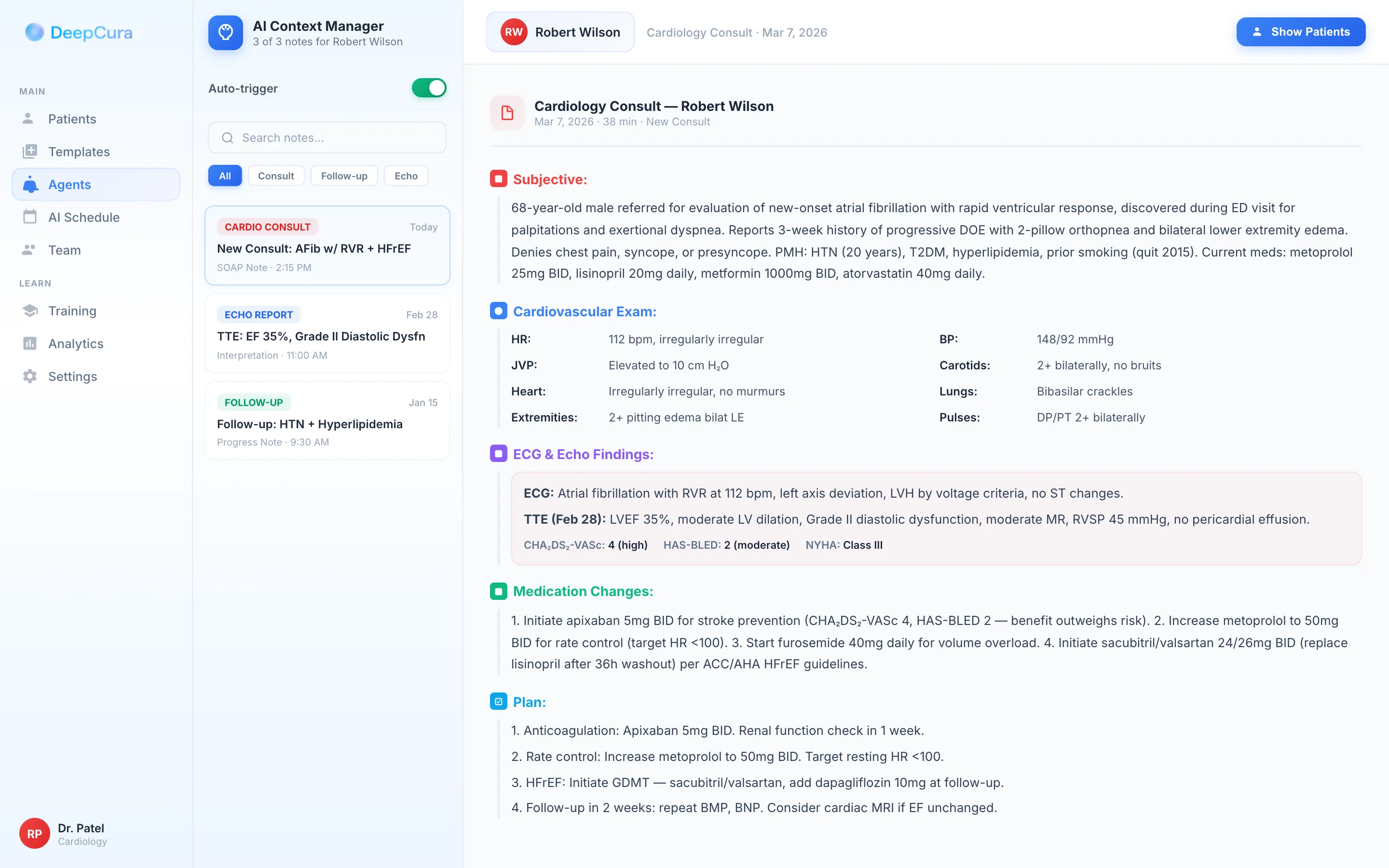
For cardiology documentation specifically, DeepCura's ambient scribe captures the full clinical encounter passively. The AI generates structured cardiology notes with cardiovascular-specific review of systems, cardiac exam documentation, and multi-system assessment and plan. Clinicians can choose between multiple leading AI engines (including models from OpenAI, Anthropic, and Google) — a flexibility no other scribe offers.
What sets DeepCura apart for cardiologists is its Clinical Decision Support (CDS) mode. When enabled, the system generates the clinical note in real-time while simultaneously launching a parallel evidence synthesis task through DeepEvidentia — DeepCura's proprietary research engine that searches PubMed, Google Scholar, and FDA DailyMed labels in real-time. For cardiology encounters, this means ACC/AHA clinical practice guidelines, ESC position statements, and drug safety data are surfaced alongside the note, not after the fact.
The E&M coding analysis is built into CDS mode: the AI evaluates the encounter against 2025 CMS/AMA MDM criteria, recommends CPT codes (99213–99215), extracts verbatim quotes from the transcript as supporting evidence, and flags potential undercoding. For cardiologists who also bill reading fees (93000 for ECG interpretation, 93306 for echo interpretation), this integrated coding support reduces missed revenue.
Strengths:
- Passive ambient listening with no manual recording steps
- CDS Mode with parallel ACC/AHA guideline surfacing via DeepEvidentia
- Cardiology-specific SOAP extraction with cardiovascular ROS and cardiac exam
- E&M coding analysis with verbatim quote extraction and anti-undercoding
- Multiple AI engine selection (gpt-5-no-cds for routine, gpt-5 CDS for complex, gpt-5-high for multi-system)
- Bidirectional EHR write-back with athenahealth, eClinicalWorks, AdvancedMD, OptiMantra, Epic, DrChrono, CharmHealth, and Cerner
- Problem list suggestion engine with cardiac SNOMED codes (hypertension, hyperlipidemia)
- AI receptionist handles calls, scheduling, and triage 24/7
- Billing automation with ICD-10/CPT coding and E&M integrity checks
- 1,000 credits/mo across all AI agents (1 credit per standard note)
Limitations:
- No pre-built cath lab procedure note templates (available via custom template builder)
- Risk score calculators are guideline-referenced, not auto-calculated from vitals
Pricing: $129/month per provider — all features included. Free trial available, no credit card required.
Verdict: DeepCura is the strongest overall choice for cardiologists who want both specialized documentation quality and a full-platform solution that handles everything from patient calls to EHR write-back. The CDS mode with real-time ACC/AHA guideline surfacing is a capability no other AI scribe offers.
2. DeepScribe — Best for Enterprise Cardiology Groups
DeepScribe has built its reputation on specialty-trained AI models, earning a 98.8 KLAS spotlight score for ambient AI documentation. The platform is specifically trained for cardiology among other specialties, which means its language models understand cardiac terminology, procedure documentation patterns, and interpretation formatting.
DeepScribe's ambient listening captures cardiology encounters and generates notes that reflect specialty-specific documentation patterns. The AI is trained on cardiology encounter data, which gives it an edge in accurately capturing cardiac-specific terminology compared to general-purpose competitors.
The tradeoff is accessibility: DeepScribe is enterprise-only with no public pricing, no self-service sign-up, and a sales-driven implementation process. There is no clinical decision support, no guideline surfacing, no AI receptionist, and no billing automation. It is a focused ambient scribe for organizations that want specialty accuracy at enterprise scale.
Strengths:
- Specialty-trained AI for cardiology terminology and documentation patterns
- 98.8 KLAS spotlight score
- Enterprise-grade security and compliance
Limitations:
- Enterprise-only — no public pricing, no self-service
- No clinical decision support or guideline surfacing
- No AI receptionist, billing automation, or practice management features
Pricing: Enterprise custom pricing only. Contact sales for quotes.
Verdict: Best for large cardiology groups and health system cardiology departments that want specialty-trained AI documentation and can justify enterprise procurement. For independent cardiologists or small groups, the enterprise-only model is a barrier. Read our DeepScribe review for the full breakdown.
3. Nuance DAX Copilot — Best for Dragon Users
Nuance DAX Copilot (Microsoft) is the enterprise standard for ambient clinical documentation, with its deepest integration in the Epic ecosystem and compatibility with 200+ EHR systems via Dragon Medical One. For hospital-based cardiology departments already using Dragon for dictation, DAX Copilot is a natural extension that adds ambient AI documentation to existing workflows.
DAX handles cardiology encounters through ambient listening and generates notes within your EHR workflow. The Microsoft backing ensures long-term enterprise support, and the Epic integration is the deepest of any AI scribe on the market. For cardiologists embedded in large health systems, DAX offers seamless institutional integration.
The tradeoff is cost: DAX is sold on enterprise contracts — pricing is not published, and implementation fees and volume discounts are negotiated per deployment. Clinical decision support is limited compared to DeepCura's real-time guideline surfacing, and there is no AI receptionist or practice automation.
Strengths:
- Deepest Epic integration of any AI scribe
- 200+ EHR system compatibility via Dragon Medical One
- Microsoft enterprise backing and long-term support
- Strong ambient quality for long cardiology encounters
Limitations:
- Enterprise contract pricing — not published, quoted per deployment
- Implementation fees negotiated per deployment
- Limited clinical decision support
- No AI receptionist or practice automation
Pricing: Not publicly priced — enterprise contract with volume discounts.
Verdict: The default choice for hospital cardiology departments on Epic or large health systems with existing Microsoft/Dragon infrastructure. Enterprise contract pricing puts it out of reach for most independent cardiology practices.
4. Freed AI — Best Budget Option
Freed AI offers the most streamlined ambient scribing experience — click record, see your encounter, and get a structured note. It requires minimal setup and has a clean interface that appeals to cardiologists who want simplicity over feature depth.
Freed captures cardiology encounters through passive ambient listening and generates notes in SOAP and custom formats. The AI handles general cardiology content reasonably well but does not have cardiology-specific features like structured interpretation documentation, procedure note templates, risk score calculation, or guideline-based clinical decision support.
EHR integration works through a Chrome browser extension with copy-paste and a beta one-click EHR push feature, rather than native API write-back — notes are transferred into the chart via browser automation rather than written directly to structured EHR fields.
Strengths:
- Simple, fast setup — first note in under 5 minutes
- Passive ambient listening with clean interface
- Affordable entry point at $39/month
Limitations:
- No cardiology-specific templates or interpretation capture
- No clinical decision support or guideline surfacing
- EHR integration via browser extension, not native API write-back
- No AI receptionist or practice automation
Pricing: $39/month (Starter, 40 notes), $79/month (Core, unlimited), or $119/month (Premier, unlimited with EHR push and ICD-10 coding).
Verdict: Best for cardiologists who want a dead-simple ambient scribe at the lowest price point without specialty-specific features. Not ideal for practices that need interpretation documentation, procedure notes, or clinical decision support. For cardiology-specific features, see how Freed compares in our Freed AI review.
5. Abridge — Best for Health Systems
Abridge is an ambient AI scribe built primarily for health system deployment, with its deepest integration in the Epic ecosystem. The platform captures clinical encounters passively and generates notes with linked evidence — clicking on a statement in the generated note shows the corresponding transcript segment that supports it.
For cardiology, Abridge's linked evidence feature is valuable for long, complex encounters where traceability between the note and the conversation matters. The institutional focus means strong compliance, security, and IT integration support.
The tradeoff is accessibility: Abridge is enterprise-focused with no public pricing and a sales-driven implementation. It does not offer cardiology-specific templates, clinical decision support with guideline surfacing, or practice automation features.
Strengths:
- Linked evidence — trace note statements back to transcript
- Strong Epic integration for health systems
- Institutional-grade security and compliance
Limitations:
- Enterprise-only — no public pricing or self-service
- No cardiology-specific templates or risk score support
- No clinical decision support with guideline surfacing
- No AI receptionist or practice automation
Pricing: Enterprise custom pricing only. Contact sales for quotes.
Verdict: Strong for health system cardiology departments that prioritize linked evidence and Epic integration. Not accessible to independent cardiologists or small groups. Read our Abridge AI review for the full breakdown.
6. Suki AI — Best Voice-First Experience
Suki AI takes a voice-first approach to clinical documentation — cardiologists dictate notes and the AI structures them into the appropriate format. The platform also supports ambient mode for passive encounter capture. Suki integrates bidirectionally with major EHRs and offers strong medication documentation.
The voice command interface is intuitive for cardiologists who prefer speaking over typing, particularly for quick procedure notes or interpretation dictations between patients. However, its enterprise pricing (not published) generally lands well above self-serve alternatives, and cardiology-specific features are limited to general templates.
Strengths:
- Voice-first interface — natural for dictation-heavy cardiologists
- Bidirectional EHR integration
- Both ambient and dictation modes
Limitations:
- Enterprise pricing — not published; contact sales
- No cardiology-specific templates or interpretation capture
- No clinical decision support or guideline surfacing
- No AI receptionist or practice automation
Pricing: Not published — contact sales.
Verdict: Strong voice-first documentation for cardiologists who prefer dictation, but the premium price is hard to justify when DeepCura offers more cardiology-specific features plus full practice automation for $129/month.
7. Sunoh AI — Most Affordable
Sunoh AI is one of the most affordable ambient AI scribes on the market at $149/month. It captures clinical encounters passively and generates structured notes. For cardiologists looking for a basic ambient scribe at a lower cost, Sunoh delivers core functionality.
The tradeoff is feature depth: Sunoh offers basic ambient scribing without cardiology-specific templates, interpretation documentation, clinical decision support, or robust EHR integration. It is a straightforward, no-frills ambient scribe.
Strengths:
- Affordable at $149/month
- Basic ambient listening and note generation
- Simple setup
Limitations:
- No cardiology-specific features
- No clinical decision support
- Limited EHR integration
- No AI receptionist or practice automation
- Fewer features than competitors at similar or lower price points
Pricing: $149/month.
Verdict: Budget option for cardiologists who want basic ambient scribing and nothing more. DeepCura at $129/month actually costs less while offering significantly more features including clinical decision support, EHR write-back, and practice automation.
Head-to-Head — Cardiology Documentation Features
| Feature | DeepCura | DeepScribe | Nuance DAX | Freed AI | Abridge | Suki AI | Sunoh AI |
|---|---|---|---|---|---|---|---|
| Ambient Listening | ✓ | ✓ | ✓ | ✓ | ✓ | ✓ | ✓ |
| Cardiovascular ROS | ✓ (structured) | ✓ | ✓ | Basic | Basic | Basic | Basic |
| ECG Interpretation Capture | ✓ | ✓ | ✓ | ✗ | ✗ | ✗ | ✗ |
| Echo Findings Documentation | ✓ | ✓ | ✓ | ✗ | ✗ | ✗ | ✗ |
| Procedure Notes | Custom | ✓ | Custom | ✗ | ✗ | ✗ | ✗ |
| CDS with Guidelines | ✓ (ACC/AHA) | ✗ | Limited | ✗ | Evidence links | ✗ | ✗ |
| Risk Score Documentation | ✓ (guideline-ref) | ✗ | ✗ | ✗ | ✗ | ✗ | ✗ |
| E&M Coding Analysis | ✓ (with quotes) | ✗ | ✓ | ICD-10 only | ✗ | CPT only | ✗ |
| Choose AI Engine | ✓ | ✗ | ✗ | ✗ | ✗ | ✗ | ✗ |
| Notes included | ~1,000 standard/mo (credits) | Unlimited | Unlimited | Unlimited (Core+) | Unlimited | Unlimited (paid) | Unlimited |
| Bidirectional EHR | ✓ (athenahealth, eCW, AdvancedMD, OptiMantra, Epic, DrChrono, CharmHealth, Cerner) | Enterprise | ✓ (Epic, 200+) | ✗ | Epic, Oracle | ✓ | Limited |
| AI Receptionist | ✓ | ✗ | ✗ | ✗ | ✗ | ✗ | ✗ |
| Billing Automation | ✓ | ✗ | ✓ | ✗ | ✗ | CPT only | ✗ |
| Price | $129/mo | Enterprise | Not publicly priced | $39–$119/mo | Enterprise | Not publicly priced | $149/mo |
How AI Scribes Handle Key Cardiology Documentation
Cardiac History and Physical Exam
The cardiac history and physical is the foundation of every cardiology encounter. A thorough cardiac H&P covers chief complaint, history of present illness with temporal progression of symptoms, cardiac risk factors (hypertension, diabetes, hyperlipidemia, smoking, family history of premature CAD), prior cardiac history (MI, PCI, CABG, valve surgery, device implantation), complete cardiovascular review of systems (chest pain, dyspnea on exertion, orthopnea, PND, palpitations, syncope, presyncope, edema), and a focused cardiovascular exam (JVP, carotid bruits, PMI, heart sounds, murmurs, peripheral pulses, edema).
AI scribes vary in how well they capture the nuances of the cardiac exam. General-purpose scribes may note "heart regular rate and rhythm" but miss the clinical distinction between a grade II/VI systolic ejection murmur at the RUSB radiating to the carotids (suggesting aortic stenosis) versus a grade III/VI holosystolic murmur at the apex radiating to the axilla (suggesting mitral regurgitation). The best cardiology AI scribes capture these granular auscultatory findings and structure them into discrete, chartable fields.
Procedure Notes — Cath Lab and EP Lab
Cardiac catheterization, PCI, pacemaker/ICD implantation, cardioversion, ablation, and transesophageal echocardiography each have specific documentation requirements. A PCI procedure note must include access site, sheath size, guide catheter, guidewire, lesion location and characteristics, balloon and stent specifications, pre- and post-intervention stenosis, TIMI flow grade, fluoroscopy time, contrast volume, and complications.
Most AI scribes do not support structured procedure note generation. The best cardiology AI scribes allow cardiologists to dictate procedure details and structure them into the appropriate format with all required elements, or offer customizable procedure note templates that capture the specific data points interventional cardiologists and electrophysiologists need.
Imaging Interpretation Documentation
Cardiologists interpret and document ECGs (93000, 93010), echocardiograms (93306, 93307, 93308), stress tests (93015, 93018), Holter monitors (93224–93227), and cardiac CT/MRI studies. Each interpretation has specific documentation requirements and generates separate reading fees — a significant revenue source for cardiology practices.
An AI scribe that captures interpretation findings from dictation and structures them into the format required for both the medical record and billing documentation helps cardiologists document more efficiently while ensuring reading fee revenue is not lost to incomplete documentation.
Medication Management and Reconciliation
Cardiology medication management involves juggling multiple drug classes with narrow therapeutic windows and significant interaction potential. A single patient with heart failure, atrial fibrillation, and coronary artery disease may be on sacubitril/valsartan, carvedilol, spironolactone, dapagliflozin, apixaban, and atorvastatin — with dose adjustments driven by blood pressure, heart rate, renal function, and potassium levels.
The best AI scribes for cardiology capture medication reconciliation from the natural flow of the encounter conversation, document dosage changes with clinical rationale, note drug interactions that were considered, and structure this information for both the clinical note and EHR medication list reconciliation.
Risk Score Integration
Cardiology documentation increasingly requires explicit risk stratification. For atrial fibrillation management, documenting CHA₂DS₂-VASc and HAS-BLED scores supports anticoagulation decisions. For chest pain evaluation, HEART and TIMI scores guide disposition. For primary prevention, the ASCVD 10-year risk score drives statin therapy recommendations per ACC/AHA guidelines.
AI scribes that extract the components of these risk scores from the clinical encounter — age, sex, comorbidities, vital signs, lab values — and document the calculated score with the clinical decision it supports provide significant value to cardiologists by improving documentation completeness, supporting guideline-concordant care, and strengthening billing justification for high-complexity encounters.
DeepCura: Clinical Decision Support for Cardiology
Real-time ACC/AHA guideline surfacing, ECG/echo interpretation capture, E&M coding with verbatim evidence, and full practice automation — $129/mo · 1,000 credits/mo (1 credit per standard note). Start your free trial.
+1 (415) 549-1829Available 24/7 · Set up in seconds · No credit card required
Cardiology Documentation Workflow with DeepCura
New Consultation Workflow
A cardiology new patient consultation with DeepCura follows this workflow:
- Referral intake — AI receptionist receives the referral call or fax, extracts patient demographics and reason for referral, and creates the appointment
- Pre-visit preparation — prior records, imaging reports, and lab results are available in the patient context
- Ambient scribing — the consultation is captured passively through ambient listening, with no manual recording steps
- CDS note generation — the AI generates a structured cardiology SOAP note while simultaneously surfacing relevant ACC/AHA guidelines and FDA drug safety data through DeepEvidentia
- E&M coding — the system analyzes MDM complexity, recommends the appropriate E&M code with verbatim transcript evidence, and flags potential undercoding
- EHR write-back — the completed note, problem list suggestions, and medication reconciliation are written back to the EHR
Follow-Up Visit Workflow
Follow-up visits leverage the same workflow with additional efficiency:
- Prior data pull — previous notes, imaging trends, and medication history are available in context
- Ambient capture — the follow-up encounter is captured passively
- Medication reconciliation — changes, adjustments, and new prescriptions are captured and structured
- Interval imaging review — new ECG, echo, or stress test findings are documented
- E&M coding — coding analysis reflects the follow-up encounter complexity
For clinical AI tools that enhance cardiology decision-making beyond documentation, see our guide on Best ChatGPT for Doctors.
See DeepCura in Action
Watch how DeepCura handles the full clinical workflow — from AI receptionist calls and patient intake through ambient scribing, automated billing, and native EHR write-back.

Frequently Asked Questions
What is the best AI scribe for cardiology?
DeepCura is the best overall AI scribe for cardiology in 2026. It combines passive ambient listening with cardiovascular-specific documentation, clinical decision support that surfaces ACC/AHA guidelines in real-time via DeepEvidentia, E&M coding analysis with verbatim evidence, and bidirectional EHR integration — all for $129/month with 1,000 credits a month (1 credit per standard note). For enterprise cardiology groups, DeepScribe offers specialty-trained AI with a 98.8 KLAS spotlight score.
Can AI scribes capture ECG and echo interpretations?
The best AI scribes capture ECG and echocardiogram interpretation findings when dictated during or after the encounter. DeepCura, DeepScribe, and Nuance DAX can structure these findings into interpretation-formatted documentation. However, most AI scribes do not automatically read or interpret the raw ECG or echo data — they capture the cardiologist's verbal interpretation and structure it into the appropriate documentation format for both the medical record and billing (CPT 93000, 93306).
Do AI scribes work with cardiology-specific EHRs?
Most AI scribes integrate with general medical EHRs used by cardiology practices. DeepCura integrates bidirectionally with athenahealth, eClinicalWorks, AdvancedMD, OptiMantra, Epic, DrChrono, CharmHealth, and Cerner. Nuance DAX supports 200+ systems via Dragon Medical One, with its deepest integration in Epic. DeepScribe and Abridge offer enterprise EHR integrations. For athenahealth users, DeepCura's integration includes cardiology-specific SOAP extraction with cardiovascular ROS sections.
How much does an AI scribe for cardiology cost?
Pricing ranges from $39/month to enterprise custom. Freed AI starts at $39/month (Core at $79, Premier at $119). DeepCura is $129/month with 1,000 credits a month (1 credit per standard note), clinical decision support, and full practice automation. Sunoh AI is $149/month for basic ambient scribing. Suki AI is not publicly priced (contact sales). Nuance DAX is not publicly priced (enterprise contract). DeepScribe and Abridge are enterprise-only with custom pricing. For most cardiology practices, the $119–$149/month range offers the best balance of features and value.
Can an AI scribe replace a human cardiology scribe?
An AI scribe can handle the core documentation work of a human cardiology scribe — capturing the encounter narrative, structuring it into a clinical note, and managing basic coding — at a fraction of the cost. A human scribe typically costs $16–$27/hour in wages ($3,300–$5,700/month fully loaded for a full-time in-house scribe), while self-serve AI scribes range from $39–$149/month (enterprise tools are custom-priced). However, AI scribes do not currently replicate all functions of an experienced cardiology scribe, such as real-time chart preparation, prior authorization support, or in-room workflow assistance. Most practices find that AI scribes handle 80–90% of documentation work, with clinicians spending 2–3 minutes on final review and edits.
Are AI cardiology scribes HIPAA compliant?
Yes. All seven AI scribes reviewed in this guide are HIPAA compliant with signed Business Associate Agreements (BAAs). Audio recordings are encrypted in transit and at rest, and most platforms delete recordings after note generation. DeepCura, DeepScribe, Nuance DAX, and Abridge all provide enterprise-grade security documentation. Verify the specific BAA terms and data handling practices of any platform before deployment in your cardiology practice.
Do AI scribes handle procedure notes for cardiac catheterization?
Limited support exists. DeepScribe and Nuance DAX can capture procedure details from dictation and structure them into documentation. DeepCura supports custom procedure note templates that can be configured for cardiac catheterization, PCI, device implantation, and other procedures. Most general-purpose AI scribes (Freed AI, Abridge, Suki AI, Sunoh AI) do not have dedicated procedure note functionality and capture procedure documentation only within the general encounter note format.
What risk scores can AI scribes calculate?
Most AI scribes do not automatically calculate cardiac risk scores. DeepCura's CDS mode references ACC/AHA guidelines that include risk stratification frameworks (CHA₂DS₂-VASc, HEART, TIMI, HAS-BLED, ASCVD) and can document score components from the clinical conversation. However, automated calculation from extracted clinical data (vitals, labs, comorbidities) is not yet standard across AI scribe platforms. Cardiologists should verify risk score calculations independently and document them explicitly in the clinical note.
Final Verdict
For cardiologists and cardiology practices, the choice comes down to three profiles:
Best overall: DeepCura at $129/month delivers the strongest combination of cardiology documentation quality (cardiovascular ROS, interpretation capture, medication reconciliation, E&M coding) and full-platform value (CDS with ACC/AHA guideline surfacing, AI receptionist, billing, EHR write-back, 1,000 credits/mo). It is the only platform where cardiology documentation tools come bundled with real-time clinical decision support and complete practice automation.
Best for enterprise cardiology groups: DeepScribe for large cardiology groups and health system departments that want specialty-trained AI documentation with a 98.8 KLAS spotlight score and can justify enterprise procurement.
Best for hospital cardiology on Epic: Nuance DAX Copilot (enterprise contract, not publicly priced) for departments already embedded in the Epic ecosystem or large health systems with existing Microsoft/Dragon infrastructure.
For a broader look at AI scribes across all specialties, see our Best AI Medical Scribes in 2026 ranking. For hospitalist H&P, problem-based A&P, GDMT for HF/AFib (sacubitril/valsartan, SGLT2i, DOACs by GFR), and complex multi-comorbidity admissions, see our best AI scribe for internal medicine guide. For physician-generalist E/M coding suggestions and structured H&P templates, see our best AI scribe for physicians ranking. For psychiatric documentation, see our Best AI Scribe for Psychiatry guide. For clinical AI chat tools, see Best ChatGPT for Doctors. For practices that need phone automation alongside documentation, see our Best AI Medical Receptionist guide. And for a comprehensive dictation vs. ambient AI comparison with all 15 tools, see our Best Medical Dictation Software guide.
References
[1] American Heart Association, "Cardiovascular Disease: A Costly Burden for America — Projections Through 2035," AHA.org. heart.org/cardiovascular-disease-a-costly-burden (PDF)
[2] American College of Cardiology / American Heart Association, "ACC/AHA Clinical Practice Guidelines," ACC.org. acc.org/guidelines
[3] Tebra, "Buried in Bureaucracy: How Administrative Work Is Driving Burnout in Cardiology," The Intake, 2025. tebra.com/theintake/practice-operations/cardiologist-burnout
[4] Arndt, B.G. et al., "Physician Time Spent Using the Electronic Health Record During Outpatient Encounters," Annals of Internal Medicine, 2020; 172(3):169-174. doi.org/10.7326/M18-3684
[5] American Medical Association, "Measuring and Addressing Physician Burnout," AMA.org. ama-assn.org/practice-management/physician-health/physician-burnout
[6] Melnick, E.R. et al., "The Association Between Perceived Electronic Health Record Usability and Professional Burnout Among US Physicians," Mayo Clinic Proceedings, 2020; 95(3):476-487. doi.org/10.1016/j.mayocp.2019.09.024
[7] Centers for Medicare & Medicaid Services, "E&M Documentation Guidelines," CMS.gov. cms.gov/Medicare/Medicare-Fee-for-Service-Payment/PhysicianFeeSched
[8] Centers for Medicare & Medicaid Services, "ICD-10-CM Official Guidelines for Coding and Reporting," CMS.gov. cms.gov/Medicare/Coding/ICD10
[9] KLAS Research, "DeepScribe Ambient AI — 2025 Emerging Company Spotlight Report." klasresearch.com/report/deepscribe-ambient-ai-2025 (DeepScribe KLAS page)
[10] DeepCura, "AI Medical Scribe Platform — Ambient Scribing, AI Receptionist, EHR Integration," DeepCura.com. deepcura.com