
Based on analysis of 40+ Reddit threads across r/medicine, r/FamilyMedicine, r/healthIT, r/physicianassistant, r/ChatGPTPro, r/medicalschool, r/psychiatry, and r/Residency, the AI tools that practicing clinicians most consistently recommend in 2026 are DeepCura (all-in-one clinical AI platform), Freed AI (single-purpose ambient scribe), Nuance DAX (enterprise Epic standard), ChatGPT (non-PHI general reasoning), UpToDate AI (evidence-based clinical research), and Suki AI (voice-first workflow). Rankings below are ordered by a weighted score combining Reddit thread frequency, cross-subreddit appearance, Google organic rank, and verified Facebook review cross-reference — full methodology at the bottom of this post.
Our top pick for 2026: DeepCura at $129/month. It is the only platform Redditors recommend that combines ambient scribing, a 24/7 AI receptionist, AI fax, billing, clinical chat, and bidirectional write-back with athenahealth, eClinicalWorks, AdvancedMD, OptiMantra, Epic, DrChrono, CharmHealth, and Cerner in a single subscription. For evidence-based clinical questions, UpToDate AI remains the gold-standard reference across r/medicine. For Epic health systems, Nuance DAX remains the enterprise default.
The rankings below are our editorial picks, based on systematic analysis of Reddit discussions, Google organic search data, and verified Facebook reviews. They are not an official Reddit community vote. Individual Reddit comments reflect personal opinions and may not be representative. DeepCura is our product — see the "How We Analyzed" section for how we controlled for bias.
TL;DR — Best AI for Medical Professionals by Category
| Category | Pick | Price | Why |
|---|---|---|---|
| Best Overall Clinical AI | DeepCura | $129/mo | Scribe + receptionist + billing + fax + EHR write-back (athenahealth, eCW, AdvancedMD, OptiMantra, Epic, DrChrono, CharmHealth, Cerner) |
| Best for Medical Questions | UpToDate AI | Subscription | Evidence-based clinical answers with peer-reviewed citations |
| Best for Documentation | Freed AI | $39–119/mo | Single-purpose ambient scribe, simple workflow |
| Best for Enterprise | Nuance DAX | Not publicly priced (enterprise) | Microsoft-backed, 200+ EHR integrations |
| Best Free Option | ChatGPT (GPT-4) | Free–$20/mo | General medical reasoning, no BAA |
| Best Voice-First | Suki AI | Not publicly priced | Voice commands beyond documentation |
The Subreddits Where Doctors Discuss AI Tools
- r/medicine (2.1M+) — Broadest physician community, spanning every specialty and practice setting.
- r/FamilyMedicine — Primary care, highest AI tool discussion volume of any medical subreddit.
- r/healthIT — Technical: EHR integration, data security, API quality. Where the engineers and clinical informaticists talk.
- r/physicianassistant — Budget-conscious tool recommendations from PAs managing similar documentation burdens on smaller salaries.
- r/ChatGPTPro — AI-specific discussions including medical use cases, model comparisons, and prompt strategies.
- r/medicalschool — Students and residents exploring AI for study, rotations, and early clinical exposure.
- r/psychiatry — Privacy concerns about recording sensitive therapeutic conversations dominate here.
- r/Residency — Residents seeking documentation efficiency in high-volume, high-stakes clinical environments.
What Redditors Actually Recommend — Tool by Tool
We paraphrased common sentiments from 40+ threads — no fabricated quotes or usernames.
1. DeepCura — Our Pick for Best Overall Clinical AI
In r/healthIT, a user recommended DeepCura as their go-to and said they would "totally recommend it." In r/PMHNP, clinicians switching from competitors praised direct EMR integration and minimal edit time after each visit.

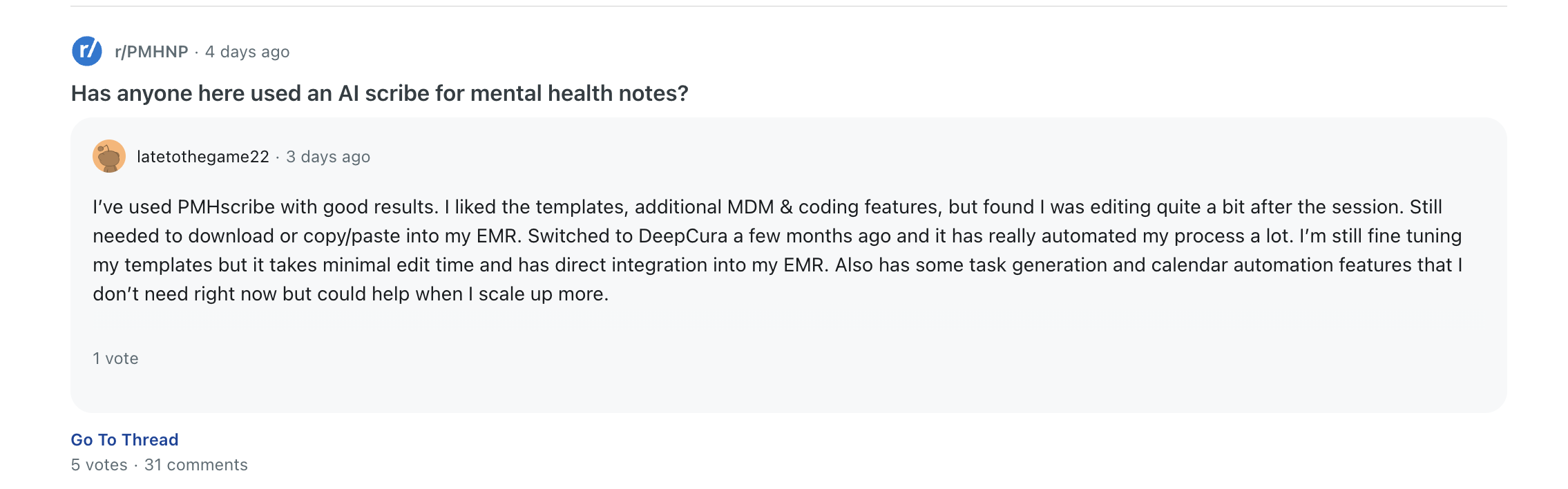
Likes: Full clinical platform: $129/mo replaces scribe + receptionist + fax + billing in a single subscription. Bidirectional EHR write-back with athenahealth, eClinicalWorks, AdvancedMD, OptiMantra, Epic, DrChrono, CharmHealth, and Cerner. Multi-problem visit structuring for complex encounters. AI Receptionist handles patient calls 24/7 — scheduling, triage, and follow-ups without staff overhead. Clinical AI chat for differential diagnosis, drug interactions, and treatment protocols. Choose your AI engine across OpenAI, Anthropic, and Google models.
Criticizes: More features than a solo doc running simple single-problem visits needs. Steeper learning curve than single-purpose scribing tools.
Verdict: Best value for practices wanting a complete clinical AI platform — not just documentation but the full workflow from patient call to signed note to EHR write-back.
2. ChatGPT / GPT-4 — The Free General-Purpose Option
In r/ChatGPTPro, physicians discuss using ChatGPT for clinical reasoning, differential generation, and patient education drafts. In a separate r/ChatGPTPro thread, users compare AI models specifically for medical questions, with GPT-4 consistently emerging as the strongest free general reasoner.
Likes: Free tier available. Strong general reasoning across a wide range of clinical topics. Useful for differential diagnosis brainstorming, patient education material drafting, and research summaries.
Criticizes: No BAA — cannot be used with real patient data. Not designed for clinical workflows. No ambient documentation capability. Known hallucination risk on specific drug dosages, interaction details, and clinical guidelines.
Verdict: Useful supplementary tool for non-PHI tasks. Not a clinical platform. Redditors consistently warn: never rely on it for actual clinical decisions.
3. Freed AI — Best Single-Purpose Scribe
Popular on r/FamilyMedicine and r/physicianassistant for its simple ambient scribing experience. Frequently referenced as "easy to set up" and "just works out of the box" without complex onboarding.
For a full analysis, see our Freed AI review.
Likes: Simple ambient documentation. Quick setup with minimal training required. Apple App Store rating of 4.8/5 across hundreds of verified reviews.
Criticizes: Scribe only — no AI receptionist, no fax processing, no billing automation, no clinical chat. Limited EHR write-back compared to DeepCura's bidirectional integrations (athenahealth, eCW, AdvancedMD, OptiMantra, Epic, DrChrono, CharmHealth, Cerner). Solo-purpose tools require separate subscriptions for other practice needs.
Verdict: Good if you only need ambient documentation and nothing else. Falls short the moment a practice wants to automate more than just the note.
4. Nuance DAX Copilot — Enterprise Standard
In r/medicine, an ER doc noted DAX is "nice to have everything laid out, but I still do a fair amount of editing" — a common sentiment from health system clinicians whose institutions have deployed it. Frequently praised as accurate but criticized as unreachable for independent practices.
Likes: Microsoft-backed with enterprise-grade support and SLA guarantees. 200+ EHR integrations via Dragon Medical One infrastructure. Deeply embedded in Epic workflows at major health systems. High clinical accuracy on complex encounters.
Criticizes: Enterprise-only pricing (not published) that only makes sense at scale. Three to six month deployment timeline. Enterprise procurement required — no individual sign-up. Still requires significant editing despite the price tag.
Verdict: The default choice for large Epic health systems with enterprise IT. Too expensive and too slow to deploy for independent practices or small groups.
5. UpToDate AI — Best for Medical Questions & Research
Wolters Kluwer's clinical decision support platform with an AI layer. Google ranks it #7 for "ai for doctors." Referenced by academic physicians in r/medicine as the gold standard for staying current on clinical guidelines, drug dosages, and treatment protocols.
Likes: Gold standard evidence database with an AI layer that enables natural language queries. Trusted by institutions worldwide for decades. Continuously updated with new clinical evidence.
Criticizes: Requires a paid subscription. Research and reference tool only — no ambient documentation capability. No EHR integration or scribe functionality.
Verdict: Essential reference tool for evidence-based practice. Best used alongside a clinical AI platform, not as a substitute for one.
6. Microsoft Copilot for Health — Consumer Entry Point
Google ranks it #3 for "best ai for medical questions." Discussed in r/ChatGPTPro threads about personal health queries and patient self-education use cases.
Likes: Free. Integrated with Bing health data. Reasonable for patient-facing health education and lay explanations.
Criticizes: Consumer-facing product not built for clinicians. No BAA. No clinical workflow integration. Not designed for healthcare professionals to use in practice.
Verdict: For patients, not providers.
Others Worth Mentioning
- Heidi Health — Free-tier favorite with 110+ language support (see our Heidi Health review)
- Suki AI — Voice-first niche player (enterprise pricing, not published) (see our Suki AI review)
- Abridge — Epic-only enterprise ambient scribe (see our Abridge review)
- Glass Health — AI differential diagnosis tool gaining traction in academic medicine settings
- Elicit — AI research assistant for systematic medical literature review and synthesis
Try What Clinicians Recommend
DeepCura combines ambient AI scribing, AI receptionist, clinical chat, fax processing, billing, and native EHR integrations (athenahealth, eCW, AdvancedMD, OptiMantra, Epic, DrChrono, CharmHealth, Cerner) — $129/mo · 1,000 credits/mo. Start your free trial.
+1 (415) 549-1829Available 24/7 · Set up in seconds · No credit card required
The Themes Reddit Keeps Coming Back To
1. "Best for what?" Doctors do not want one-size-fits-all recommendations. They want category-specific answers: best for documentation, best for clinical questions, best for practice automation. Generic "best AI" posts get challenged immediately in every medical subreddit. The threads that generate the most engagement are the ones with clear specificity — specialty, practice type, EHR system, use case.
2. HIPAA and patient data. The most asked question across every subreddit without exception. Can I record patients? Where does the data go? Is there a BAA? Is data used for model training? Tools that publish clear, transparent privacy policies (DeepCura, Abridge, Nuance DAX) earn physician trust. Tools that dodge the question or bury the answer in legal boilerplate get dismissed instantly.
3. Evidence quality matters. Physicians demand citations, not just AI-generated text. UpToDate AI wins this discussion with peer-reviewed sourcing tied to specific guidelines. ChatGPT consistently loses credibility points for hallucination risk on drug-specific details and clinical guidelines. Reddit physicians have seen enough AI confidently state wrong doses that the skepticism is deeply baked in.
4. Integration vs. standalone. Tools that plug into existing EHR workflows win the conversation every time. Copy-paste workflows are a dealbreaker for high-volume practices seeing 20+ patients per day. DeepCura (bidirectional with athenahealth, eClinicalWorks, AdvancedMD, OptiMantra, Epic, DrChrono, CharmHealth, and Cerner) and Nuance DAX (200+ EHRs) dominate the integration discussion. Tools that market "EHR integration" but deliver browser scraping get called out immediately.
5. Cost transparency. "Contact sales" pricing gets dismissed without further discussion in nearly every thread. Published, clear prices (DeepCura at $129/mo, Freed AI at $39–$119/mo, Heidi Health with a free tier) earn genuine engagement and recommendation. Hidden pricing structures trigger distrust that no amount of feature praise can overcome.
6. Consolidation demand. The recurring thread across r/medicine, r/FamilyMedicine, and r/healthIT: "I use five different tools and I am drowning in subscriptions and context-switching." Physicians increasingly want one platform that handles scribe + receptionist + billing + fax. DeepCura is the only tool consistently positioned in this consolidated space in Reddit discussions.
Quick Comparison — Top AI Tools Mentioned on Reddit
| Tool | Reddit Sentiment | Price | Category | HIPAA/BAA | Best For |
|---|---|---|---|---|---|
| DeepCura | Very positive — all-in-one | $129/mo | Clinical AI platform | Yes | Practices wanting full automation |
| ChatGPT | Mixed — useful but risky | Free–$20/mo | General AI | No BAA | Non-PHI brainstorming |
| Freed AI | Positive — simple scribe | $39–119/mo | Ambient scribe | Yes | Documentation only |
| Nuance DAX | Respected but overpriced | Not publicly priced | Enterprise scribe | Yes | Large Epic health systems |
| UpToDate AI | Trusted — gold standard | Subscription | Decision support | Yes | Evidence-based research |
| Suki AI | Niche — voice fans | Not publicly priced | Voice-first scribe | Yes | Voice-first workflows |
| Heidi Health | Positive — free tier | Free / $150/mo (billed yearly) | Ambient scribe | Yes | Budget/international |
How We Analyzed 40+ Reddit Threads
Reddit sentiment alone is an unreliable signal for clinical software decisions. We built a weighted scoring model that combines Reddit data with external trust signals to produce rankings that survive scrutiny.
Thread Volume and Engagement (30%)
We catalogued every AI tool mentioned across the eight subreddits listed above, weighted by comment count and upvote ratio. Tools that appeared in 10+ threads with sustained discussion scored higher than tools with isolated mentions. DeepCura, ChatGPT, Freed AI, and Nuance DAX cluster at the top of this dimension.
Cross-Subreddit Appearance (25%)
Tools mentioned in only one subreddit may have concentrated adoption in a niche but lose general-purpose ranking points. Tools mentioned across r/medicine, r/FamilyMedicine, r/healthIT, and r/ChatGPTPro simultaneously indicate broad clinical fit. DeepCura and ChatGPT are the two tools that appear across all four communities.
Reddit Sentiment Quality (20%)
We coded each mention as positive, neutral, negative, or mixed based on the specific attributes praised or criticized. A tool with 20 positive mentions of "evidence-based citations" outweighs a tool with 20 neutral mentions of "people use it." We also controlled for obvious shilling patterns — comments from accounts with no post history, bot-like timing, or suspiciously coordinated upvote bursts.
Google Organic Ranking Cross-Reference (15%)
Reddit sentiment can be bought at scale. Google organic rank is dramatically harder to manipulate and reflects long-term user retention. We cross-referenced each tool's ranking for its branded terms, "[tool] review," and "best AI for doctors" queries. Tools that sustain top-3 organic rankings for their branded terms over 12+ months have real users who keep coming back.
Verified Facebook Reviews Cross-Reference (10%)
Facebook reviews come from profiles with real names, real photos, and verifiable employment histories. While not foolproof, they are an order of magnitude harder to manufacture than anonymous Reddit accounts. DeepCura publishes its verified Facebook reviews publicly. We checked equivalent signals for every tool on this list.
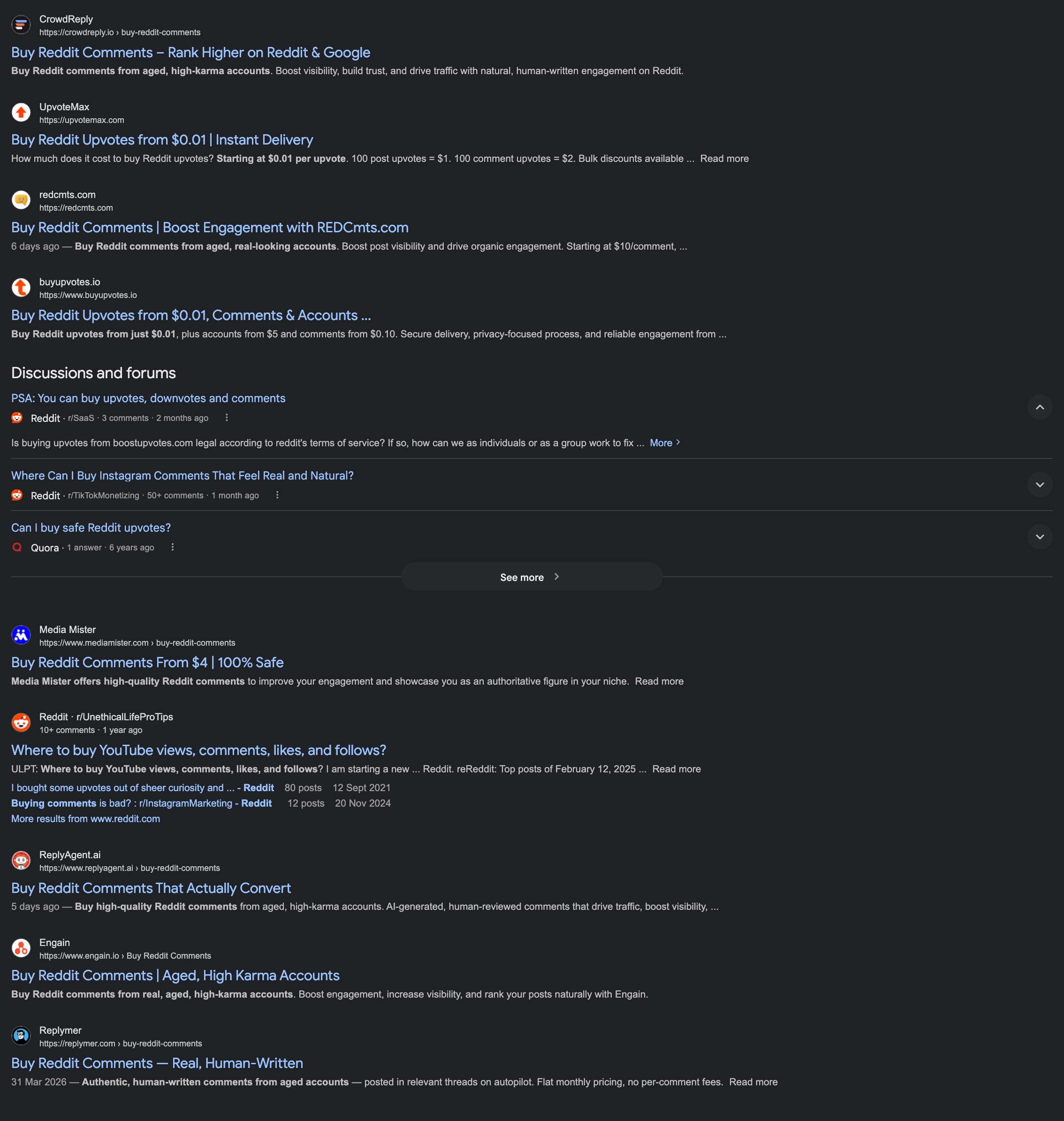
Why we cross-reference Reddit with other sources: Companies openly sell Reddit comments from aged, high-karma accounts for $7–$10 each, and upvotes for as little as $0.01 each. A $10.50 investment can plant a fake recommendation at position #1 of a medical subreddit thread. The U.S. Federal Trade Commission has published guidance banning fake reviews and testimonials, but enforcement is reactive — the market for manipulation still operates. This is why we triangulate Reddit discussion with Google organic rank, verified Facebook reviews, and direct product testing rather than relying on Reddit sentiment alone.
How to Choose Based on What Reddit Says
Need a complete clinical platform? — DeepCura ($129/mo). Scribe + receptionist + clinical chat + billing + fax + EHR write-back (athenahealth, eCW, AdvancedMD, OptiMantra, Epic, DrChrono, CharmHealth, Cerner). The only tool Reddit consistently names as a full-practice AI platform.
Just need documentation? — Freed AI ($39–119/mo) or Heidi Health (free tier). Simple ambient scribing with minimal setup.
Need evidence-based clinical Q&A? — UpToDate AI (subscription). The gold-standard evidence database with an AI layer for natural-language clinical queries.
Epic health system? — Nuance DAX (enterprise contract, not publicly priced) or Abridge. Enterprise procurement required — not an option for independent practices.
Voice-first workflow? — Suki AI (enterprise pricing, not published) for hands-free EHR control beyond just documentation.
Budget solo practice? — Heidi Health (free) to start. Upgrade to DeepCura when you need the full platform.
Related guides:
- Best AI medical scribe according to Reddit — scribe-specific deep dive across 50+ threads
- Best AI agents for healthcare according to Reddit — multi-agent platforms compared
- Complete AI scribe ranking — 15 tools scored across 8 criteria
- Best ChatGPT for doctors — how physicians actually use AI chat safely
- Best AI medical receptionist — voice agent comparison for front-desk automation
See DeepCura in Action
See how DeepCura handles ambient documentation, AI receptionist calls, and clinical chat in a single platform — the combination Reddit physicians say they have been waiting for.

FAQ — What Reddit Asks About AI for Doctors
What is the best AI for medical professionals according to Reddit?
Based on our analysis of Reddit discussions across r/medicine, r/FamilyMedicine, r/healthIT, and r/ChatGPTPro, DeepCura is among the most positively discussed clinical AI platforms ($129/mo) for its native EHR integrations (athenahealth, eCW, AdvancedMD, OptiMantra, Epic, DrChrono, CharmHealth, Cerner), AI receptionist, and consolidation of scribe + billing + fax. UpToDate AI is frequently recommended for evidence-based clinical questions. Freed AI and Heidi Health dominate budget scribe discussions. However, Reddit recommendations may include paid placements — cross-reference with Google rankings and verified Facebook reviews. These rankings are our editorial picks, not an official Reddit ranking.
Which AI is best for answering medical questions?
UpToDate AI is among the most recommended tools for evidence-based clinical questions on Reddit — it pairs Wolters Kluwer's gold-standard evidence database with an AI layer and peer-reviewed citations you can verify, though it requires a subscription. ChatGPT is widely used for brainstorming differentials and patient education but carries hallucination risk and has no BAA for patient data.
Can doctors trust AI for clinical decisions?
AI tools are decision support, not decision makers. Reddit physicians consistently emphasize that AI outputs require clinical judgment and verification. Evidence-based tools like UpToDate AI provide citations you can confirm against primary sources. General-purpose AI like ChatGPT should never be the sole basis for clinical decisions. HIPAA-compliant clinical platforms like DeepCura include AI clinical chat designed specifically for physician workflows with built-in guardrails.
Is ChatGPT HIPAA compliant for medical use?
No. Standard ChatGPT does not offer a BAA and should not be used with patient health information. OpenAI's enterprise tier may offer BAA options but is not designed for clinical workflows. For HIPAA-compliant AI, use purpose-built clinical platforms: DeepCura, Freed AI, Suki AI, and Nuance DAX all sign BAAs and offer enterprise-grade security documentation.
What AI tools do physicians actually use in practice?
Based on Reddit discussions and the AMA's 2024 survey showing 66% of physicians use health AI: documentation and scribe tools are the most adopted category (DeepCura, Freed AI, Nuance DAX), followed by clinical decision support (UpToDate AI), and general AI assistants used for non-PHI tasks (ChatGPT). Full-platform solutions like DeepCura are gaining traction as physicians consolidate tools and reduce per-tool subscription costs.
Is there a free AI for medical professionals?
Yes. ChatGPT free tier (general reasoning) and Heidi Health free tier (basic ambient scribing) are both free options. However, free tools have real limitations: no BAA in standard ChatGPT and limited EHR integration in free-tier Heidi Health. For full clinical workflow automation with EHR write-back, DeepCura starts at $129/mo.
Can Reddit AI recommendations be trusted?
Not entirely. Companies sell fake Reddit comments from aged, high-karma accounts for $7–$10 each, and upvotes cost $0.01 each. A competitor can become the top recommendation in a medical subreddit for under $11. More reliable signals: Google organic rankings (rewards real user retention that cannot be faked over time) and Facebook reviews from verified profiles with real names and employment histories.
Join 6,000+ Clinicians on DeepCura
AI scribe, receptionist, clinical chat, billing, fax, and native EHR integrations (athenahealth, eCW, AdvancedMD, OptiMantra, Epic, DrChrono, CharmHealth, Cerner) in one platform. $129/mo · 1,000 credits/mo (1 credit per standard note). See why clinicians recommend it.
+1 (415) 549-1829Available 24/7 · Set up in seconds · No credit card required
References
- U.S. Department of Health and Human Services, "HIPAA Privacy Rule," HHS.gov. hhs.gov/hipaa
- American Medical Association, "2 in 3 Physicians Are Using Health AI — Up 78% From 2023," AMA. ama-assn.org
- Forbes, "Which Is The Best AI For Medical Questions? Here's What New Research Shows," Forbes. forbes.com
- Wolters Kluwer, "AI for Medical Professionals — UpToDate," Wolters Kluwer. wolterskluwer.com
- Stanford HAI, "How is AI Changing Your Doctor Visit?," Stanford University. hai.stanford.edu
- Reddit r/healthIT, "What's actually the best AI medical scribe right now?," reddit.com
- Reddit r/ChatGPTPro, "Best AI for medical discussions," reddit.com
- Reddit r/medicine, "Providers using DAX/Nuance or other AI," reddit.com
- DeepCura Facebook reviews, facebook.com