
Therapists in private practice spend roughly 15-20 hours per week on documentation, treatment plans, and insurance paperwork — on top of their direct clinical hours — and the after-session "progress note backlog" is the single most-cited driver of burnout in the 2024 NASW and APA workforce surveys. A solo LCSW or LMFT carrying a full 25-session weekly caseload typically writes 25 progress notes, 4-6 intake biopsychosocial assessments, 2-3 treatment plan updates, and a rotating queue of insurance prior-authorization narratives — all of which must hold up under payer audit, state licensing-board review, and (in litigation cases) subpoena.
We ranked 5 AI scribes on the criteria that matter most for therapy documentation:
- Therapy note format support — does the AI produce BIRP (Behavior, Intervention, Response, Plan), DAP (Data, Assessment, Plan), SOAP, GIRP (Goal, Intervention, Response, Plan), or PIE (Problem, Intervention, Evaluation) — not just generic SOAP?
- DSM-5-TR alignment — does it capture symptom criteria with code-level specificity (F32.1 vs F33.1 vs F33.2; F41.1 vs F43.10) so the diagnosis section survives an audit?
- Timed CPT capture — does it timestamp session length to support 90834 (38-52 min) vs 90837 (53+ min) billing distinction, including 90846 (family without patient) and 90847 (family with patient)?
- Validated measure documentation — does it capture PHQ-9, GAD-7, PCL-5, AUDIT, DAST-10, C-SSRS, ACE, OQ-45, or PROMIS scores into the chart in a measurement-based-care friendly format?
All products were evaluated in February-April 2026. Pricing reflects publicly available rates. Custom-priced products were assessed based on disclosed ranges and verified practitioner reports.
Disclosure & methodology. This comparison is published by DeepCura, which is included in the ranking. Pricing and feature claims for competitor products reflect publicly available information as of the evaluation period above and may change — verify directly with each vendor before procurement. This article is editorial commentary; it is not medical, legal, billing, or compliance advice. CPT® is a registered trademark of the American Medical Association. All other product names and trademarks are property of their respective owners; references are nominative and do not imply affiliation or endorsement.
Why Therapists Need an AI Scribe
The Documentation Crisis in Behavioral Health
Therapists carry a documentation burden that is qualitatively different from medical specialties. A psychiatrist writes a 20-minute med-management note focused on MSE, medication response, side-effect screen, and refill plan — short, structured, and largely template-driven. A therapist writes a 50-minute psychotherapy progress note that must capture content (what was discussed), process (what happened therapeutically), intervention (what the clinician did), the client's response, and a treatment-plan-aligned plan for next session — all while protecting the therapeutic frame, maintaining HIPAA confidentiality, and producing a record that a payer auditor, a licensing board investigator, or a forensic reviewer can read without the clinical context.
The 2024 APA Workforce Study found that documentation and insurance paperwork is the single biggest contributor to early-career therapist attrition, ahead of compensation, caseload, and supervision quality. Solo private-practice therapists report 15-20 hours per week on charting, treatment plans, prior authorizations, and SOAP/BIRP/DAP rewrites — effectively a part-time job appended to direct clinical hours. The result is the "Sunday night progress-note backlog" — a phenomenon endemic to private practice where therapists batch a week of notes into one Sunday session because they cannot afford the documentation time mid-week between sessions.
What General-Purpose AI Scribes Miss in Psychotherapy
Most AI medical scribes are built for a 15-minute primary care visit with a focused HPI, ROS, and exam. Therapy sessions are fundamentally different from medical encounters in ways that break general-purpose scribes:
- Process vs. content distinction. A medical encounter is mostly content (what is the symptom, what are the findings, what is the plan). A therapy session is content + process — what the client said, but also how they said it, what shifted in affect during the session, what the therapeutic relationship looked like in the room, and what intervention the clinician deployed (cognitive restructuring, behavioral experiment, chair work, EMDR target processing, IFS parts work). A scribe that flattens process into a content-only summary loses the clinical signal that distinguishes a good progress note from a transcript.
- Therapeutic frame protection. Therapy progress notes serve a documentation function for the payer/board, but the chart is also discoverable in litigation and may be requested by the client. Skilled therapists write notes that document medical necessity and clinical intervention without exposing every word of session content — the BIRP and DAP formats emerged precisely to protect the therapeutic frame. An ambient scribe that transcribes everything verbatim defeats this.
- Risk and safety documentation. Suicidal ideation (SI), homicidal ideation (HI), self-harm, abuse disclosures (mandated reporter triggers), and Tarasoff duty-to-warn situations require precise documentation: presence/absence, plan/intent/means, protective factors, safety planning intervention, and disposition. The C-SSRS (Columbia Suicide Severity Rating Scale) is the de facto standard. A scribe that does not capture risk in a structured, defensible format leaves the therapist exposed in board complaints and malpractice suits.
- Modality-specific documentation. Different evidence-based modalities require different documentation conventions. CBT requires identification of cognitions, behaviors, and homework. DBT modules (mindfulness, distress tolerance, emotion regulation, interpersonal effectiveness) need module-aware notes. EMDR requires SUDS (Subjective Units of Distress) and VOC (Validity of Cognition) ratings, target memory documentation, and processing notes. ACT requires defusion, acceptance, and values-clarification documentation. IFS uses parts language ("the protector," "the exile," "Self-energy"). A generic SOAP misses every one of these.
- Treatment plan alignment. Insurance audits look for whether each progress note advances a goal listed on the active treatment plan. A note that documents intervention without tying back to a treatment goal ("reduce PHQ-9 from 18 to
<10," "increase social engagement from 0 to 3 events/week," "process index trauma using EMDR Phase 4-7") is a denial waiting to happen. The AI must explicitly map intervention to goal. - Medication and prescriber coordination. Therapists work alongside psychiatrists, NPs, and PCPs who manage medications. The progress note should reference current medication, recent changes, side effects observed, and any communication with the prescriber — without making medication recommendations the therapist isn't licensed to make.
- Diagnosis specificity to ICD-10 / DSM-5-TR. F32.1 (Major Depressive Disorder, Single Episode, Moderate) bills differently from F33.2 (MDD, Recurrent, Severe Without Psychotic Features). F41.1 (Generalized Anxiety Disorder) differs from F43.10 (Post-Traumatic Stress Disorder, unspecified) and F43.12 (PTSD, chronic). DSM-5-TR introduced new diagnostic specifiers (Prolonged Grief Disorder F43.81, Stimulant Use Disorder with mild/moderate/severe specifiers). A scribe that produces "depression" or "anxiety" without code-level specificity creates audit risk.
Insurance, Audit, and Medicolegal Stakes
Insurance carriers audit therapy documentation more aggressively than any other clinical specialty. Behavioral health is high-volume, the encounters are uniform on the surface (a 50-minute hour), and payer cost-containment focuses on clawbacks of "medically unnecessary" care. Audit findings that recoup payment regularly include: progress notes that don't document intervention, notes that don't tie to treatment plan goals, missing time-stamps that fail to substantiate 90837 billing, missing risk assessment in cases with prior SI history, missing measurement-based-care data, copy-paste templated notes that don't reflect session-specific content, and treatment plans that haven't been updated within the payer's required window (often 90 or 180 days).
State licensing boards investigate documentation in nearly every complaint — the most common finding cited in disciplinary orders for LCSW, LMFT, LPC, and psychologist boards is "inadequate clinical record." Forensic and family-court cases (custody disputes, conservatorship, fitness-for-duty) routinely subpoena therapy records — the chart becomes evidence and is read by attorneys, judges, and opposing experts who are not clinicians. An AI scribe that captures BIRP-formatted intervention, treatment-plan alignment, validated measures, and risk assessment in structured fields directly reduces the most common deficiencies cited in board orders and audit clawbacks.
Quick Comparison — Top AI Scribes for Therapists
| Rank | Tool | Price | Therapy-Specific | EHR Integration | Best For |
|---|---|---|---|---|---|
| 1 | DeepCura | $129/mo | Custom BIRP/DAP/GIRP + CDS | athenahealth, eCW, AdvancedMD, OptiMantra, Epic, DrChrono, CharmHealth, Cerner (paste-in for therapy PMS) | Best Overall |
| 2 | Upheal | ~$59-$99/mo | Telehealth-focused | Limited write-back | Telehealth Therapy |
| 3 | Blueprint | ~$59-$99/mo | Measurement-based care | SimplePractice, TherapyNotes | Measurement-Based Care |
| 4 | Heidi Health | Free / $150/mo (billed yearly) | Therapy templates available | Limited write-back | Free Tier |
| 5 | Freed AI | $39–$119/mo | Generic medical, no therapy templates | Browser-based EHR push | Solo therapists adapting general tool |
For a broader cross-specialty comparison, see our Best AI Medical Scribes in 2026 ranking.
What to Look For in a Therapist AI Scribe
Therapy documentation is not medical documentation with a longer time slot. Before choosing a tool, evaluate it against these eight criteria:
1. Native BIRP, DAP, GIRP, and SOAP Format Support. The AI must offer the dominant therapy formats out of the box. BIRP (Behavior, Intervention, Response, Plan) is most common in community mental health and substance-use treatment. DAP (Data, Assessment, Plan) is common in private practice. GIRP (Goal, Intervention, Response, Plan) explicitly anchors to treatment plan goals. SOAP is used by therapists working in integrated medical settings. A tool that only produces SOAP forces reformatting on every note.
2. DSM-5-TR Diagnostic Specificity. The AI should output diagnoses at code-level specificity (F32.1 Major Depressive Disorder Single Episode Moderate; F33.2 MDD Recurrent Severe; F41.1 GAD; F43.10 PTSD unspecified; F43.12 PTSD chronic; F90.0 ADHD predominantly inattentive; F90.1 ADHD predominantly hyperactive-impulsive; F90.2 ADHD combined; F60.3 Borderline Personality Disorder) — not generic labels.
3. Risk Assessment and Safety Planning Capture. The note should include explicit fields for SI/HI presence, plan, intent, means, protective factors, prior attempts, and the safety planning intervention deployed. C-SSRS, the Stanley-Brown Safety Planning Intervention, and crisis disposition (admit, mobile crisis, ER, voluntary outpatient, mandated reporter notification) need to flow into the chart in defensible format.
4. Validated Measure Documentation (Measurement-Based Care). PHQ-9 for depression, GAD-7 for anxiety, PCL-5 for PTSD, AUDIT and DAST-10 for substance use, ACE (Adverse Childhood Experiences), C-SSRS for suicide risk, OQ-45 for global outcome, PROMIS measures, ORS/SRS for session-by-session feedback. Insurance carriers increasingly require measurement-based-care for utilization review. The AI should capture scores into the chart and (ideally) trend them.
5. Treatment Plan Alignment. Every progress note should explicitly reference one or more active treatment-plan goals and objectives, document the intervention that addressed the goal, and document the client's response. Without this, the documentation fails the most common payer audit criterion.
6. Modality-Specific Templates. CBT (cognitive identification, behavioral experiments, homework), DBT (mindfulness, distress tolerance, emotion regulation, interpersonal effectiveness modules), EMDR (Phase, target memory, SUDS/VOC, processing), ACT (defusion, acceptance, values, committed action), IFS (parts identified, Self-energy, unblending), Gottman/EFT for couples, MI (motivational interviewing) for substance use — each modality has documentation conventions the AI should know.
7. Timed Billing Capture. Session start and end times must be captured to support 90791 (intake biopsychosocial diagnostic eval), 90832 (16-37 min), 90834 (38-52 min), 90837 (53+ min), 90846 (family/couple without identified patient), 90847 (family/couple with identified patient), 90853 (group). Add-on codes 90785 (interactive complexity) and 90840 (crisis psychotherapy add-on). The AI must distinguish 90834 vs 90837 because the audit risk on 90837 is higher and payers scrutinize it.
8. EHR Integration with Therapy-Native Platforms. SimplePractice, TherapyNotes, TheraNest, ICANotes, Valant, Headway, and Alma are the dominant therapy practice management platforms. Bidirectional integration to push the progress note, treatment plan update, and validated measure scores into the client chart eliminates the highest-leverage administrative friction. (Still choosing the platform itself? Our best EHR for private practice ranking compares all of them on price, billing, and AI readiness.)
Detailed Reviews
1. DeepCura — Best Overall for Therapy Practice
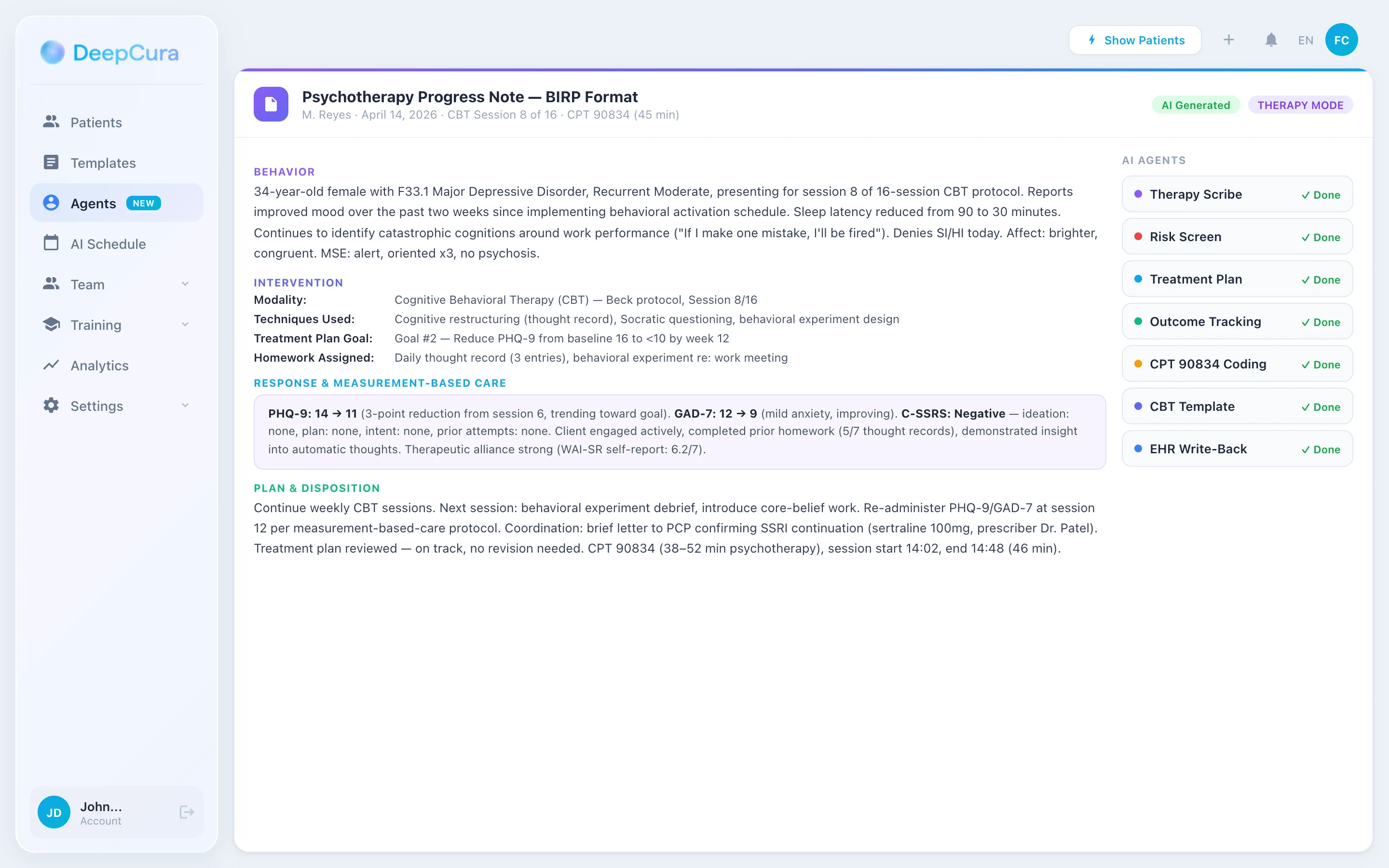
DeepCura is a customizable clinical AI platform that combines ambient scribing, clinical decision support, evidence search, practice automation, and bidirectional EHR integration — $129 per provider per month (or $999/yr) with 1,000 credits a month across every AI agent; a standard note costs 1 credit (3 on premium models, 15 on the deepest reasoning tier). For solo and group therapy practices that want one platform handling progress notes, treatment plan updates, biopsychosocial intakes, and after-hours intake routing with crisis-escalation handoffs to live clinicians or 911 per practice policy, DeepCura's combination of customizable templates and CDS Mode delivers the strongest feature-to-cost ratio in the therapy market.
For therapists, the key differentiators are template flexibility and modality awareness. DeepCura's custom template builder lets clinicians encode BIRP, DAP, GIRP, SOAP, or hybrid formats — and within each, encode modality-specific fields (CBT cognitions/behaviors/homework, DBT module/skill taught, EMDR phase/SUDS/VOC, IFS parts/Self-energy, ACT defusion/values). A solo LCSW running a CBT-and-EMDR practice can build two templates that both anchor to BIRP structure but diverge in the modality-specific intervention fields, and the AI will choose the appropriate template based on session content.
CDS Mode (3 credits per note) generates differential considerations alongside the progress note — useful for ambiguous presentations like the new client whose initial presentation could fit MDD vs. Persistent Depressive Disorder vs. Bipolar II Depression vs. Adjustment Disorder with Depressed Mood, where the differential affects treatment planning and informed-consent documentation.
DeepEvidentia — DeepCura's evidence search engine — pulls from PubMed, APA Division 12 evidence-based practice resources, SAMHSA TIP series, NICE guidelines, and treatment manual references. "EMDR efficacy for complex PTSD vs. trauma-focused CBT" returns the relevant Bisson et al. and Hofmann et al. meta-analyses. "Stanley-Brown Safety Planning Intervention validated outcomes" returns the original Stanley & Brown 2012 paper and replication studies.
Strengths:
- Custom template builder for BIRP, DAP, GIRP, SOAP, and modality-specific formats (CBT, DBT, EMDR, ACT, IFS, MI)
- CDS Mode with differential diagnoses for ambiguous presentations (3 credits per note)
- DeepEvidentia evidence search (PubMed and links to publicly available clinical guidelines)
- AI receptionist for after-hours intake routing with crisis-escalation handoffs to live clinicians or 911 per practice policy — particularly valuable for solo private practices where no staff is available evenings/weekends
- Multiple AI engines matched to encounter complexity (1-15 credits)
- Custom templates for biopsychosocial intake (90791), couples/family (90846/90847), crisis (90839/90840), and group (90853)
- Treatment plan generator that produces SMART goals and measurable objectives designed to support common payer documentation standards
- Bidirectional integration with major EHRs and therapy platforms via custom field mapping
- 1,000 credits a month per provider (1 credit per standard note) — enough for a 25-session-per-week solo therapist without hitting a per-note cap
Limitations:
- Custom template builder requires initial setup time (2-4 hours for a solo practitioner to encode 3-5 modality templates)
- SimplePractice and TherapyNotes are not native write-back targets (native write-back covers athenahealth, eClinicalWorks, AdvancedMD, OptiMantra, Epic, DrChrono, CharmHealth, and Cerner) — notes are pasted into therapy PMS platforms
- CDS Mode trained primarily on broad medical literature — therapy-specific differentials require validation by the clinician
Pricing: $129/month per provider — all features included. Free trial available, no credit card required.
Verdict: DeepCura is the strongest choice for therapy practices that want one platform to handle progress notes across modalities, biopsychosocial intakes, treatment plan generation, after-hours intake routing with crisis-escalation handoffs to live clinicians or 911 per practice policy, and evidence search. The flexibility cost is upfront setup time, but for solo private practices and group practices where the clinician wears every hat, DeepCura's combined scribe + receptionist + treatment plan + CDS value is unmatched.
DeepCura: Customizable AI Scribe for Therapy Practice
BIRP/DAP/GIRP templates, modality-aware notes (CBT/DBT/EMDR/ACT/IFS), and AI receptionist for after-hours crisis screening — $129/mo · 1,000 credits/mo (1 credit per standard note). Start your free trial.
+1 (415) 549-1829Available 24/7 · Set up in seconds · No credit card required
2. Upheal — Best for Telehealth-Only Therapy Practices
Upheal targets the telehealth-only therapy segment with native integration into the video-session workflow. The session is recorded and transcribed within Upheal's video platform, the AI generates the progress note in BIRP, DAP, or SOAP format, and the clinician reviews and signs. Upheal also provides session-level analytics (talk-time ratio, sentiment trends, topic frequency) that some practices use for supervision and outcomes tracking.
For therapists running a full telehealth caseload — a model that became dominant during the 2020-2022 expansion and persists in many private practices — Upheal's integrated video + transcription + note generation eliminates the friction of using separate platforms. The product is well-suited to clinicians who prefer one platform end-to-end over assembling Zoom + ambient scribe + EHR.
The limitations are scope and modality breadth. Upheal works best as a telehealth-native tool — practices that mix telehealth with in-office sessions need a separate solution for in-person, and Upheal's modality-specific template depth is narrower than DeepCura's. EHR integration is improving but not yet as mature as therapy-native platforms.
Pricing: Approximately $59-$99/month per clinician depending on tier.
Verdict: Best for therapists running fully or majority telehealth practices who want an integrated video-and-documentation platform. For mixed in-office and telehealth practices, an ambient scribe like DeepCura that works across modalities is more flexible.
3. Blueprint — Best for Measurement-Based Care
Blueprint is a behavioral health measurement-based care platform that has expanded into AI-assisted documentation. The original product centered on automated administration of validated measures (PHQ-9, GAD-7, PCL-5, OQ-45, ACE, C-SSRS, ORS/SRS) to clients before sessions, with results flowing into the clinician's session prep and into the chart over time. The recent AI scribe addition generates progress notes that explicitly cite the session's measurement results and document treatment response as a function of measure trajectory.
For therapy practices that contract with payers requiring measurement-based care, Blueprint is the most targeted tool. Some payer-network contracts increasingly require this — verify each network's current policy. The clinical and audit value of having every progress note tied to a PHQ-9 or GAD-7 trend is meaningful — both for utilization review defense and for quality-of-care self-assessment.
The limitation is breadth. Blueprint excels at measurement-based care and the documentation tied to it; the AI scribe does not match DeepCura on modality-specific template depth, CDS, evidence search, and receptionist functions.
Pricing: Approximately $59-$99/month per clinician depending on plan and measure library access.
Verdict: Best for therapy practices already invested in measurement-based care, particularly those contracted with payer networks that require it. For practices not yet using measure-based care, the cost may be hard to justify against more general-purpose therapy-AI alternatives.
4. Heidi Health — Best Free Tier for Solo Therapists
Heidi Health offers a usable free tier (limited notes per month) before paid plans kick in at the Pro level, making it the only credible no-cost entry point for solo therapists testing AI documentation. Heidi was originally human-medicine focused but has added BIRP, DAP, and SOAP therapy templates as part of its specialty expansion. The interface is clean, the learning curve is short, and ambient capture quality is competitive with paid alternatives for individual therapy sessions.
Heidi has stronger product traction in Australia, New Zealand, and the UK than in North America, and its therapy templates reflect that — international payer conventions and DSM/ICD code conventions are well-supported, while US-specific payer audit conventions (CPT timed-code distinction, treatment-plan-goal-aligned notes) are less mature.
PIMS integration is limited — Heidi pushes notes into the EHR via clipboard or email rather than direct API write-back to SimplePractice or TherapyNotes. The product team has indicated more native integrations on the roadmap, but as of early 2026, US therapists should plan on copy-paste workflow.
Pricing: Free tier (limited notes); Clinician plan $150/user/month billed yearly (higher month-to-month); enterprise tier higher.
Verdict: Best for solo therapists who want to test ambient AI documentation at zero cost before committing to a paid tool, and for international therapy practitioners. US therapists running a full caseload typically outgrow the free tier within the first month and should compare paid Heidi against DeepCura. For an in-depth review, read our Heidi Health review.
5. Freed AI — Simplest Ambient Without Therapy Templates
Freed AI is a clean, fast ambient scribe for primary care medicine with a low learning curve and a tiered Free-to-Premier pricing structure. Solo therapists sometimes adopt Freed because the price is accessible ($39–$119/month) and the ambient experience is good, but as of our February-April 2026 evaluation, Freed has no therapy-specific templates, no DSM-5-TR-aware diagnostic structure, no measurement-based-care fields, and no integration with therapy-specific EHRs.
Practical effect: Freed transcribes the session, generates a SOAP note structured for medical documentation (not BIRP or DAP), and the therapist then reformats into the therapy-format expected by their EHR and payer. The time savings exist but are smaller than with a therapy-native or therapy-customizable tool, and clinically meaningful structured-instrument events (e.g., C-SSRS results, EMDR SUDS ratings) require manual entry.
Pricing: $39/month (Starter, 40 notes), $79/month (Core, unlimited), $119/month (Premier, unlimited + EHR push + ICD-10; $104 billed annually).
Verdict: Adequate as a stopgap for solo therapists testing the ambient AI category before committing to a therapy-native or therapy-customizable tool. We did not find Freed to be a strong long-term primary scribe for therapy practice — its medical bias created rework in our testing. Read our Freed AI review.
Head-to-Head — Therapy Documentation Features
| Feature | DeepCura | Upheal | Blueprint | Heidi | Freed |
|---|---|---|---|---|---|
| Ambient Listening | ✓ | ✓ (telehealth) | ✓ | ✓ | ✓ |
| BIRP / DAP / GIRP / PIE | Custom build | ✓ | ✓ | Partial | ✗ |
| Modality Templates (CBT/DBT/EMDR/ACT/IFS) | Custom | Limited | Limited | Limited | ✗ |
| DSM-5-TR Code-Level Specificity | ✓ | ✓ | ✓ | Partial | Generic |
| Risk Assessment (C-SSRS, SI/HI) | ✓ structured | Partial | ✓ structured | Partial | ✗ |
| Measurement-Based Care (PHQ-9/GAD-7/PCL-5/OQ-45) | ✓ | Partial | ✓ (core focus) | Partial | ✗ |
| Treatment Plan Generator (SMART goals) | ✓ | Limited | ✓ | Limited | ✗ |
| Timed CPT Capture (90834 vs 90837) | ✓ | ✓ | ✓ | Partial | Limited |
| Couples/Family (90846/90847) | ✓ | Limited | Limited | Limited | ✗ |
| Group (90853) | ✓ | ✗ | Limited | ✗ | ✗ |
| Clinical Decision Support | ✓ (differentials) | ✗ | ✗ | ✗ | ✗ |
| Evidence Search | ✓ (DeepEvidentia) | ✗ | ✗ | ✗ | ✗ |
| AI Receptionist (after-hours) | ✓ | ✗ | ✗ | ✗ | ✗ |
| EHR Bidirectional | athenahealth, eCW, AdvancedMD, OptiMantra, Epic, DrChrono, CharmHealth, Cerner (paste-in for therapy PMS) | Limited | SimplePractice/TherapyNotes | Limited | Browser-based EHR push |
| Price | $129/mo | ~$59-$99/mo | ~$59-$99/mo | Free / $150/mo (billed yearly) | $39–$119/mo |
Therapy Documentation Workflow with DeepCura
DeepCura's tiered credit system lets therapists match AI resources to encounter complexity — fast for routine progress notes, deeper for biopsychosocial intakes and crisis sessions.
Routine Progress Note (1 Credit) — 90834 / 90837 Individual Therapy
For routine 45-minute or 53+ minute individual therapy sessions — CBT for MDD, DBT skill review, EMDR processing within an established treatment plan — the 1-credit model generates a BIRP or DAP note in under 30 seconds with intervention, response, treatment plan goal alignment, and next-session plan. Speed-optimized for the high-volume clinical day where a solo therapist runs 6-8 individual sessions back-to-back.
Biopsychosocial Intake (3 Credits CDS) — 90791 New Client Evaluation
For new client diagnostic evaluations — presenting concerns, history of presenting illness, psychiatric history, substance use history, medical history, family history, developmental history, social history, ACE screen, current functioning, MSE, risk assessment, working diagnostic formulation, and treatment plan draft — CDS Mode activates differential diagnosis generation. The AI structures the biopsychosocial across the standard sections and flags differential considerations: in a client presenting with low mood, sleep disturbance, and anhedonia, the differential includes MDD, Persistent Depressive Disorder, Adjustment Disorder with Depressed Mood, Bipolar II Depression, Hypothyroidism (medical rule-out), substance-induced mood disorder, and grief reaction — all of which inform initial treatment planning.
Crisis Session and Family Therapy (15 Credits) — 90839/90840 Crisis, 90847 Family
For crisis psychotherapy sessions (90839 60-min crisis, 90840 30-min add-on), couples therapy with high relational complexity, family therapy with multi-generational dynamics, and forensic-adjacent evaluations — the maximum-depth model produces complete narratives capturing multi-party dialogue, identification of each participant, intervention specific to the system, response of each party, and structured safety planning where indicated.
Match AI to Session Acuity
1 credit for routine progress notes, 3 credits for biopsychosocial intakes with differential generation, 15 credits for crisis and family sessions — DeepCura scales documentation depth to match clinical complexity. Start your free trial.
+1 (415) 549-1829Available 24/7 · Set up in seconds · No credit card required
Clinical Decision Support and Evidence Search for Therapists
CDS Mode — Differentials and Treatment Selection
CDS Mode outputs are documentation-aid suggestions for clinician review. They are not diagnoses, treatment recommendations, or substitutes for clinical judgment. The therapist retains full responsibility for diagnosis, treatment planning, and risk decisions. DeepCura is not an FDA-cleared medical device.
Therapy is full of presentations where the differential drives treatment selection. CBT vs. trauma-focused CBT vs. EMDR vs. Cognitive Processing Therapy for PTSD. DBT vs. Mentalization-Based Therapy vs. Transference-Focused Psychotherapy for Borderline Personality Disorder. Behavioral Activation vs. CBT vs. Interpersonal Therapy for MDD. CDS Mode generates differential diagnoses alongside the BIRP/DAP — flagging high-yield differential considerations and rule-outs that affect treatment planning.
For a 34-year-old presenting with chronic interpersonal instability, affect dysregulation, and self-harm history, CDS Mode flags: Borderline Personality Disorder (DSM-5 criteria explicitly), Complex PTSD (per ICD-11 framework), Bipolar II with high mood reactivity, and ADHD with rejection sensitivity — each of which has different first-line treatment recommendations and informs the treatment plan and informed-consent discussion.
As of our February-April 2026 evaluation, none of the four other tools we reviewed advertise integrated CDS comparable to DeepCura's CDS Mode. Upheal, Blueprint, Heidi, and Freed are documentation-only tools. DeepCura adds the clinical reasoning layer that supports both treatment planning and the documented clinical reasoning in the chart.
DeepEvidentia — Evidence at the Bedside for Therapists
DeepEvidentia surfaces citations to PubMed and links to publicly available clinical guidelines and treatment-manual references.
Example queries therapists actually ask:
- "EMDR efficacy for complex PTSD vs. trauma-focused CBT" — returns Bisson et al. systematic review and the Bohus et al. complex PTSD trial
- "DBT skills training without weekly individual sessions outcomes" — surfaces Linehan et al. dismantling studies
- "Stanley-Brown Safety Planning Intervention validated outcomes" — returns the original Stanley & Brown 2012 paper and replication
- "Behavioral Activation vs. CBT for MDD effect size" — returns the Ekers et al. meta-analysis
- "Mindfulness-Based Cognitive Therapy for relapse prevention in recurrent depression" — surfaces Kuyken et al. Lancet trial
For complex case formulation, supervision prep, and informed-consent discussions about treatment options, evidence access at the bedside transforms documentation time into clinical reasoning time.
Pricing Comparison
| Tool | Monthly | Notes included | CDS | Best Plan |
|---|---|---|---|---|
| DeepCura | $129/mo | Up to ~1,000 standard notes/mo (credits) | ✓ (CDS Mode: 3 credits/note) | Single plan, all features |
| Upheal | ~$59-$99/mo | Unlimited | ✗ | Standard with telehealth integration |
| Blueprint | ~$59-$99/mo | Unlimited | ✗ | MBC + AI scribe combined |
| Heidi Health | Free / $150/mo (billed yearly) | Free tier limited | ✗ | Free or Clinician |
| Freed AI | $39–$119/mo | 40-unlimited | ✗ | Core ($79) or Premier ($119; $104 billed annually) |
See DeepCura in Action
Watch how DeepCura handles the full clinical workflow — ambient progress note generation in BIRP/DAP/GIRP, biopsychosocial intake with differential generation, treatment plan creation with SMART goals, evidence search via DeepEvidentia, and AI receptionist for after-hours intake routing.

Frequently Asked Questions
What is the best AI scribe for therapists?
DeepCura is the strongest cross-functional choice for therapy practices that want one platform handling progress notes across modalities (CBT, DBT, EMDR, ACT, IFS), biopsychosocial intakes, treatment plan generation, after-hours crisis screening, and evidence search. For practices contracted with payers requiring measurement-based care, Blueprint is a strong purpose-built alternative. For fully telehealth practices, Upheal's integrated video-and-documentation workflow is the path of least resistance.
Do AI scribes handle BIRP, DAP, GIRP, and SOAP formats for therapy notes?
Therapy-native tools (Upheal, Blueprint) ship with BIRP, DAP, GIRP, and SOAP templates pre-loaded. Customizable platforms (DeepCura) support all therapy formats via custom template builders — therapists encode the format once at onboarding, then the AI follows it for every session. Human-medicine-only tools (Freed and generic ambient scribes) do not natively support BIRP or DAP and require manual reformatting on every note. For an in-depth look at therapy note formats themselves, read our best AI for therapy notes guide.
Can AI scribes capture C-SSRS, PHQ-9, GAD-7, and PCL-5 scores for measurement-based care?
Therapy-native tools and customizable platforms support measurement-based care capture. Blueprint is the most measurement-focused — administering measures pre-session and surfacing trends. DeepCura captures measure scores from the session conversation or from manual entry into structured fields. Heidi and Freed do not have native measurement-based-care capture; scores require manual chart entry.
Do AI scribes integrate with SimplePractice, TherapyNotes, TheraNest, and ICANotes?
Therapy-native tools integrate directly: Blueprint integrates with SimplePractice and TherapyNotes; Upheal integrates with selected platforms; DeepCura writes back natively to athenahealth, eClinicalWorks, AdvancedMD, OptiMantra, Epic, DrChrono, CharmHealth, and Cerner — SimplePractice and TherapyNotes are not native write-back targets, so notes are pasted in. Heidi and Freed target medical EHRs and require copy-paste workflows for therapy practice management platforms.
Are AI scribes compliant with HIPAA and 42 CFR Part 2 for substance use treatment?
Reputable AI scribes operate under HIPAA Business Associate Agreements and use encryption in transit and at rest. 42 CFR Part 2 (the federal regulation governing substance use disorder records) imposes additional consent and disclosure requirements beyond HIPAA. Therapists working in dedicated substance-use treatment programs should verify that the AI vendor explicitly addresses Part 2 in their BAA and consent flows — most consumer-grade AI tools do not. DeepCura signs HIPAA BAAs. Therapists working with SUD records subject to 42 CFR Part 2 should independently verify each vendor's Part 2 posture in writing — Part 2 imposes consent and redisclosure controls that go beyond standard HIPAA.
Can AI scribes document Tarasoff duty-to-warn and mandated reporter situations?
The AI captures the clinical conversation, the risk identified, the safety planning intervention deployed, and the disposition. The Tarasoff notification itself (notifying identifiable potential victims and/or law enforcement) and the mandated reporter call (CPS/APS/CWS) are clinician actions that must be documented in the chart with a date-time stamp and identification of the parties notified. DeepCura's risk template includes structured fields for Tarasoff-related notifications and mandated reporter calls to support the clinician in documenting Tarasoff-related notifications and mandated reporter actions; the clinician remains responsible for ensuring the underlying legal duty is met.
How much do AI scribes for therapists cost?
Pricing ranges from a free Heidi tier through enterprise. Upheal and Blueprint are in the $59-$99/month range. Freed starts at $39/month. DeepCura is $129/month with 1,000 credits a month (1 credit per standard note), CDS, evidence search, AI receptionist, and customizable templates. For most solo private therapy practices carrying a 20-25 session weekly caseload, the $80-$130/month range offers the best feature-to-cost ratio depending on whether therapy-native templates or cross-functional capability is the priority.
Do clients object to ambient AI recording in therapy sessions?
Therapy clients are more likely to raise concerns than medical patients because the therapeutic frame is the treatment. Practical mitigations: discuss AI documentation in informed consent at intake, clearly document the client's consent (or refusal) in the chart, default to consent-on-record for new clients, and offer an opt-out workflow for clients who decline (manual SOAP/BIRP entry by the clinician). For trauma-focused work, EMDR Phase 4-7 reprocessing, and IFS unburdening sessions, many therapists default to non-recording even for consenting clients to protect the therapeutic frame.
Final Verdict
For therapists and therapy practice owners, the choice comes down to three profiles:
Best overall: DeepCura at $129/month — customizable BIRP/DAP/GIRP and modality-specific templates (CBT, DBT, EMDR, ACT, IFS), CDS differentials, evidence search via DeepEvidentia, AI receptionist for after-hours crisis screening, treatment plan generator with SMART goals, and 1,000 credits a month (1 credit per standard note). The strongest choice for solo private practices, group practices, and integrated behavioral health programs where the therapist wears every administrative hat and one platform handling scribe + intake + treatment plan + receptionist + CDS delivers more value than a documentation-only therapy tool.
Best for telehealth-only therapy: Upheal at $59-$99/month — integrated video-and-documentation platform with BIRP, DAP, and SOAP support and session-level analytics. The path of least resistance for therapists running a fully telehealth caseload who want one platform end-to-end over assembling Zoom + ambient scribe + EHR.
Best for measurement-based care: Blueprint at $59-$99/month — measurement-based care platform with AI scribe integrated. Best for therapy practices contracted with payer networks requiring measurement-based care or running outcome-focused supervision and quality assurance programs.
For a broader cross-specialty comparison, see our Best AI Medical Scribes in 2026 ranking. For clinicians seeking a purely format-focused guide to therapy note structures themselves, read our best AI for therapy notes guide. For psychiatrists managing medication alongside therapy, see our best AI scribe for psychiatry ranking. For psychological assessment and testing workflows, see our best AI scribe for psychologists guide. For free copy-paste clinical templates, see our SOAP note template and biopsychosocial assessment references. For practices that need after-hours crisis screening and intake automation alongside documentation, see our Best AI Medical Receptionist guide. If you are evaluating EMRs and practice management alongside the scribe decision, see our best EMR for small practices ranking.
References
[1] American Psychological Association, "2024 APA Workforce Study," APA. apa.org/workforce
[2] National Association of Social Workers, "NASW Workforce Studies and Practice Research," NASW. socialworkers.org/practice/research
[3] American Psychiatric Association, "Diagnostic and Statistical Manual of Mental Disorders, Fifth Edition, Text Revision (DSM-5-TR)," APA Publishing, 2022. psychiatry.org/dsm5
[4] Posner K, Brown GK, Stanley B, et al, "The Columbia–Suicide Severity Rating Scale: Initial Validity and Internal Consistency Findings From Three Multisite Studies With Adolescents and Adults," American Journal of Psychiatry, 168(12), 2011. cssrs.columbia.edu
[5] Stanley B, Brown GK, "Safety planning intervention: A brief intervention to mitigate suicide risk," Cognitive and Behavioral Practice, 19(2), 256-264, 2012. pubmed.ncbi.nlm.nih.gov/22678708
[6] Bisson JI, Roberts NP, Andrew M, Cooper R, Lewis C, "Psychological therapies for chronic post-traumatic stress disorder (PTSD) in adults," Cochrane Database of Systematic Reviews, 12, CD003388, 2013. cochranelibrary.com
[7] Linehan MM, Korslund KE, Harned MS, et al, "Dialectical behavior therapy for high suicide risk in individuals with borderline personality disorder: A randomized clinical trial and component analysis," JAMA Psychiatry, 72(5), 475-482, 2015. pubmed.ncbi.nlm.nih.gov/25806661
[8] American Psychological Association Division 12, "Society of Clinical Psychology — Research-Supported Psychological Treatments," Div 12. div12.org/treatments
[9] Substance Abuse and Mental Health Services Administration, "TIP 35: Enhancing Motivation for Change in Substance Use Disorder Treatment," SAMHSA. store.samhsa.gov/product/tip-35
[10] American Medical Association, "CPT 2026 Professional Edition — Psychiatry CPT Codes (90791, 90832, 90834, 90837, 90846, 90847, 90839, 90840, 90853)," AMA. ama-assn.org/practice-management/cpt
[11] Code of Federal Regulations, "42 CFR Part 2 — Confidentiality of Substance Use Disorder Patient Records," ecfr.gov. ecfr.gov/current/title-42/chapter-I/subchapter-A/part-2