
Veterinarians spend up to 40% of clinic hours on documentation — across canine dentals, feline thyroid recheck visits, equine lameness exams, and emergency C-sections — and administrative burden is now the leading cited reason veterinarians leave practice. A 2019 CDC analysis found female veterinarians had a proportionate mortality ratio for suicide approximately 3.5× higher than the general U.S. working-age population (Tomasi et al., CDC/JAVMA, 2019), with male veterinarians at approximately 2.1×, with documentation overload, controlled-drug log compliance, and after-hours charting cited repeatedly as compounding stressors in AVMA Workplace Wellbeing data.
We ranked 6 AI scribes on the criteria that matter most for veterinary documentation:
- Species-stratified workflow — does the AI handle canine, feline, equine, and exotic species with appropriate normal ranges, vaccine protocols, and diagnostic templates?
- SOAP-V structure — does it produce SOAP-V (Subjective, Objective, Assessment, Plan, Vaccinations/Veterinary recommendations) instead of human SOAP?
- Controlled drug log support — does it document Schedule II-V administration in a format that satisfies DEA recordkeeping requirements (21 CFR 1304)?
- PIMS integration — bidirectional write-back to Cornerstone, AVImark, ezyVet, Provet Cloud, eVetPractice, IDEXX Neo, or Pulse?
All products were evaluated in February-April 2026. Pricing reflects publicly available rates. Custom-priced products were assessed based on disclosed ranges and verified practice reports.
Disclosure & methodology. This comparison is published by DeepCura, which is included in the ranking. Pricing and feature claims for competitor products reflect publicly available information as of the evaluation period above and may change — verify directly with each vendor before procurement. This article is editorial commentary; it is not medical, legal, billing, or compliance advice. All product names and trademarks are property of their respective owners; references are nominative and do not imply affiliation or endorsement.
Why Veterinarians Need an AI Scribe
The Documentation Crisis in Veterinary Medicine
Veterinary practitioners face a documentation burden that compounds every stressor in clinical work. Unlike physicians who document a single human patient, vets routinely chart across canine, feline, equine, lagomorph, avian, reptile, and exotic mammal cases in the same shift — each with different normal ranges, vaccine protocols, parasiticides, and species-stratified workups. The AVMA Workplace Wellbeing Study has consistently shown that documentation and administrative load is the most-cited contributor to compassion fatigue and burnout in clinical practice, and industry surveys suggest a meaningful share of veterinarians have considered leaving the profession primarily over administrative burden.
The Tomasi et al. (CDC, 2019) analysis of 11,620 veterinarian death records (1979-2015) found female veterinarians had a proportionate mortality ratio for suicide approximately 3.5× higher than the general U.S. working-age population (Tomasi et al., CDC/JAVMA, 2019), with male veterinarians at approximately 2.1×. While the etiology is multifactorial, the consistent qualitative finding across AVMA wellbeing follow-ups is that after-hours charting, controlled-drug log compliance, and DEA inspection anxiety stack on top of euthanasia cases, client conflict, and student debt — making documentation efficiency one of the few practical levers practice owners can actually pull.
The result is what hospital teams call "kennel-time charting" — vets staying past close to finish records on the day's appointments, often forfeiting lunch breaks and evening hours simply to keep up with SOAP-V notes, Rx authorizations, and CVI (Certificate of Veterinary Inspection) paperwork.
What General-Purpose AI Scribes Miss in Veterinary Practice
Most AI medical scribes are built for a 15-minute human office visit with a single chief complaint and a focused exam. Veterinary encounters are fundamentally different from human medicine in ways that break general-purpose scribes:
- Species-stratified normal ranges. A canine resting heart rate of 80-120 bpm is normal; the same rate in a cat (normal: 140-220) is bradycardic. A rabbit RR of 50 is calm; a horse at 50 is in respiratory distress. A scribe that flags "tachycardia" using human normal ranges generates clinically meaningless notes.
- TPR documentation by species. Temperature, pulse, and respiration normals vary widely (canine T: 100.5-102.5°F, feline T: 100-102.5°F, equine T: 99-101.5°F). Body Condition Score uses a 1-9 scale that has different visual landmarks per species. Muscle Condition Score is feline-specific (WSAVA). General-purpose scribes have no concept of these.
- Vaccine protocol documentation. Canine core vaccines (DA2PP/DHPP — distemper, adenovirus, parvovirus, parainfluenza) and rabies on AAHA-recommended intervals; non-core lifestyle vaccines (Bordetella, Lepto, Lyme, canine influenza H3N2/H3N8). Feline core (FVRCP — feline viral rhinotracheitis, calicivirus, panleukopenia) plus FeLV for at-risk cats. Equine require EWT (eastern/western/tetanus), West Nile, rabies, and venue-dependent strangles, EHV, influenza. A scribe needs to recognize these by name and route them into vaccine modules — not just transcribe "got shots."
- Parasiticide and prevention documentation. NexGard, Bravecto, Heartgard, Interceptor Plus, Simparica Trio, Revolution Plus, Credelio, Frontline Gold — each has specific dosing windows, age/weight indications, and label warnings. Recommendations need to flow into the chart with refill tracking.
- Anesthesia and sedation documentation. ACVA ASA classification (1-5) with E modifier for emergency, pre-anesthetic CBC/Chem, drug protocols (premed: dexmedetomidine + butorphanol; induction: propofol or alfaxalone; maintenance: isoflurane or sevoflurane), monitoring (capnography, SpO2, temperature, NIBP), and recovery documentation. Mass-market AI scribes have no anesthesia template.
- Dental grading 0-4. WSAVA periodontal grade documentation with per-tooth charts, dental radiographs, extractions (Triadan numbering), and oral pathology requires a structured dental record. SOAP narrative alone fails AAHA Dental Care Guidelines.
- Controlled drug log requirements. DEA Schedule II (hydromorphone, fentanyl), III (ketamine, buprenorphine, telazol), IV (butorphanol, midazolam, diazepam), and V (gabapentin in some states for animals) require contemporaneous logs with dispensing veterinarian DEA #, patient ID, drug, strength, quantity dispensed, and balance. State boards inspect these. A scribe that doesn't capture controlled administration in log-friendly format leaves practice managers reconciling paper logs against the chart at month-end.
- Euthanasia documentation. AVMA Guidelines on Euthanasia (2020) require informed consent, method, dose, route, time of cardiac/respiratory cessation, witness, body care disposition (cremation private/communal, home burial, group burial). This is its own documentation template — not a SOAP note variant.
Medicolegal and Compliance Stakes
Veterinary medicine carries lower malpractice exposure than human medicine in dollar terms but higher state-board complaint frequency per veterinarian. State veterinary medical boards investigate documentation completeness in nearly every complaint, and the most common finding cited in board orders is "inadequate medical records." AAHA-accredited practices must demonstrate compliance with 900+ standards, the documentation-related ones covering medical record content, anesthesia records, dental records, controlled substance logs, and informed consent. USDA-accredited veterinarians issuing CVIs (interstate Certificates of Veterinary Inspection) for travel, sale, or breeding face APHIS audits — one missing physical exam date can void the certificate.
In litigation and board investigations alike, the chart is the record. An AI scribe that captures TPR, BCS, MCS, dental grading, vaccine status, parasiticide refills, and ASA classification in structured format directly reduces the most common deficiency cited in disciplinary orders.
Quick Comparison — Top AI Scribes for Veterinarians
| Rank | Tool | Price | Vet-Specific | PIMS Integration | Best For |
|---|---|---|---|---|---|
| 1 | DeepCura | $129/mo | Custom species templates + CDS | Human EHRs (athenahealth, eCW, AdvancedMD, OptiMantra, Epic, DrChrono, CharmHealth, Cerner); vet PIMS via custom mapping | Best Overall |
| 2 | Scribenote | Custom/quoted pricing — verify directly with Scribenote | Purpose-built for vets | Cornerstone, AVImark, ezyVet | Vet-Native AI Scribe |
| 3 | Heidi Health | Free / $150/mo (billed yearly) | Vet templates added 2025 | Limited write-back | International Practices |
| 4 | Talkatoo | Custom/quoted pricing — verify directly with Talkatoo | Vet dictation shortcuts | broad multi-PIMS push compatibility | Vet Dictation Incumbent |
| 5 | Freed AI | $39–$119/mo | Human medicine only | Browser-based EHR push | Solo vets adapting general tool |
| 6 | DeepScribe | Custom/quoted pricing — verify directly with DeepScribe | Customizable templates | Limited | Customizable General-Purpose |
For a broader cross-specialty comparison, see our Best AI Medical Scribes in 2026 ranking.
What to Look for in a Veterinary AI Scribe
Veterinary documentation is not human documentation with different patient names. Before choosing a tool, evaluate it against these eight criteria:
1. Species-Stratified Templates. The AI must recognize species at intake and apply correct normal ranges, vaccine protocols, and exam templates. A canine annual wellness exam, a feline senior wellness with thyroid screening, and an equine pre-purchase exam each require different documentation structures. A scribe that lumps everything into a generic SOAP misses species-specific findings (e.g., feline blood pressure trending, equine hoof testers, canine CCL exam).
2. SOAP-V Format Support. Veterinary SOAP-V adds vaccinations and veterinary-specific recommendations as discrete sections (often called "V" or "P/V"). The format also accommodates client communication notes — verbal estimates, declined recommendations, owner compliance concerns — that affect both medical decision making and medicolegal defense.
3. Vaccine and Parasiticide Module. The AI should recognize DA2PP, FVRCP, Rabies (1-yr vs 3-yr), Bordetella (oral vs intranasal vs injectable), Lepto 4-way, Lyme, EWT, West Nile, FeLV, etc., by name during the appointment and route them into the patient's vaccine record with manufacturer, lot, expiration, and route. Same for parasiticides — NexGard/Bravecto/Heartgard recognition with refill cadence.
4. Anesthesia Record Generation. Pre-anesthetic CBC/Chem flagging, ASA classification 1-5, premedication, induction, maintenance, monitoring values (HR, RR, SpO2, EtCO2, NIBP, temp), recovery time, and any complications. ACVAA-style anesthesia records are part of AAHA Standards.
5. Dental Grade Documentation. Per-tooth charting using Triadan numbering, periodontal grading 0-4, gingivitis/recession measurements, mobility scoring, calculus index, and extraction documentation. Dental radiograph notes with exposure and findings. AAHA Dental Care Guidelines compliance.
6. Controlled Drug Logging. Capture of Schedule II-V administration with prescribing DEA holder, patient ID, drug, strength, dose, route, balance — in a format that exports to DEA-compliant logs. Without this, controlled-drug compliance reverts to paper or PIMS-native log modules and the scribe creates duplicate work.
7. CVI and Health Certificate Documentation. USDA APHIS Form 7001 (Certificate of Veterinary Inspection) and APHIS Form 7001A (international) for interstate and international travel — physical exam findings, microchip number, rabies certificate, parasite treatment, owner attestation. These have time-of-issue requirements that need to be timestamped against the exam.
8. PIMS Bidirectional Integration. Direct write-back to Cornerstone (IDEXX), AVImark (Covetrus), ezyVet (IDEXX), Provet Cloud, eVetPractice (Covetrus), IDEXX Neo, Pulse (Patterson), or DaySmart Vet. Without bidirectional integration, the AI generates notes that staff manually paste into the PIMS — eliminating most of the time savings.
Detailed Reviews
1. DeepCura — Best Overall for Veterinary Practice
DeepCura is a customizable clinical AI platform that combines ambient scribing, clinical decision support, evidence search, practice automation, and bidirectional EHR integration — $129 per provider per month (or $999/yr) with 1,000 credits a month across every AI agent; a standard note costs 1 credit (3 on premium models, 15 on the deepest reasoning tier). While DeepCura is designed primarily for human medicine, its custom template builder and AI receptionist make it the strongest cross-specialty option for veterinary practices that want one platform to handle scribing, client phone triage, and documentation across mixed-species caseloads.
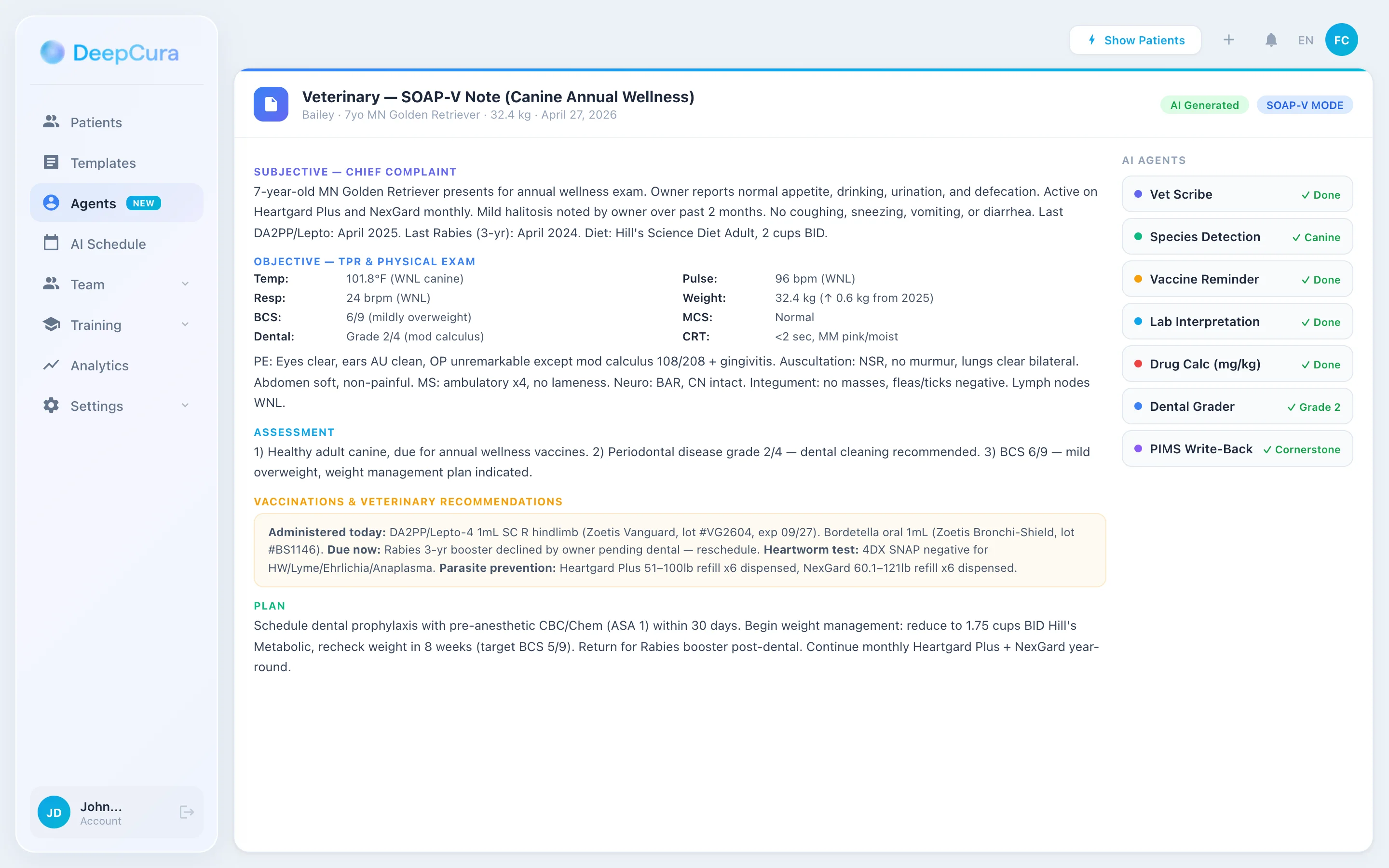
For veterinarians, the key differentiator is template flexibility. DeepCura's custom template builder lets practice owners encode species-stratified workflows — a canine annual wellness template with DA2PP/Rabies vaccine slots, BCS 1-9 picker, dental grade 0-4 capture, and NexGard refill tracking can coexist with a feline senior wellness template that swaps in FVRCP, blood pressure, and thyroid screening. CDS Mode, when activated, generates differential diagnosis alongside the note — useful for ambiguous presentations like the chronic vomiter (renal vs IBD vs lymphoma vs hepatic disease vs pancreatitis vs hyperthyroidism in cats vs dietary indiscretion in dogs) where the workup logic is non-obvious.
DeepEvidentia — DeepCura's evidence search engine — pulls from PubMed, VeterinaryPartner.com, AAHA guidelines, and ACVIM consensus statements when queried about species-specific dosing and protocols. "Maropitant dose for feline post-anesthetic nausea" returns the published 1 mg/kg SC range with citations. "ISFM consensus on feline diabetic remission protocols" surfaces the Sparkes et al. consensus paper.
Strengths:
- Custom template builder for species-stratified workflows (canine, feline, equine, exotic)
- CDS Mode with differential diagnoses for ambiguous presentations (3 credits per note)
- DeepEvidentia evidence search (PubMed, AAHA, ACVIM, ISFM access)
- AI receptionist for after-hours emergency triage and appointment booking — particularly valuable for solo practitioners and rural mixed-animal practices
- Multiple AI engines matched to encounter complexity (1-15 credits)
- Custom SOAP-V templates with vaccine, parasiticide, dental, and anesthesia modules
- Bidirectional integration via custom field mapping (works with most modern PIMS via FHIR-style integration where supported)
- 1,000 credits/mo across all AI agents (1 credit per standard note)
Limitations:
- Custom template builder requires initial setup time (4-8 hours for a multi-doctor practice to encode templates per species)
- Native write-back exists for human EHRs (athenahealth, eClinicalWorks, AdvancedMD, OptiMantra, Epic, DrChrono, CharmHealth, and Cerner) — vet PIMS like Cornerstone and AVImark require custom field mapping at onboarding
- CDS Mode trained primarily on human medicine literature — vet-specific differentials require validation by the practitioner
Pricing: $129/month per provider — all features included. Free trial available, no credit card required.
Verdict: DeepCura is the strongest choice for veterinary practices that want one platform to handle scribing, after-hours phone triage (AI receptionist), evidence search, and customizable per-species templates. The flexibility cost is upfront setup time, but for multi-doctor practices and emergency hospitals where the front desk is the bottleneck, DeepCura's combined scribe + receptionist value is differentiated in the vet market.
DeepCura: Customizable AI Scribe for Veterinary Practice
Per-species templates, AI receptionist for after-hours triage, evidence search, and PIMS integration — $129/mo · 1,000 credits/mo (1 credit per standard note). Start your free trial.
+1 (415) 549-1829Available 24/7 · Set up in seconds · No credit card required
2. Scribenote — Best Purpose-Built Vet AI Scribe
Scribenote is the only AI medical scribe in this comparison, to our knowledge, built from day one for veterinary medicine. The product team comes from veterinary backgrounds, the templates ship pre-loaded with canine, feline, equine, and exotic workflows, and the integrations target the vet PIMS ecosystem (Cornerstone, AVImark, ezyVet) directly rather than as an afterthought.
For solo vets and small clinics that want a working SOAP-V tool out of the box without configuration time, Scribenote is the path of least resistance. The ambient capture handles common appointment types — wellness, sick visit, dental consult, surgical recheck, euthanasia — and produces structured notes with vaccine and parasiticide sections pre-filled. Scribenote's vet-specific terminology training means the AI recognizes "DA2PP," "FVRCP," "NexGard Plus," "12-week-old MN canine," "Triadan 108 extraction" without retraining or template engineering.
The tradeoff is depth. Scribenote is a documentation tool — there is no clinical decision support, no evidence search, no AI receptionist, no fax automation, and no multi-modal capability beyond ambient capture. For practices that need an end-to-end clinical AI platform, Scribenote covers one workflow well rather than the full clinic operation.
Pricing: Custom/quoted pricing — verify directly with Scribenote.
Verdict: Best choice for solo vets and small clinics that want vet-native templates with zero configuration time and don't need CDS, evidence search, or receptionist features. The documentation quality is strong out of the box — practitioners pay a premium relative to general-purpose scribes for the vet-specific experience.
3. Heidi Health — Best for International Vet Practices
Heidi Health added veterinary support in 2025 as part of an international expansion that includes Australia, the UK, and Canada. The product was originally human-medicine focused but adapted templates to include canine and feline wellness, sick visit, and dental workflows. Heidi has stronger product traction in Australia, New Zealand, and the UK than in North America, and its vet templates reflect that — UK MRCVS and Australian AVA conventions are well-supported, while AAHA-aligned templates in the US market are less mature.
Heidi captures encounters via ambient listening with a usable free tier (limited notes per month) before paid plans kick in at the Pro level. The interface is clean and the learning curve is short. For international vet practitioners or US practices comfortable with adapting templates from a base that wasn't designed around AAHA standards, Heidi is a credible mid-tier option.
PIMS integration is limited — Heidi pushes notes into the chart via clipboard or email rather than direct API write-back to Cornerstone or AVImark. The product team has indicated more native integrations on the roadmap, but as of early 2026, US vets should plan on copy-paste workflow.
Pricing: Free tier (limited notes); Clinician plan $150/user/month billed yearly (higher month-to-month); enterprise tier higher.
Verdict: Best for international vet practices already using or considering Heidi for their human-side telehealth or where MRCVS/AVA documentation conventions matter more than AAHA standards. US practices should weigh the limited PIMS write-back against more vet-native options. For an in-depth review, read our Heidi Health review.
4. Talkatoo — Best Vet Dictation Incumbent
Talkatoo is not an AI scribe in the ambient-listening sense — it is a voice-to-text dictation platform with vet-specific command shortcuts and broad multi-PIMS push compatibility. It has been the de facto incumbent for vet voice documentation for years, particularly at corporate consolidator hospitals (in the corporate veterinary segment) where IT teams standardized on it before ambient AI scribes were viable.
For practitioners who prefer dictation over passive ambient capture — many large-animal vets, surgery-heavy practices, and equine ambulatory vets fall into this group — Talkatoo's vet shortcuts ("dot phrases" expanding "ddx canine cushings" into a full differential block) are well-tuned. It also avoids the privacy concerns some clients raise with ambient recording in the exam room since the practitioner controls when to dictate.
The limitation is that Talkatoo is dictation, not generation. The vet still authors the note structure — Talkatoo speeds up typing, it does not synthesize a complete SOAP-V from the appointment conversation. For practices wanting full ambient generation, Talkatoo is not in the same product category.
Pricing: Custom/quoted pricing — verify directly with Talkatoo.
Verdict: Best for practitioners who prefer dictation workflow (large animal, equine ambulatory, surgical specialty) and value broad PIMS push compatibility over ambient generation. Practices on Cornerstone or AVImark with established Talkatoo workflows often keep it as a dictation backbone even after adopting an ambient scribe like DeepCura or Scribenote for routine appointments.
5. Freed AI — Simplest Ambient Scribe Without Vet Templates
Freed AI is a clean, fast ambient scribe for human medicine with a low learning curve and a tiered free-to-Premier pricing structure. Solo vets sometimes adopt Freed because the price is accessible ($39–$119/month) and the ambient experience is good, but Freed has no vet-specific templates, no species-aware normal ranges, and no PIMS integration in the vet ecosystem — all integrations target human EHRs.
Practical effect: Freed transcribes the appointment, generates a SOAP note structured for human medicine (with no vaccine, parasiticide, or dental modules), and the vet then re-formats it into the PIMS manually. The time savings exist but are smaller than with a vet-native or vet-customizable tool. In our internal testing during the evaluation period, Freed transcribed several veterinary-specific drug names and vaccine series imprecisely, requiring cleanup.
Pricing: $39/month (Starter, 40 notes), $79/month (Core, unlimited), $119/month (Premier, unlimited + EHR push + ICD-10; $104 billed annually).
Verdict: Adequate as a stopgap for solo vets testing the ambient AI scribe category before committing to a vet-native or vet-customizable tool. Not recommended as a long-term primary scribe for veterinary practice — the human-medicine bias creates rework. Read our Freed AI review.
6. DeepScribe — Customizable Templates for Vet Adaptation
DeepScribe offers ambient AI documentation with a customizable template engine that some vet practices have adapted for veterinary workflows. Like Freed, DeepScribe was built for human medicine, but its template flexibility is greater — practice managers can build canine, feline, and equine templates with appropriate field structures, and the AI will populate them from the ambient capture.
The adaptation is functional but not vet-native. The underlying language model is trained on human-medicine corpora, so vet-specific terminology (Triadan numbering, ASA E modifier, ISFM staging) requires custom prompt engineering or post-edit corrections. PIMS integration is limited compared to vet-native tools.
Pricing: Custom/quoted pricing — verify directly with DeepScribe.
Verdict: Solid mid-range option for vet practices comfortable with template engineering effort and willing to validate AI output for species-stratified content. Less out-of-box than Scribenote, more customizable than Freed. Read our DeepScribe review.
Head-to-Head — Veterinary Documentation Features
| Feature | DeepCura | Scribenote | Heidi | Talkatoo | Freed | DeepScribe |
|---|---|---|---|---|---|---|
| Ambient Listening | ✓ | ✓ | ✓ | Dictation | ✓ | ✓ |
| Vet-Native Templates | Custom build | ✓ (out of box) | Partial | Dot-phrases | ✗ | Custom build |
| Species-Stratified Normals | Custom | ✓ | Partial | Manual | ✗ | Custom |
| Vaccine Module (DA2PP/FVRCP) | Custom | ✓ | Partial | Dot-phrases | ✗ | Custom |
| Parasiticide Tracking | Custom | ✓ | Partial | Manual | ✗ | Custom |
| Dental Grade 0-4 + Triadan | Custom | ✓ | Limited | Dot-phrases | ✗ | Custom |
| Anesthesia Records (ASA 1-5) | Custom | ✓ | Limited | Dot-phrases | ✗ | Custom |
| Controlled Drug Logging | Custom | Partial | ✗ | Manual | ✗ | Custom |
| CVI / APHIS Forms | Custom | Partial | ✗ | Dot-phrases | ✗ | Custom |
| Clinical Decision Support | ✓ (differentials) | ✗ | ✗ | ✗ | ✗ | ✗ |
| Evidence Search | ✓ (DeepEvidentia) | ✗ | ✗ | ✗ | ✗ | ✗ |
| AI Receptionist (after-hours) | ✓ | ✗ | ✗ | ✗ | ✗ | ✗ |
| PIMS Bidirectional | Custom | Cornerstone/AVImark/ezyVet | Limited | Multi-PIMS push | Browser-based EHR push | Limited |
| Price | $129/mo | Custom/quoted pricing — verify directly with Scribenote | Free / $150/mo (billed yearly) | Custom/quoted pricing — verify directly with Talkatoo | $39–$119/mo | Custom/quoted pricing — verify directly with DeepScribe |
Veterinary Documentation Workflow with DeepCura
DeepCura's tiered credit system lets veterinarians match AI resources to encounter complexity — fast for routine wellness, deeper for complex sick visits and surgery.
Wellness Visit (1 Credit) — Annual Exam, Vaccine Boosters, Refills
For routine annual wellness in a healthy adult patient — TPR, BCS/MCS, full physical exam, DA2PP/Rabies booster, NexGard Plus refill, fecal float — the 1-credit model generates a SOAP-V in under 30 seconds. Speed-optimized for the high-volume wellness day where a 4-doctor practice may run 60+ wellness appointments. No CDS overhead for encounters where the diagnosis is "healthy adult, recheck in 12 months."
Sick Visit with Workup (3 Credits CDS) — Chronic Vomiting, Polyuria/Polydipsia, Lameness
For sick visit presentations that require a differential workup — chronic vomiting (renal vs IBD vs lymphoma vs hepatic vs pancreatitis vs hyperthyroidism in cats vs dietary in dogs), PU/PD (diabetes vs CKD vs Cushing's vs psychogenic vs primary renal vs hyperthyroidism), suspected CCL rupture, ear effusion in a feline — CDS Mode activates differential diagnosis generation. The AI flags critical "rule-outs" like feline lymphoma in any cat over 8 with chronic GI signs, and structures the recommended workup (CBC/Chem/T4/UA/abdominal ultrasound) into the plan.
Surgical and Emergency (15 Credits) — Mass Removal, Foreign Body, GDV, C-Section
For surgical encounters and emergencies — mass removal with histopath, GI foreign body laparotomy, GDV (gastric dilatation-volvulus) decompression and gastropexy, dystocia C-section, splenectomy for splenic mass, urethral obstruction in a male cat — the maximum-depth model produces full operative reports with anesthesia records (ASA classification, premedication, induction, maintenance, monitoring values, recovery time, complications), surgical narrative, and discharge instructions in one pass.
Match AI to Encounter Acuity
1 credit for wellness, 3 credits for CDS differentials on sick visits, 15 credits for surgery and emergency — DeepCura scales documentation depth to match clinical complexity. Start your free trial.
+1 (415) 549-1829Available 24/7 · Set up in seconds · No credit card required
Clinical Decision Support and Evidence Search for Vets
CDS Mode outputs are documentation-aid suggestions for clinician review. They are not diagnostic or treatment recommendations. The veterinarian retains full responsibility for differential diagnosis, workup, and treatment decisions. DeepCura is not an FDA- or USDA-regulated medical device.
CDS Mode — Differentials for Ambiguous Presentations
Veterinary medicine is full of ambiguous presentations where the differential is broad and the workup logic is non-obvious. The chronic vomiter cat. The PU/PD dog. The acutely lame young large-breed dog. The senior cat with weight loss and a normal physical. CDS Mode activates differential diagnosis generation alongside the SOAP-V — flagging high-yield rule-outs and suggesting the appropriate diagnostic plan.
For a 12-year-old MN domestic shorthair presenting with chronic vomiting and weight loss, CDS Mode flags: feline GI lymphoma (high prior in this signalment), IBD, CKD with uremic gastritis, hyperthyroidism, hepatic lipidosis if anorexia is recent, chronic pancreatitis, and rules out triaditis as a co-presentation pattern. The recommended workup (CBC/Chem/T4/fPLI/UA/abdominal ultrasound +/- endoscopic biopsy) flows into the plan section, and the documented differential becomes part of the chart — useful both clinically and for state board record completeness.
As of our February-April 2026 evaluation, none of the competitors we reviewed advertised an integrated differential-diagnosis CDS layer comparable to DeepCura's CDS Mode. Scribenote, Heidi, Talkatoo, Freed, and DeepScribe are marketed primarily as ambient documentation tools. DeepCura adds the clinical reasoning layer.
DeepEvidentia — Evidence at the Bedside
DeepEvidentia provides real-time access to PubMed, ACVIM consensus statements, AAHA guidelines, ISFM (International Society of Feline Medicine) protocols, and FDA/EMA drug labels directly within the documentation workflow.
Example queries veterinarians actually ask:
- "Maropitant dosing for feline post-anesthetic nausea" — returns 1 mg/kg SC with published citation
- "ACVIM consensus on canine chronic enteropathy" — surfaces Cerquetella et al. with the diagnostic algorithm
- "ISFM CKD-IRIS staging in cats" — returns the IRIS stages 1-4 with substaging on proteinuria and blood pressure
- "AAFP retroviral testing recommendations" — surfaces the AAFP/AAHA Feline Retrovirus Management Guidelines
- "Toceranib (Palladia) dose adjustment for canine MCT" — returns label dose with toxicity grading
For exotic medicine and emergency cases, evidence access at the bedside transforms documentation time into clinical reasoning time — the difference between an AI that types what you said and an AI that helps you think.
Pricing Comparison
| Tool | Monthly | Notes included | CDS | Best Plan |
|---|---|---|---|---|
| DeepCura | $129/mo | Up to ~1,000 standard notes/mo (credits) | ✓ (CDS Mode: 3 credits/note) | Single plan, all features |
| Scribenote | Custom/quoted pricing — verify directly with Scribenote | Unlimited | ✗ | Vet-specific tier |
| Heidi Health | Free / $150/mo (billed yearly) | Free tier limited | ✗ | Free or Clinician |
| Talkatoo | Custom/quoted pricing — verify directly with Talkatoo | Unlimited dictation | ✗ | Standard with PIMS push |
| Freed AI | $39–$119/mo | 40-unlimited | ✗ | Core ($79) or Premier ($119; $104 billed annually) |
| DeepScribe | Custom/quoted pricing — verify directly with DeepScribe | Unlimited | ✗ | Standard plan |
See DeepCura in Action
Watch how DeepCura handles the full clinical workflow — ambient SOAP generation, CDS differentials, evidence search, AI receptionist for after-hours emergency triage, and PIMS write-back.

Frequently Asked Questions
What is the best AI scribe for veterinarians?
DeepCura is the strongest cross-functional choice for veterinary practices that want one platform handling scribing, AI receptionist for after-hours emergency triage, clinical decision support, and customizable per-species templates. For practices that want vet-native templates out of the box with zero setup time and no need for CDS or receptionist features, Scribenote is the leading purpose-built vet AI scribe. The right answer depends on whether the practice wants breadth (DeepCura) or vet-native depth (Scribenote).
Do AI scribes handle SOAP-V format and species-stratified workflows?
Vet-native tools (Scribenote) ship with SOAP-V templates, canine and feline normal ranges, vaccine modules (DA2PP, FVRCP, Rabies), and parasiticide tracking pre-loaded. Customizable platforms (DeepCura, DeepScribe) support SOAP-V via custom template builders — practice managers encode the template once at onboarding, then the AI follows it for every appointment. Human-medicine-only tools (Freed, generic ambient scribes) do not natively support SOAP-V and require manual reformatting.
Can AI scribes document controlled drug administration for DEA compliance?
Partially. No AI scribe in this comparison auto-generates a DEA-compliant log file (21 CFR 1304 format). The best tools — DeepCura with custom controlled drug fields, and Scribenote with partial support — capture controlled administration in the medical record and flag it for export. Practice managers still typically reconcile against the PIMS native controlled-substance log module or paper logs at month-end. State board inspections look at both the chart and the dedicated log; the AI's job is to ensure the chart entry is complete and contemporaneous.
Do AI scribes integrate with veterinary PIMS like Cornerstone, AVImark, ezyVet, and IDEXX Neo?
Vet-native tools have direct integration to the major PIMS — Scribenote integrates with Cornerstone, AVImark, and ezyVet; Talkatoo offers broad multi-PIMS push compatibility via voice-to-PIMS workflow. DeepCura uses a flexible custom field-mapping integration that works with most modern PIMS through their available APIs (where exposed). Freed and DeepScribe target human EHRs and require copy-paste into vet PIMS.
Are AI scribes accurate with veterinary terminology like Triadan numbering, BCS, and parasiticide brand names?
Vet-native tools (Scribenote) train on veterinary corpora and recognize Triadan numbers (108, 208, 304, etc.), BCS 1-9, MCS feline-specific scoring, ASA classification 1-5 with E modifier, and parasiticide brand names (NexGard, Bravecto, Heartgard, Simparica, Revolution) without retraining. General tools require either custom prompt engineering (DeepCura, DeepScribe) or accept transcription errors on vet-specific terms (Freed). Verify accuracy during your trial period using a representative mix of canine, feline, and exotic appointments.
Can AI scribes generate USDA APHIS CVIs and international health certificates?
No AI scribe auto-generates a signed USDA APHIS Form 7001 — these are accredited-veterinarian regulatory forms that require physical signature and submission through APHIS VEHCS or paper. The AI's role is to populate the underlying physical exam, microchip, vaccine, and parasite treatment data into the chart so the accredited vet can complete the certificate efficiently. DeepCura's custom templates can include CVI prep fields (microchip, rabies certificate number, parasite treatment date, attestation) that flow into the form-prep workflow.
How much do AI scribes for veterinarians cost?
Pricing ranges from a free Heidi tier through enterprise. Talkatoo (vet dictation, not full AI scribe) is custom/quoted pricing — verify directly with Talkatoo. Freed starts at $39/month. DeepScribe is custom/quoted pricing — verify directly with DeepScribe. DeepCura is $129/month with 1,000 credits a month (1 credit per standard note), CDS, evidence search, AI receptionist, and customizable templates. Scribenote, the vet-native option, is custom/quoted pricing — verify directly with Scribenote. For most independent vet practices, the available price ranges offer different feature-to-cost ratios depending on whether vet-native templates or cross-functional capability is the priority.
Do clients object to ambient AI recording in the exam room?
Some clients raise concerns, particularly in equine and large-animal contexts where the practitioner is in the client's home or barn. Practical mitigations: post a brief notice in the exam room explaining that ambient AI documentation is used to improve note quality, default to consent-on-record for new clients, and offer an opt-out workflow that falls back to dictation (Talkatoo) or manual SOAP-V entry. AAHA-accredited practices should align their recording practices with their client communication policy.
Final Verdict
For veterinarians and vet practice owners, the choice comes down to three profiles:
Best overall: DeepCura at $129/month — customizable per-species templates, CDS differentials, evidence search via DeepEvidentia, AI receptionist for after-hours emergency triage, and 1,000 credits a month (1 credit per standard note). The strongest choice for multi-doctor practices, emergency hospitals, and rural mixed-animal practices where the front desk is the bottleneck and one platform handling scribe + receptionist + CDS delivers more value than a vet-only documentation tool.
Best vet-native: Scribenote at custom/quoted pricing — verify directly with Scribenote — purpose-built for veterinary medicine with canine, feline, and equine templates pre-loaded. The path of least resistance for solo vets and small clinics that want zero setup time and don't need CDS, evidence search, or receptionist features. Documentation quality is strong out of the box.
Best dictation backbone: Talkatoo at custom/quoted pricing — verify directly with Talkatoo — vet-specific voice-to-text with broad PIMS push compatibility. Best for practitioners who prefer dictation workflow (large animal, equine ambulatory, surgical specialty) and value control over passive ambient capture. Many practices keep Talkatoo as a dictation backbone alongside a primary ambient scribe.
For a broader cross-specialty comparison, see our Best AI Medical Scribes in 2026 ranking. For practices that need after-hours phone automation alongside documentation, see our Best AI Medical Receptionist guide. For clinical AI chat tools that support diagnostic reasoning across species, see Best ChatGPT for Doctors. For mental and behavioral health workflows in adjacent practice areas, see our best AI scribe for psychiatry guide. For free copy-paste clinical note templates, see our SOAP note template guide and our biopsychosocial assessment reference. If you are evaluating EMRs alongside the scribe decision, see our best EMR for small practices ranking.
References
[1] American Veterinary Medical Association, "AVMA Workplace Wellbeing Study," AVMA. avma.org/resources-tools/wellbeing
[2] Tomasi SE, Fechter-Leggett ED, Edwards NT, Reddish AD, Crosby AE, Nett RJ, "Suicide among veterinarians in the United States from 1979 through 2015," Journal of the American Veterinary Medical Association, 254(1), 104-112, 2019. avmajournals.avma.org/view/journals/javma/254/1/javma.254.1.104.xml
[3] American Animal Hospital Association, "AAHA Standards of Accreditation," AAHA. aaha.org/standards
[4] U.S. Drug Enforcement Administration, "21 CFR 1304 — Records and Reports of Registrants," DEA Diversion Control Division. deadiversion.usdoj.gov/21cfr/cfr/1304/1304_03.htm
[5] U.S. Department of Agriculture, Animal and Plant Health Inspection Service, "National Veterinary Accreditation Program — APHIS Form 7001 Certificate of Veterinary Inspection," USDA APHIS. aphis.usda.gov/aphis/ourfocus/animalhealth/nvap
[6] American College of Veterinary Anesthesia and Analgesia, "ASA Physical Status Classification System for Veterinary Patients," ACVAA. acvaa.org
[7] American Animal Hospital Association, "AAHA Dental Care Guidelines for Dogs and Cats," AAHA. aaha.org/aaha-guidelines/dental-care
[8] American Association of Feline Practitioners, "AAFP / AAHA Feline Retrovirus Management Guidelines," AAFP. catvets.com/guidelines
[9] American College of Veterinary Internal Medicine, "ACVIM Consensus Statements," ACVIM. acvim.org
[10] International Renal Interest Society, "IRIS Staging of CKD," IRIS Kidney. iris-kidney.com/guidelines
[11] American Veterinary Medical Association, "AVMA Guidelines for the Euthanasia of Animals (2020 Edition)," AVMA. avma.org/resources-tools/avma-policies/avma-guidelines-euthanasia-animals
[12] DeepCura, "AI Medical Scribe Platform — Ambient Scribing, CDS, AI Receptionist, EHR Integration," DeepCura.com. deepcura.com