
Native API integration. AI patient synopsis. Scribe It automation. Multiplayer charting. Four layers of eClinicalWorks integration, built from 2+ years of production API development and thousands of real patient encounters.
DeepCura is the only AI scribe with a native eClinicalWorks native API integration — pushing allergies, medications, diagnoses, lab orders, and immunizations directly into the chart with zero copy-paste. But we did not stop there. After building the deepest FHIR integration on the market, we discovered that eCW's API has structural limitations for clinical notes — it cannot push vitals, treatment plans linked to specific diagnoses, or billing codes. So we built something no other AI scribe has: a proprietary AI Scribe It Engine with 3 specialized agents that converts your note into eCW's native Scribe It format with validated ICD-10 codes from your own code library.
The result:
- Before the visit — AI synopsis extracts and organizes the patient's entire clinical history by diagnosis
- During the visit — ambient AI scribe captures the encounter and generates the note
- After the visit — 3 AI agents format the note for Scribe It import (ICD codes, billing, orders), while the native API handles structured data (allergies, meds, labs, immunizations)
- Across the team — MAs pre-chart on the physician's schedule, physicians pick up seamlessly
If you are searching for the best AI scribe for eClinicalWorks, this guide covers how each layer works, what we learned building a production native API integration, and why we built a proprietary Scribe It engine to handle what the API cannot.
This guide was last updated in April 2026 with the AI Scribe It Engine (3 AI agents for native eCW import), enhanced AI synopsis, and multiplayer team scheduling. All technical claims are based on DeepCura's production eClinicalWorks integration. Pricing reflects current publicly available information.
Watch: Full eClinicalWorks Integration Demo
See the AI Scribe It Engine, AI synopsis, and native API write-back working inside an eClinicalWorks encounter — from pre-chart through final import — in under 10 minutes.
AI Pre-Chart Synopsis — The Full Patient Story, Instantly
Most AI scribes help you after the encounter. DeepCura helps you before it starts — and this is the feature that changes how you practice.
When you click Import Patient Chart from the calendar, DeepCura pulls the patient's full Consolidated Clinical Document (clinical record) from eClinicalWorks — every encounter, every diagnosis, every medication change, every lab result — and generates a longitudinal patient synopsis organized the way physicians actually think: by diagnosis, not by visit date.
No other AI scribe does this. Here is why it matters.
What the Synopsis Looks Like
Here is an actual synopsis generated from a real eClinicalWorks patient with 19 encounters across 10 active diagnoses:
Jane Doe, 58-year-old Female
First seen: 03/15/2024 Last seen: 02/10/2026
Last Visit Summary — 02/10/2026
Mrs. Doe presented for routine follow-up of hypertension, type 2 diabetes, and hyperlipidemia. BP 126/78 — well controlled on lisinopril 20 mg and HCTZ 12.5 mg. HbA1c 6.7% (down from 7.4% at diagnosis) on metformin 500 mg BID. LDL 86 on atorvastatin 20 mg. All chronic conditions at goal. Plan: continue current regimen unchanged. Ordered annual metabolic panel and lipid panel. Reinforced low-sodium diet, carbohydrate tracking, and daily walking. Next follow-up in 6 months. Annual diabetic eye exam due — referral placed.
1. Essential hypertension (I10)
Mrs. Doe initially presented on 03/15/2024 with elevated blood pressure readings averaging 152/94 mmHg over the prior 3 months, confirmed by home monitoring. Lisinopril 10 mg daily was initiated. By 06/20/2024, BP had improved to 138/88 but remained above goal. Lisinopril was increased to 20 mg daily and hydrochlorothiazide 12.5 mg was added. By 10/15/2024, readings consistently below 130/80 on the combination regimen. Most recent visit (02/10/2026) confirmed sustained control at 126/78. Current plan: continue lisinopril 20 mg daily and HCTZ 12.5 mg daily; annual metabolic panel; reinforce low-sodium diet and daily walking.
2. Type 2 diabetes mellitus without complications (E11.9)
Diagnosed on 03/15/2024 with HbA1c of 7.4%. Metformin 500 mg twice daily was initiated along with dietary counseling. By 09/12/2024, HbA1c improved to 6.9% with good medication adherence. Metformin was maintained at 500 mg twice daily. Repeat labs on 01/22/2026 showed HbA1c of 6.7% — well controlled. Patient reports consistent carbohydrate tracking and 30-minute daily walks. Current plan: continue metformin 500 mg BID; HbA1c every 6 months; annual diabetic eye exam; foot exam at each visit.
3. Hyperlipidemia (E78.5)
Lipid panel on 03/15/2024 revealed total cholesterol 248, LDL 162, HDL 42, triglycerides 198. Atorvastatin 20 mg daily was started. Follow-up labs on 09/12/2024 showed improvement — LDL 98, triglycerides 148. By 01/22/2026, LDL down to 86 and triglycerides 132 on stable dose. Patient tolerating medication well with no myalgia or liver enzyme elevation. Current plan: continue atorvastatin 20 mg daily; annual lipid panel; dietary counseling to maintain HDL improvement.
[...continues for all 7 active diagnoses, followed by Past Medical History, Past Surgical History, Current Medications table, and Allergies]
This is how physicians think about patients. Not "what happened on visit #7" but "what is the full story of this patient's diabetes, and where are we in the treatment plan?" The synopsis makes every follow-up visit feel like you have been seeing the patient for years — even if it is your first time.
What Powers the Synopsis
The synopsis is not a simple text summary. DeepCura's clinical data parser extracts and deduplicates 14 clinical sections from the eClinicalWorks clinical record document:
- Problems — active diagnoses with ICD-10 codes and onset dates
- Encounter Assessments — the per-encounter clinical narrative (deduplicated — eCW duplicates the same note across every diagnosis in a visit, inflating the document 3-6x; our parser compresses it back down)
- H&P Notes — history of present illness narratives per visit
- Progress Notes — physical exam findings per visit
- Medications, Allergies, Immunizations, Social History, Procedures, Plan of Treatment — complete longitudinal record
The AI then threads each diagnosis across encounters chronologically — synthesizing months or years of clinical history into the narrative format physicians use when discussing patients with colleagues.
Automatic Patient Data Import
When you start an encounter from the calendar, DeepCura automatically imports the patient's date of birth, email address, and phone number from the eCW patient data. DOB is displayed on the schedule card to help distinguish patients with similar names. Previously, this data required manual entry — now it flows automatically from eClinicalWorks the moment you click Start AI Scribe.
The AI Scribe It Engine — Why We Built It and How It Works
This section tells the full story — including what did not work. We think transparency about engineering decisions builds more trust than pretending everything was seamless.
The FHIR API: What It Does Well and Where It Falls Short
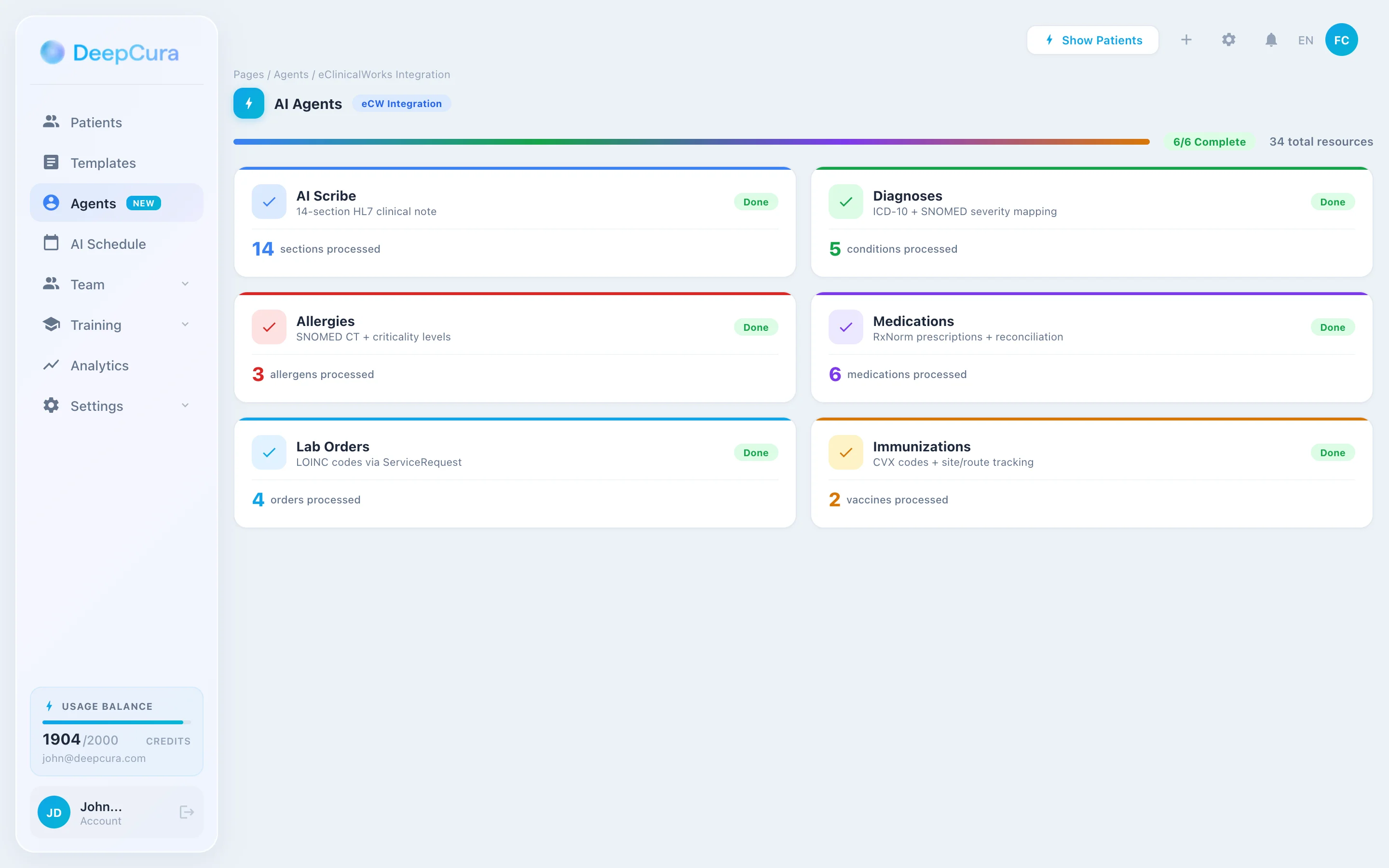
DeepCura has a production native API integration with eClinicalWorks — over 2,000 lines of dedicated code covering 7 resource types. We are grateful to the eCW FHIR team for developing and supporting this API. For structured data, the native API works well:
- Allergies — SNOMED CT-coded allergens with criticality levels write to the allergy section reliably
- Medications — RxNorm-coded prescriptions (MedicationRequest) and reconciliation (MedicationStatement) flow through correctly
- Lab and imaging orders — LOINC-coded ServiceRequests with clinical justification push cleanly
- Immunizations — CVX codes with site, route, dose, and lot tracking import accurately
- Problems and diagnoses — ICD-10 + SNOMED severity write to the problem list
These are real, valuable automations that eliminate clicks every day. We still use the native API for all of these workflows, and they work on day one after connecting.
But the native API has structural limitations for the data clinicians need most — the clinical note itself and the clinical workflows built around it:
- No vitals push — vital signs captured during the encounter cannot be written back through the API
- No assessment-to-treatment-note linkage — the native API cannot create per-diagnosis Treatment Note objects, which is how eCW links care plans to specific diagnoses for billing, follow-up, and patient portal visibility
- No billing code automation — E&M codes and CPT procedure codes cannot be pushed through the API
- No order-to-diagnosis linkage — lab orders pushed via FHIR are not linked to their justifying diagnosis, which matters for insurance pre-authorization
In practice, 100% of our eClinicalWorks customers told us the same thing: the native API handles the "easy" data well, but it cannot push the critical clinical workflow data — the treatment plans, billing codes, and order linkages that drive downstream revenue and compliance.
We needed a different approach.
The Solution: eCW's Native Scribe It Parser
eClinicalWorks has a powerful built-in feature called Scribe It — a line-based text parser in the progress note editor. When a provider pastes formatted text with specific trigger patterns, Scribe It recognizes each pattern and auto-imports the content into the correct eCW fields: Assessment, Treatment Notes, Orders, Billing codes, and more.
Scribe It can do things the native API cannot:
- Create per-diagnosis Treatment Note objects linked to specific ICD-10 codes
- Push E&M and CPT billing codes directly
- Create order-to-diagnosis linkages for insurance pre-authorization
- Import structured data into the exact eCW fields the provider's workflow expects
The challenge: Scribe It is extremely precise. The ICD-10 code descriptors must match eCW's internal database exactly — character for character. A single word difference causes a silent import failure. And the colon character is eCW's parser delimiter, so stray colons in clinical text shift content into wrong sections.
No human can reliably format a clinical note to meet these requirements. But an AI system with access to the right databases can.
3 AI Agents, Running in Parallel
DeepCura's AI Scribe It Engine uses 3 specialized AI agents that run in parallel to convert your finalized clinical note into production-ready Scribe It format:
Agent 1: Clinical Data Normalizer
This agent takes your finalized encounter note — the 14-section clinical document generated by DeepCura's AI Scribe — and restructures it into eCW Scribe It syntax. It maps each clinical section to the correct Scribe It trigger pattern:
- Assessment findings become
ICDtrigger lines with per-diagnosis Treatment Notes - Care plans become
Treatment notes:blocks linked to each diagnosis (external, patient-visible in the eCW portal) - Internal clinical reasoning becomes
Clinical Notes:blocks (provider-only, not patient-visible) - Follow-up scheduling becomes
Next Appointment:triggers
The agent also runs a post-processing colon sanitizer — scanning all clinical text for stray colons that would break eCW's parser and stripping them before output. This single step prevents an entire class of silent import failures.
Agent 2: ICD-10 Code Resolver
This agent solves the #1 Scribe It failure mode: ICD-10 descriptor mismatches.
eCW Scribe It validates every ICD-10 code against the provider's internal database. If the description does not match exactly — even a single word difference — the import silently fails. The AI writes "Type 2 diabetes" but eCW expects "Type 2 diabetes mellitus without complications," and the diagnosis disappears without any error message.
Our ICD-10 agent cross-references every code against the official medical code database AND the provider's own imported code library. When we analyzed real EBO data from eClinicalWorks practices, we found that 51% of ICD-10 codes had different descriptions for the same code across different providers within the same practice. The agent knows which version YOUR eCW instance uses and matches it exactly.
You can import your own codes in seconds — upload your EBO report (the spreadsheet your practice already has), select your name from the provider list, and the system deduplicates and stores your exact code descriptions. From that point on, every Scribe It conversion uses your codes, not generic ones.
Agent 3: CPT/E&M Code Resolver
The billing agent determines the appropriate E&M service code (99213, 99214, 99215, etc.) based on encounter complexity, and identifies any CPT procedure codes mentioned during the visit. Each code is formatted as an Add EM or Add CPT trigger line for Scribe It import.
When the provider has imported their code library, the agent validates CPT codes against it. When they have not, it uses standard AMA CPT guidelines.
All three agents run in parallel using streaming server-sent events (SSE), so the Scribe It output appears in real-time as each agent completes its work.
Import Your Own ICD-10 Codes from Your EBO Report
One of the most powerful features of the Scribe It Engine is the ability to import your own ICD-10 code library directly from your eClinicalWorks Business Optimizer (EBO) report — the XLSX file your practice receives from insurance payers.
Here is what happens when you upload an EBO file:
- Auto-detection — the parser scans the spreadsheet and identifies every provider listed in the file (we have seen single EBO files with 66+ providers from a multi-provider practice)
- Provider selection — you select your name from the detected list, and the system filters to only your codes
- Deduplication — when the same ICD-10 code appears with different descriptions across payers (51% of codes in our analysis), the system keeps the description with the highest usage count for your specific provider
- Library creation — your personal code library is stored in DynamoDB, and Agent 2 checks it on every Scribe It generation
This means the ICD-10 descriptors in your Scribe It output will match exactly what your eCW instance expects — because they came from your own billing data. No more silent import failures from descriptor mismatches.
Per-Diagnosis Linked Objects (Not a Text Blob)
Most AI scribes that support any form of eCW integration dump the entire note into a single text field. DeepCura's Scribe It Engine uses a per-diagnosis trigger pattern that creates separate linked objects in eCW for each diagnosis:
Each Treatment notes: trigger repeats before each ICD line, creating a separate Treatment Note object linked to that specific diagnosis. Click on "Otitis media" in the eCW problem list and you see only its treatment note. Click on "Dermatitis" and you see only that one. This is how eCW is designed to work — per-diagnosis linkage that supports billing audits, follow-up visits, and patient portal visibility.
The engine also handles the distinction between Treatment Notes (external, patient-visible in the portal) and Clinical Notes (internal, provider-only) — routing care plans to the patient-facing field and sensitive clinical reasoning to the provider-only field.
Native API Structured Data Automation
While the AI Scribe It Engine handles clinical notes and billing, DeepCura's native API integration handles structured data types where the API excels. These features work instantly on day one after connecting your eCW account — no Scribe It formatting needed.
Problem and Diagnosis Management
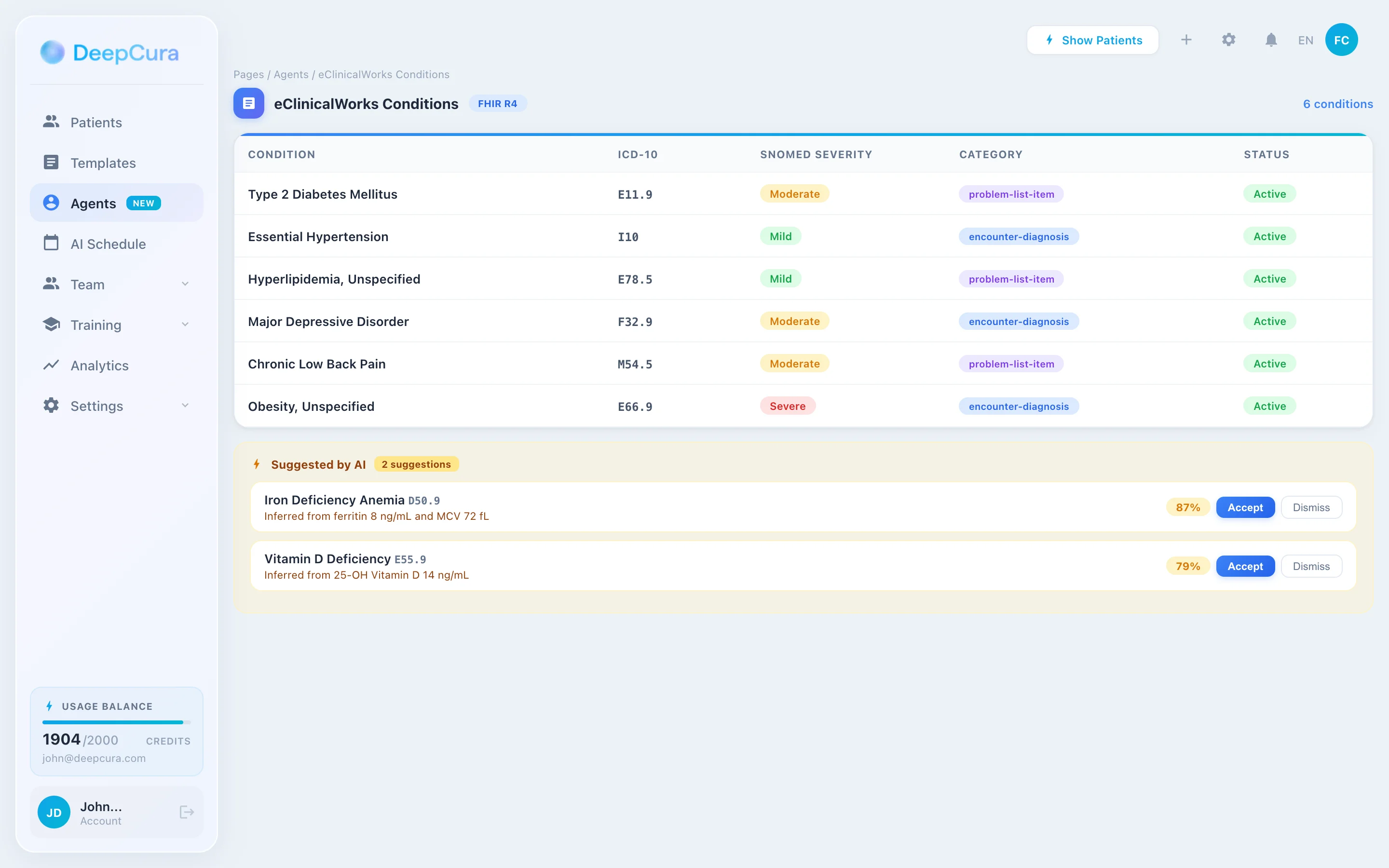
The Problem and Diagnosis agent extracts every clinical problem mentioned during the encounter and maps each one to both ICD-10-CM codes and SNOMED CT severity levels (Mild, Moderate, or Severe). Each condition is categorized as either an encounter-diagnosis (this visit only) or a problem-list-item (ongoing chronic condition).
The agent also suggests additional diagnoses based on the patient's current medication list, lab results, and clinical context. For example, if a patient is on metformin and their most recent HbA1c is 7.8%, the agent will suggest Type 2 Diabetes (E11.9) if it is not already on the problem list. Each suggestion includes a confidence score.
Allergy Management
The Allergy agent extracts every allergen mentioned during the encounter — medications, foods, and environmental factors — along with SNOMED CT substance codes, criticality levels (low, high, or unable-to-assess), and reaction types. By mapping allergens to standardized SNOMED CT codes and assigning proper criticality levels, the agent ensures that every allergy entry works with eCW's built-in drug interaction checking.
Medications — Prescriptions and Reconciliation
The Medications agent handles two distinct FHIR resource types: MedicationRequest for new prescriptions and MedicationStatement for medication reconciliation. Every medication is coded using RxNorm codes exclusively — eClinicalWorks returns error code 2027 when NDC (National Drug Code) identifiers are used. Each prescription includes the medication name, RxNorm code, dosage instructions, route of administration, and frequency.
Lab and Imaging Orders
The Lab Orders agent creates FHIR ServiceRequest resources with LOINC codes. Each order includes clinical justification text for insurance pre-authorization workflows. The agent includes confidence scoring to prevent false positives — a clearly stated "let's get a CBC" gets high confidence, while a tentative "we might want to consider an MRI" is flagged for provider review.
Immunization Records
The Immunization agent captures every vaccination and creates FHIR Immunization resources with CDC-maintained CVX codes. Each record includes site codes (Left Arm, Right Arm, Left Thigh, Right Thigh), route codes (Intramuscular, Subcutaneous, Nasal Inhalation), dose quantity, and lot number for tracking and recall purposes. This is particularly valuable for pediatric practices where immunization tracking is a significant administrative burden.
Multiplayer Mode: Team-Based Clinical Workflows
DeepCura's department-based scheduling turns eClinicalWorks from a single-provider tool into a team platform. This is not just "shared calendar view" — it is a full multiplayer clinical workflow.
How It Works
MAs and PAs can view their physician's eClinicalWorks schedule — and physicians can view their team's schedule — directly from DeepCura's calendar. Permissions are managed through DeepCura departments:
- MAs/PAs see the physician's encounter list and can start charting before the provider enters the room — importing the patient chart, running the AI synopsis, and having everything ready
- Physicians see which patients their MA has already started, with real-time "last accessed by" tracking so nothing falls through the cracks
- Any department member can start, continue, or finish a patient chart — the encounter context (EHR patient link, DOB, email, phone, synopsis) is shared automatically
The Pre-Chart Workflow
This is where multiplayer mode and the AI synopsis combine into something genuinely new:
- The MA opens the physician's schedule in DeepCura at the start of the day
- For each patient, the MA clicks Import Patient Chart — DeepCura pulls the full clinical record, deduplicates, and generates the longitudinal synopsis
- When the physician walks into the room, the synopsis is already on screen — every diagnosis threaded from initial presentation through current treatment
- The physician starts the AI Scribe, conducts the encounter, and reviews the generated note
- One click generates the Scribe It output with validated ICD-10 codes and billing — the physician pastes it into eCW
Zero handoff friction. The MA saves the physician 5-10 minutes per patient on chart review alone, and the physician never has to piece together a patient's history from fragmented encounter notes again.
eCW Prism AI vs DeepCura: Head-to-Head
If you are comparing every eClinicalWorks AI scribe option available in 2026, this is the head-to-head breakdown.
| Capability | eCW Prism AI (Built-in) | DeepCura ($129/mo total) |
|---|---|---|
| Ambient AI Scribing | Yes | Yes |
| Note Generation | Yes (unstructured) | Yes (14-section structured) |
| AI Scribe It Engine | No | Yes (3 AI agents) |
| Per-Diagnosis Treatment Notes | No | Yes (linked objects in eCW) |
| ICD-10 Code Validation | No | Yes (NLM API + provider library) |
| E&M/CPT Billing Codes | No | Yes (auto-generated) |
| EBO Code Library Import | No | Yes (XLSX auto-parse) |
| AI Pre-Chart Synopsis | No | Yes (clinical longitudinal narrative) |
| Problem/Diagnosis Push (API) | No | Yes (ICD-10 + SNOMED) |
| Allergy Management (API) | No | Yes (SNOMED + criticality) |
| Medication Orders (API) | No | Yes (RxNorm) |
| Lab/Imaging Orders (API) | No | Yes (LOINC) |
| Immunization Records (API) | No | Yes (CVX + site/route) |
| Team Schedule Sharing | No | Yes (department-based multiplayer) |
| Auto-Import DOB/Email/Phone | No | Yes (from eCW patient data) |
Prism AI is a reasonable starting point for practices that only need basic ambient scribing. But for practices that want to automate the full encounter — from pre-chart through billing — it covers roughly 15% of the opportunity.
How Many Clicks Does This Actually Save?
We measured the manual click count for a typical primary care encounter in eClinicalWorks across every workflow stage:
- Note documentation: 20-25 clicks (section navigation, field entry, template selection)
- Problem/diagnosis entry: 8-10 clicks per diagnosis (search, select, confirm, set severity)
- Allergy updates: 5-8 clicks per allergen (search, select, set criticality, confirm)
- Medication orders: 10-12 clicks per medication (search, select, dosage, route, frequency, sign)
- Lab/imaging orders: 8-10 clicks per order (search, select, justification, sign)
- Immunization recording: 6-8 clicks per vaccine (search, select, site, route, lot, confirm)
- Billing code entry: 4-6 clicks per code (search E&M level, add CPT codes)
Total: approximately 75-100 clicks per patient encounter.
At 20 patients per day, that is roughly 1,700 clicks — the equivalent of 4-5 hours of data entry, gone. Over a year, that adds up to approximately 1,000 hours of administrative work.
At an average physician compensation rate of $300/hour, those 1,000 hours represent $300,000 in annual opportunity cost. Even recovering 50% of that time through automation delivers $150,000 in value — for a tool that costs $1,548/year ($129/month total).
Pricing
DeepCura for eClinicalWorks costs $129/month total. This includes the $50/month integration fee charged by eClinicalWorks for API access — you pay one price and get everything: the AI Scribe It Engine, AI synopsis, native API write-back, and multiplayer scheduling.
The plan includes 1,000 credits, which supports approximately 15-20 patient encounters per day for a typical primary care provider.
For context, here is how that compares:
- eCW Prism AI: Included with eClinicalWorks subscription, but limited to basic ambient scribing — no Scribe It automation, no synopsis, no structured write-back
- Freed AI: $39-$119/month tiered pricing — no native eClinicalWorks integration, no structured write-back
- Nuance DAX Copilot: Custom pricing (typically $200-400/month), strong ambient scribing but limited workflow automation beyond notes
- DeepCura: $129/month total (includes $50/month eCW API fee) for AI Scribe It Engine + AI synopsis + native API write-back + multiplayer
The value proposition is straightforward: at $129/month total — less than most competitors offering ambient-only scribing — DeepCura automates the full eCW workflow from pre-chart synopsis through billing code entry.
Start with a free trial to see the AI Scribe It Engine and AI synopsis in action with your own eClinicalWorks environment. No credit card required. Sign up at app.deepcura.com/register.
Getting Started: Connect eCW to DeepCura
Most of DeepCura's eClinicalWorks integration features are available instantly after you connect your eCW account — no waiting, no meetings, no approval queues. Schedule sync, AI synopsis, native API structured data write-back, and the AI Scribe It Engine all work on day one.
What Works Instantly (Day 1)
As soon as you connect your eClinicalWorks account to DeepCura, these features are ready to use:
- Schedule sync — your eCW appointment calendar syncs automatically
- AI Pre-Chart Synopsis — pull the patient's full clinical record and get a longitudinal synopsis organized by diagnosis
- AI Scribe It Engine — generate Scribe It-formatted output with validated ICD-10 codes and billing for paste-and-import into eCW
- Pushing problems and diagnoses — ICD-10 + SNOMED-coded conditions write directly to the patient's problem list
- Pushing allergies — SNOMED CT-coded allergens with criticality levels write to the allergy section
- Pushing medications — RxNorm-coded prescriptions and reconciliation write to the medication list
- Pushing lab and imaging orders — LOINC-coded ServiceRequests with clinical justification
- Pushing immunizations — CVX-coded vaccine records with site, route, dose, and lot tracking
- Multiplayer scheduling — team members can view each other's schedules and share encounter context
Activate FHIR APIs in eClinicalWorks (IT Admin)
Your IT administrator or eCW admin user will need to enable the integration inside eClinicalWorks:
- Go to Admin > Product Activation in your eCW instance.
- Scroll to FHIR APIs and click Settings.
- Under Provider Centric Apps, click Setup and enter the DeepCura activation code:
7e760cdae0c34b94 - Click Add, then Continue, then Approve.
- The request will show as Pending — contact DeepCura support (via the in-app chat or email) so we can approve it on our end. This is a one-time step.
- Once approved, return to FHIR APIs > Provider Centric Apps, find DeepCura in the list, and click Activate — select all permission checkboxes and click Next.
- Critical — Go to App Configuration and enable each specific provider who will use DeepCura. See the warning below — skipping this step is the #1 setup failure we see.
The #1 Setup Mistake: Skipping "App Configure" for Each Provider
After activating DeepCura in Product Activation, you must also go to App Configuration and explicitly enable each provider who will use the integration. This is a separate step that many admins miss.
If you skip this step, the provider will see a "FHIR App not enabled for this user" error when they try to connect their eClinicalWorks account to DeepCura. The integration will not work — no schedule sync, no synopsis, no write-back, nothing.
How to fix it: Go back to Admin > Product Activation > FHIR APIs > Settings, then click App Configuration (not just Activate). Select each provider by name and grant them access to the DeepCura app. Once enabled, the provider can immediately log in and connect without any further steps.
This is a per-provider setting — if your practice has 5 providers, all 5 must be individually enabled in App Configuration. Activating the product at the practice level is not enough.
Connect DeepCura to Your eCW Instance
- Sign up at app.deepcura.com/register — free trial, no credit card required.
- In the DeepCura dashboard, go to Settings > EHR and select eClinicalWorks as your EHR system.
- Enter your Practice ID — this is your eClinicalWorks practice identifier (a 6-digit code). See below if you are not sure where to find it.
- Click Submit — you will be prompted to log into your eClinicalWorks account to complete the OAuth authorization.
- Click Continue and Approve on the authorization windows, and the connection is live.
Can't find your Practice ID? Try one of these:
- Contact eCW Support (fastest) — ask your eCW representative: "Can you provide our practice's 6-digit OEM/Practice Code for third-party integrations?" They can retrieve it immediately.
- Check Support Tickets — if you have ever opened integration tickets, search for terms like "OEM Code," "Practice Code," or "Interface Code" in the ticket notes.
- Contact DeepCura — reach out via the in-app chat and we will provide your practice code directly.
Once connected, tokens auto-refresh so you never need to re-authenticate. All features — synopsis, Scribe It Engine, native API write-back, and multiplayer scheduling — work immediately.
Who Is This For?
DeepCura's eClinicalWorks integration is the strongest fit for these practice profiles:
- Primary care providers on eClinicalWorks who spend 2+ hours per day on documentation and data entry beyond the clinical encounter itself.
- Multi-provider practices where consistency in documentation, coding, and order entry across providers is a priority. The AI agents enforce consistent workflows regardless of individual provider habits.
- Pediatric practices where immunization volume is high and the manual vaccine recording workflow in eCW consumes significant staff time. The Immunization agent with CVX codes, site tracking, and lot numbers automates the entire process.
- Practices frustrated with Scribe It formatting who know Scribe It is powerful but cannot reliably format notes to meet its exact syntax requirements. The AI Scribe It Engine handles the precision formatting — validated ICD-10 descriptors, colon sanitization, per-diagnosis triggers — that no human can do consistently.
- Clinicians frustrated with Prism AI's scope who have tried eCW's built-in AI assistant and found that it handles basic dictation but leaves everything else — diagnoses, medications, labs, billing — completely manual.
- Team-based practices where MAs, PAs, and physicians need to share scheduling and patient context without manual handoffs.
For providers using other EHR systems, DeepCura also integrates with athenahealth, Epic, AdvancedMD, OptiMantra, and Veradigm. For athenahealth users specifically, see our athenahealth AI Scribe guide which covers the 8 AI agents available for that platform. For AdvancedMD users, see our AdvancedMD AI Scribe guide covering 5 AI agents with direct write-back. For international and multilingual practices evaluating alternatives, see our Heidi Health review. For a broader look at AI tools for clinical practice, see our guides to the Best ChatGPT for Doctors and the Best AI Medical Receptionist.
See DeepCura in Action
Watch the full platform demo to see how DeepCura handles ambient scribing, AI chat, patient management, and EHR integration across all supported systems.

Frequently Asked Questions
Does DeepCura integrate with eClinicalWorks?
Yes. DeepCura has a full bidirectional integration with eClinicalWorks — a AI-powered pre-chart synopsis, a 3-agent AI Scribe It Engine for native eCW import, and native API write-back for structured data (diagnoses, allergies, medications, labs, immunizations). Data flows both directions: DeepCura reads patient context from eCW and writes structured clinical data back into the appropriate eCW fields.
What is the best AI scribe for eClinicalWorks?
For practices that want automation beyond basic ambient scribing, DeepCura is the most comprehensive AI scribe for eClinicalWorks. It is the only platform with a dedicated AI Scribe It Engine that converts clinical notes into eCW's native Scribe It format with validated ICD-10 codes and billing — plus AI synopsis and native API write-back across 5 resource types. For a full comparison of AI scribes, see our Best AI Medical Scribes in 2026 ranking.
What is the AI Scribe It Engine?
The AI Scribe It Engine is DeepCura's proprietary system for converting finalized clinical notes into eClinicalWorks' native Scribe It format. It uses 3 specialized AI agents running in parallel: Agent 1 restructures the note into Scribe It syntax with per-diagnosis Treatment Note triggers, Agent 2 resolves ICD-10 codes using the NLM Clinical Tables API and the provider's own imported code library, and Agent 3 determines E&M and CPT billing codes. The output is ready to paste directly into eCW's Scribe It page for one-click import into the chart.
Why did you build the Scribe It Engine instead of using the native API for everything?
The eCW native API works well for structured data — allergies, medications, lab orders, immunizations, and problem lists. We use it for all of those. But the native API has structural limitations for clinical notes: it cannot create per-diagnosis Treatment Note objects, cannot push billing codes, and cannot link orders to their justifying diagnoses. These are the data types clinicians need most for downstream workflows. The Scribe It Engine fills that gap by using eCW's own native Scribe It parser, which supports all of these features.
How does the ICD-10 code library work?
You can import your own ICD-10 codes from your eClinicalWorks Business Optimizer (EBO) report — the XLSX file your practice receives from insurance payers. The parser auto-detects all providers in the file (we have seen 66+ in a single EBO), lets you select your name, then deduplicates codes keeping the highest-usage description. In our analysis, 51% of ICD-10 codes had different descriptions for the same code across providers. Your imported library ensures that Scribe It output uses the exact descriptors your eCW instance expects.
Is eCW Prism AI a good AI scribe?
Prism AI is a competent basic ambient dictation tool for practices that only need note generation. Its main advantage is that it is included with the eClinicalWorks subscription, so there is no separate app or additional cost. However, Prism AI is limited to basic dictation — it does not automate Scribe It formatting, ICD-10 validation, billing code entry, diagnosis management, allergy management, medication orders, lab ordering, or immunization recording. For practices that want broader workflow automation, Prism AI covers roughly 1 out of the full workflow.
How much does DeepCura cost for eClinicalWorks users?
DeepCura costs $129 per month total for eClinicalWorks users. This includes the $50/month integration fee charged by eClinicalWorks for API access — you pay one price and get everything. The plan includes the AI Scribe It Engine, AI synopsis, native API write-back, multiplayer scheduling, and 1,000 credits supporting approximately 15-20 patients per day. A free trial is available with no credit card required.
Can DeepCura push notes directly into eClinicalWorks?
Yes, through two methods. The AI Scribe It Engine generates Scribe It-formatted output that you paste into eCW's native Scribe It page — eCW then auto-imports each section (diagnoses, treatment notes, billing codes, orders) into the correct chart fields as linked objects. For structured data (allergies, medications, labs, immunizations, problems), DeepCura pushes directly via the native API with no paste step needed.
Does DeepCura handle medication reconciliation for eCW?
Yes. The Medications agent handles two distinct FHIR resource types: MedicationRequest for new prescriptions and MedicationStatement for medication reconciliation. This means both new medication orders and updates to existing medications (dose changes, discontinuations, continuations) are processed through the correct eCW workflows. All medications use RxNorm codes exclusively — eCW returns error code 2027 when NDC codes are used.
How does DeepCura compare to Freed AI for eClinicalWorks?
Freed AI is an ambient-only AI scribe that does not integrate with eClinicalWorks beyond copy-paste workflows. It generates notes from encounter audio, but the clinician must manually format and enter everything into eCW. DeepCura automates the full workflow: AI synopsis for pre-charting, AI Scribe It Engine for native eCW import with validated codes and billing, and native API write-back for structured data. For a detailed comparison, see our Freed AI review and our DeepCura vs Freed AI breakdown.
What is the AI Pre-Chart Synopsis?
The AI Pre-Chart Synopsis is a longitudinal patient summary generated from the patient's complete eClinicalWorks clinical record record. When you click "Import Patient Chart" from the calendar, DeepCura parses the patient's entire clinical history — every encounter, diagnosis, medication, lab result, and procedure — deduplicates the content (eCW duplicates notes 3-6x across diagnoses), and generates a narrative organized by diagnosis. Each diagnosis section threads the clinical story from initial presentation through current treatment plan, including specific dates, medication changes, and lab values. It is the same chart review a physician does mentally before walking into a follow-up visit, but generated instantly.
Can MAs and PAs see the physician's eClinicalWorks schedule in DeepCura?
Yes. DeepCura's department-based scheduling allows any team member in the same department to view each other's eClinicalWorks schedules. MAs can see the physician's encounter list, import patient charts, run clinical synopses, and start charting before the provider enters the room. The physician picks up where the MA left off with full encounter context shared automatically. Permissions are managed through DeepCura's department settings, not through eClinicalWorks.
Does DeepCura automatically import patient DOB, email, and phone from eClinicalWorks?
Yes. When you click "Start AI Scribe" from the calendar, DeepCura automatically reads the patient's date of birth, email address, and phone number from the eCW patient data and stores them on the patient record. DOB is also displayed on the schedule card to help distinguish patients with similar names. Previously, this data required manual entry — now it flows automatically from eClinicalWorks.
Is DeepCura HIPAA compliant?
Yes. DeepCura is fully HIPAA compliant and provides a Business Associate Agreement (BAA) to all covered entities. All data — including encounter audio, generated notes, and eClinicalWorks API communications — is encrypted in transit (TLS 1.2+) and at rest (AES-256). The platform maintains SOC 2-aligned security practices and undergoes regular security assessments. Audio recordings are processed in real-time and are not stored after note generation is complete.
Do all features work immediately after connecting eClinicalWorks?
Yes — everything works on day one. Schedule sync, clinical pre-chart synopsis, the AI Scribe It Engine, and pushing structured data (problems, allergies, medications, labs, immunizations) all work instantly after connecting. There is no separate mapping meeting or additional setup required. Just connect your eCW account, import a patient chart, and start using the full suite.
Why am I seeing "FHIR App not enabled for this user" when trying to connect?
This means your eClinicalWorks admin activated DeepCura at the practice level but did not enable your specific provider account in App Configuration. Activating the product in Product Activation is not enough — the admin must also go to App Configuration and explicitly grant access to each provider who will use DeepCura. Once your admin enables your provider account there, the error disappears and you can connect immediately.
Final Verdict
Prism AI is a fine starting point — it is included with eClinicalWorks and handles basic ambient dictation. But for practices that want to automate the full encounter workflow, Prism AI covers roughly 15% of the opportunity.
DeepCura covers the full stack — making it the best AI scribe for eClinicalWorks in 2026. The AI synopsis gives you every patient's full history before you walk in. The AI Scribe It Engine converts your note into native Scribe It format with validated ICD-10 codes, per-diagnosis Treatment Notes, and billing codes — one paste and eCW handles the import. native API write-back pushes structured data (allergies, medications, labs, immunizations) directly into the chart. And multiplayer scheduling lets your team pre-chart before you even enter the room.
At $129/month total (includes the $50 eCW integration fee), it automates more of the eClinicalWorks workflow than any other AI scribe on the market. Start a free trial and see the full suite in action with your own eCW environment.
For more on AI-powered clinical documentation, explore our AI Medical Scribe platform overview and our Best AI Medical Scribes in 2026 comprehensive comparison.
References
[1] eClinicalWorks, "Cloud-Based EHR, Practice Management, and Patient Engagement," eclinicalworks.com. eclinicalworks.com
[2] eClinicalWorks, "Prism AI — AI-Powered Clinical Documentation," eclinicalworks.com. eclinicalworks.com/prism
[3] HL7 International, "FHIR R4 — Fast Healthcare Interoperability Resources," hl7.org. hl7.org/fhir
[4] HL7 International, "HL7 v2 ORU^R01 — Observation Result/Unsolicited," hl7.org. hl7.org/implement/standards
[5] SNOMED International, "SNOMED CT — Systematized Nomenclature of Medicine," SNOMED.org. snomed.org
[6] World Health Organization, "International Classification of Diseases, Tenth Revision (ICD-10)," WHO. who.int/classifications/icd
[7] U.S. National Library of Medicine, "RxNorm — Normalized Names for Clinical Drugs," NLM. nlm.nih.gov/research/umls/rxnorm
[8] Regenstrief Institute, "LOINC — Logical Observation Identifiers Names and Codes," loinc.org. loinc.org
[9] Centers for Disease Control and Prevention, "CVX — Vaccines Administered Code Set," CDC. cdc.gov/vaccines/programs/iis
[10] U.S. Department of Health and Human Services, "HIPAA for Professionals," HHS.gov. hhs.gov/hipaa/for-professionals
[11] DeepCura, "AI Medical Scribe Platform — Ambient Scribing, AI Receptionist, EHR Integration," DeepCura.com. deepcura.com
[12] Freed AI, "AI Medical Scribe — Ambient Clinical Documentation," Freed.ai. getfreed.ai
[13] U.S. National Library of Medicine, "Clinical Tables Service — ICD-10-CM Code Search API," NLM. clinicaltables.nlm.nih.gov