
Disclaimer: This review is based on publicly available information as of March 2026. Features, pricing, and capabilities may have changed. We encourage readers to verify current details directly with the vendor.
Over $1 billion valuation. Hundreds of millions raised. Cleveland Clinic's five-year pick over four other AI scribes. That is Ambience Healthcare in a nutshell — the enterprise AI documentation platform built for health systems, not solo practices.
Here is what Ambience Healthcare does and does not do:
- Does: Ambient scribing (AutoScribe), automated coding (AutoCDI), after-visit summaries (AutoAVS), referral drafting (AutoRefer), chart-aware pre-visit prep (AutoPrep), deep EHR integration with Epic, Cerner, and reportedly athenahealth
- Does not: Serve solo or small practices, offer transparent pricing, provide an AI receptionist, manage faxes, automate patient intake, or allow self-serve signup
- Best for: Enterprise health systems with 50+ providers that need specialty-tuned AI documentation at scale
- Not for: Solo practitioners, small practices, budget-conscious clinicians, or anyone who needs a full-platform solution beyond documentation
This review is an honest assessment of Ambience Healthcare in 2026. We cover features, enterprise pricing, EHR integration, accuracy, the new Chart Awareness platform, and how it stacks up against platforms that automate more of the clinical workflow for a fraction of the cost.
This review was last updated in March 2026. Features and pricing estimates reflect publicly available information from Ambience Healthcare, Sacra, KLAS Research, G2, and verified press releases at the time of writing.
What Is Ambience Healthcare?
Ambience Healthcare is an enterprise AI platform for clinical documentation, coding, and workflow automation. Founded in San Francisco and backed by approximately $370 million in total funding — including a $243 million Series C in July 2025 led by Andreessen Horowitz (a16z) and Oak HC/FT — Ambience builds AI tools designed for large health systems, not individual clinicians.
The company's investors include Kleiner Perkins, the OpenAI Startup Fund, and Optum Ventures. At a post-money valuation reported between $1 billion and $1.25 billion (estimates vary by source), Ambience is one of the most heavily funded companies in the clinical AI space — alongside Abridge and Nabla.
Ambience's flagship product is AutoScribe, an ambient AI medical scribe that listens to patient-clinician conversations and generates structured clinical notes. But unlike scribe-only tools like Freed AI or Heidi Health, Ambience bundles AutoScribe with a suite of post-visit automation products: AutoCDI for coding integrity, AutoAVS for after-visit summaries, AutoRefer for referral letters, AutoPrep for pre-visit chart preparation, and the newly launched Chart Awareness platform for longitudinal record synthesis.
On G2, Ambience Healthcare holds a reported 4.7 out of 5 rating. Ambience has been recognized as a KLAS/CHIME Trailblazer Award winner — recognizing exceptional leadership in innovation, impact, and client success among emerging healthcare technology vendors. KLAS Research has also ranked Ambience #1 for Improving the Clinician Experience and Top 3 for Improving Patient Experience and Outcomes in the Emerging Solutions category.
The company's most significant validation came from Cleveland Clinic. After a head-to-head pilot evaluating five AI scribe vendors across 80+ specialties and subspecialties, Cleveland Clinic selected Ambience for an exclusive five-year enterprise contract — the first competitive bake-off of its kind among major health systems.
How Ambience AutoScribe Works
The Ambience AutoScribe workflow is designed for enterprise clinical environments where documentation must integrate directly into the EHR and support coding accuracy at scale. Here is how a typical encounter works:
The AI listens. During a clinical encounter, Ambience AutoScribe captures the ambient audio of the conversation between clinician and patient. The system processes speech in real time using proprietary models trained on clinical dialogue across numerous medical specialties.
Structured notes are generated. Within seconds of the encounter ending, AutoScribe generates a structured clinical note — formatted to match the clinician's preferred template, specialty-specific documentation standards, and the EHR system's required fields. Notes are not generic SOAP outputs; they are tuned to the specialty and encounter type.
Chart Awareness enriches the note. Launched in February 2026, the Chart Awareness platform enables AutoScribe to incorporate data from the patient's full longitudinal record — prior notes, diagnoses, labs, imaging, medications, pathology, and problem lists. Chart-Aware Assessment and Plan generation grounds the note in both the current visit and relevant chart history, reducing copy-forward risk and improving documentation integrity.
Coding integrity is validated. AutoCDI (Clinical Documentation Integrity) runs in parallel, analyzing the generated note against coding requirements to ensure the documentation supports accurate ICD-10 and CPT code assignment. This is not informational coding suggestions — it is documentation-level validation designed to protect revenue integrity and reduce audit risk.
The note is pushed to the EHR. Ambience integrates directly with Epic and Cerner via native APIs, and reportedly supports athenahealth as well. Notes, coding data, and after-visit summaries flow into the EHR without manual copy-paste. The integration is bidirectional — Ambience reads patient context from the chart and writes structured data back.
After-visit summary is delivered. AutoAVS generates a patient-facing summary of the encounter in plain language, which can be delivered through the EHR's patient portal. AutoRefer drafts referral letters when the encounter includes a referral decision.
The entire workflow requires enterprise implementation — EHR integration configuration, specialty template tuning, and IT coordination. This is not a download-and-start tool. Typical deployment timelines range from weeks to months depending on the health system's size and complexity.
Ambience Healthcare Pricing
Ambience Healthcare does not publish pricing. All contracts are negotiated directly with the sales team, and costs vary based on organization size, number of providers, module selection, and integration complexity. There is no self-serve signup, no free trial, and no publicly listed price.
Based on industry analysis and third-party estimates, here is what enterprise buyers should expect:
- AutoScribe only (base): ~$2,800-3,200 per provider per year ($233-267/month)
- Full suite (AutoScribe + AutoCDI + AutoAVS + AutoRefer): ~$4,000-5,000 per provider per year ($333-417/month)
- Implementation fee: One-time cost covering EHR integration, specialty template tuning, and deployment support
- Deployment timeline: 3-6 months for full enterprise rollout, requiring IT team involvement
Ambience reportedly uses a tiered pricing structure with optional add-on modules. Volume discounts are expected for large health systems, and multi-year contracts (like Cleveland Clinic's five-year deal) likely carry lower per-provider rates.
Here is how Ambience Healthcare's estimated pricing compares to a full-platform alternative:
| Plan | Est. Price | Scribe | Coding | EHR Write-Back | AI Receptionist | Fax Management |
|---|---|---|---|---|---|---|
| Ambience AutoScribe | ~$250/mo/provider | ✓ | ✗ | ✓ (Epic, Cerner, reportedly athena) | ✗ | ✗ |
| Ambience Full Suite | ~$375/mo/provider | ✓ | ✓ | ✓ (Epic, Cerner, reportedly athena) | ✗ | ✗ |
| DeepCura | $129/mo/provider | ✓ | ✓ | ✓ (athenahealth, eCW, AdvancedMD, OptiMantra, Epic, DrChrono, CharmHealth, Cerner) | ✓ | ✓ |
At the base tier alone, Ambience costs roughly 2x what a full-platform solution like DeepCura charges — and DeepCura includes native EHR write-back for athenahealth, eClinicalWorks, AdvancedMD, OptiMantra, Epic, DrChrono, CharmHealth, and Cerner, an AI receptionist, billing automation, fax management, and patient intake for $129/month. For the full Ambience suite, the gap widens to roughly 3x the cost, and Ambience still does not include patient communication, fax management, or intake automation.
For large health systems with deep Epic or Cerner integration requirements and dedicated IT teams, the enterprise pricing may be justified by the depth of the EHR integration and specialty tuning. For everyone else, the cost-to-feature ratio is difficult to justify when more comprehensive alternatives exist at a fraction of the price.
Ambience Healthcare Key Features
AutoScribe — Ambient AI Medical Scribe
AutoScribe is the core product — an ambient AI scribe that captures clinical encounters and generates structured documentation. It supports a wide range of medical specialties (the company claims up to 200) with specialty-tuned note templates and was validated across 80+ specialties during the Cleveland Clinic pilot. Notes are generated within seconds of the encounter ending and integrate directly into the EHR.
AutoCDI — Clinical Documentation Integrity
AutoCDI analyzes generated notes against coding requirements in real time. It identifies documentation gaps that could lead to undercoding, overcoding, or audit risk — and suggests specific language additions that support accurate code assignment. Health systems using AutoCDI report improved coding accuracy and revenue integrity, with some organizations citing $13,000+ in additional revenue per clinician per year through better documentation-supported coding.
AutoAVS — After-Visit Summaries
AutoAVS generates patient-facing summaries of each encounter in plain, accessible language. These summaries are delivered through the EHR's patient portal, ensuring patients receive clear documentation of what was discussed, what was decided, and what follow-up is needed. This addresses a common patient complaint — leaving an appointment without a clear understanding of the care plan.
AutoRefer — Referral Letter Generation
When an encounter includes a referral decision, AutoRefer automatically drafts a referral letter based on the encounter documentation. The letter includes relevant clinical history, the reason for referral, and supporting documentation — reducing the time clinicians spend on referral paperwork and improving communication between referring and receiving providers.
AutoPrep — Pre-Visit Chart Preparation
AutoPrep generates a pre-visit summary by synthesizing relevant information from the patient's chart before the encounter begins. This gives clinicians a structured overview of the patient's history, active problems, medications, and recent results — reducing the time spent reviewing the chart before each visit.
Chart Awareness — Longitudinal Record Intelligence
Launched in February 2026, Chart Awareness is Ambience's newest capability. It enables all products in the Ambience suite to interpret the patient's full longitudinal record — not just the current encounter. Four core capabilities have been announced:
- Chart-Aware Patient Summaries: Problem-oriented summaries that organize a patient's longitudinal history by diagnosis, enabling clinicians to see everything related to a condition in one place without reviewing the chart note by note.
- Chart-Aware Assessment and Plan: Assessment and plan generation grounded in both the current visit and relevant chart history. This reduces copy-forward risk, improves documentation integrity, and ensures the plan reflects what changed in the encounter.
- Chart-Aware Diagnostics: Automated extraction and synthesis of lab trends, imaging findings, and pathology results directly into the note, highlighting clinically meaningful changes over time.
- Chart-Aware Coding: Automated coding informed by the patient's full record. Early pilots are underway with select health system partners, with broad availability expected later in 2026.
Chart-Aware Patient Summaries and Assessment and Plan are live across all deployed health systems. Chart-Aware Diagnostics is in alpha with select partners.
What Ambience Healthcare Does Well
Enterprise-grade EHR integration. This is Ambience's most significant technical advantage. The platform integrates directly with Epic and Cerner via native APIs — reading patient context from the chart and writing structured data back — and reportedly supports athenahealth as well. This is not scraping-based or copy-paste automation; it is bidirectional data flow that treats the EHR as a first-class integration partner. For large health systems on Epic, this depth of integration is genuinely differentiated.
Specialty breadth validated at scale. Most AI scribes claim multi-specialty support but have not been tested rigorously across dozens of specialties in a controlled environment. Ambience has. The Cleveland Clinic evaluated AutoScribe across 80+ specialties and subspecialties during a head-to-head pilot against four competitors — and chose Ambience. That real-world validation across diverse clinical workflows is difficult to replicate with marketing claims alone.
Coding accuracy drives measurable ROI. AutoCDI is not an afterthought — it is a revenue-generating product. By validating that clinical documentation supports accurate code assignment, Ambience helps health systems capture revenue that would otherwise be lost to undercoding or documentation gaps. Industry estimates suggest $13,000+ in additional revenue per clinician per year through improved coding accuracy. For a 200-provider health system, that translates to $2.6 million in annual recovered revenue — easily justifying the platform cost.
High clinician adoption rates. Health systems report significant documentation time reduction — Houston Methodist reported a 40% reduction in documentation time and a 27% increase in patient face time, while Ardent Health reported 90% clinician utilization. Physicians actually use the tool because it genuinely reduces their administrative burden rather than creating a new one.
Chart Awareness represents a genuine platform leap. Most AI scribes process each encounter in isolation. Ambience's Chart Awareness platform, launched in February 2026, enables the AI to interpret the patient's full longitudinal record — prior notes, lab trends, imaging history, and medication changes. This is a fundamentally different approach to clinical AI, moving from encounter-level documentation to longitudinal record intelligence. For complex patients with extensive histories, this reduces the risk of missed context and copy-forward errors.
Enterprise customer base validates reliability. Cleveland Clinic, Houston Methodist, UCSF, Memorial Hermann, and Ardent Health are not organizations that select vendors casually. Each has dedicated evaluation teams, compliance requirements, and clinical governance processes. The fact that Ambience has passed these enterprise procurement gauntlets — and secured multi-year contracts — speaks to the platform's reliability, security, and clinical accuracy.
Ambience Healthcare Accuracy by Specialty
Ambience's specialty accuracy was validated during the Cleveland Clinic pilot across 80+ specialties and subspecialties. Based on available information from deployment reports and third-party analysis:
- Primary Care / Family Medicine: Strong performance across standard office visits. AutoScribe captures chief complaints, HPI, review of systems, and assessment and plan with high fidelity. The most straightforward encounters produce notes that are ready for review with minimal editing.
- Internal Medicine: Complex multi-problem visits benefit from Chart Awareness, which pulls relevant history and lab trends into the note. Multi-condition encounters are handled more reliably than scribe-only competitors due to the longitudinal record context.
- Surgical Specialties: Procedure documentation, operative notes, and anatomical terminology are supported through specialty-tuned templates. Cleveland Clinic specifically evaluated surgical subspecialties during the pilot.
- Psychiatry: Mental health encounters require nuanced documentation — affect descriptions, risk assessments, and treatment plan details. Ambience supports psychiatric documentation, though clinicians in any specialty should expect some post-generation review for clinical precision.
- Emergency Medicine: Ambience is live in emergency department settings. The platform handles the rapid pace and interruption patterns of ED encounters, though complex trauma or multi-provider resuscitation scenarios may require more editing.
- Cardiology and Subspecialties: Highly specialized terminology, diagnostic workups, and condition-specific documentation are supported. The depth of specialty tuning is a key differentiator versus generalist AI scribes.
- Pediatrics: Well-child visits, developmental assessments, and three-way conversations (parent-clinician-child) are supported across deployed health systems.
For any specialty, the accuracy gap between Ambience and competitors is widest in complex, multi-problem encounters where Chart Awareness and specialty tuning provide context that encounter-only scribes cannot match.
Where Ambience Healthcare Falls Short
No option for solo or small practices. Ambience is enterprise-only. There is no self-serve signup, no individual clinician plan, and no small-practice tier. If you are a solo practitioner or run a practice with fewer than 20-30 providers, Ambience will not sell to you. The sales process requires enterprise procurement, IT involvement, and multi-month implementation timelines. For the majority of clinicians in the United States who practice independently or in small groups, Ambience is simply not accessible.
No transparent or public pricing. Every contract is custom-negotiated, and Ambience does not publish pricing on its website. This lack of transparency makes it impossible for potential buyers to evaluate cost-effectiveness before engaging with the sales team. Enterprise health systems are accustomed to this model, but it creates a significant friction point for mid-size organizations that want to budget accurately before committing to a sales cycle.
No AI receptionist or call handling. Ambience does not offer any patient communication automation. There is no AI receptionist to handle incoming calls, schedule appointments, triage patient requests, or manage prescription refill inquiries. For practices where phone volume is a major operational bottleneck, this is a meaningful gap. For options, see our ranking of the best AI medical receptionists in 2026.
No fax management. Inbound fax processing, document routing, and fax-based referral management are not part of the Ambience platform. Practices that still receive a high volume of faxed records — which remains the reality for the vast majority of clinical offices — will need to handle this workflow separately or pay for an additional point solution.
No patient intake or pre-visit automation. AutoPrep generates pre-visit chart summaries from existing EHR data, but Ambience does not offer patient-facing intake forms, pre-visit questionnaires, or AI-powered patient communication before the encounter. The patient experience starts at the encounter — everything before it is outside Ambience's scope. For intake automation options, see our patient intake form templates with free downloads for 8 specialties.
No clinical AI chat or decision support. Ambience focuses on documentation and coding — there is no clinical AI assistant for answering medical questions, reviewing evidence, or supporting clinical decision-making during encounters. Clinicians who want AI-assisted clinical reasoning alongside their documentation will need a separate tool. See our guide to the best ChatGPT for doctors.
No choice of AI engine. Clinicians cannot select which underlying AI model processes their encounters. Ambience uses its own proprietary model pipeline, and there is no ability to switch between different AI engines that may perform better for specific specialties or documentation styles.
Long implementation timeline. While download-and-start tools like Freed AI or DeepCura can be operational in minutes, Ambience requires weeks to months of implementation — EHR integration, specialty template configuration, IT coordination, and provider training. For health systems with dedicated IT teams, this is standard. For everyone else, it means months of delay before seeing any value.
Who Is Ambience Healthcare Best For?
Ambience Healthcare is a strong fit for a specific type of organization:
- Large health systems with 50+ providers that need enterprise-grade AI documentation deployed across multiple specialties and departments with centralized governance.
- Organizations deeply embedded in Epic or Cerner that require bidirectional EHR integration with native API write-back — not scraping-based workarounds.
- Health systems that prioritize coding accuracy and revenue integrity — where AutoCDI's documentation validation can recover $13,000+ per clinician per year in revenue that would otherwise be lost to undercoding.
- Academic medical centers and teaching hospitals that need AI documentation to work across 80+ specialties and subspecialties, including complex surgical and subspecialty workflows.
- Organizations with dedicated IT and compliance teams that can manage a multi-month implementation process, enterprise procurement, and ongoing vendor relationship management.
Who Should Consider Alternatives?
Not every practice or organization will find Ambience Healthcare accessible or appropriate. Consider looking at other platforms if you fall into any of these categories:
- Solo practitioners and small practices that need a scribe they can start using in minutes, not months. Ambience does not sell to individual clinicians or small groups.
- Budget-conscious practices that cannot justify $250-417/month per provider for documentation alone when full-platform alternatives include scribing, reception, billing, and fax management for $129/month.
- Clinics that need an AI receptionist to handle incoming patient calls, scheduling, triage, and prescription refill requests — capabilities Ambience does not offer.
- Practices that want a single platform replacing multiple point solutions rather than adding an enterprise documentation layer on top of existing systems.
- Organizations on EHR systems beyond Epic and Cerner — such as eClinicalWorks, AdvancedMD, OptiMantra, or CharmHealth — where Ambience's integration coverage is limited or unavailable.
- Clinicians who want transparent pricing and the ability to evaluate cost-effectiveness before committing to an enterprise sales cycle.
If you need ambient scribing plus native EHR write-back for athenahealth, eClinicalWorks, AdvancedMD, OptiMantra, Epic, DrChrono, CharmHealth, and Cerner, a 24/7 AI receptionist, billing integrity checks, and fax management in one platform, DeepCura includes all of these for $129/month — with no enterprise sales cycle, no implementation timeline, and signup in minutes.
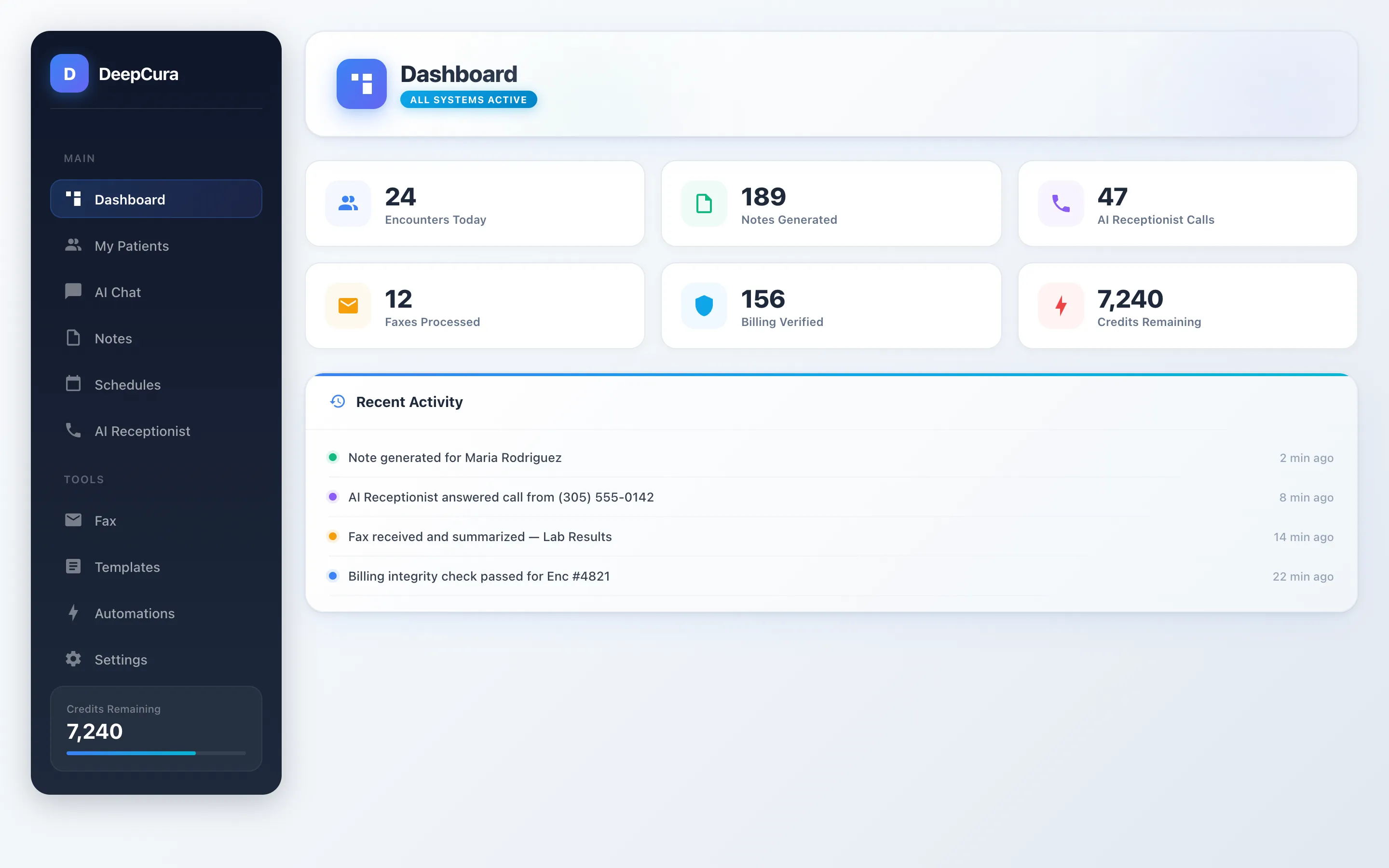 Screenshot: DeepCura UI — full dashboard with patient management, AI receptionist, notes, and automation.
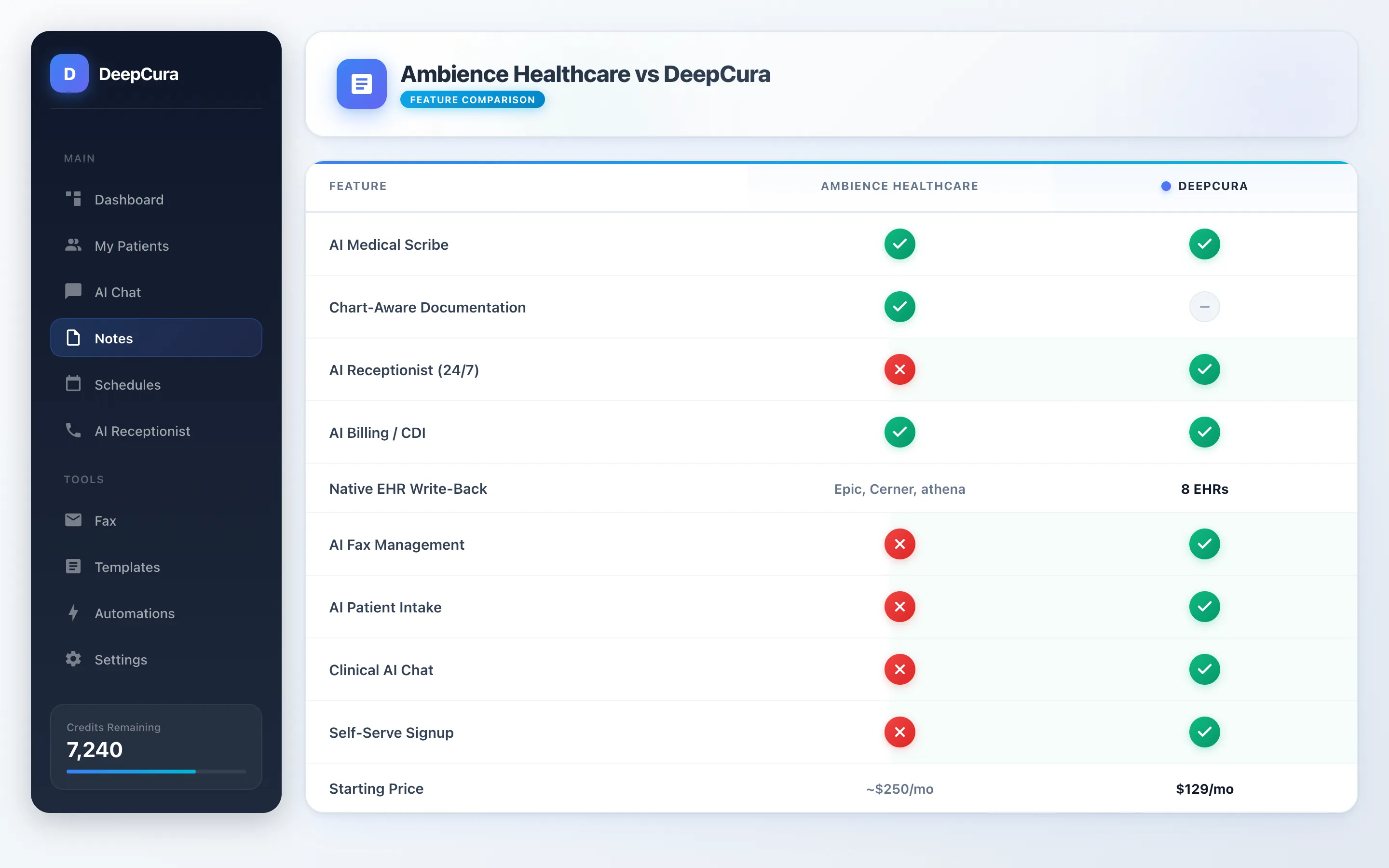 Screenshot: Ambience Healthcare vs DeepCura — feature comparison across the full clinical workflow.
Ambience Healthcare vs Full-Platform Solutions
Ambience Healthcare builds enterprise AI products for the documentation and coding phase of the clinical workflow. To evaluate whether that scope is enough for your organization, you need to see how Ambience compares across every phase — before, during, and after the visit.
Pre-Visit Automation
| Feature | Ambience Healthcare | DeepCura |
|---|---|---|
| AI Patient Intake | ✗ | ✓ |
| AI Receptionist (Phone) | ✗ | ✓ |
| Pre-Visit Chart Summary | ✓ (AutoPrep) | ✓ |
Ambience's AutoPrep generates pre-visit chart summaries from existing EHR data, which is valuable for clinicians preparing for complex patients. However, Ambience has zero patient-facing pre-visit capabilities. There is no AI receptionist to handle incoming patient calls for scheduling, triage, or prescription refill requests. There are no patient-facing intake forms or pre-visit questionnaires. DeepCura's AI receptionist answers patient calls 24/7, handles scheduling and triage, and generates pre-visit summaries so the clinician walks into every encounter already informed.
During the Visit
| Feature | Ambience Healthcare | DeepCura |
|---|---|---|
| AI Medical Scribe | ✓ (AutoScribe) | ✓ |
| Chart-Aware Documentation | ✓ (Chart Awareness) | ✗ |
| 50+ Specialties | ✓ (up to 200 claimed) | ✓ |
| Clinical AI Chat (Copilot) | ✗ | ✓ |
This is where Ambience Healthcare delivers its strongest value. AutoScribe with Chart Awareness represents the most technically sophisticated ambient scribe on the market — particularly for complex, multi-problem encounters where longitudinal record context improves documentation accuracy. The key difference: DeepCura includes a clinical AI copilot for real-time reasoning during encounters — differential diagnosis support, drug interaction checks, and evidence-based recommendations. Ambience has no in-visit decision support.
Post-Visit Automation
| Feature | Ambience Healthcare | DeepCura |
|---|---|---|
| AI Coding / CDI | ✓ (AutoCDI) | ✓ |
| After-Visit Summary | ✓ (AutoAVS) | ✓ |
| Referral Letters | ✓ (AutoRefer) | ✓ |
| EHR Integration (Native API) | ✓ (Epic, Cerner, reportedly athena) | ✓ (athenahealth, eCW, AdvancedMD, OptiMantra, Epic, DrChrono, CharmHealth, Cerner) |
| AI Prior Authorization | ✗ | ✓ |
| AI Fax Management | ✗ | ✓ |
| AI Payment Collection (Stripe) | ✗ | ✓ |
Post-visit is where the platforms diverge most sharply. Ambience covers documentation integrity (AutoCDI), patient summaries (AutoAVS), and referral letters (AutoRefer) — all strong enterprise capabilities. But the platform stops at the documentation layer. Prior authorizations, fax management, and payment collection remain manual workflows. DeepCura automates all three with dedicated AI agents — the fax management agent summarizes inbound faxes and routes them to the correct provider, the prior authorization agent drafts and submits requests, and the payment collection agent handles patient balance outreach through Stripe.
Platform Capabilities
| Feature | Ambience Healthcare | DeepCura |
|---|---|---|
| Choose AI Engine (GPT, Claude, Gemini) | ✗ | ✓ |
| Self-Serve Signup | ✗ | ✓ |
| Team Collaboration | Enterprise-only | ✓ |
| Analytics Dashboard | Enterprise-only | ✓ |
| Starting Price | ~$250/mo/provider | $129/mo/provider |
| Setup Time | Weeks to months | Minutes |
Ambience locks organizations into a proprietary AI model pipeline and an enterprise sales process. DeepCura lets practices choose between GPT, Claude, and Gemini — selecting the engine that performs best for their specialty — and offers self-serve signup with no enterprise procurement required.
For a broader comparison across all AI scribes, see our Best AI Medical Scribes in 2026 ranking.
See DeepCura in Action
Watch how DeepCura handles the full clinical workflow — from AI receptionist calls and patient intake through ambient scribing, automated billing, and native EHR write-back.

Frequently Asked Questions
Is Ambience Healthcare HIPAA compliant?
Yes. Ambience Healthcare is HIPAA compliant and provides a Business Associate Agreement (BAA) to covered entities. The company maintains a public Trust Center at trust.ambiencehealthcare.com with details on security practices, compliance certifications, and data handling policies. As with any clinical AI tool, HIPAA compliance is a shared responsibility — your organization must also ensure proper access controls, staff training, and configuration.
How much does Ambience Healthcare cost?
Ambience Healthcare does not publish pricing. All contracts are custom-negotiated based on organization size, number of providers, module selection, and integration complexity. Industry estimates suggest base AutoScribe pricing of $2,800-3,200 per provider per year ($233-267/month), with full suite pricing reaching $4,000-5,000 per provider per year ($333-417/month). A one-time implementation fee covers EHR integration and specialty template configuration.
Does Ambience Healthcare integrate with my EHR?
Ambience Healthcare integrates natively with Epic and Cerner via bidirectional APIs, and reportedly supports athenahealth as well — reading patient context from the chart and writing structured notes, coding data, and after-visit summaries back. This is native API write-back, not scraping-based. However, integration support for other EHR systems — such as eClinicalWorks, AdvancedMD, OptiMantra, Veradigm, or CharmHealth — is limited or unavailable. Practices on these systems should consider alternatives with broader EHR coverage.
Is Ambience Healthcare accurate?
Ambience Healthcare's accuracy was validated during a head-to-head pilot at Cleveland Clinic, where it was evaluated across 80+ specialties and subspecialties against four competing AI scribes. Clinicians reported detailed, specialty-appropriate notes that improved care coordination. With the February 2026 launch of Chart Awareness, documentation accuracy is further enhanced by incorporating the patient's full longitudinal record — prior notes, lab trends, and imaging history — into note generation.
Can Ambience Healthcare handle specialty encounters?
Yes. Ambience supports a wide range of medical specialties (the company claims up to 200) with specialty-tuned note templates and documentation workflows. The Cleveland Clinic pilot specifically evaluated performance across 80+ specialties and subspecialties, including surgical specialties, psychiatry, emergency medicine, and complex subspecialties. The Chart Awareness platform further enhances specialty accuracy by incorporating longitudinal patient data into documentation.
Does Ambience Healthcare offer a free trial?
No. Ambience Healthcare does not offer a free trial or self-serve signup. The platform requires an enterprise sales engagement, contract negotiation, and a multi-week to multi-month implementation process. This enterprise-only approach means there is no way to test the platform before committing to a contract.
What are the best Ambience Healthcare alternatives?
The best alternative depends on your organization's size and needs. DeepCura is the strongest option for practices that want a full-platform solution including scribing, an AI receptionist, billing integrity checks, fax management, and EHR write-back for athenahealth, eClinicalWorks, AdvancedMD, OptiMantra, Epic, DrChrono, CharmHealth, and Cerner for $129/month — with no enterprise sales cycle required. Freed AI is the simplest scribe for solo practitioners starting at $39/month. DeepScribe offers specialty-tuned AI with human QA review for mid-size practices. Abridge is another enterprise option focused on linked evidence. Nuance DAX Copilot is the leading choice for large health systems already on Microsoft infrastructure. For a comprehensive comparison, see our Best AI Medical Scribes in 2026 ranking.
Is Ambience Healthcare worth it for a small practice?
No. Ambience Healthcare is designed for enterprise health systems and does not sell to solo practitioners or small practices. There is no self-serve signup, no transparent pricing, and no small-practice tier. Implementation requires dedicated IT resources and takes weeks to months. For small practices and solo clinicians, full-platform solutions like DeepCura ($129/month) or scribe-focused tools like Freed AI (starting at $39/month) are more accessible, more affordable, and operational in minutes rather than months.
Final Verdict
Ambience Healthcare is the most technically sophisticated AI documentation platform on the market. AutoScribe with Chart Awareness represents a genuine platform leap — moving from encounter-level scribing to longitudinal record intelligence that incorporates the patient's full history into every note. The Cleveland Clinic validation, KLAS/CHIME Trailblazer Award, and enterprise customer base (Houston Methodist, UCSF, Memorial Hermann, Ardent Health) confirm that the technology works at scale.
For large health systems with 50+ providers, deep Epic or Cerner integration requirements, and dedicated IT teams, Ambience delivers measurable value. AutoCDI drives an estimated $13,000+ in recovered revenue per clinician per year through better coding accuracy. Health systems report significant reductions in documentation time (Houston Methodist cited 40%). Clinician satisfaction and utilization rates rank among the highest in the market.
The limitation is equally clear: Ambience Healthcare is an enterprise product priced and distributed as an enterprise product. There is no self-serve option, no transparent pricing, no free trial, and no path for solo practitioners or small practices. The platform focuses exclusively on documentation and coding — there is no AI receptionist, no fax management, no patient intake automation, and no clinical decision support. Practices that need any of these capabilities will need to layer additional point solutions on top of Ambience, adding cost and complexity.
For clinicians evaluating their options, the decision comes down to scale and scope. If you are a large health system on Epic or Cerner that needs the deepest possible AI documentation integration, Ambience is the enterprise leader. If you are a solo practitioner, small practice, or mid-size organization that needs a full clinical AI platform — scribing, reception, billing, fax management, and intake in one subscription — DeepCura delivers all of these for $129/month with signup in minutes. Review our Best AI Medical Scribes in 2026 ranking and our reviews of Freed AI, DeepScribe, Abridge, Suki AI, and Heidi Health to compare alternatives side by side. For a comprehensive comparison of all 15 dictation and ambient AI tools — including pricing, Mac support, and free tiers — see our Best Medical Dictation Software guide.
Last verified: March 2026
References
[1] Ambience Healthcare, "Ambience Healthcare Announces $243 Million Series C to Scale its AI Platform for Health Systems," ambiencehealthcare.com. ambiencehealthcare.com/blog
[2] Becker's Hospital Review, "Ambience Healthcare raises $243M, reaches $1.25B valuation," beckershospitalreview.com. beckershospitalreview.com
[3] Fierce Healthcare, "Cleveland Clinic rolls out Ambience's AI for doctors after testing scribe technologies," fiercehealthcare.com. fiercehealthcare.com
[4] Healthcare IT Today, "Cleveland Clinic's AI Scribe Bake-Off: How Ambience Healthcare Came Out on Top," healthcareittoday.com. healthcareittoday.com
[5] HIT Consultant, "Ambience Healthcare Launches Chart Awareness to Automate Coding and Clinical Summaries," hitconsultant.net. hitconsultant.net
[6] Sacra, "Ambience revenue, valuation & funding," sacra.com. sacra.com/c/ambience
[7] G2, "Ambience Healthcare Competitors and Alternatives," g2.com. g2.com/products/ambience-healthcare
[8] U.S. Department of Health and Human Services, "HIPAA for Professionals," HHS.gov. hhs.gov/hipaa/for-professionals
[9] Ambience Healthcare, "Ambience Healthcare Trust Center," trust.ambiencehealthcare.com. trust.ambiencehealthcare.com
[10] DeepCura, "AI Medical Scribe Platform — Ambient Scribing, AI Receptionist, EHR Integration," DeepCura.com. deepcura.com
[11] eesel AI, "Ambience Healthcare: A 2025 overview of the billion-dollar AI medical scribe," eesel.ai. eesel.ai/blog/ambience-healthcare