
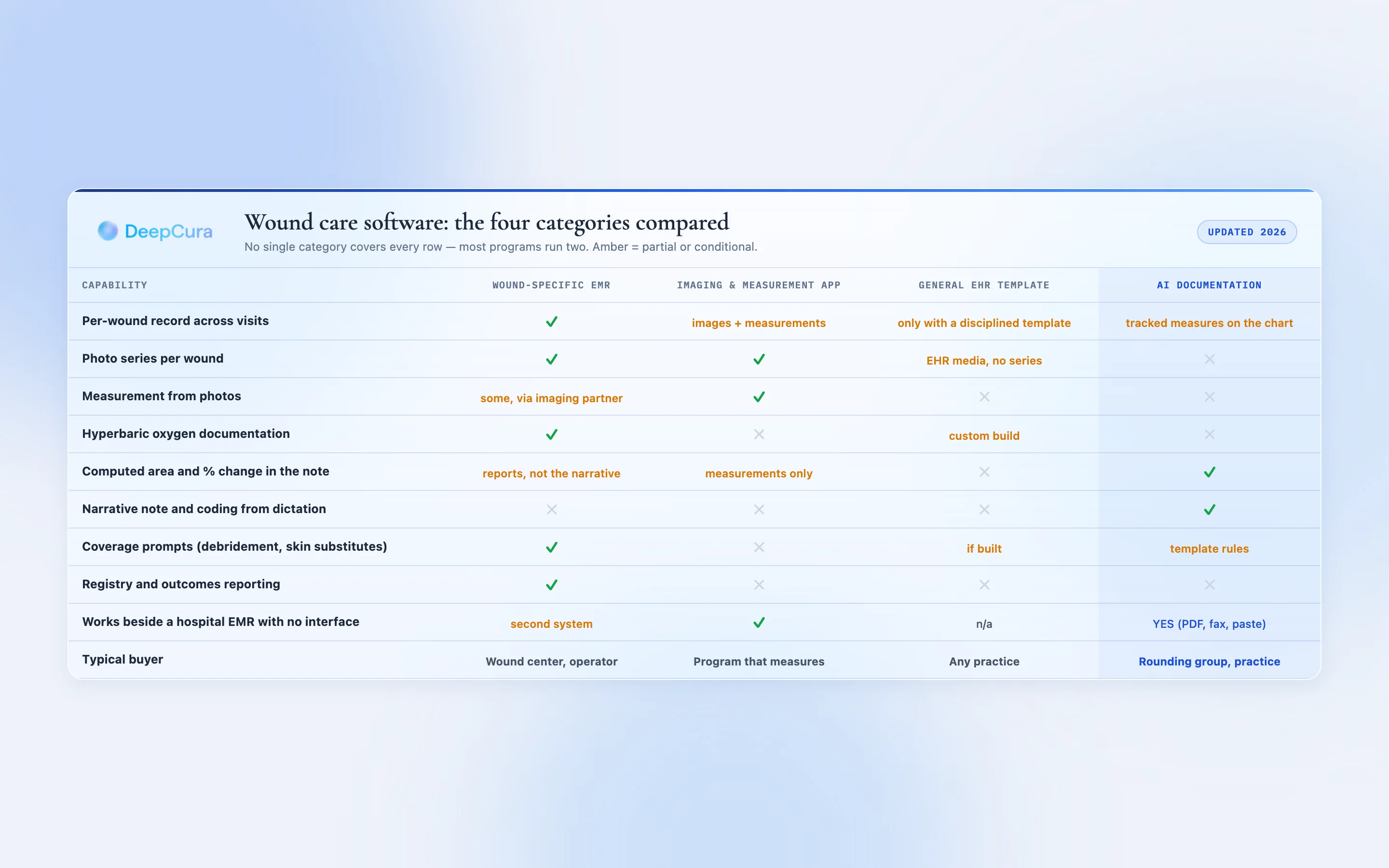
Four kinds of software claim the wound clinic. Most programs need two of them, and which two depends on where the wounds are treated. A hospital outpatient wound center with hyperbaric oxygen, a physician group rounding through skilled-nursing facilities, and a private practice seeing a dozen chronic wounds a month are buying different things, even when the vendor websites use the same words.
This guide sorts the market so you can decide in one sitting:
- What a wound care EMR actually does that a general EHR does not, and when that difference is worth a second system
- The four categories you will be quoted: wound-specific EMRs, imaging and measurement apps, general EHRs with wound templates, and AI documentation
- Which category fits which program, with the trade-off stated for each
- What it costs and the six questions to ask before you sign
- How the note gets into the hospital's EMR when there is no integration
- Where an AI scribe fits in wound care, and where it does not
DeepCura publishes this guide and is one of the tools discussed. DeepCura is not a wound care EMR and is not ranked as one here: it is AI documentation that sits beside whatever system holds the chart, and this guide says where a wound-specific EMR or an imaging tool is the better pick. No vendor prices are quoted for the other categories, because none are published and we did not obtain quotes; DeepCura's own plan comes from its pricing page and was checked on the date shown. The wound-care documentation requirements referenced here are covered in detail in the companion guide linked below.
What a wound care EMR actually does (and a general EHR does not)
A general EHR stores a wound as text in a progress note, or as a flowsheet row if someone built one. A wound care EMR stores the wound as a record of its own: each wound has an identity that persists across visits, and every measurement, photo, product and procedure attaches to it. Everything else a wound-specific system offers follows from that one design choice.
- A per-wound record with location, etiology, classification, serial measurements, tissue composition, exudate and the interventions applied at each visit, so the trend is a chart rather than a paragraph.
- Photo capture tied to the wound and the visit, usually with a measurement overlay, consent capture and a side-by-side history.
- Hyperbaric oxygen therapy documentation for programs that run a chamber: dive logs, treatment counts, safety checks and the physician attendance record payers ask for.
- Coverage prompts that surface the elements a Medicare contractor's coverage determination expects before a debridement or a skin-substitute application is billed: weeks of standard care, area reduction, product and area applied.
- Product and lot tracking for cellular and tissue-based products, which matters more in 2026 now that Medicare pays those products per square centimeter.
- Registry and outcomes reporting: healing rates, days to heal and benchmark reports across a program or an operator's sites, the numbers a hospital administrator asks for when the program's contract is reviewed.
If your program runs a chamber, applies advanced products weekly and reports outcomes to an operator or a hospital, that list is the job description and a wound-specific EMR is built for it. If your wounds are a fraction of a general practice or a rounding day, the same list is a second login and a second contract for features you will use twice a month.
The four categories of wound care software
Wound-specific EMRs
Net Health WoundExpert and Intellicure are the two names most hospital outpatient wound programs evaluate. Both are wound care EMRs in the sense above: per-wound records, photo history, HBOT documentation, product tracking and outcomes reporting, sold to wound centers and multi-site programs rather than to individual clinicians. The trade-off is structural: they hold the wound record beside the hospital's own EMR, so registration, orders and the legal medical record still live in the hospital system, and the clinician documents in the wound EMR while the rest of the chart lives elsewhere.
Imaging and measurement apps
Swift Medical, eKare inSight and Tissue Analytics (now part of Net Health) measure wounds from a smartphone or tablet photo, some with 3D depth capture, and keep a per-wound image series with the measurements attached. MolecuLight is a related device category: fluorescence imaging that visualizes bacterial load rather than dimensions. These tools replace the paper ruler and the applicator, and they solve the photo-series problem that most EMRs and every AI scribe leave open. They do not write the narrative note, code the visit, or hold the plan; they feed measurements into whatever does.
General EHRs with wound documentation
Epic, Oracle Health, athenahealth, eClinicalWorks and the other general systems document wounds through templates, flowsheets or SmartForms that a practice or a hospital builds. This is the category most wound patients are actually documented in, and its strength is that there is no second system. Its weakness is that the wound has no identity of its own unless the template is disciplined: the same block in the same order every visit, with the arithmetic done by the clinician. The wound care documentation guide gives that block.
AI documentation
An AI scribe or dictation tool produces the note from what the clinician says. In wound care the useful ones do something different from conversation-listening: they take dictated measurements and compute the surface area, the change from the prior visit and from baseline, the per-wound summary table and the coding arithmetic, in a fixed block that a spreadsheet or a registry can parse. DeepCura's wound template works this way, on a general EHR or beside a hospital EMR with no integration, with tracked measures confirmed by the clinician on the patient's chart. It does not measure wounds, does not hold a photo series per wound, and is not a wound registry.
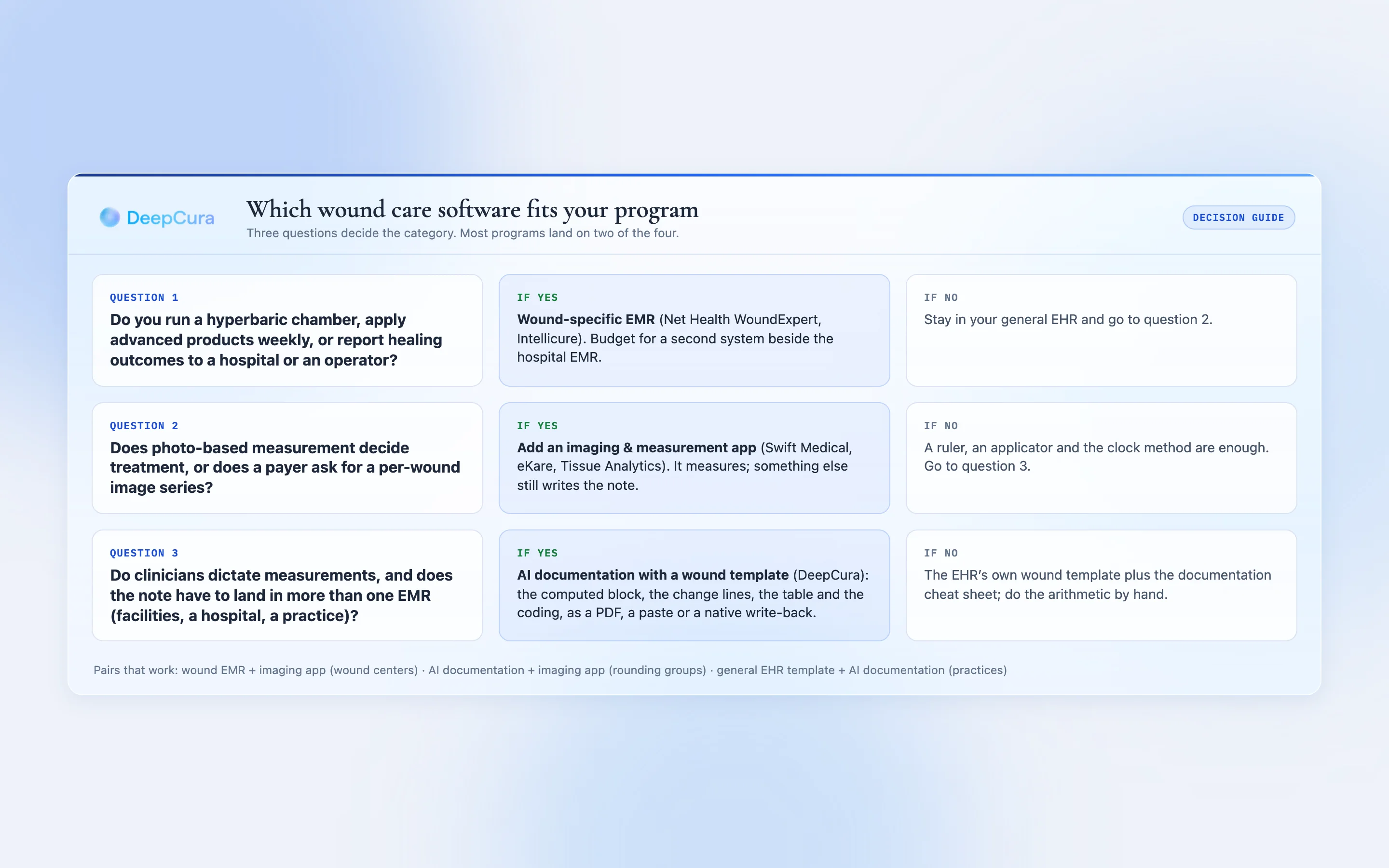
Which wound care software fits which program
| Situation | Strongest fit | Why | Trade-off |
|---|---|---|---|
| Hospital outpatient wound center with hyperbaric oxygen, weekly advanced products and outcomes reporting to the hospital or an operator | Wound-specific EMR (Net Health WoundExpert or Intellicure) | HBOT logs, product and lot tracking, coverage prompts, registry exports | A second system beside the hospital EMR; facility-level contract; clinicians still type the note |
| Multi-site wound program run by an operator inside host hospitals | Wound-specific EMR, plus an imaging app where photo evidence drives product decisions | One standard every host site inherits; benchmark reporting across sites | Each host hospital signs its own agreement and runs its own IT review; two vendors to align |
| Physician group rounding through skilled-nursing facilities and home visits, notes copied into each facility's EMR | AI documentation with a wound template, on a phone or tablet | Dictated measurements become the computed block, the change lines, the table and the coding; the signed note is a PDF for any EMR | No wound measurement from photos; values confirmed each visit; a facility EMR with no integration still gets a paste or a fax |
| Private practice on a general EHR (athenahealth, eClinicalWorks, AdvancedMD, OptiMantra and the others on the list) with wounds as part of the panel | AI documentation with a wound template, written into the EHR where an integration exists | No second system; the wound block and the trend live in the existing chart | Not a registry; no HBOT module; photo series only through the EHR's own media |
| Program that needs measurement from photos above all else | Imaging and measurement app | Calibrated measurement, 3D depth, a per-wound image history | The narrative, the coding and the plan still need another tool |
| Clinic with a handful of chronic wounds a month | The general EHR's own template plus the documentation cheat sheet | Nothing new to buy or learn | The arithmetic and the visit-to-visit comparison are done by hand |
Two honest notes on that table. First, the wound-specific EMR row is where DeepCura is not the right pick on its own: a program that needs a chamber module and registry exports needs the system built for them, and AI documentation can only sit beside it. Second, the imaging row and the AI documentation row are complements, not rivals: one measures, the other writes and computes, and neither replaces the other today.
What wound care software costs, and the six questions to ask
Wound-specific EMRs and imaging platforms are quoted per facility, per provider or per device after a demo; none of the vendors named above publishes a price list, and this guide did not obtain quotes, so no figures are given for them. General EHR wound templates cost the time to build them. AI documentation is the one category with public pricing:
$129 per provider per month (or $999/yr) with 1,000 credits a month across every AI agent — a standard note costs 1 credit, premium reasoning models 3, the deepest reasoning tier 15. Free trial, no credit card.Credit math for a wound day: at one credit per standard note, twenty facility patients are twenty credits on the standard engine, or sixty on a premium reasoning engine, which a rule-heavy wound template needs. That is the whole cost of the documentation layer for that day; the EMR that holds the chart is priced separately.
Before you sign with any vendor in the first two categories, ask these six questions in writing:
- Does the system record the elements your Medicare contractor's coverage determination requires for debridement and for skin substitutes, and can it show them per visit without a custom report?
- How are photos consented, stored and exported, and can a per-wound image series leave the system if you change vendors?
- Does the wound record leave with you as structured data, or only as PDFs?
- What is the interface to the hospital's EMR: an HL7 document message, a discrete-data interface, or a copy-and-paste workflow?
- Who is the clinician documenting in, and how many logins does a visit take?
- What does the contract cost per facility when a second site is added, and who pays when the program is run by an operator inside a host hospital?
How the note gets into the hospital's EMR
The question that decides most wound-care software purchases is not which tool writes the best note but how the note lands in the system of record. The options form a ladder, from no integration to full integration, and a program should start on the lowest rung that its compliance office accepts rather than wait a year for the top one.
- Copy and paste. Universal, and what most rounding groups do today into Practice Fusion, Paragon and similar systems. Tables do not survive the paste in every EMR; the fixed block does.
- The signed note as a PDF. DeepCura stores the e-signed note as a PDF that can be faxed to health information management or uploaded as a document, which lands in the hospital chart with zero interface work.
- A document message. An HL7 interface that carries the PDF or the text as a document is the simplest interface most hospital IT departments will approve.
- Native integration. Where the EHR is on DeepCura's integration list, the note and its diagnoses and orders write back into fields; for the rest, the list says "not on our current integration list" and the ladder applies. Many hospital EMRs expose read-only interfaces to outside vendors, so a document message is often the realistic top rung. See the athenahealth and eClinicalWorks guides for what native write-back looks like.
Ask the clinicians which is harder, making the note or entering it. The answer picks the rung.
See a wound note compute itself
Dictate the measurements and watch the surface area, the change from baseline and the per-wound table appear in the note. Free trial, no credit card.
+1 (415) 549-1829Available 24/7 · Set up in seconds · No credit card required
Where an AI scribe fits in wound care, and where it does not
Searches for a wound care AI scribe are new, and the phrase hides a distinction that matters. A conversation-listening scribe transcribes the visit and summarizes it; that is the tool most vendors sell, and it adds little to a wound visit, because the clinician already states the numbers and the note's value is in what is done with them. A computing scribe takes the dictated numbers and does the arithmetic, the comparison and the coding, in a format that never changes. The first kind saves typing; the second kind saves the spreadsheet, the calculator and the audit reconstruction.
What DeepCura's wound template does, verified on a live account in September 2026: a fixed block in the same order every visit; surface area computed from the dictated length and width; change from the prior visit and from baseline in cm² and percent, using the patient's tracked measures that the clinician confirms in the chart or the previous note attached as context; a per-wound summary table; a procedure paragraph inserted by the practice's own trigger phrase; coding arithmetic from the documented depth and area; and site-specific diagnoses staged for approval. Templates are built per account from a sample note on the setup call or with the template tools; there is no pre-built wound library.
What it does not do, so you can plan the pair correctly: it does not measure the wound or photograph it; it does not keep a photo series per wound; it does not replace a wound registry; and it needs a reasoning engine tier, because the fastest tier drops rules and invents values. For the broader field of AI scribes across specialties, see the best AI medical scribes comparison and the AI medical scribe overview.
Medicare 2026 and the software question
Medicare's 2026 changes moved the burden of wound care billing onto the measurement record. Skin-substitute products applied in the office are now paid as supplies at a single per-square-centimeter rate, and the contractors' coverage determinations for diabetic foot ulcers and venous leg ulcers require, before the first application, documented standard care for at least four weeks with less than a 50% reduction in wound area, measurements at every visit, and a limited number of applications per episode. Debridement codes continue to be selected by depth and by total area.
For a software decision that means one test: can the system show, per visit and without a custom report, the measurements, the computed area, the percent change from baseline, the weeks of standard care, and the product and area applied? A wound-specific EMR does this by design. A general EHR does it only with a disciplined template. AI documentation does it when the template computes those lines from the dictation. Whatever you buy, run the test on your own patient before the contract, using the elements in the wound care documentation guide.
CPT® codes are referenced by number only in this guide. CPT® is a registered trademark of the American Medical Association.
Frequently Asked Questions
What is a wound care EMR?
A wound care EMR is an electronic medical record built around the wound as its own record: each wound keeps an identity across visits with its measurements, photos, tissue composition, products and procedures attached, plus hyperbaric oxygen documentation, coverage prompts and outcomes reporting. General EHRs document wounds as text or flowsheet rows inside the visit note instead.
Do I need a wound-specific EMR?
You need one if your program runs a hyperbaric chamber, applies advanced products weekly, tracks products by lot, or reports healing outcomes to a hospital or an operator. A practice or a rounding group whose wounds are part of a broader panel usually does better with a disciplined wound template in its existing EHR, with or without AI documentation and an imaging app.
Can an AI scribe replace a wound care EMR?
No. An AI scribe writes and, in wound care, computes the note; it does not hold the wound record, the photo series, the HBOT logs or the registry reports. It replaces the spreadsheet and the hand arithmetic, and it sits beside whatever system holds the chart.
What is the best software for wound care documentation?
It depends on the program: a wound-specific EMR for hospital wound centers with hyperbaric oxygen and outcomes reporting, an imaging app where photo-based measurement matters most, the general EHR's own template for low volumes, and AI documentation with a wound template for physician groups and practices that dictate measurements and need the computed note in any EMR.
How do wound care apps measure wounds from photos?
Imaging apps calibrate a smartphone or tablet photo with a reference marker or a depth sensor, trace the wound edge, and compute length, width, area and in some products depth and volume, keeping each image in a per-wound series. They feed measurements to the documentation; they do not write the note.
How does a wound note get into an EMR that has no integration?
Copy and paste the note, upload or fax the signed PDF to health information management, or ask the hospital's IT department for an HL7 document interface. Discrete-data integration is available only where the EMR is on the documentation tool's integration list.
What changed for wound care software in 2026?
Medicare began paying office-applied skin substitutes as supplies at a single per-square-centimeter rate, and its contractors' coverage determinations require documented standard care with measured wound area before and during treatment, with a limited number of applications per episode. Software now has to show those measurements per visit, whichever category it belongs to.
Final Thoughts
Buy the category your program's wounds live in, not the one with the longest feature list. A wound center with a chamber and an outcomes report due every quarter needs a wound-specific EMR, and probably an imaging app beside it. A physician group rounding through facilities and pasting notes into three different EMRs needs the note computed and portable, which is what AI documentation with a wound template does, and it should not pretend to be a registry. Whichever you choose, run the Medicare test on your own patient before you sign, and keep the documentation checklist beside the contract.
References
[1] Centers for Medicare & Medicaid Services, "Calendar Year (CY) 2026 Medicare Physician Fee Schedule Final Rule," fact sheet, CMS. cms.gov
[2] Centers for Medicare & Medicaid Services, "Medicare Coverage Database," local coverage determinations for wound care, debridement services, and skin substitute grafts/cellular and tissue-based products for diabetic foot ulcers and venous leg ulcers (effective 2026), CMS. cms.gov/medicare-coverage-database
[3] Centers for Medicare & Medicaid Services, "Complying With Medical Record Documentation Requirements," MLN Fact Sheet MLN909160, CMS. cms.gov
[4] National Pressure Injury Advisory Panel, "NPIAP Pressure Injury Stages," NPIAP. npiap.com/page/PressureInjuryStages
[5] Net Health, "WoundExpert" and "Tissue Analytics" product pages, Net Health Systems, accessed 2026-09-30. nethealth.com
[6] Intellicure, wound care EHR and registry product pages, Intellicure, accessed 2026-09-30. intellicure.com
[7] Swift Medical, "Swift Skin and Wound" product pages, Swift Medical, accessed 2026-09-30. swiftmedical.com
[8] eKare, "inSight" wound imaging product pages, eKare, accessed 2026-09-30. ekare.ai
[9] MolecuLight, fluorescence wound imaging product pages, MolecuLight, accessed 2026-09-30. moleculight.com
[10] American Medical Association, "CPT® (Current Procedural Terminology)," AMA. ama-assn.org/practice-management/cpt