HEALTHCARE CRM

The Healthcare CRM Software That Fills Itself

Every CRM on earth runs on fields somebody had to type. This one runs on the chart itself.

Healthcare CRM software is supposed to keep every patient relationship organized — but a medical CRM is only as good as the data somebody keys into it. DeepCura takes a different path: the CRM record is built from the clinical visit itself — coded facts extracted from the conversation, staged with evidence, and approved by you. One thread per patient. Plain-English panel queries. $129/month, everything included.

No credit card required

Why Most Healthcare CRM Software Goes Stale in 90 Days

Every CRM for healthcare providers starts the same way: a clean database, a set of custom fields, and a plan for the front desk to keep them current. Then reality arrives. The person expected to type the data — the medical assistant between rooming patients, the front desk between phone calls, the physician after clinic — is exactly the person with the least time to do it. Fields go blank. Tags drift out of date. The “last A1c” column stops matching the chart. Within a quarter, the CRM for your medical practice has become a second system nobody fully trusts, sitting next to the EHR nobody wants to duplicate.

This isn’t a failure of any particular vendor — established platforms are capable systems, and EHR reporting modules can run real registries. It’s a structural problem: manual data entry is a tax, and clinical teams are the most over-taxed workforce in the economy. Any patient CRM that depends on typing will always lag behind the truth of the chart, because the truth of the chart is spoken out loud in the exam room and documented once — not twice.

The fix isn’t more discipline. It’s changing where the data comes from. If the facts a medical CRM needs — diagnoses, medications, lab values, follow-up intent — are already being said during care, the CRM should be built from those moments directly, with the clinician approving what lands. That is what DeepCura does, and it’s why the record stays current without anyone doing data entry.

WATCH DEMO

See the Chart Fill Itself

DeepCura AI Medical Scribe Platform Demo
HOW IT WORKS

How a CRM Built on the Chart Fills Itself

01

The visit is recorded

The AI scribe listens to the encounter and extracts coded clinical facts — diagnoses (ICD-10), medications (RxNorm), labs and vitals (LOINC), allergies (SNOMED), immunizations (CVX) — validated against current official code releases before anything is proposed.

02

Every fact is staged with its evidence

Each suggested fact carries the verbatim quote it came from and the exact second of visit audio. Nothing touches the record until a clinician reviews it — approve, edit, or reject, with every decision audited.

03

Approved facts become queryable fields

Once approved, a fact is a structured field on the patient record — trendable over time, filterable across your whole panel, and exportable. The CRM database builds itself as a byproduct of care.
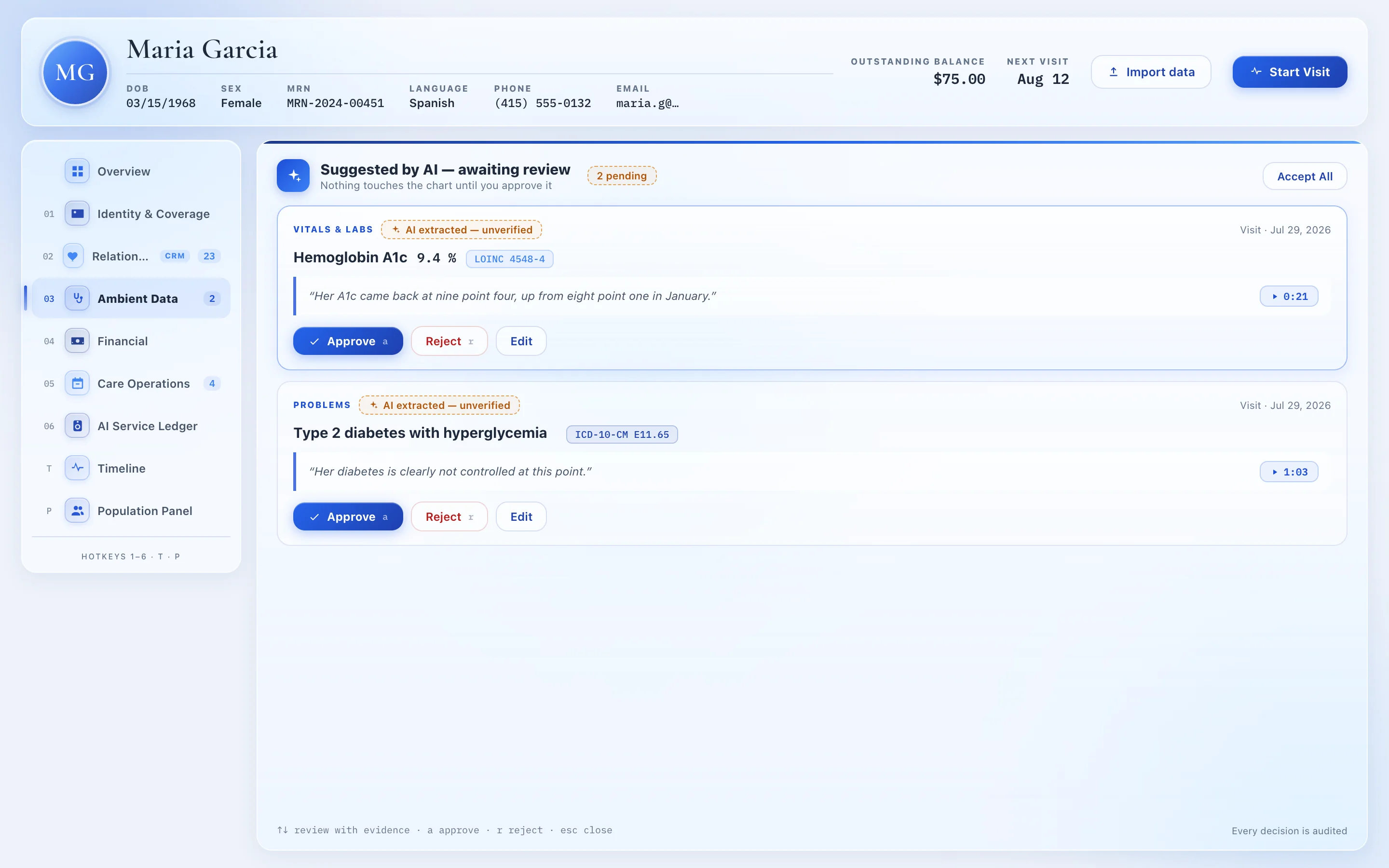
DeepCura clinical fact review card showing an extracted A1c value with its verbatim quote, audio timestamp, and approve or reject controls

Illustrative interface with simulated patient data.

To our knowledge, this makes DeepCura the first US system that turns conversations into population-level data — the chart writes itself, every value carries its evidence, every entry approved by you.

Our claim, and precisely scoped: ambient visit conversation captured as coded, per-value-evidenced, clinician-approved chart data that is queryable across patients. Ambient documentation tools stop at the encounter; chart-intelligence tools mine existing records without ambient capture. Based on a competitive review of US vendors in both categories, July 2026, re-verified quarterly.

Every Field a Healthcare CRM Needs — Without the Typing

The patient CRM software fields you’d normally maintain by hand, next to where DeepCura gets them.

Diagnosis and problem lists, retyped from the chart

Extracted from the recorded visit and approved by you

Medication fields, updated when someone remembers

Captured when you say them, with the quote attached

Lab values copied into custom fields

Coded LOINC values that trend automatically

Contact preferences on a sticky note

Preferred channel and TCPA consent as fields on the record

Tags and status, maintained by whoever has time

Lifecycle status, tags, and referral source set once, kept on the chart
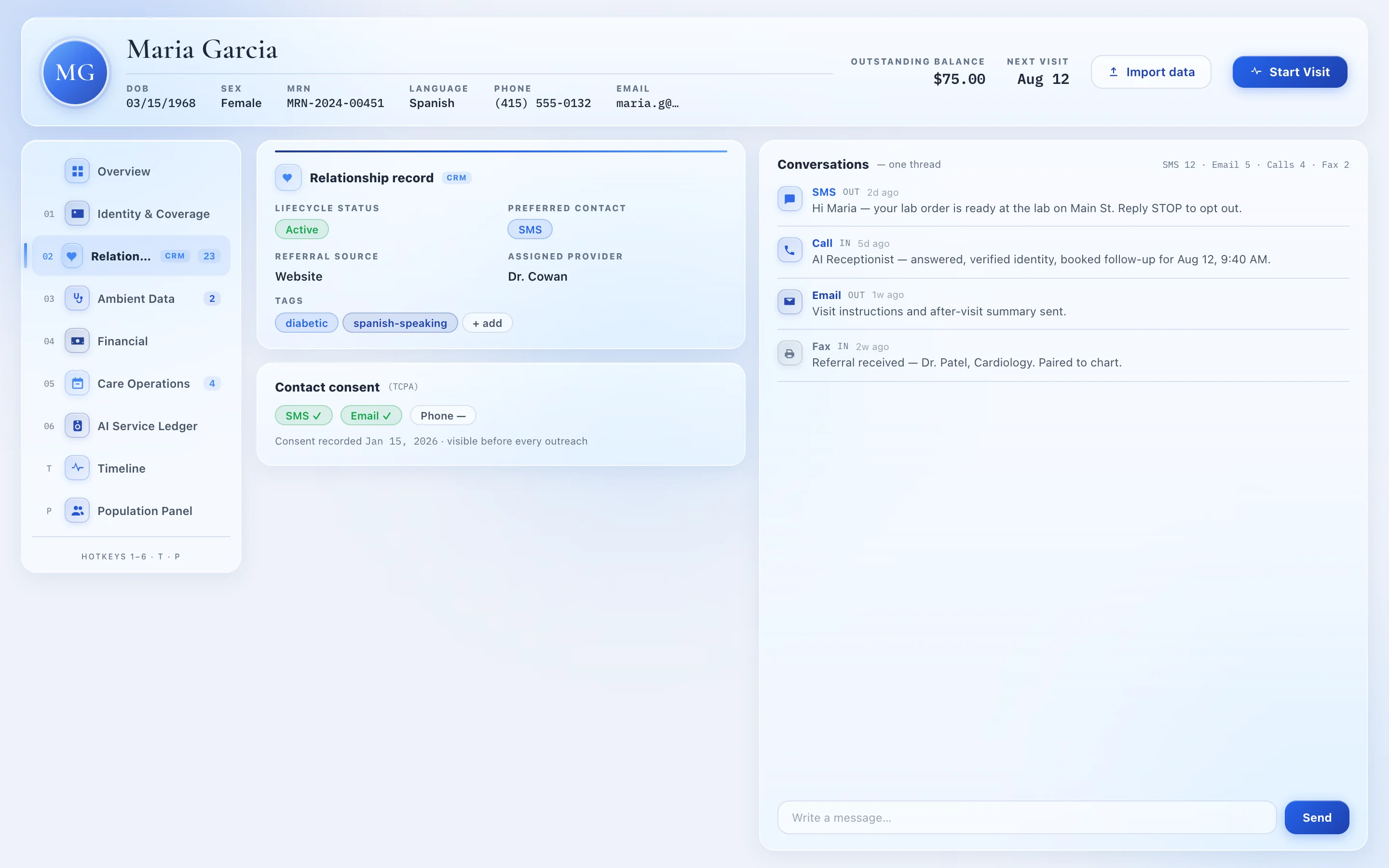
DeepCura Relationship lens showing healthcare CRM fields on the patient chart: lifecycle status, tags, referral source, preferred contact channel, TCPA consent, and a unified conversation thread

Illustrative interface with simulated patient data.

Lifecycle status, tags, referral source, preferred channel, and contact consent are fields you set on the record — nothing here is a computed score. What the chart does automatically is carry the clinical facts and the full conversation history alongside them.

One Conversation Thread: SMS, Email, Calls, and Faxes

Every touchpoint with a patient lands on one thread on their chart: two-way SMS (consent-gated, with STOP handling built in), emails, phone calls answered by the 24/7 AI receptionist — including the booking it made and the call summary — and inbound faxes paired to the right patient. Before anyone reaches out, the preferred channel and TCPA consent state are visible right on the record.

And a line worth being explicit about: DeepCura does not send bulk campaigns or drip sequences. Messaging is person-to-person. The system’s job is to make sure the person reaching out has the full history and the patient’s consent in front of them.

POPULATION PANEL

Ask Your Whole Panel a Question in Plain English

Because the record is coded, the panel is queryable. Three modes: threshold (“every diabetic with a latest A1c above 9” — 28 matched of 216 scanned, on a demo panel), exists (everyone with a condition or medication on record), and missing (everyone overdue for a value — a recall list with a one-click CSV export). Every row shows its evidence.

If you bill insurance

Registries and care-gap closure

Run your diabetes, hypertension, or CKD registry as a live query. Missing-mode results are care-gap lists, and a quality-style denominator is one panel question away. Read the care gaps guide.

If you’re cash-pay or wellness

Recall and reactivation

The same query engine builds recall and reactivation lists from your own charts — patients overdue for a follow-up, a retest, or a next visit. See patient recall software.

Four Things a CRM Built on the Chart Does Differently

Self-filling data

The database is a byproduct of the visit. Nobody types CRM fields after hours — the facts are extracted from care as it happens and approved by the clinician.

Per-row audio provenance

Every value can show you the verbatim quote and play the exact second of audio it came from. A CRM field you can audit is a CRM field you can trust.

Self-serve custom concepts

Track anything your practice cares about — custom concepts you define yourself (DeepCura calls them Ambient Trackables) — charted longitudinally and queryable like any built-in field.

Asking out loud

Query your panel conversationally. Say or type a question and the Population Panel runs it — threshold, exists, or missing — and shows its work on every row.

Established platforms run registries too. The difference is where the data comes from — and what each row can prove.

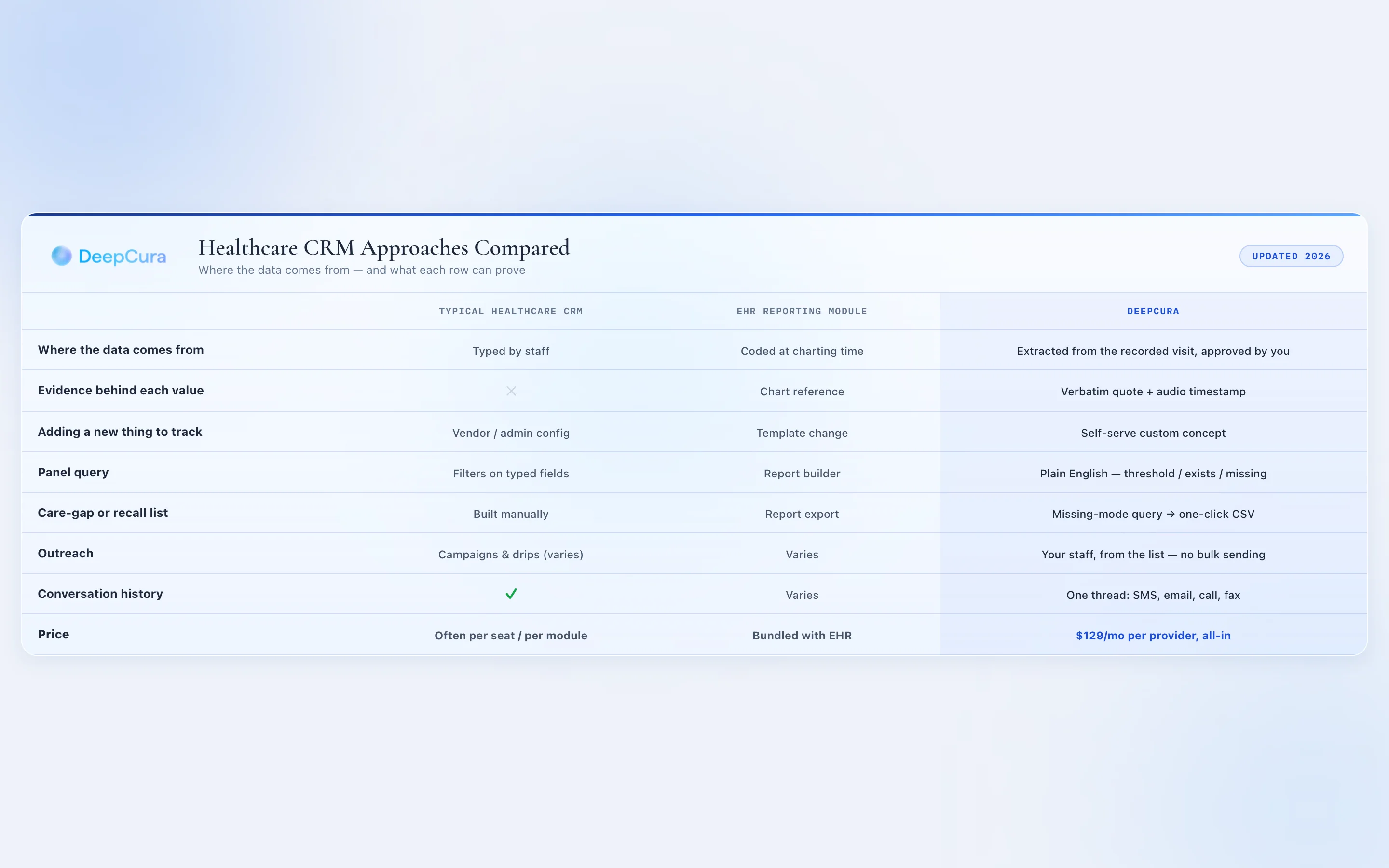
Healthcare CRM vs. EHR Reporting vs. a Chart-Native Record

Typical healthcare CRMEHR reporting moduleDeepCura
Where the data comes fromTyped by staffCoded at charting timeExtracted from the recorded visit, approved by you
Evidence behind each valueChart referenceVerbatim quote + audio timestamp
Adding a new thing to trackVendor or admin configTemplate changeSelf-serve custom concept
Panel queryFilters on typed fieldsReport builderPlain English — threshold, exists, missing
Care-gap or recall listBuilt manuallyReport exportMissing-mode query → one-click CSV
OutreachCampaigns and drips (varies)VariesYour staff, from the list — no bulk sending
Conversation historyYesVariesOne thread: SMS, email, call, fax
PriceOften per seat or per moduleBundled with the EHR$129/mo per provider, all-in
Comparison chart of healthcare CRM software approaches: typical CRM vs EHR reporting module vs DeepCura's chart-native record

$129 a Month. Everything Included.

The relationship record, the Population Panel, the AI scribe, the 24/7 AI receptionist, and EHR integrations — one price per provider. No per-seat CRM licensing, no per-module upselling.

$129/mo
FAQ

Healthcare CRM Software FAQ

What is a healthcare CRM?

A healthcare CRM (customer relationship management system) organizes patient relationships — contact details, communication history, lifecycle status, preferences, and consent — so a practice can follow up, recall, and retain patients. Traditional healthcare CRMs depend on staff typing this data in; DeepCura builds the record from the clinical visit itself, with every entry approved by a clinician.

How is a healthcare CRM different from an EHR?

An EHR is the legal system of record for clinical care and billing. A healthcare CRM manages the relationship around that care — outreach lists, communication threads, preferences, and follow-up. DeepCura sits alongside your EHR rather than replacing it: your EHR stays the system of record while DeepCura organizes the relationship and panel-level views.

Do I have to type patient data into DeepCura?

Not for the clinical substance. Coded facts are extracted from recorded visits and staged for your approval, and patient demographics can be imported. Relationship fields like lifecycle status, tags, referral source, and preferred contact channel are simple fields you set once on the record — they are not computed scores.

Where do the CRM fields come from, and can I see the evidence?

Clinical fields come from the recorded visit: each extracted fact carries the verbatim quote and the exact second of audio it came from, and nothing lands on the record until a clinician approves it. Relationship fields (status, tags, consent, preferred channel) are set by your team and kept on the chart.

Can I query my whole patient panel at once?

Yes. The Population Panel runs plain-English queries across your panel over one coded concept or a curated registry family (diabetes, hypertension, or chronic kidney disease) — for example, patients above a lab threshold, patients with a condition on record, or patients missing a recent value. Results show every matched patient with the evidence behind each row, and export to CSV in one click.

Does DeepCura send automated reminders or marketing campaigns?

No. DeepCura does not send bulk campaigns, drip sequences, or automated reminders. It builds the list — a recall or care-gap query with a one-click CSV export — and your staff does the outreach, person to person. When patients call back, the AI receptionist answers 24/7, books appointments, and can text links or payment requests during the call.

Does DeepCura replace my EHR?

No. Your EHR remains the system of record for billing, e-prescribing, and compliance. DeepCura works on top of it — capturing the visit, organizing the relationship, and making your panel queryable — with bi-directional note write-back to EHRs including Epic, eClinicalWorks, Athena, AdvancedMD, and OptiMantra.

How much does DeepCura's healthcare CRM cost?

DeepCura costs $129/month per provider with everything included — the AI scribe, the Population Panel, the relationship record, the 24/7 AI receptionist, and EHR integrations. There is no per-seat CRM pricing, no per-module fees, and a free trial requires no credit card.

References

  1. National Committee for Quality Assurance, “HEDIS and Performance Measurement,” ncqa.org. ncqa.org/hedis
  2. Centers for Medicare & Medicaid Services, “Quality Payment Program,” qpp.cms.gov. qpp.cms.gov
  3. Regenstrief Institute, “LOINC — the international standard for identifying health measurements,” loinc.org. loinc.org
  4. National Library of Medicine, “RxNorm,” nlm.nih.gov. nlm.nih.gov/rxnorm
  5. SNOMED International, “SNOMED CT,” snomed.org. snomed.org
  6. Centers for Disease Control and Prevention, “CVX — Vaccine Administered Codes,” cdc.gov. cdc.gov/vaccines
  7. Federal Communications Commission, “Telephone Consumer Protection Act (TCPA) Rules,” fcc.gov. fcc.gov

HEDIS® is a registered trademark of the National Committee for Quality Assurance (NCQA). Mentions of third-party organizations and standards are descriptive and do not imply affiliation, endorsement, or certification.

GET STARTED

A CRM Your Team Never Has to Feed

Record a visit, review the suggested facts, and watch the record build itself — with the evidence one click away.

No credit card required · HIPAA compliant · BAA included