
US adults receive just over half of the preventive and chronic care that clinical guidelines recommend — everything in the missing half is a care gap. A landmark 2003 national study of care quality found adults received 54.9% of recommended care, and AHRQ's national quality reports still document persistent gaps in screenings, immunizations, and chronic care today.
The patients behind those numbers are already on your panel — overdue, findable, and invisible. Care gaps in healthcare are, at root, a visibility problem: the value was said out loud in an exam room and never landed in a queryable field. This guide is a working manual for finding and closing them in a small or mid-sized practice:
- What care gaps are — the four types, with real ICD-10, LOINC, CVX, and RxNorm coded examples
- What the quality vocabulary means — HEDIS care gaps, MIPS, and eCQMs in plain English
- How to run a care gap analysis — a tool-neutral method, then an honest map of care gap closure software
- How to close gaps — a worked panel query and a 30-day playbook that ends in booked appointments
Definitions first, because the vocabulary matters.
DeepCura appears in this guide as one way to solve the underlying data problem — we build it. This is educational content about care gaps and quality terminology, not medical or billing advice.
What Are Care Gaps in Healthcare?
A care gap is the difference between the care a patient should receive under evidence-based guidelines and the care their record shows they actually received. A patient with diabetes and no hemoglobin A1c in the past year has a care gap. So does a 58-year-old with no colorectal screening on file, and a child behind on the immunization schedule.
Formally, every care gap is a denominator-and-numerator problem: the denominator is everyone who qualifies for a service (every patient with diabetes), the numerator is everyone who received it on time (an A1c in the last six months), and the gap is the difference. The framing makes gaps countable — measurable, workable, re-measurable.
Gaps matter clinically (missed early detection, drifting chronic disease), financially (quality-linked payments are priced off gap rates), and operationally: every unclosed gap is an appointment that never got booked — the work of closing gaps is scheduling, not paperwork.
Gaps in Care, Care Gaps, and Care Gap Closure: What Each Term Means
The terminology is inconsistent across payers, vendors, and quality programs:
- Care gap / gap in care / gaps in care — the same concept in three grammatical outfits: recommended care with no documentation it happened. Payers say "gaps in care"; vendors say "care gaps."
- Open vs. closed gap — a gap stays open until the service is delivered and documented in coded form — care that happened but never landed in a structured field still reads as open.
- Care gap analysis — the measurement step: defining denominators and counting who is missing from the numerators.
- Care gap closure — the workflow step: gap → contact → booked appointment → delivered care → coded documentation.
- Patient recall — the front-office side of closure: contacting overdue patients and getting them scheduled — see our patient recall software page.
- HEDIS gap / quality gap — a care gap defined by a formal quality measure rather than clinical judgment alone (more below).
The Four Types of Care Gaps (With Coded Examples)
Most care gaps fall into four buckets. Each example names the standard codes involved, because a gap only becomes queryable once its facts are coded.
1. Preventive Care Gaps
Recommended screenings and immunizations the record does not show: no colorectal cancer screening encounter (ICD-10 Z12.11) for an eligible adult; no influenza vaccine (CVX 141) this season; pneumococcal vaccination missing per the CDC immunization schedules. The most-measured category — intervals are explicit and age-based.
2. Chronic Disease Monitoring Gaps
The condition is documented; the monitoring is not. Type 2 diabetes on the problem list (ICD-10 E11.9) with no hemoglobin A1c (LOINC 4548-4) in a year; hypertension (I10) with no blood pressure reading (systolic LOINC 8480-6); chronic kidney disease with no recent creatinine (LOINC 2160-0). These are the gaps that quietly become emergencies.
3. Medication and Treatment Gaps
The plan names a therapy that never shows up — or lapses: the patient agreed to start metformin (RxNorm 6809), but it never reaches the medication list; refills stop and nobody notices. Coded medications make these queryable too: condition present, expected therapy absent.
4. Follow-Up and Transition Gaps
Care started but never completed: an abnormal result with no repeat test, a referral whose consult note never returned, a discharge with no follow-up visit — the seams between organizations, where unstructured documents pile up.
Why Care Gaps Happen: The Data Problem Underneath
Most care gaps are not knowledge failures — clinicians know the patient with diabetes needs an A1c. They are data failures, compounding four ways:
1. The fact was spoken but never structured. The A1c was discussed, the pharmacy flu shot mentioned — none of it landed in a coded field. Family physicians routinely manage three or more problems in a 15-minute visit — our best AI scribe for family medicine guide covers that load — and discrete-field data entry is the first casualty.
2. The record is fragmented. Outside results arrive as faxed PDFs and scans; care from urgent care or a specialist lives in someone else's system — in the chart as an image, not in the data as a value.
3. Registries go stale. A registry is only as current as the structured fields feeding it — manual entry decays at the speed of your busiest week, and claims lag by weeks to months.
4. Nobody owns the re-look. Gap lists get pulled for an audit, worked once, and never re-run. Without a cheap way to ask again, the panel goes dark between pulls.
Underneath all four is one root cause: care produces spoken information, and spoken information does not file itself. The gap is invisible because the value was said out loud and never landed in a field. Fixing that at the source is the premise of the second half of this guide.
HEDIS Care Gaps and Quality Reporting: What the Terms Mean
Care gap conversations fill with acronyms fast. The big three:
HEDIS — the Healthcare Effectiveness Data and Information Set, maintained by NCQA — is the standardized measure set most US health plans are scored on. A HEDIS care gap is a member who has not met a measure's numerator — diabetes with no A1c on claims, for example. Plan ratings ride on these measures, so plans push gap lists to practices to close and document.
MIPS — the Merit-based Incentive Payment System, part of the CMS Quality Payment Program — scores clinicians on quality measures and adjusts Medicare Part B payments. eCQMs are electronic clinical quality measures: machine-computable specifications built on HL7 standards and calculated by certified software.
A small practice usually does not need its own certified measure engine — plans, registries, and EHR vendors compute the official numbers. What it lacks is the working layer underneath: seeing, on any Tuesday, which of its own patients sit in a denominator with nothing in the numerator.
DeepCura does not compute HEDIS, MIPS, or eCQM measures. What it does is let you ask a quality-style denominator as a panel query. The HEDIS-shaped question "how many of my diabetic patients have a recent A1c" becomes a plain-English query over your own clinician-approved data.
Care Gap Analysis: How to Find the Gaps in Your Panel
Care gap analysis is a method, not a product. It works the same regardless of tooling:
- Pick a short list of targets. Three gaps that matter to you and your payer contracts beat thirty you will never work.
- Define each gap precisely. Denominator, numerator, recency window: all patients with diabetes / an A1c result / within six months.
- Pull the list from whatever structured data you have: an EHR registry report, a payer-supplied gap list, or a sampled chart audit.
- Validate against the chart. Expect false gaps — payer lists lag, and care done elsewhere may sit in the chart as an unstructured attachment. No list goes to the phones without a human pass.
- Quantify and prioritize by clinical judgment — worst-first beats first-in-list.
Steps 3 and 4 are where the method dies in small practices: the pull depends on structured fields nobody had time to fill, so analysis becomes chart-by-chart archaeology — done once, never repeated. The rest of this guide removes that bottleneck.
Care Gap Closure: Turning a List Into Appointments
A list is not closure. Closure means the gap became a contact, the contact an appointment, the appointment delivered care, and the care a coded entry — so the gap reads closed the next time anyone asks.
Here is the chain as it runs in DeepCura, stated honestly: identify the gaps with a panel query → generate the care-gap recall list in one click → CSV export for outreach → your staff works the list person to person — phone calls, or consent-gated one-to-one texts and emails → when patients call back, the AI receptionist answers 24/7 and books the appointment, nights and weekends included.
There is no automated recall engine in that chain. DeepCura does not send bulk campaigns, drip sequences, or automated reminders — it builds the list and answers the phone; the outreach in the middle is yours. The hard parts of recall were never the sending — they were knowing who to call and catching the call-back at 7pm, the two ends the software covers.
This is clinically targeted outreach, not list-blasting: every patient is on the list because of a coded fact. And the loop closes where it opened: at the next visit the spoken A1c is approved into the record, and re-running the query shows the gap gone.
Care Gap Closure Software: What These Tools Actually Do
"Care gap closure software" covers five different tool categories — knowing which one a vendor sells saves months of mismatched evaluation:
| Category | Where the data comes from | How gaps surface | How outreach happens | Typical fit |
|---|---|---|---|---|
| Payer gap lists | Claims the plan has processed | The plan sends a member gap list | Practice staff work the list | Practices in quality-scored contracts |
| Population health platforms | Aggregated claims + EHR data feeds | Registries and quality analytics | Care-coordination teams with built-in messaging | Health systems, ACOs, large groups |
| EHR registry reports | Structured fields staff typed into the EHR | Built-in registry and recall reports | Handed to the front office | Practices with disciplined structured charting |
| Outreach and recall tools | A list you import | Assumed — you bring the list | Text, phone, and email tooling | Practices that know who is overdue |
| Chart-native ambient extraction (DeepCura) | Clinician-approved coded facts from the visit conversation | Plain-English Population Panel queries | Care-gap recall list + CSV export; your staff makes contact; the AI receptionist answers call-backs 24/7 and books | Small practices without a data team |
Established EHRs and population health platforms run registries well, and payer gap lists catch real gaps every day. The difference is upstream — where the structured data comes from, and how much typing keeps it current. Every category except the last runs on fields somebody typed or claims somebody filed; the chart-native approach builds the coded data during the visit, so its fields stay current without a data-entry step. It is the same engine behind our healthcare CRM, where it fills relationship fields instead of gap lists.
Where Care Gap Data Comes From
To run any query in this guide, the facts underneath must be coded. Five code systems do most of the work — see our medical codes reference:
- LOINC (Regenstrief Institute) — labs, vitals, observations: hemoglobin A1c is LOINC 4548-4, systolic blood pressure 8480-6.
- ICD-10-CM (CDC/NCHS) — diagnoses: E11.9 for type 2 diabetes, I10 for hypertension.
- RxNorm (National Library of Medicine) — medications.
- CVX (CDC) — vaccines, like 141 for seasonal influenza.
- SNOMED CT (SNOMED International) — the broad clinical terminology for problems and findings.
Procedure and billing codes are a separate family — CPT, maintained by the American Medical Association — and outside this article's scope. Every gap in this guide is a question about coded facts, and traditionally those facts exist only if someone typed them into a field after the visit.
DeepCura's Ambient Data approach creates them differently: during a recorded visit, ambient extraction listens for six kinds of codeable clinical facts — diagnoses, medications, lab values, vitals, immunizations, and more — plus family history. Each fact is staged as a suggestion carrying its verbatim quote and audio timestamp; codes are verified against National Library of Medicine terminology services — a fact that fails verification is dropped, not guessed. New values are compared against what the chart already holds, and nothing enters the record until a clinician approves it — one keystroke at a time. You can also define Ambient Trackables — custom clinical concepts you name once, which extraction then listens for in every future visit.
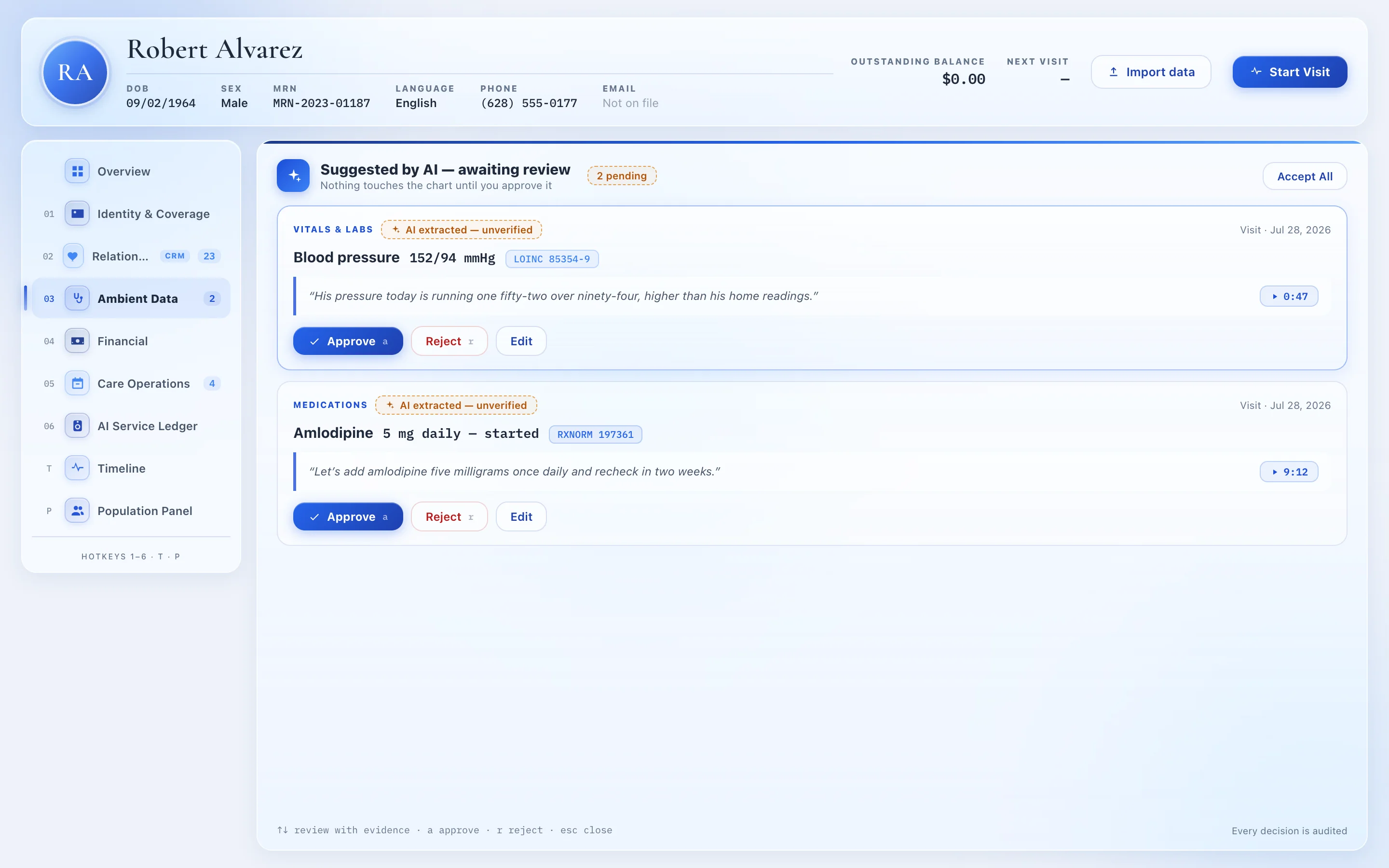
Illustrative interface with simulated patient data.
Two honest boundaries: DeepCura builds this record forward, from live visits — it does not retroactively mine years of old notes — and every fact in the panel is clinician-approved, which is what makes the denominators trustworthy. The result is the promise on our Ambient Data page: "Say it once. Tracked forever."
Running a Care Gap Query on Your Own Panel
Once the facts are coded and approved, finding gaps stops being an afternoon project. In DeepCura's Population Panel you ask in plain English — typed, or out loud in chat. Three modes:
- Threshold — values crossing a line: "every diabetic with latest A1c above 9." On a demo panel of 216 patients, that might return 28 matched · 216 scanned — the honest denominator shown next to the match count.
- Exists — patients with a documented fact: everyone with a documented penicillin allergy, say.
- Missing — the care-gap mode: patients with hypertension and no blood pressure reading in the last 12 months, or diabetic patients with no A1c result in the last six months.
Results render as a beeswarm with per-patient sparklines, and every row keeps its provenance: click a value, see the quote, jump to the second of audio. A wrong-looking number is verified in seconds, not taken on faith.
The boundary, stated plainly: a query today runs over one coded concept at a time, or one of three curated condition families — diabetes, hypertension, and chronic kidney disease — with a recency window. It does not stack payer, demographic, or multi-condition filters, and there are no saved or scheduled panels: you ask, it answers, you export. Within that boundary, any clinical denominator built on a single concept or family is one question away.
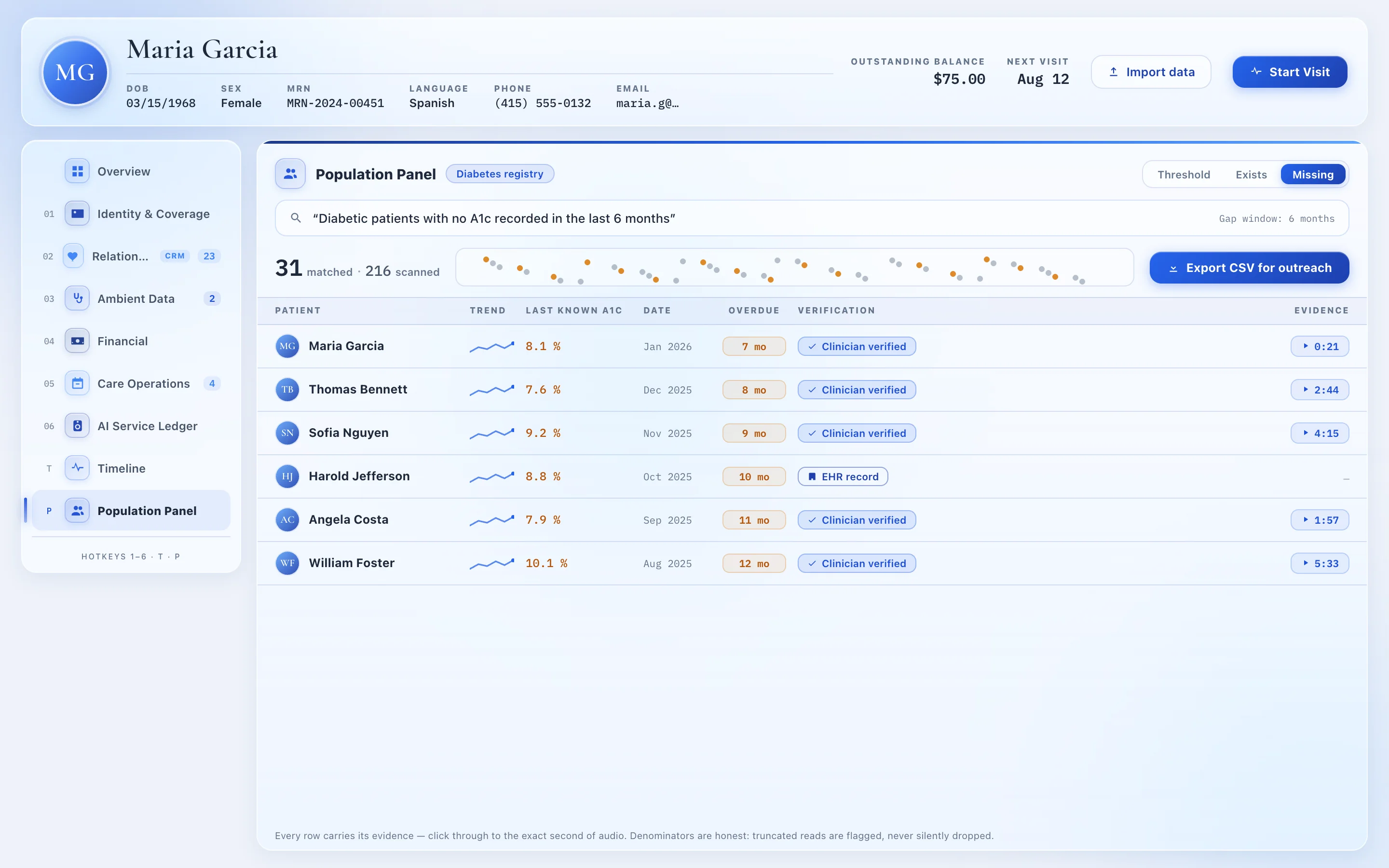
Illustrative interface with simulated patient data.
One click — Export CSV — turns the matches into a care-gap recall list with the values and dates your staff needs.
Ask your panel a question in plain English
DeepCura's Population Panel turns clinician-approved coded facts into care-gap recall lists with one-click CSV export — $129/month, everything included. Start your free trial.
+1 (415) 549-1829Available 24/7 · Set up in seconds · No credit card required
A 30-Day Care Gap Closure Playbook for a Small Practice
You do not need a quality department for this — one clinician-champion, one front-office owner, four weeks.
Week 1: Pick Three Gaps and Get a Baseline
Choose targets expressible as a single concept or one of the curated families — diabetes monitoring, blood pressure follow-up, one immunization or screening. Run the queries and write down the three honest denominators — your baseline. Diabetes, hypertension, and CKD are bread-and-butter for internists' panels — our best AI scribe for internal medicine guide covers documenting those visits.
Week 2: Validate the List and Prep the Outreach
Chart-check every hit before anyone is called — some gaps close on inspection because the care happened elsewhere. Export the CSV, assign an owner, and write a two-sentence phone script that names the clinical reason: "Dr. Alvarez asked us to call — you're due for an A1c." Specific beats generic.
Week 3: Work the List, Person to Person
Calls first, with consent-gated one-to-one texts or emails for patients who prefer them — consent status is visible on the record. Not everyone answers at 2pm — the AI receptionist catches the call-backs 24/7 and books them straight onto the schedule.
Week 4: Re-Run, Measure, Make It a Habit
Re-run the same three queries against the baseline. Expect movement, not perfection — some patients decline, some gaps were false, some appointments land next month. Then fold the two highest-value queries into a monthly routine: re-run, export, work the list. Each visit's review-and-approve pass keeps the panel current, so month two starts from better data than month one.
Close your first care gaps this month
Run a panel query, export the recall list, and let the AI receptionist book the call-backs — DeepCura is $129/month per provider, with a free trial to start.
+1 (415) 549-1829Available 24/7 · Set up in seconds · No credit card required
See DeepCura in Action
Watch the extraction-to-panel-query loop run end to end:

Frequently Asked Questions
What are care gaps in healthcare?
A care gap is the difference between the care a patient should receive under evidence-based guidelines and the care their record shows they received — for example, a diabetic patient with no recent hemoglobin A1c result. Every care gap can be expressed as a denominator (who qualifies) and a numerator (who received the care on time).
What is care gap closure?
Care gap closure is the workflow of resolving identified care gaps: find the overdue patients, contact them, book the appointment, deliver the care, and document it in coded form so the gap reads as closed. In DeepCura, that chain is a panel query, a one-click care-gap recall list, a CSV export your staff works person to person, and an AI receptionist that answers 24/7 and books when patients call back.
What are HEDIS care gaps?
HEDIS care gaps are care gaps defined by HEDIS, the standardized quality measure set maintained by NCQA and used to score most US health plans. A HEDIS care gap means a member has not met a measure's numerator — a member with diabetes and no A1c on claims, for example.
How do you identify care gaps in a patient panel?
Define each gap as a denominator, a numerator, and a recency window — all patients with diabetes, an A1c result, within six months. Pull the list from the structured data you have: an EHR registry report, a payer gap list, or a plain-English panel query in a tool like DeepCura. Then validate hits against the chart.
Does DeepCura compute HEDIS, MIPS, or eCQM measures?
No. DeepCura does not compute HEDIS, MIPS, or eCQM measures. What it does is let you ask a quality-style denominator as a panel query. For example: which diabetic patients have no A1c result in the last six months — answered with an exportable care-gap recall list. Certified measure computation stays with your quality program, registry, or EHR vendor.
Does DeepCura send automated outreach to close care gaps?
No. DeepCura does not send bulk campaigns, drip sequences, or automated reminders. It identifies gaps with a panel query, builds the care-gap recall list, and exports a CSV; your staff does the outreach, person to person. When patients call back, the AI receptionist answers 24/7 and books the appointment.
How much does care gap closure software cost?
Enterprise population health platforms are typically custom-priced annual contracts. Payer-supplied gap lists are free but claims-lagged. DeepCura is $129 per month per provider and includes ambient extraction, the Population Panel, care-gap recall lists, CSV export for outreach, and the 24/7 AI receptionist.
Final Thoughts
Care gaps are usually framed as a discipline problem. They are mostly a visibility problem: the care conversations are happening, and the data they produce evaporates on the way to the chart. Close that leak and everything downstream — analysis, recall lists, booked appointments — gets dramatically cheaper.
If you need the patient record that fills itself, start with our healthcare CRM that fills itself; if you need the overdue list and the call sheet, start with patient recall software that builds its own list. The bet is the same either way: the fastest care gap to close is the one that was never invisible.
References
[1] Agency for Healthcare Research and Quality, "National Healthcare Quality and Disparities Reports," AHRQ. ahrq.gov/research/findings/nhqrdr
[2] McGlynn, E.A. et al., "The Quality of Health Care Delivered to Adults in the United States," New England Journal of Medicine, 2003;348:2635-2645. pubmed.ncbi.nlm.nih.gov/12826639
[3] National Committee for Quality Assurance, "HEDIS Measures and Technical Resources," NCQA. ncqa.org/hedis
[4] Centers for Medicare & Medicaid Services, "Quality Payment Program — MIPS Overview," CMS. qpp.cms.gov/mips/overview
[5] Regenstrief Institute, "LOINC," LOINC. loinc.org
[6] National Library of Medicine, "RxNorm," NLM. nlm.nih.gov/research/umls/rxnorm
[7] Centers for Disease Control and Prevention, "Immunization Schedules," CDC. cdc.gov/vaccines/schedules
[8] CDC National Center for Health Statistics, "ICD-10-CM," CDC. cdc.gov/nchs/icd/icd-10-cm
[9] Health Level Seven International, "HL7 Standards," HL7. hl7.org
[10] SNOMED International, "SNOMED CT," SNOMED. snomed.org
HEDIS® is a registered trademark of the National Committee for Quality Assurance (NCQA). CPT® is a registered trademark of the American Medical Association. MIPS and eCQM are programs of the Centers for Medicare & Medicaid Services. Their mention here is descriptive and does not imply affiliation, endorsement, or certification.