
A clinical CRM is a CRM whose database is the patient chart itself — fields created as a byproduct of care, approved by the clinician, and linked to the evidence behind every value.
Nobody types the data in, and nobody buys an audience. The record fills because the visit happened. That inversion separates a clinical CRM from every system that borrowed its playbook from sales software:
- A marketing CRM runs on typed fields. A clinical CRM's fields come out of the visit itself.
- A marketing CRM segments on demographics and tags. A clinical CRM segments on clinical facts — every hypertensive patient with no blood pressure reading in twelve months.
- A marketing CRM ends in a blast. A clinical CRM ends in a list your staff works, person to person.
DeepCura builds a platform that works this way, so this guide is not neutral — but it is honest, including about what a clinical CRM is not.
The Clean Definition
A category term earns its keep only if products can be tested against it:
A clinical CRM is a relationship-management system whose database is the patient chart itself. Its fields are created as a byproduct of clinical care — coded facts extracted from recorded visits, reviewed and approved by the clinician, and linked to the verbatim quote and audio timestamp each one came from — rather than typed into forms by staff. Because the data is clinical, segmentation is clinical too: any clinical denominator can become a patient list, and every list ends in human outreach.
Clinical CRM vs. Traditional Healthcare CRM
Most healthcare CRM software is a general-purpose CRM adapted to medicine: contact records, pipelines, campaign tooling. Useful — and established vendors run patient registries too. The difference is where the data comes from, and what stands behind it.
| Traditional healthcare CRM | Clinical CRM | |
|---|---|---|
| Data source | Typed fields, entered and updated by staff | Clinician-approved coded facts generated by the visit |
| Evidence | None — the field holds a value; the source lives in somebody's memory | A verbatim quote and an audio timestamp, one click from every fact |
| Segmentation | Demographics, typed tags, campaign history | Any clinical denominator — one coded concept or a curated registry family (diabetes, hypertension, chronic kidney disease), with recency windows |
| Upkeep | Manual — a chore that competes with patient care | A byproduct of the visit — no separate maintenance step |
| Outreach | Campaigns and bulk sends | A recall list your staff works person to person, plus a 24/7 inbound AI receptionist for the calls that come back |
Before staff call fifty patients about an overdue lab, someone has to trust the fifty rows. In a clinical CRM that trust is structural: every row traces to an approved fact, every fact to a second of audio.
Where the Fields Come From
The mechanism is a pipeline with a human gate in the middle:
- The visit is recorded. The ambient scribe listens while care happens — no dictation, no data entry.
- Coded facts are staged, with evidence. The system extracts six kinds of coded clinical facts plus family history, each carrying its verbatim quote and audio timestamp. Codes are verified against National Library of Medicine terminology services — verification fails closed, so an unverifiable fact is never staged.
- The clinician approves. Staged facts wait in a review card: approve, edit, or reject. Nothing enters the record without that decision.
- Approved facts become queryable. An approved fact can appear in a panel query, a care-gap list, or a recall list.
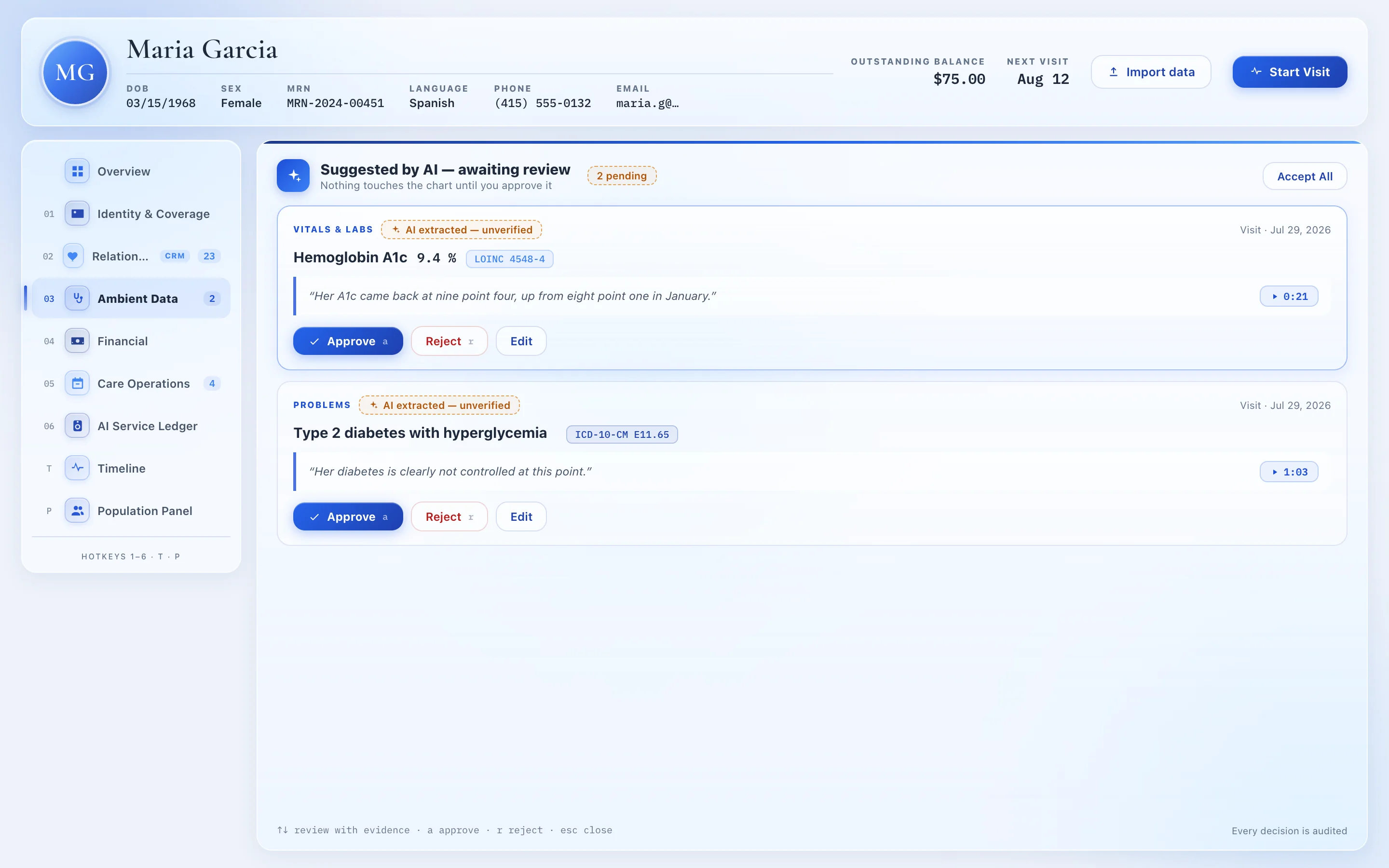
Illustrative interface with simulated patient data.
Not every field is extracted. The relationship layer — lifecycle status, tags, referral source, preferred contact channel, and contact consent, including TCPA consent for calls and texts — consists of fields you set on the record yourself: settings, not scores. Nothing here computes a risk score or a no-show prediction behind your back.
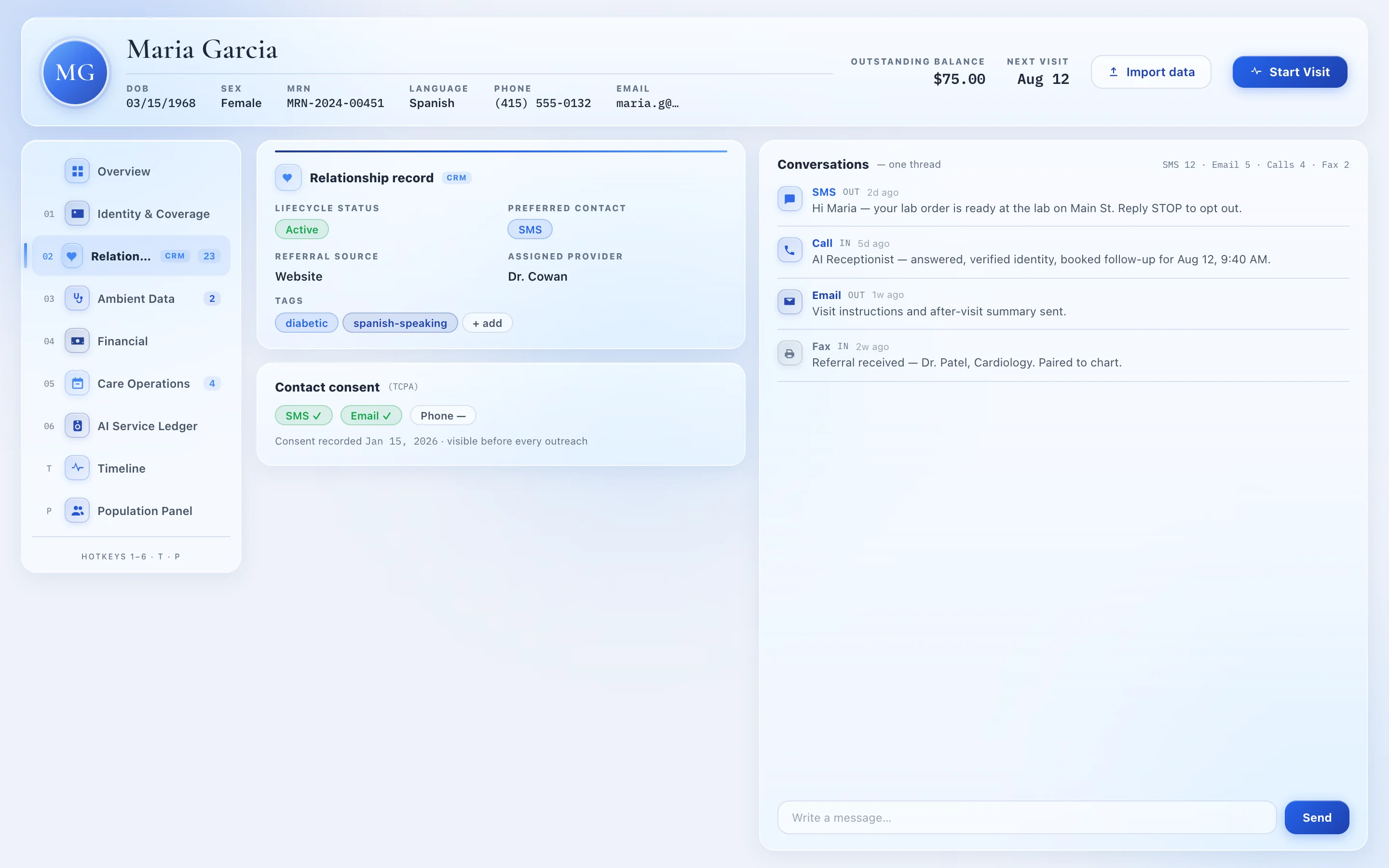
Illustrative interface with simulated patient data.
You can extend the schema, too: Ambient Trackables — custom clinical concepts you define in plain English — tell the scribe what else to listen for, so a concept you create today becomes a queryable field tomorrow. DeepCura ships this mechanism as Ambient Data — "Say it once. Tracked forever." — and the Ambient Data announcement tells how an ambient scribe turned out to be a CRM database that writes itself.
What a Clinical CRM Makes Possible
Recall lists from clinical facts. Ask the Population Panel — typed in plain English, or out loud in chat — for a threshold, a fact that exists, or a fact that is missing: every diabetic whose latest A1c is above 9; every hypertensive patient with no blood pressure reading in twelve months. One click exports the CSV and your front desk starts calling. That is patient recall software built from the chart instead of a spreadsheet.
Care-gap recall lists. The same missing-mode query is how practices close care gaps in healthcare: patients in a denominator with no qualifying fact inside the recency window. Every row is there because an approved fact — or its documented absence — put it there, and closure happens the human way: a phone call, a booked appointment.
Reactivation lists. Patients drift away quietly. A clinical CRM finds them clinically — a last blood pressure reading eighteen months old, no A1c on file in over a year — and hands you the CSV. Your staff makes the calls; when patients ring back, the 24/7 inbound AI receptionist answers and books the visit.
Hence DeepCura's line for the idea: "every clinical fact is a campaign waiting to happen." Here a campaign means clinically targeted outreach: a list built from approved facts, exported to CSV, worked by people. The sending stays human.
Get Onboarded in Seconds
Call now and our AI onboarding agent will set up your entire practice — AI scribe, receptionist, billing, EHR integration — in a single call. 24/7 live support, $129/mo.
+1 (415) 549-1829Available 24/7 · Set up in seconds · No credit card required
What a Clinical CRM Is Not
A new category term invites inflation, so the borders matter as much as the definition:
- Not a bulk-messaging tool. No blast texts, no drip sequences, no automated reminder campaigns. Messaging is one-to-one, consent-gated, in a single thread per patient across SMS, email, calls, and fax.
- Not a marketing-automation suite. No purchased audiences, no lead funnels. The audience is your own panel; the automation lives in the data layer, not the outreach.
- Not a patient portal. Patients never log into anything — they get a call or text from your staff, and a receptionist that answers 24/7 when they call back.
- Not a replacement for your EHR. Keep your EHR: it remains the system of record for the legal chart, orders, and billing. A clinical CRM runs alongside it as the relationship layer.
See DeepCura in Action

Frequently Asked Questions
What is a clinical CRM?
A clinical CRM is a relationship-management system whose database is the patient chart itself. Its fields are created as a byproduct of care — coded clinical facts extracted from recorded visits, reviewed and approved by the clinician, each linked to a verbatim quote and audio timestamp — rather than typed in by staff. Segmentation runs on clinical facts, and every list ends in human outreach.
How is a clinical CRM different from a healthcare CRM?
A traditional healthcare CRM is a general-purpose CRM adapted for healthcare: staff type values into fields, segmentation runs on demographics and tags, and outreach means campaigns. A clinical CRM inverts the data source: fields come from clinician-approved coded facts generated during the visit, each with evidence attached, so you can segment on any clinical denominator.
Does a clinical CRM replace my EHR?
No. Your EHR remains the system of record for the legal chart, orders, and billing. A clinical CRM runs alongside it, turning what is said during visits into queryable, evidence-linked fields for relationship management, recall, and care-gap outreach.
Is patient data safe to use for outreach?
A clinical CRM works only from your practice's own charts — no purchased audiences or third-party lists. Contact consent, including TCPA consent for calls and texts, is a field on the patient record, visible before anyone reaches out. The data behind each list is clinician-approved, and outreach is one-to-one by your staff rather than automated bulk messaging.
What does a clinical CRM cost?
DeepCura is $129 per provider per month, all-in: the ambient AI scribe, coded fact extraction with evidence, the Population Panel, care-gap recall lists with CSV export, relationship fields, unified messaging threads, and the 24/7 inbound AI receptionist in one subscription.
Final Thoughts
The chart was always the practice's real CRM database — it held the conditions, the values, the context — but it lived as prose inside notes, not fields you could query, so practices bolted on a second system and staffed it with typing. A clinical CRM closes the gap from the other direction: it makes the chart itself queryable, with facts extracted as care happens, approved by a clinician, and linked to their evidence.
Evaluating the category? Interrogate the mechanism, not the feature list: where do the fields come from, what stands behind each value, who does the sending? For the commercial version — pricing, screenshots, the full walkthrough — start with the healthcare CRM that fills itself.
References
[1] Federal Communications Commission, "Telemarketing and Robocalls (Telephone Consumer Protection Act)," FCC.gov. fcc.gov/general/telemarketing-and-robocalls
[2] Office of the National Coordinator for Health Information Technology, "What information does an electronic health record (EHR) contain?," HealthIT.gov. healthit.gov/faq
[3] National Committee for Quality Assurance, "Measuring Quality. Improving Health Care.," NCQA.org. ncqa.org
[4] Regenstrief Institute, "LOINC — Logical Observation Identifiers Names and Codes," loinc.org. loinc.org
[5] SNOMED International, "SNOMED CT" (US edition distributed by the National Library of Medicine), NLM.nih.gov. nlm.nih.gov/healthit/snomedct
[6] DeepCura, "Ambient Data — Population Panels and Evidence-Linked Patient Charts," DeepCura.com. deepcura.com