
Disclaimer: This review is based on publicly available information as of March 31, 2026. Features, pricing, and capabilities may have changed since the time of writing. We encourage readers to verify current details directly with the vendor.
$119/month for their top plan. Setup in minutes. No native EHR API write-back. That is Freed AI in a nutshell — the simplest AI scribe on the market, for better and worse.
Here is what Freed AI does and does not do:
- Does: Ambient listening, SOAP note generation, fast turnaround, clean interface, patient instructions, referral letters, ICD-10 coding
- Does not: Dark mode, native EHR API integration, full billing automation with E&M integrity checks, fax management, real-time SMS during calls
- Expanding into: AI receptionist (Early Access — requires booking a sales call to try), revenue cycle tools (Early Access)
- Best for: Solo practitioners who primarily need notes and basic coding assistance
- Not for: Practices that need full workflow automation, 7 AI agents orchestrating every communication channel, or a platform you can test without a sales call
This review is an honest assessment of Freed AI in 2026. We cover pricing, features, accuracy, EHR integration, HIPAA compliance, and how it stacks up against platforms that automate more of the clinical workflow.
The Agentic Chat Gap — One Query, Many Actions
Freed's UI is built around a single linear flow: select a patient, pick a template, capture a visit. Look at Freed's blank-state screen — it starts every session with a literal arrow telling you to "Enter the patient's name before starting your visit." There is no chat box that orchestrates work, no way to chain multiple backend actions, and no way to generate a finished note from a single multi-step instruction. Freed's AI chat capability is limited to reviewing details from previously generated notes — useful for visit prep, but not agentic.
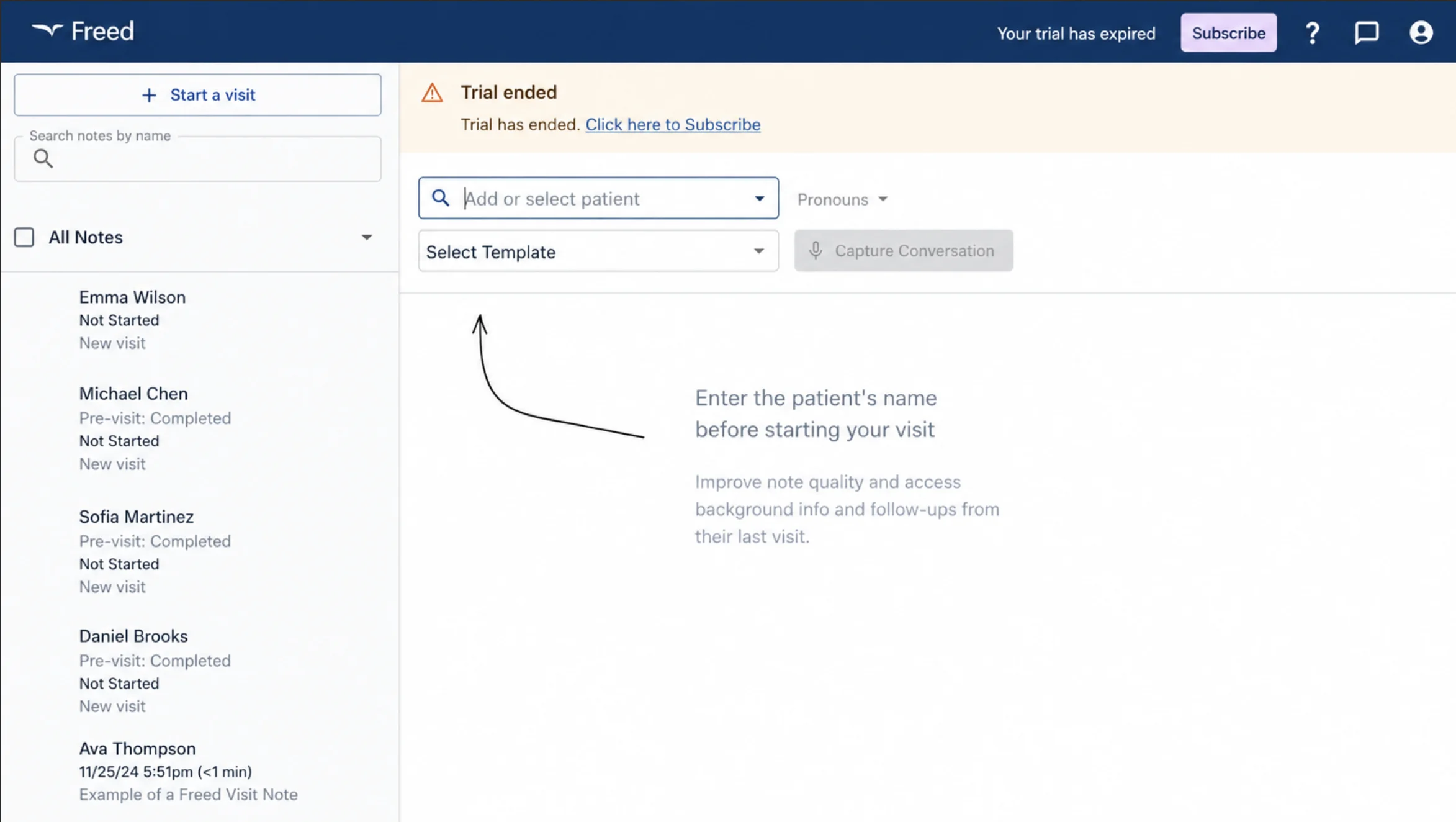
Freed's blank-state UI — linear workflow, single template per visit, no chat orchestration that can chain template retrieval, patient history lookup, and note generation into a single instruction. Screenshot from Freed's web app.
DeepCura's Agentic Chat is fundamentally different. It is not a chat box — it is an LLM-driven orchestrator (Claude, GPT, or Gemini) that can chain multiple backend actions inside a single user prompt. When you ask DeepCura to "pull this patient's last visit, apply my Cardiology Follow-Up template, and add F48.9 to the problem list," the agent autonomously fires three separate tool calls behind the scenes — fetching the prior chart, locating your saved template, loading its structure — then merges everything into one finished note. No clicking. No copying, splitting, or opening unnecessary tabs. No second prompt.
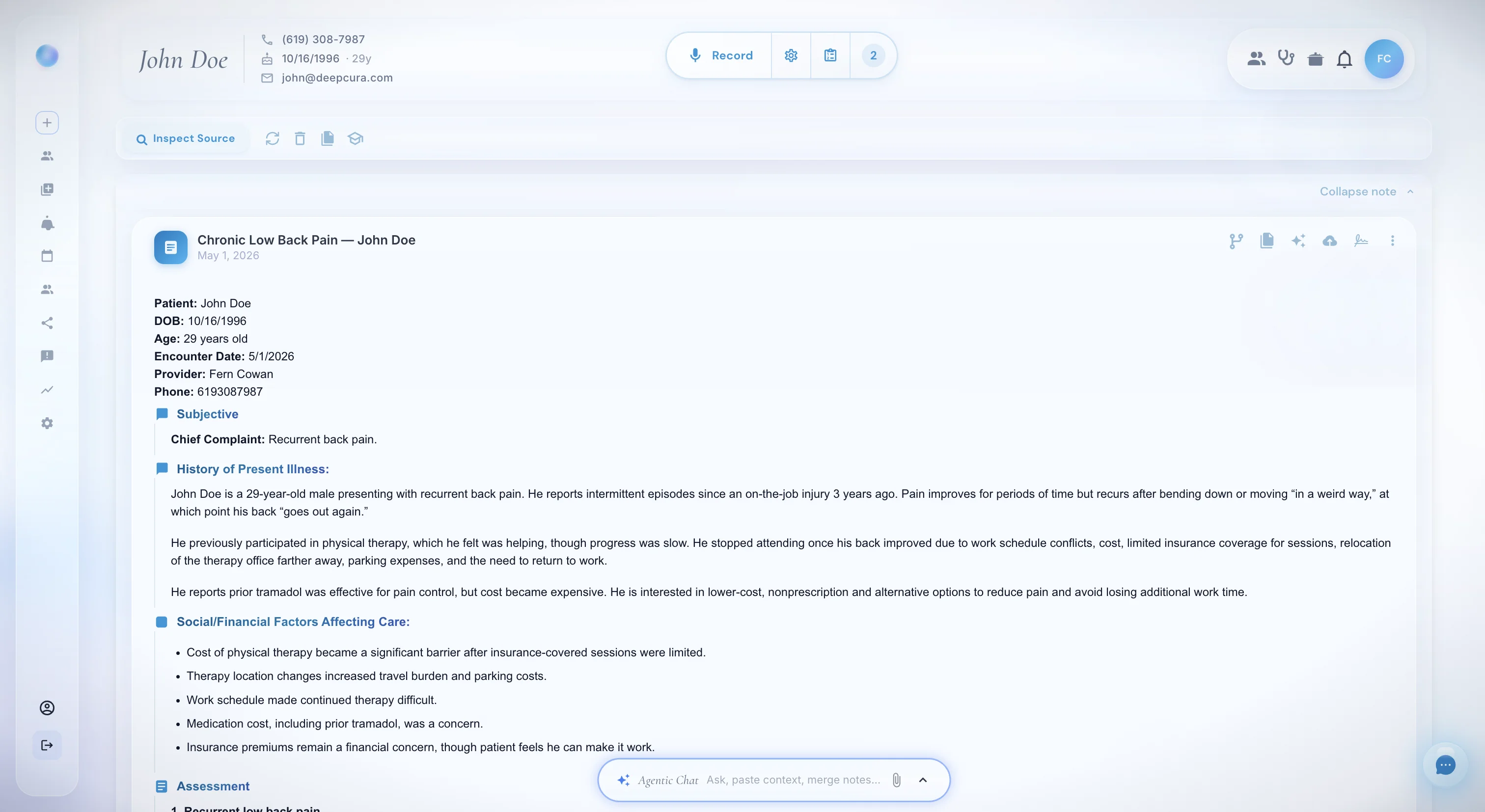
DeepCura's Agentic Chat sits inside every patient chart — type one instruction and the AI chains template retrieval, patient history lookup, ICD-10 coding, and note generation in a single pass.
Three real prompts a clinician can fire today, each chaining two or three backend actions in one query:
- "Pull the last visit, add F48.9 as a new diagnosis, and reformat with my SOAP template." → agent chains fetch recent transcript → list templates → load SOAP template → emits the rewritten note.
- "Apply my Cardiology Follow-Up template to today's encounter and write a referral letter to Dr. Martinez." → list templates → load Cardiology template → generate note → generate referral letter in sequence.
- "Change the metformin dose to 1000 mg in the most recent note and update the plan section." → fetch recent transcript → edit the targeted field → re-emit the full note with no other changes.
This is what agentic actually means in clinical software: the model decides which backend function to call, in what order, and how to combine the results — all from one natural-language sentence. Freed's AI chat can review and discuss a previous note. DeepCura's Agentic Chat orchestrates the entire encounter — and every tool call is audited inside the saved transcript so you can see exactly what context the agent pulled.
And because most clinicians finish their charts at night, the entire experience runs in dark mode too:
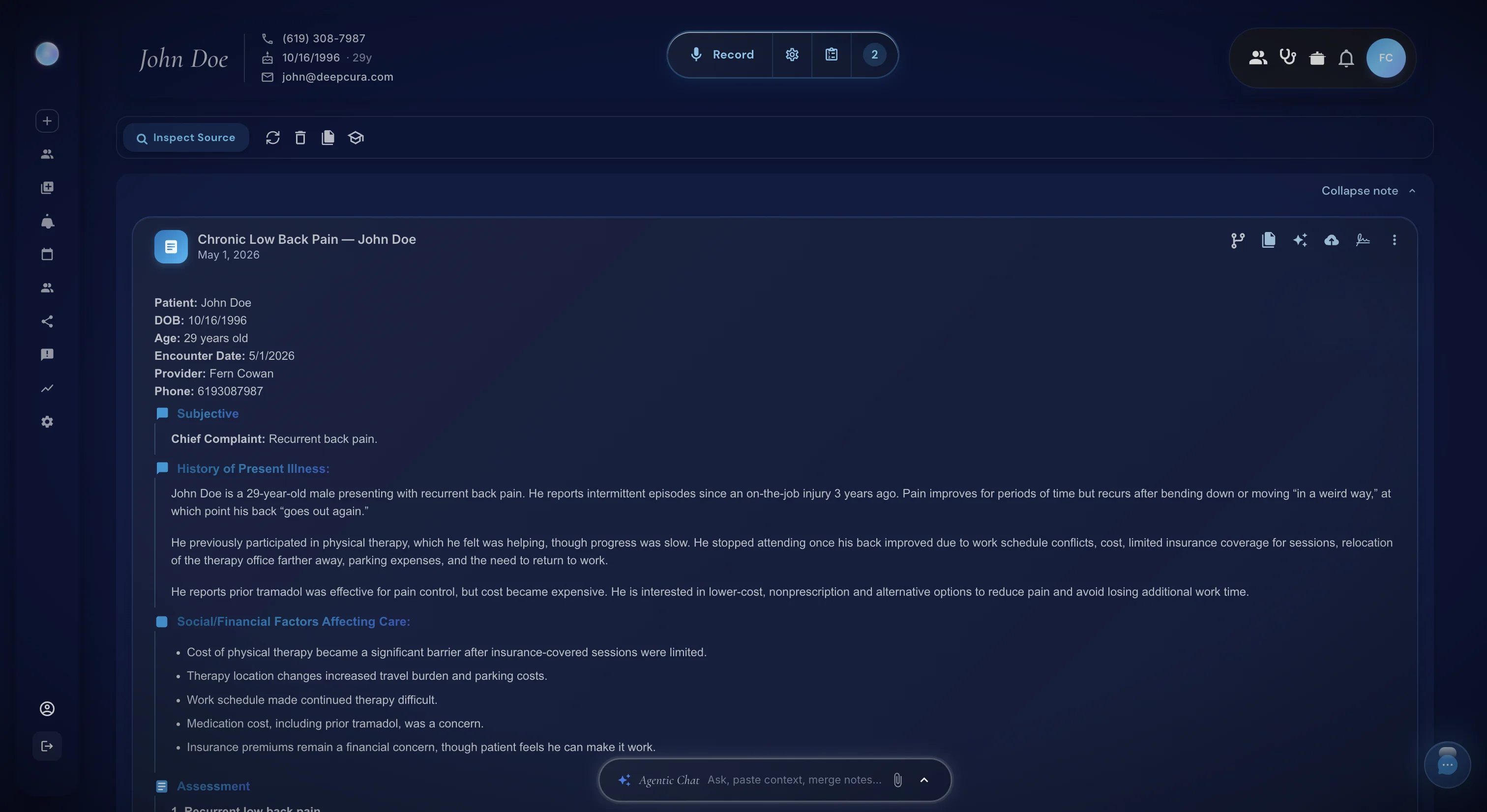
Same patient, same Agentic Chat — in dark mode for the 8 PM chart-finishing session that defines most clinicians' actual workflow. Freed remains light-mode only. And on the annual plan, DeepCura ($999/yr) is actually $429 cheaper than Freed Premier annualized ($1,428/yr) while including 6 extra AI agents beyond the scribe.
What Is Freed AI?
Freed AI is an ambient AI medical scribe designed to automate clinical documentation. It listens to patient encounters in real time — whether in-person or via telehealth — and generates structured clinical notes that clinicians can review, edit, and transfer into their EHR. The company was founded with a focused mission: build the simplest possible AI scribe and do that one thing well.
Unlike broader clinical AI platforms that bundle scribing with intake automation, billing tools, AI receptionists, and EHR integrations, Freed AI has historically stayed deliberately narrow. It began as a scribe, and only a scribe. That focus has been both its greatest strength and its most significant limitation. However, as of early 2026, Freed AI is expanding into adjacent workflows — an AI receptionist ("Front Desk") and revenue cycle tools are both available through an Early Access program, signaling a shift toward a broader platform strategy.
Freed AI supports both mobile and desktop usage, making it accessible across clinical environments. The platform is HIPAA compliant and provides a Business Associate Agreement (BAA) to covered entities. On the Apple App Store, Freed AI holds a 4.8 out of 5 rating — one of the highest-rated AI scribe apps available. It has gained particular traction among primary care physicians, family medicine practitioners, and solo clinicians who value speed and simplicity over feature breadth.
How Freed AI Works
The Freed AI workflow is designed to be as frictionless as possible. Here is how a typical encounter works:
Start a visit. The clinician opens the Freed AI app on their phone or desktop and taps a button to begin recording. There is no complex configuration — just press start and begin the patient conversation.
The AI listens. Freed AI captures the ambient audio of the clinical encounter, processing the conversation between the clinician and patient in real time. The platform uses speaker diarization to distinguish between voices, though performance is best in standard two-speaker encounters.
The encounter ends. When the visit is complete, the clinician stops the recording. Freed AI processes the audio and generates a structured clinical note, typically within one to two minutes.
Review and transfer. The generated note appears in the Freed AI interface, formatted as a SOAP note, H&P, progress note, or another supported template. The clinician reviews the note, makes any necessary edits, and copies it into their EHR — usually via copy-paste or a basic integration.
The entire process requires no IT setup, no EHR configuration, and no training beyond a few minutes of familiarization. For clinicians accustomed to spending 10-15 minutes per note on after-hours documentation, the time savings are immediate and meaningful.
Freed AI Pricing
Freed AI now uses tiered pricing across three individual plans:
- Starter — $39/month: Up to 40 notes/month, basic ambient scribing, specialty templates, live support
- Core — $79/month: Unlimited notes, instant template builder, AI clinician assistant for editing
- Premier — $119/month: Everything in Core plus EHR push (Chrome extension-based, not native API write-back), visit summaries, patient context, ICD-10 coding, CPT codes (beta), and AI assistant with medical knowledge base
- Groups — Custom pricing: Premier features plus admin dashboards, SSO, dedicated account manager, medical assistant users (alpha), patient sharing (beta)
The Premier plan at $119/month is where Freed AI bundles its more advanced features including EHR push and billing code suggestions. However, the EHR push operates via a Chrome browser extension — it automates note transfer at the browser level rather than writing structured data directly into EHR fields via native API integration. This is a meaningful distinction for practices that need bidirectional data flow with their EHR.
Freed AI offers a 7-day free trial with no credit card required. In the context of the broader AI scribe market, Freed AI's Premier plan at $119/month sits close to full-platform solutions like DeepCura at $129/month — which includes native EHR write-back across 8 EHR systems, a 24/7 AI receptionist, billing automation, and fax management. The question for any practice is whether Freed AI's scribe-focused approach at $119/month delivers better value than a full-platform solution for just $10 more.
Here is how each Freed AI pricing tier compares against a full-platform alternative:
| Plan | Price | Notes/Month | EHR Push | Billing Codes | Key Limitation |
|---|---|---|---|---|---|
| Freed AI Starter | $39/mo | 40 | ✗ | ✗ | Note cap, no EHR push |
| Freed AI Core | $79/mo | Unlimited | ✗ | ✗ | No EHR push, no coding |
| Freed AI Premier | $119/mo | Unlimited | Chrome extension | Beta | No native API write-back |
| DeepCura | $129/mo | Unlimited | Native API | ✓ | — Full platform included |
At the Starter tier ($39/month), the Freed AI scribe offers genuine value for clinicians who generate fewer than 40 notes per month — roughly 2 notes per working day. At the Core tier ($79/month), unlimited notes make sense for busier clinicians who do not need EHR push or billing codes. The inflection point is the Premier tier ($119/month) — at that price, the $10 gap to DeepCura ($129/month) is almost impossible to justify. For $10 more per month, you get 7 separate AI agents orchestrating every communication channel in your practice: AI medical scribe, AI receptionist (self-serve — no sales call to test), AI billing with E&M integrity checks, AI prior authorization, AI fax management, AI payment collection, and a clinical AI copilot. You also get dark mode for comfortable late-night charting, real-time SMS during AI receptionist calls for 100% accuracy on patient details, native EHR API write-back across 7+ systems, and the ability to choose your AI engine (GPT, Claude, or Gemini). Freed AI is expanding into some of these areas (AI receptionist and revenue cycle are in Early Access as of March 2026), but you cannot even test those features without booking a sales call — and they are not yet generally available or included in standard pricing tiers.
Freed AI Scribe: Key Features
Ambient Encounter Capture
Freed AI records clinical encounters using ambient dictation — AI-powered ambient audio capture that processes the natural conversation between clinician and patient. There is no need for the physician to dictate into a microphone or follow a structured template during the encounter. The AI listens to the organic flow of the visit and extracts clinically relevant information.
SOAP and Custom Note Generation
Notes are generated in standard clinical formats, including SOAP notes, H&P formats, and progress notes. Freed AI also supports custom note templates, allowing clinicians to define the structure and sections that match their documentation preferences and specialty requirements.
Mobile App Support
Freed AI is available on mobile devices, making it usable in exam rooms, at the bedside, or during telehealth visits conducted from a phone or tablet. The mobile experience mirrors the desktop workflow — start recording, conduct the visit, and receive a generated note.
HIPAA Compliance and BAA
Freed AI maintains HIPAA-compliant infrastructure and provides a Business Associate Agreement (BAA) to covered entities. The platform is also SOC 2 Type II certified and HITECH-compliant. Audio and note data are encrypted in transit and at rest, and Freed AI states that patient recordings are not stored. These compliance credentials meet and in some areas exceed baseline requirements for clinical AI tools.
Custom Note Templates
Beyond the standard SOAP and H&P formats, Freed AI allows clinicians to create and save custom templates. This is useful for specialists who need documentation structures that do not fit neatly into generic formats — for example, a psychiatry intake note or a dermatology procedure note. Need templates before committing to an AI scribe? Start with our doctor's note template collection.
Multi-Specialty Support
Freed AI supports documentation across multiple medical specialties, though it was originally built with a primary care focus. The platform handles common specialties reasonably well, though clinicians in highly specialized fields may find that the AI requires more post-generation editing compared to specialty-tuned alternatives.
What the Freed AI Scribe Does Well
Simplicity and ease of setup. This is Freed AI's defining advantage. A clinician can download the app, create an account, and begin using the tool in under five minutes. There is no IT department to involve, no EHR integration to configure, and no multi-week onboarding process. For solo practitioners and small practices without dedicated technical staff, this matters enormously.
Clean, distraction-free interface. The Freed AI interface is minimal by design. There are no dashboards full of analytics, no complex navigation menus, and no feature bloat. The screen shows what you need — a record button, your generated notes, and basic editing tools. Clinicians who are frustrated by overly complex software will appreciate this approach.
Good note accuracy for primary care encounters. In standard primary care visits — a single clinician, a single patient, common presenting complaints — Freed AI generates notes that require minimal editing. The AI captures chief complaints, history of present illness, review of systems, and assessment and plan elements with reasonable fidelity. Most clinicians report starting with a note that is 85-90% complete.
Affordable entry point at $39/month. Freed AI's tiered pricing means clinicians can start with basic scribing at $39/month (Starter) and scale up to $79/month (Core) for unlimited notes or $119/month (Premier) for EHR push and billing codes. Clinicians who save even 30 minutes per day on documentation are getting substantial value relative to the cost at any tier.
Fast note turnaround. Notes are typically generated within one to two minutes of ending the encounter. There is no batch processing delay and no need to wait until end-of-day for your documentation. This allows clinicians to review and finalize notes between patients rather than accumulating a documentation backlog.
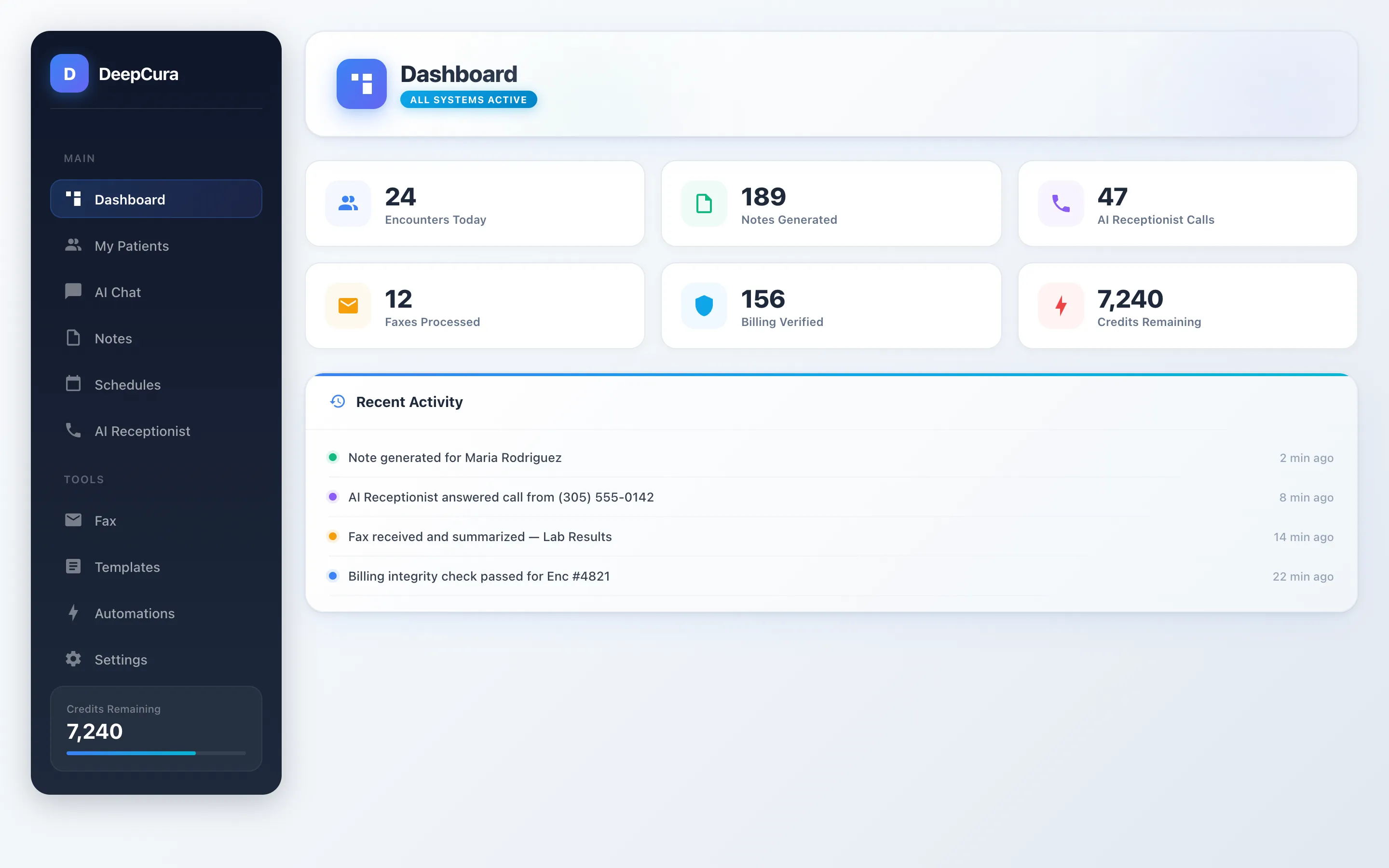 Screenshot: DeepCura UI — full dashboard with patient management, AI receptionist, notes, and automation.
Freed AI Scribe Accuracy by Specialty
Note accuracy varies significantly depending on the medical specialty and encounter complexity. The Freed AI scribe was built with primary care as its foundation, and performance reflects that origin:
- Primary Care / Family Medicine: This is where the Freed AI scribe performs best. Standard office visits with a single presenting complaint produce notes that are 85-90% complete. Common conditions like hypertension management, diabetes follow-ups, and wellness visits are captured reliably with minimal editing required.
- Internal Medicine: Multi-problem visits with complex medication lists require more post-generation editing. The AI handles individual problems well but sometimes misorders or conflates assessment elements when patients present with four or more active conditions simultaneously.
- Psychiatry: Mental health encounters involve nuanced clinical language, affect descriptions, and risk assessments that demand precise documentation. The Freed AI scribe captures the broad clinical narrative but frequently requires clinician editing for diagnostic precision and safety documentation.
- Orthopedics and Surgical Specialties: Procedure-heavy encounters with specific anatomical terminology and surgical planning language challenge any ambient scribe. Standard musculoskeletal evaluations are handled adequately, but operative planning and complex procedure documentation often need significant revision.
- Pediatrics: Well-child visits with developmental milestones, growth parameters, and immunization reviews are handled reasonably well. Three-way conversations between parent, clinician, and child are less reliably processed than standard two-speaker encounters. For a detailed comparison of AI scribes for pediatric documentation, see our Best AI Scribe for Pediatrics guide.
- Cardiology and Other Subspecialties: Highly specialized terminology, complex diagnostic workups, and condition-specific documentation requirements push the limits of a generalist AI scribe. Subspecialists should expect more editing time compared to primary care colleagues.
- Chiropractic and Integrative Medicine: Practitioners in alternative and integrative medicine report that Freed AI struggles with non-conventional clinical vocabulary. In a published case study by OptiMantra, Dr. Tori D.C. of San Juan Chiropractic stated that "Freed AI took weeks to learn the word subluxation — a term I use multiple times during a single visit" [9]. After switching to DeepCura, she reduced weekly charting time from over 15 hours to just 2 hours — with notes that accurately captured integrative care terminology from the first use.
For any specialty, testing the Freed AI scribe with your 10 most common encounter types during the 7-day free trial is the best way to evaluate real-world accuracy before committing.
Where Freed AI Falls Short
No dark mode. This matters more than you might think. Clinicians who chart at night — which is most of them — are staring at a bright white screen for hours after a full day of patient encounters. Freed AI offers no dark mode interface. DeepCura includes a full dark mode that reduces eye strain during late-night charting, makes reading charts and reviewing AI-generated notes significantly more comfortable in low-light settings, and is the kind of quality-of-life feature that a platform built by clinicians, not just for clinicians, would include from day one.
AI receptionist in Early Access only — and you cannot even test it without booking a sales call. As of March 2026, Freed AI has announced an AI receptionist product ("Front Desk") available through an Early Access program — however, it is not yet generally available or included in standard pricing tiers. Worse, there is no way to test Freed AI's receptionist or AI calling capabilities on your own. You must book a sales call and go through a demo process before you can evaluate the product. DeepCura's AI receptionist and AI calling features are fully launched and self-serve — any practice can sign up, configure their receptionist, and test it with real calls in minutes without ever speaking to a sales representative. For a platform that prides itself on simplicity, gating its newest features behind a sales wall is a contradiction. For options, see our ranking of the best AI medical receptionists in 2026.
No real-time SMS during AI calls. This is a capability gap that directly impacts documentation accuracy. When DeepCura's AI receptionist is on a live call with a patient, it can simultaneously send an SMS to the patient to confirm spellings, collect insurance details, or verify appointment preferences — all in real time, while the conversation is still happening. This dual-channel approach ensures 100% accuracy on critical details like medication names, insurance IDs, and callback numbers that are notoriously error-prone over voice alone. Freed AI's Early Access receptionist does not offer this real-time SMS verification during calls. The difference is the difference between "mostly accurate" and "100% accurate" — and in healthcare, that gap matters.
Specialty and alternative medicine terminology challenges. Freed AI was built with conventional primary care as its foundation, and while the platform now lists Functional/Integrative Medicine among its supported specialties, some practitioners outside the primary care scope have reported terminology gaps. In a third-party case study published by OptiMantra, a chiropractic and integrative medicine provider documented switching from Freed AI to DeepCura after the platform repeatedly failed to recognize core clinical terms used in every visit [9]. The provider reported an 87% reduction in weekly charting time after switching — from over 15 hours to just 2 hours — along with a drop from 10-20 manual clicks per chart to just 2 clicks with DeepCura's native EHR integration. Freed AI's "Learn my format" feature may help address some of these gaps over time, but practices in chiropractic, acupuncture, functional medicine, naturopathy, and other integrative specialties should test thoroughly during the free trial.
No native EHR API integration. Freed AI's Premier plan ($119/month) includes EHR push, but this operates via a Chrome browser extension — it automates note transfer at the browser level rather than writing structured data directly into EHR fields via native API integration. The extension supports dozens of browser-based EHRs including Athena, DrChrono, SimplePractice, Elation, and others. However, there is no bidirectional data flow that reads patient context from the chart, pushes diagnoses, triggers order entry, or writes billing codes into the EHR's charge system. Practices using EHR systems like Epic, eClinicalWorks, or Athena that need native API write-back will find this gap significant. For athenahealth users specifically, see our guide to the best AI scribe for athenahealth, which covers the 8 AI agents that automate the full Athena workflow. For eClinicalWorks users, see our eClinicalWorks AI Scribe guide covering 6 AI agents with FHIR R4 write-back. For AdvancedMD users, see our AdvancedMD AI Scribe guide covering 5 AI agents with direct write-back.
Billing codes limited to Premier plan; no E&M integrity checks. Freed AI's Premier plan ($119/month) includes ICD-10 coding and CPT code suggestions (beta). However, lower tiers have no billing or coding assistance at all. Based on publicly available documentation, there is no automated E&M integrity verification that confirms the documentation supports the billed level of service — the coding suggestions are informational rather than validated against the note content. Freed AI has announced revenue cycle tools through an Early Access program, but these are not yet generally available. For practices concerned about audit risk or revenue optimization, this remains a gap compared to platforms with full billing automation.
No fax management. At the time of writing, Freed AI's public documentation does not mention inbound fax processing, document routing, or fax-based referral management. Practices that still receive a high volume of faxed records — which remains the reality for most clinical offices — will need to handle this workflow separately.
Limited clinical AI chat. Freed AI includes an AI chat agent that allows clinicians to ask about and discuss details from previous notes — useful for visit preparation. However, based on publicly available documentation, this chat feature is focused on reviewing historical patient information rather than providing real-time clinical decision support such as differential diagnosis generation, drug interaction checking, or evidence-based recommendations during encounters. Clinicians who want broader AI-assisted clinical reasoning should see our guide to the best ChatGPT for doctors.
Only 1 AI agent vs 7. Freed AI is fundamentally a single-purpose tool — one AI agent that listens and generates notes. DeepCura deploys 7 separate AI agents that orchestrate every communication channel a medical practice uses: (1) AI Medical Scribe for ambient documentation, (2) AI Receptionist for inbound/outbound patient calls, (3) AI Billing Agent for E&M integrity and claims, (4) AI Fax Agent for inbound fax processing and routing, (5) AI Prior Authorization Agent for payer submissions, (6) AI Payment Collection Agent for patient balance outreach via Stripe, and (7) AI Clinical Copilot for real-time clinical reasoning during encounters. All seven agents are included for $129/month — just $10 more than Freed AI's single-agent Premier plan at $119/month. The difference between one agent and seven is the difference between automating one task and automating your entire practice.
No choice of AI engine. Based on publicly available information, clinicians cannot select which underlying AI model generates their notes. Freed AI uses its own model pipeline, and at the time of writing, there is no publicly documented ability to switch between different AI engines that may perform better for specific specialties or documentation styles.
No patient intake automation. Pre-visit intake and patient questionnaires are not available in Freed AI based on current public documentation. However, Freed AI does now offer visit preparation features including patient summaries from previous visits and an AI chat agent for reviewing prior notes. The platform does not automate the patient-facing intake process itself. For practices that need to streamline patient intake, see our guide to patient intake form templates with free downloads for 8 specialties.
Venture-backed with potential pricing risk. Freed AI has been recognized by CB Insights as one of the 50 Most Promising Digital Health Startups, and the company's rapid growth and expansion into new product areas (Front Desk, Revenue Cycle) suggest significant external investment. While venture funding is not inherently negative, it can introduce uncertainty about long-term pricing stability. VC-funded companies face pressure to increase revenue as they scale, which can lead to price increases, feature gating, or strategic pivots that affect existing users. Bootstrapped competitors, by contrast, may have more pricing flexibility and aligned long-term incentives.
Who Is Freed AI Best For?
Freed AI is a strong fit for a specific type of clinician and practice:
- Solo practitioners who need ambient scribing and nothing else. If your documentation workflow is the primary pain point and everything else — reception, billing, fax, intake — is already handled, Freed AI solves the problem cleanly.
- Clinicians who want the simplest possible tool. If you are not comfortable with complex software, do not want to configure integrations, and just want to press a button and get a note, Freed AI delivers.
- Practices that do not need native EHR API write-back. If your workflow already involves copying notes into your EHR and you are comfortable with that process — or if Freed AI's Chrome extension-based EHR push (Premier, $119/month) is sufficient — the lack of native API integration is not a drawback.
- Budget-conscious solo providers. Starting at $39/month for basic scribing (Starter) or $79/month for unlimited notes (Core), Freed AI offers some of the most affordable entry points in the AI scribe market. For clinicians who are price-sensitive and need only core scribing, it represents good value.
- Primary care and general practice physicians. Freed AI's note accuracy is strongest in primary care encounters. If the majority of your visits are standard office visits, you will get the best results from the platform.
Who Should Consider Alternatives?
Not every practice will find Freed AI sufficient. Consider looking at other platforms if you fall into any of these categories:
- Multi-provider practices that need team management, collaboration tools, and centralized administration.
- Integrative, chiropractic, and alternative medicine practitioners whose clinical vocabulary extends beyond conventional medicine. A published third-party case study documented a provider switching from Freed AI to DeepCura and reducing weekly charting time from 15+ hours to 2 hours, citing Freed AI's inability to learn specialty terminology [9].
- Clinics needing native EHR API integration with bidirectional write-back to Epic, eClinicalWorks, Athena, OptiMantra, or Veradigm. Freed AI's Premier plan offers Chrome extension-based EHR push, but not native API write-back.
- Practices that need a fully launched AI receptionist today for handling calls, scheduling, and triage. Freed AI's Front Desk product is in Early Access and not yet generally available.
- Clinicians who need E&M integrity verification — Freed AI offers ICD-10 coding and CPT codes (beta), but does not validate that documentation supports the billed level of service.
- Offices that process a high volume of faxes and need automated inbound fax routing and document management.
- Practices looking for a single platform that replaces multiple point solutions rather than adding another tool to an already fragmented stack.
7 AI agents. Dark mode. Real-time SMS during calls. No sales call required to test. If you need ambient scribing plus native EHR API write-back, a fully launched 24/7 AI receptionist that chats with patients via SMS during live calls for 100% accuracy, E&M billing integrity checks, fax management, and 5 more AI agents orchestrating your entire practice — DeepCura includes all of this for $129/month. That is $10 more than Freed AI's single-agent Premier plan — and you can test every feature yourself without booking a sales call.
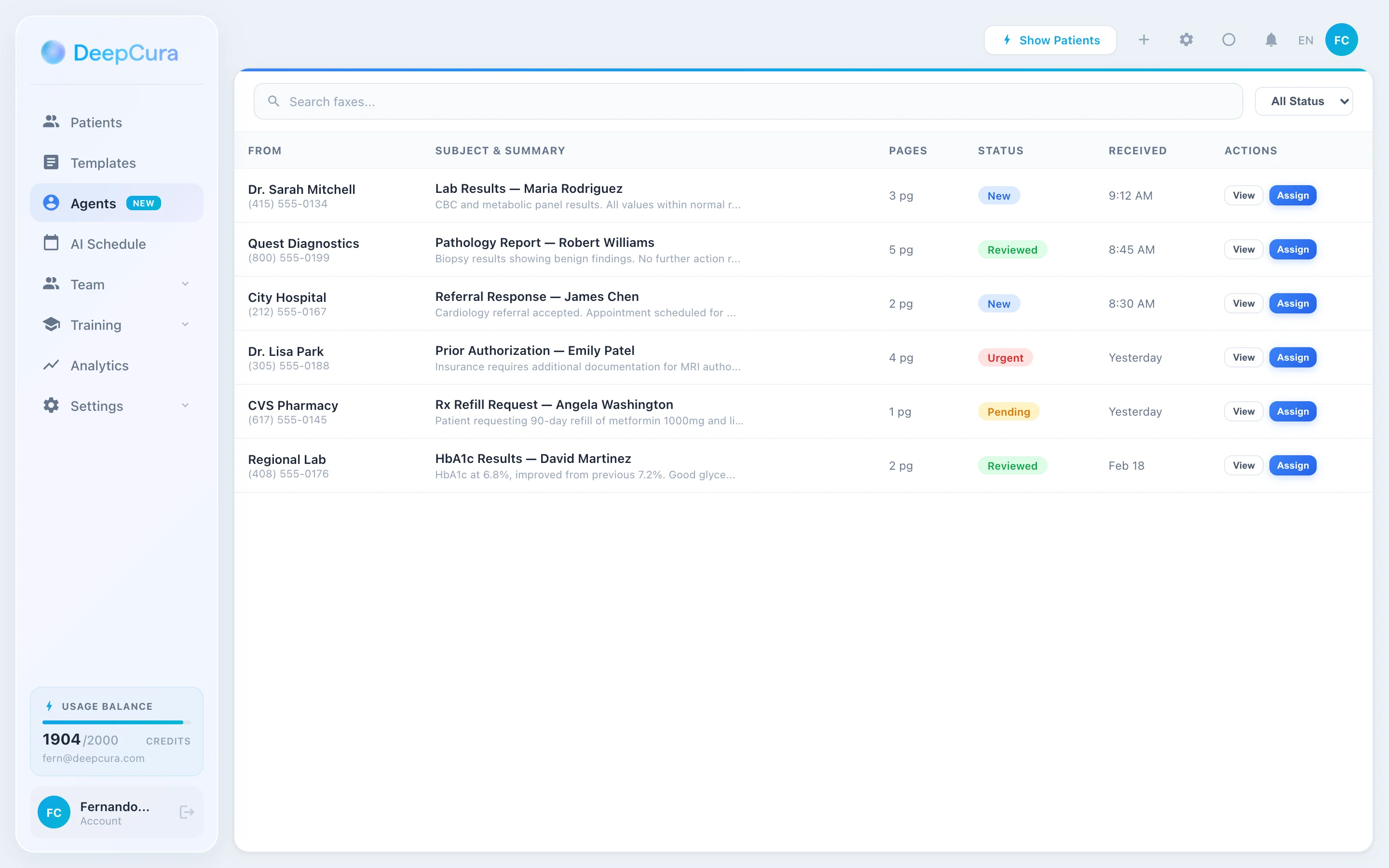 Screenshot: DeepCura UI — inbound fax management with AI-summarized faxes and automated processing.
Freed AI Scribe vs Full-Platform Solutions
The Freed AI scribe's core strength remains the encounter itself, though the platform has expanded into pre-visit summaries, post-visit letters, and billing codes. To evaluate whether that scope is enough for your practice, here is how Freed AI compares across every phase — before, during, and after the visit.
Pre-Visit Automation
| Feature | Freed AI | DeepCura |
|---|---|---|
| AI Patient Intake | ✗ | ✓ |
| AI Receptionist (Phone) | Early Access (sales call required to test) | ✓ (self-serve, test in minutes) |
| Real-Time SMS During AI Calls | ✗ | ✓ |
| Pre-Visit Summary | ✓ (from Freed notes) | ✓ |
Freed AI has expanded its pre-visit capabilities. The platform now offers visit summaries that pull context from previous Freed-generated notes, and an AI chat agent for reviewing prior visit details. Freed AI has also announced an AI receptionist ("Front Desk") available through an Early Access program, though it is not yet generally available — and you cannot even try it without booking a sales call first. There are no automated patient intake forms. DeepCura's AI receptionist is fully launched and self-serve — any practice can sign up, configure their receptionist, and test it with real calls in minutes. It answers patient calls 24/7, handles scheduling and triage, generates pre-visit summaries, and can send real-time SMS messages to patients during the call to verify spellings, insurance details, and appointment preferences with 100% accuracy.
During the Visit
| Feature | Freed AI | DeepCura |
|---|---|---|
| AI Medical Scribe | ✓ | ✓ |
| Custom Note Templates | Limited | ✓ |
| 50+ Specialties | ✓ | ✓ |
| Clinical AI Chat (Copilot) | Limited (note review) | ✓ (full clinical reasoning) |
This is where the Freed AI scribe delivers its core value. Both platforms offer ambient scribing across 50+ medical specialties. The key differences: DeepCura includes a clinical AI copilot for real-time clinical reasoning during encounters — differential diagnosis support, drug interaction checks, and evidence-based recommendations. Freed AI offers an AI chat agent focused on reviewing and discussing previous notes, along with a "Magic Edit" feature for AI-assisted note refinement. Custom note templates are available on both platforms, though Freed AI restricts advanced template features to higher pricing tiers.
Post-Visit Automation
| Feature | Freed AI | DeepCura |
|---|---|---|
| AI Billing / ICD-10 Coding | ✓ (ICD-10; CPT beta) | ✓ |
| E&M Integrity Verification | ✗ | ✓ |
| EHR Integration (Native API) | ✗ (Chrome extension on Premier) | ✓ |
| AI Prior Authorization | ✗ | ✓ |
| AI Referral Letters | ✓ (14+ letter types) | ✓ |
| AI Patient Instructions | ✓ | ✓ |
| AI Tasks & Alerts | ✗ | ✓ |
| AI Fax Management | ✗ | ✓ |
| AI Payment Collection (Stripe) | ✗ | ✓ |
Post-visit is where meaningful differences emerge between Freed AI and a full clinical AI platform. Freed AI has expanded its post-visit capabilities — it now generates ICD-10 codes, CPT codes (beta), patient instructions, and 14+ types of post-visit letters including referrals, sick notes, and caregiver letters. However, there is no E&M integrity verification that validates documentation against the billed level of service, no prior authorization automation, no fax management, and no payment collection.
DeepCura automates all of these post-visit workflows with dedicated AI agents. The billing agent validates E&M codes against note content to prevent downcoding and audit risk. The prior authorization agent drafts and submits requests. The fax management agent summarizes inbound faxes and routes them to the correct provider. The payment collection agent handles patient balance outreach through Stripe — without staff involvement. For practices using EHR systems like athenahealth, see how the full AI workflow integrates with Athena.
Platform Capabilities
| Feature | Freed AI | DeepCura |
|---|---|---|
| Dark Mode | ✗ | ✓ |
| Total AI Agents | 1 (scribe only) | 7 (full practice orchestration) |
| Choose AI Engine (GPT, Claude, Gemini) | ✗ | ✓ |
| Self-Serve Testing (no sales call) | ✗ (Early Access features require sales call) | ✓ |
| Real-Time SMS During AI Calls | ✗ | ✓ |
| Team Collaboration | Basic | ✓ |
| Analytics Dashboard & Wellness | ✗ | ✓ |
| Starting Price | $39/mo (1 agent) | $129/mo (all 7 agents included) |
The platform capabilities gap is where the $10 price difference between Freed AI Premier ($119/month) and DeepCura ($129/month) becomes almost absurd. DeepCura includes a full dark mode for comfortable late-night charting — Freed AI does not. DeepCura deploys 7 AI agents that orchestrate every communication channel — Freed AI has 1. DeepCura lets you test every feature, including the AI receptionist and AI calls, without ever booking a sales call — Freed AI gates its newest capabilities behind a sales process. DeepCura's AI receptionist sends real-time SMS during live calls to verify patient details with 100% accuracy — Freed AI's Early Access receptionist does not. And DeepCura lets practices choose between GPT, Claude, and Gemini — selecting the engine that performs best for their specialty. Freed AI uses its own model pipeline with no publicly documented option to switch.
For multi-provider practices, DeepCura includes team collaboration tools, role-based access, and an analytics dashboard that tracks documentation metrics, clinician efficiency, and practice wellness indicators. Freed AI offers team features on its custom-priced Groups plan, including admin dashboards, SSO, and a team template library.
For a direct side-by-side comparison, see our DeepCura vs Freed AI breakdown.
See DeepCura in Action
Watch how DeepCura handles the full clinical workflow — from AI receptionist calls and patient intake through ambient scribing, automated billing, and native EHR write-back.

Frequently Asked Questions
Is Freed AI HIPAA compliant?
Yes. Freed AI is HIPAA compliant and provides a Business Associate Agreement (BAA) to covered entities. The platform is also SOC 2 Type II certified and HITECH-compliant. Data is encrypted in transit and at rest, and Freed AI states that patient recordings are not stored. As with any clinical AI tool, HIPAA compliance is a shared responsibility — your practice must also ensure proper access controls, staff training, and configuration.
How much does Freed AI cost?
Freed AI uses tiered pricing: Starter at $39/month (40 notes/month), Core at $79/month (unlimited notes), and Premier at $119/month (EHR push, ICD-10 coding, CPT codes). A Groups plan with custom pricing is available for multi-provider practices. Freed AI offers a 7-day free trial with no credit card required.
Does Freed AI integrate with my EHR?
Freed AI's Premier plan ($119/month) includes EHR push via a Chrome browser extension — it automates note transfer at the browser level for dozens of browser-based EHRs including Athena, DrChrono, SimplePractice, and Elation. Lower tiers (Starter and Core) are limited to manual copy-paste workflows. The EHR push is unidirectional — there is no bidirectional data flow that reads patient context from the chart or pushes structured diagnoses, orders, or billing codes into the EHR via native API. Practices that need native EHR API integration with Epic, eClinicalWorks, Athena, or other major platforms should consider alternatives with native API write-back.
Is Freed AI accurate?
Freed AI produces reasonably accurate clinical notes, particularly for standard primary care encounters. Most clinicians report that generated notes are 85-90% complete and require some review and editing before finalization. Accuracy can vary based on specialty complexity, audio quality, the number of speakers in the room, and how closely the encounter follows common clinical patterns. Complex multi-problem visits and highly specialized terminology may require more significant post-generation editing.
Can Freed AI handle specialty encounters?
Freed AI supports documentation across multiple medical specialties and offers custom note templates. However, the platform was originally built with a primary care focus, and clinicians in highly specialized fields — such as cardiology, orthopedics, or psychiatry — may find that the AI requires more editing compared to specialty-tuned platforms like DeepScribe. If specialty accuracy is your top priority, test Freed AI with your most common encounter types during the free trial to assess performance in your specific discipline.
Does Freed AI offer a free trial?
Yes. Freed AI offers a free trial that allows clinicians to test the platform with real clinical encounters before subscribing. This is a useful opportunity to evaluate note accuracy, workflow fit, and time savings in your specific practice environment. We recommend conducting at least 15-20 encounters across your most common visit types during the trial to get a reliable sense of performance.
What are the best Freed AI alternatives?
The best alternative depends on what you need beyond ambient scribing. DeepCura is the strongest option for practices that want 7 AI agents orchestrating every communication channel — AI scribe, AI receptionist (with real-time SMS during calls), AI billing, AI fax, AI prior auth, AI payment collection, and clinical AI copilot — all for $129/month. DeepCura also offers dark mode for night charting and lets you test every feature without booking a sales call. DeepScribe is the leading choice for oncology practices and large health systems that want specialty-tuned AI with human QA review. Ambience Healthcare is the enterprise leader for large health systems on Epic or Cerner that need deep EHR integration and Chart Awareness. Nuance DAX Copilot is the leading choice for large health systems on Microsoft infrastructure. Heidi Health serves international clinics with multi-language support. Suki AI offers a voice-first clinical assistant for hands-free EHR interaction. For a comprehensive comparison, see our Best AI Medical Scribes in 2026 ranking.
Does Freed AI have agentic chat that can chain multiple actions in one query?
No. Freed AI's chat capability is limited to reviewing and discussing details from previously generated notes — useful for visit preparation, but not agentic. There is no chat orchestrator that can chain template retrieval, patient history lookup, ICD-10 coding, and note generation from a single multi-step instruction. DeepCura's Agentic Chat is an LLM-driven orchestrator (Claude, GPT, or Gemini) that autonomously fires multiple backend tool calls from one natural-language prompt — for example, "pull the last visit, apply my Cardiology Follow-Up template, and add F48.9 to the problem list" triggers fetch-transcript → list-templates → load-template → generate-note in one pass, with every tool call audited inside the saved transcript.
Is Freed AI worth it?
For the right clinician, yes — at the lower tiers. If you are a solo practitioner whose primary pain point is documentation and nothing else, the Starter plan at $39/month delivers real value. However, at the Premier tier ($119/month), the math breaks down. For $10 more, DeepCura ($129/month) gives you 7 AI agents instead of 1 — including an AI receptionist that sends real-time SMS during live calls for 100% accuracy, dark mode for comfortable night charting, native EHR write-back, billing automation, fax management, and AI prior authorization. You can also test every DeepCura feature yourself without booking a sales call. Notably, practitioners in integrative and alternative medicine specialties have reported switching from Freed AI to DeepCura due to persistent terminology limitations — with one published case study documenting an 87% reduction in charting time after making the switch [9].
Final Verdict
Freed AI is a solid, focused ambient AI scribe that does exactly what it promises — captures clinical encounters and generates usable clinical notes with minimal setup and a clean interface. For solo practitioners and small practices whose primary pain point is after-hours documentation, it remains one of the simplest solutions available in 2026.
Its strength is its simplicity. There is no feature bloat, no complex onboarding, and no IT overhead. A clinician can go from download to first generated note in under five minutes. That frictionless experience is genuinely valuable for physicians who have been skeptical of clinical technology.
Its limitation is equally clear: Freed AI's core product remains primarily a scribe — one AI agent doing one job. The Premier plan ($119/month) adds Chrome extension-based EHR push, ICD-10 coding, CPT codes (beta), referral letters, and patient instructions. Freed AI is expanding — an AI receptionist ("Front Desk") and revenue cycle tools are both in Early Access as of March 2026 — but you cannot test these features without booking a sales call, and they are not yet generally available. There is no dark mode for late-night charting, no real-time SMS during AI calls, no native EHR API write-back, no E&M integrity verification, no fax management, and no patient intake automation in the current generally available product. Practices that need these capabilities today will either need to wait for Freed AI's Early Access features to mature, or look to full-platform alternatives. This pattern is already playing out: in a third-party case study published by OptiMantra, a chiropractic provider documented switching from Freed AI to DeepCura after experiencing persistent terminology gaps and excessive manual clicks — and reported cutting weekly charting time from 15+ hours to just 2 hours [9].
For clinicians evaluating their options, the math is simple. Freed AI's Starter plan at $39/month is excellent value for basic scribing. But at the Premier tier ($119/month), paying $10 more for DeepCura ($129/month) gets you 7 AI agents instead of 1, dark mode for comfortable late-night charting, an AI receptionist you can test yourself without a sales call, real-time SMS during AI calls for 100% accuracy on patient details, native EHR write-back, billing automation, fax management, and your choice of AI engine. One agent for $119, or seven for $129 — the decision almost makes itself. Review our DeepCura vs Freed AI comparison and our Best AI Medical Scribes in 2026 ranking to find the right fit for your practice. For unfiltered clinician opinions, see our best AI medical scribe according to Reddit guide. For cardiology-specific features and comparisons, see our Best AI Scribe for Cardiology guide. You can also read our reviews of Abridge, Suki AI, and Heidi Health to compare alternatives side by side.
Last verified: March 31, 2026
Trademarks, product names, and screenshots referenced in this article are the property of their respective owners. Their use here is for editorial commentary, comparison, and identification purposes under nominative fair use. This review reflects independent analysis based on publicly available information and is not affiliated with or endorsed by Freed AI.
References
[1] Freed AI, "AI Medical Scribe — Ambient Clinical Documentation," Freed.ai. getfreed.ai
[2] U.S. Department of Health and Human Services, "HIPAA for Professionals," HHS.gov. hhs.gov/hipaa/for-professionals
[3] U.S. Department of Health and Human Services, "Business Associate Contracts — Sample BAA Provisions," HHS.gov. hhs.gov/hipaa/for-professionals/covered-entities/sample-business-associate-agreement-provisions
[4] DeepCura, "AI Medical Scribe Platform — Ambient Scribing, AI Receptionist, EHR Integration," DeepCura.com. deepcura.com
[5] Nuance Communications, "Dragon Ambient eXperience (DAX) Copilot," Nuance.com. nuance.com
[6] Heidi Health, "AI-Powered Clinical Documentation," HeidiHealth.com. heidihealth.com
[7] Suki AI, "Voice AI Assistant for Clinicians," Suki.ai. suki.ai
[8] Apple App Store, "Freed — AI Scribe Assistant," Apple Inc. apps.apple.com/us/app/freed-ai-scribe-assistant/id6449428266
[9] OptiMantra, "San Juan Chiropractic Cut Charting Time with DeepCura + OptiMantra Integration," OptiMantra Case Studies. optimantra.com/case-studies/san-juan-chiropractic-cut-charting-time-with-deepcura-optimantra-integration